Klipsch The Fives II Review: An AVR Hiding Inside a Pair of Bookshelf Speakers
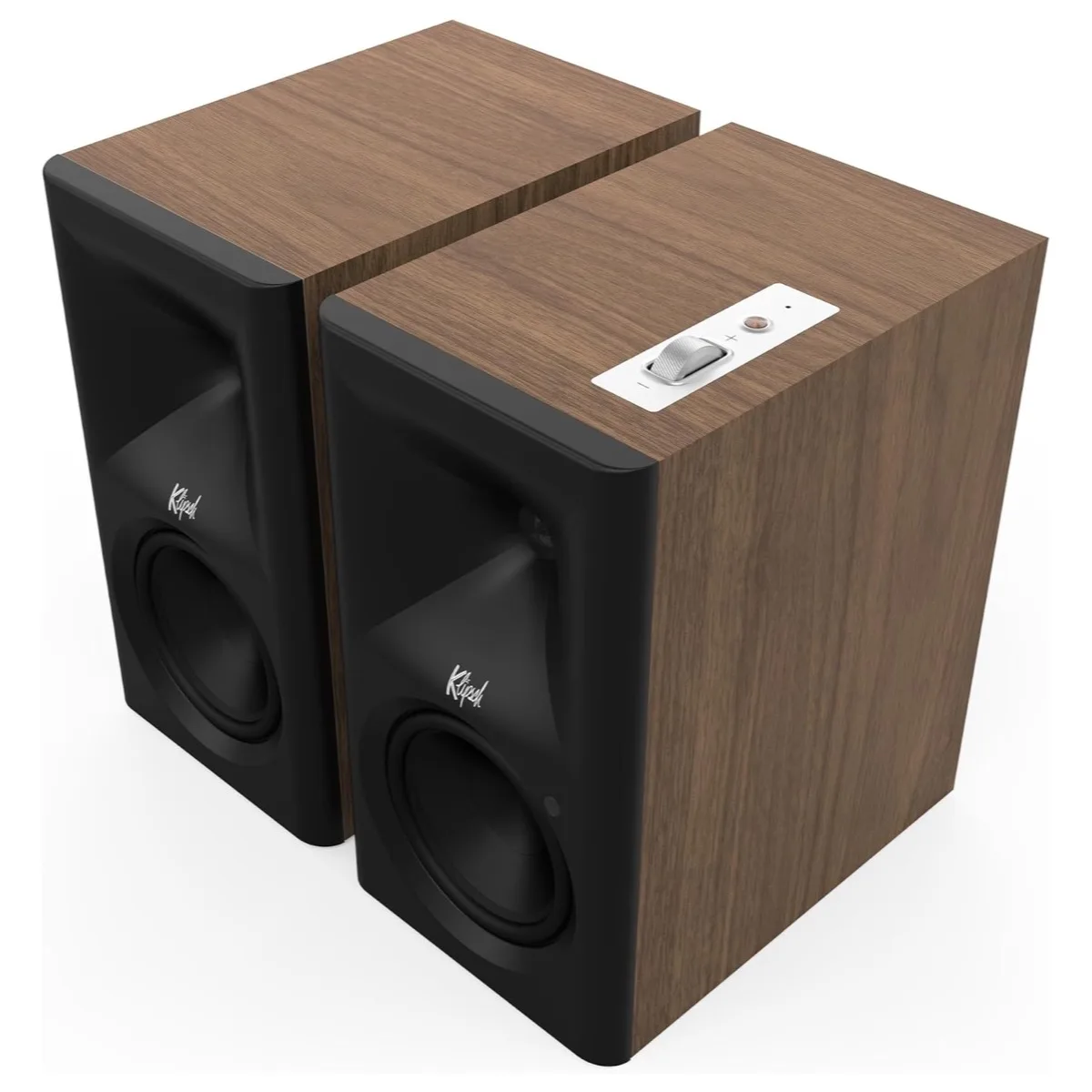
The Fives II are the best TV-and-turntable system Klipsch has ever put in two boxes, and the spec sheet is more honest about what changed than the marketing is. Onkyo's electronics turn these from a pair of powered monitors into something closer to a small AV receiver wearing wood veneer: a real HDMI 2.1 input with 8K passthrough, eARC out, Dolby Atmos decoding, Wi-Fi streaming through AirPlay 2, Chromecast, Spotify Connect, Tidal Connect and Qobuz Connect, plus a phono stage. For anyone who wants one cable to the TV, no receiver, and no soundbar, that combination is genuinely hard to match at any price. But the second generation also gives things back. Klipsch no longer publishes an amplifier power rating at all. Rated maximum output drops from 109 dB to 103 dB. Stated high-resolution decoding falls from 192 kHz to 96 kHz. aptX and aptX HD are gone from the Bluetooth stack. And the headline feature of this product generation, Dirac Live room correction, is reserved for the more expensive Sevens II and Nines II — the Fives II get a five-band EQ. Buy them for the connectivity and the sound in a small-to-medium room. Do not buy them expecting the spec sheet to be a straight upgrade, because in four measurable places it is not.
✅ Pros
- +A full HDMI 2.1 input with 8K, Dolby Vision, VRR and ALLM passthrough, plus eARC out — no receiver needed
- +Genuinely comprehensive streaming: AirPlay 2, Chromecast, Spotify, Tidal and Qobuz Connect, over Wi-Fi or Ethernet
- +Real MM phono stage with a ground post, so a turntable plugs straight in
- +Dolby Atmos decoding, so Atmos content over eARC plays rather than being refused
- +One power cord for the whole system; the secondary speaker is fed from the primary
- +Larger 5.25" Jet Cerametallic woofer and a much heavier, better-braced cabinet than gen 1
- +Honest ±3 dB tolerance on the published frequency response
- +Genuine wood veneer, a metal volume wheel, and a backlit remote — it feels like the money
❌ Cons
- −Klipsch does not publish an amplifier power rating anywhere, for a $1,399 product
- −Rated max output is 6 dB lower than gen 1 on Klipsch's own spec sheets, with no explanation of the measurement change
- −No Dirac Live — that is reserved for the Sevens II and Nines II, despite being the launch's headline feature
- −aptX and aptX HD are gone; Bluetooth is SBC/AAC only
- −Stated decoding ceiling drops from 192 kHz to 96 kHz
- −Only one HDMI input, so exactly one source device gets passthrough
- −Dolby Atmos is virtualized — no up-firing or height drivers
- −Wi-Fi 5 and 10/100 Ethernet are dated parts for the price
- −50 Hz rated low end means most buyers will want a subwoofer
- −Bigger than "bookshelf" implies, and the primary speaker's placement is constrained by ports, power, and a 4 m cable
Key Specs at a Glance
| Spec | Detail |
|---|---|
| Type | Powered (active) stereo pair — primary + secondary, wired |
| Price | $1,399.99 MSRP; $1,349.00 for walnut at the time of writing |
| Tweeter | 1" titanium LTS vented dome on a Tractrix horn |
| Woofer | 5.25" Jet Cerametallic |
| Enclosure | MDF with genuine wood veneer, bass-reflex via rear-firing port |
| Frequency Response | 50 Hz – 25 kHz ±3 dB |
| Max Output | 103 dB (1 m, stereo pair) |
| Amplifier Power | Not published by Klipsch |
| Decoding | 96 kHz / 24-bit |
| Immersive Audio | Dolby Atmos playback with virtual height channels |
| Sound Modes | Music, Movie, Direct, Dialog Enhancement, 5-band EQ |
| Room Correction | None (no Dirac Live — that is Sevens II / Nines II only) |
| HDMI | 1 × HDMI 2.1 in, 1 × HDMI 2.1 out with ARC/eARC and CEC, HDCP 2.3 |
| HDMI Passthrough | 8K, HDR10+, Dolby Vision, BT.2020, VRR, ALLM, QFT |
| Other Inputs | RCA phono (with ground post), RCA analog line, optical, USB-C audio, USB-A |
| Outputs | Single RCA subwoofer line out, HDMI out |
| Network | 802.11ac 2×2 MIMO Wi-Fi (2.4/5 GHz), 10/100 Ethernet |
| Streaming | AirPlay 2, Google Cast, Spotify Connect, Tidal Connect, Qobuz Connect |
| Bluetooth | 5.4, A2DP codecs SBC and AAC only |
| Dimensions (each) | 12.9" H × 7.2" W × 10.7" D (327 × 181 × 273 mm) |
| Weight | 18.2 lb primary / 15.5 lb secondary |
| Mains Rating | 120–240 V, 50/60 Hz, 100 W (printed on the primary speaker) |
| Finishes | Walnut, Ebony, Red Oak |
| In the Box | Power cord, backlit remote, 4 m 4-conductor speaker cable, 1.5 m HDMI cable |
What Klipsch Actually Built Here
The original Fives, launched in 2020, had one trick that nothing else in its class had: HDMI ARC. You could run a single cable from a TV, get real stereo speakers instead of a soundbar, and never think about a receiver. Everything else about it was a conventional powered monitor with a phono stage bolted on.
The Fives II is a different kind of product wearing the same cabinet shape. Klipsch's parent company now also owns Onkyo, and Onkyo's engineers in Osaka designed the electronics package inside. What they put in there is, functionally, an AV receiver's input board: a real HDMI 2.1 input with 8K and Dolby Vision passthrough, an HDMI output carrying eARC, a network stack with Ethernet and Wi-Fi, five streaming protocols, and Dolby Atmos decoding with virtual height processing.
That reframes the whole product. The first Fives competed with other powered speakers. The Fives II competes with the entire idea of buying a budget AV receiver and a pair of passive bookshelves — which is exactly the comparison our AV receiver vs. integrated amp vs. stereo receiver explainer walks through. If you have never bought active speakers before, our passive vs. powered vs. active speakers primer covers why "powered" and "active" are not actually the same word.
The physical arrangement is unchanged and still smart. One speaker is the primary: it holds every port, the amplification, and the only AC inlet. The secondary is fed from it over a supplied 4 m four-conductor cable. One outlet, one power cord, two speakers. That is a real advantage over rival systems that need mains power at both ends of the room.
The Connectivity Is the Reason to Buy Them
Read the back panel and the ambition is obvious. HDMI IN, HDMI OUT with ARC and eARC, Ethernet, USB-C audio in, USB-A, optical, RCA phono with a ground post, RCA line, subwoofer out. That is more input flexibility than most $500 receivers.
A few things are worth spelling out because the marketing does not.
What the HDMI board gives you:
- One HDMI input, so exactly one source device gets passthrough — a console, a streamer, or a disc player, not all three
- Passthrough is specified for 8K, HDR10+, Dolby Vision, BT.2020 colour, plus VRR, ALLM and QFT — the gaming-relevant parts of the spec our HDMI 2.1 features explained piece breaks down
- The HDMI output is the one that carries eARC back to the TV, which is how you get lossless Atmos from the TV's own apps
- HDCP 2.3, so protected 4K sources negotiate properly
Klipsch does not publish an HDMI bandwidth figure in Gbps. The 8K and VRR claims imply a high-bandwidth chip, but if you specifically need 4K/120 from a console through the passthrough, confirm it against the manual for your exact firmware rather than inferring it from the "HDMI 2.1" badge. That label has been doing a lot of unearned work across the industry for years.
The eARC side matters more for most buyers than the passthrough does. Our eARC vs. ARC explained post covers the practical difference: plain ARC cannot carry lossless Atmos, eARC can. If your TV is the hub and everything plugs into it, eARC is the connection you will actually use, and the HDMI ARC/eARC setup guide will save you the usual half hour of CEC troubleshooting.
What the network stack gives you:
- AirPlay 2, Google Cast, Spotify Connect, Tidal Connect and Qobuz Connect built in
- Wired Ethernet as well as Wi-Fi, which is unusual and welcome in a speaker
- No dongle, no separate streamer, no Bluetooth-as-primary-source compromise
Two nitpicks at this price. The Wi-Fi radio is 802.11ac — Wi-Fi 5, 2×2 MIMO — not Wi-Fi 6 or 6E. And the Ethernet port is 10/100, not gigabit. Neither limits audio, which needs a rounding error of the available bandwidth, and honestly a wired 100 Mbps link is more reliable for streaming than most Wi-Fi. But on a $1,399 product shipping in 2026, both read as parts-bin choices rather than engineering ones.
The Four Things That Went Backwards
This is the part of the review that took the longest to verify, because it only shows up when you put both official spec sheets side by side. Klipsch publishes a PDF spec sheet for each generation. Comparing them line by line turns up four regressions.
| Spec | The Fives (gen 1) | The Fives II |
|---|---|---|
| Amplifier power | 160 W total system, 320 W peak (60 W LF, 20 W HF, bi-amped) | Not published |
| Max output | 109 dB (1 m, stereo pair) | 103 dB (1 m, stereo pair) |
| Decoding ceiling | 192 kHz / 24-bit | 96 kHz / 24-bit |
| Bluetooth codecs | SBC, AAC, aptX, aptX HD | SBC, AAC |
| Dynamic bass extension | 46 Hz at 35% volume | Not published |
| Woofer | 4.5" fiber composite | 5.25" Jet Cerametallic |
| Frequency response | 50 Hz – 25 kHz | 50 Hz – 25 kHz ±3 dB |
| Weight (primary / secondary) | 11.8 lb / 10.7 lb | 18.2 lb / 15.5 lb |
Take those one at a time, because they are not all equally damning.
The missing amplifier rating is the one that bothers me most, and not because the amp is necessarily weak. Gen 1 published a specific, checkable number and a bi-amp split. Gen 2 publishes nothing — not on the spec sheet, not on the product page, not in the Amazon listing. The only power figure printed anywhere is on the back of the primary speaker: a 100 W mains input rating. That is what the speaker is allowed to draw from the wall, not what the amplifier delivers to the drivers, and the two are not interchangeable. But it does put a hard ceiling on sustained output, and it is telling that a mains-draw stamp is the only wattage a buyer can find.
The 6 dB drop in rated max output is the most consequential number here, if you take it at face value. Both sheets use identical phrasing — "(1M Stereo Pair)" — so they are at least nominally comparable, but Klipsch does not state whether either figure is peak or continuous, or what signal produced it. Six decibels is a large gap; it is roughly the difference between a speaker that fills a big open-plan room and one that is comfortable in a normal living room. Given the larger woofer and heavier cabinet, I would be surprised if the Fives II were genuinely quieter in use, and the likeliest explanation is a change in measurement convention between generations. But Klipsch published both numbers, and a buyer comparing the two sheets deserves to know the second one is lower. If you are planning around a big room, this is the spec to ask a dealer about rather than assume.
The decoding ceiling going from 192 kHz to 96 kHz is real but mostly academic. Essentially all commercial high-resolution music is 96 kHz or lower, and the audibility of anything above that is, charitably, unsettled. It still reads oddly on a more expensive product.
Losing aptX and aptX HD is the one that will actually annoy people. On an Android phone, the Fives II now falls back to SBC or AAC over Bluetooth — a step down from what gen 1 offered, on a system with Bluetooth 5.4. In practice you should be using AirPlay 2, Chromecast or a Connect app instead, all of which are better than any Bluetooth codec. But if Bluetooth from an Android device is your main listening path, this is a genuine downgrade.
There is a fifth, smaller omission in that table worth noting: gen 1 published a "dynamic bass extension" figure of 46 Hz at 35% volume, describing what its Dynamic Bass EQ actually bought you below the rated response. Gen 2 publishes no equivalent. That is one more checkable claim that became an unstated one.
The wins are real too, and the table shows them: a physically larger 5.25" Jet Cerametallic woofer in place of the 4.5" fiber-composite cone, and a cabinet that is about 55% heavier, which normally means more bracing and a quieter enclosure. Klipsch also moved to a one-piece BMC baffle with a curved radius around the horn, which is the kind of change that shows up in off-axis response rather than in any headline number.
No Dirac Live, and That Is a Deliberate Choice
Klipsch's whole second-generation powered speaker launch was announced with Dirac Live room correction as the marquee feature. Read the coverage quickly and it is easy to assume all three models got it.
They did not. Dirac's own press release names The Sevens II and The Nines II. The Fives II are not on that list, and the Fives II spec sheet confirms it: the only tuning on offer is a five-band EQ in the Klipsch Connect app, plus Music, Movie, Direct and Dialog Enhancement modes.
This matters more than it sounds. Room correction is not a luxury feature for speakers like these — it is the single most effective thing you can do about the bass peaks and nulls that come from a real room with real walls. Our Audyssey vs. Dirac vs. YPAO comparison explains why Dirac generally sits at the top of that pile. If you were choosing the Fives II specifically for the Dirac headline, you are looking at the wrong model in the range.
The practical consequence is that placement has to do the work that DSP would otherwise do. These are rear-ported speakers, so distance from the wall behind them directly changes how much bass you get. Expect to spend real time on positioning, and expect it to matter more than it would on a Dirac-corrected system.
Dolby Atmos From Two Speakers: Manage Your Expectations
The Fives II decode Dolby Atmos and render it through virtual height channels. There are no up-firing drivers and no height drivers — the height information is synthesized by DSP and played through the same two boxes.
Virtualized height is not nothing. On the right content it does widen and lift the soundstage in a way plain stereo downmixing does not. It is also not the same thing as height channels, and anyone who has heard a proper setup knows the difference immediately. Our in-ceiling vs. up-firing vs. height speakers breakdown covers where each approach actually lands, and Dolby Atmos vs. DTS:X covers what the formats are doing in the first place. If genuine overhead effects are the goal, the honest answer is a receiver and height speakers such as the Klipsch RP-500SA II, and the Dolby Atmos setup guide is the place to start.
What Atmos decoding does buy you here is that Atmos-encoded content over eARC plays correctly rather than being refused or downmixed by the TV. That is worth having on its own.
The Dialog Enhancement mode deserves a specific mention, because dialogue intelligibility is the single most common complaint about TV audio and the reason many people shop for speakers at all. A horn-loaded tweeter with a real 5.25" midbass driver is already a large improvement over any flat-panel TV speaker, and the dedicated mode helps further. If that is your core problem, our guide to why you can't hear movie dialogue has fixes that cost nothing before you spend $1,349.
Bass, Room Size, and the Subwoofer You Will Probably Want
Rated response is 50 Hz to 25 kHz ±3 dB. That is a genuinely good number for a 5.25" two-way in a cabinet this size, and the ±3 dB tolerance is more honest than the untolerated "50 Hz – 25 kHz" gen 1 printed. But 50 Hz is still 50 Hz. The bottom octave of film soundtracks and a lot of electronic music lives below it.
Klipsch clearly knows this, which is why there is an RCA subwoofer output on the back and a subwoofer level control in the app. Adding a sub is the intended upgrade path, not an admission of failure — something like the SVS SB-1000 Pro or, if space is tight, the SVS 3000 Micro. Our subwoofer placement guide and the 80 Hz crossover explainer cover getting the handoff right, and the crossover frequency how-to covers the settings themselves.
On room size: treat these as a small-to-medium room system. The cabinets are 12.9" tall and 10.7" deep, which is bigger than people expect from "bookshelf" — they need proper stands or a substantial credenza, not a narrow shelf. Klipsch sells the KS-28 stand for exactly this. And because the primary speaker holds every port and the only power inlet, your layout has three constraints at once: the primary must reach the TV, reach an outlet, and sit within the 4 m supplied cable of the secondary. Work that out before you buy, not after. If you are still deciding between standmounts and something floorstanding, our bookshelf vs. floorstanding comparison is the right starting point.
The Turntable Case
The phono input is a real MM phono stage with a ground post, not a line input with a label. Combined with the Atmos-capable HDMI board and streaming, that makes the Fives II one of the few products that genuinely replaces four boxes: speakers, amplifier, phono preamp, and streamer.
For a lot of people that is the entire argument. A turntable, a TV, and two speakers, with no receiver in the room and no rack. If that is the setup you want, very little else does it this cleanly — the KEF LSX II LT needs an external phono stage, and a conventional receiver setup means another box and more cable. Our speaker wiring guide is irrelevant here, which is rather the point.
The Fives II vs. the Alternatives
| System | Price | What it is | HDMI | Atmos | Room correction |
|---|---|---|---|---|---|
| Klipsch The Fives II | $1,349 – $1,399 | Powered pair, phono + streaming | 2.1 in + eARC out | Yes (virtual height) | 5-band EQ only |
| KEF LSX II LT | $999 | Powered pair, wireless L/R link | ARC only | No | App EQ + desk/wall modes |
| Sonos Arc Ultra | $999 | Single Atmos soundbar | eARC | Yes (up-firing) | Trueplay |
| RP-600M II + WiiM Amp | ~$1,048 | Passive pair + streaming amp | No HDMI on the amp | No | App EQ |
| Bose Smart Ultra | $999 MSRP | Single Atmos soundbar | eARC | Yes (up-firing) | ADAPTiQ |
Against the KEF LSX II LT, the Fives II cost around $350 more and win on connectivity outright — the KEF has ARC, not eARC, no HDMI input, no Atmos, and no phono stage. KEF counters with the Uni-Q coaxial driver and a published 100 W per channel bi-amped, which is a number Klipsch declines to give you. The KEF also links its two speakers wirelessly, so you are not running a cable across the room; the trade is that both KEF cabinets need mains power while the Klipsch needs one outlet.
Against a soundbar like the Sonos Arc Ultra or the Bose Smart Ultra, it is the usual trade, and our soundbar vs. AV receiver piece lays it out. A bar is one box under the TV with real up-firing Atmos drivers and proper room correction. Two real speakers give you an actual stereo image, a phono input, and a soundstage that a single bar cannot produce. The Fives II also cost more than either bar.
Against the DIY route, this is where the Fives II look expensive. A pair of Klipsch RP-600M II at $749 plus a WiiM Amp at $299 gets you to roughly $1,048 with a published 60 W per channel, the same streaming services, app EQ, and the freedom to change either half later. You give up HDMI input and Atmos, and you add a box and speaker cable. If you want to go further up that path, the WiiM Ultra adds a display and better analog stages. The Fives II are buying you integration and an HDMI board, not raw performance per dollar — and if you think you might eventually want more channels or more power, our speaker impedance and AVR pairing guide is a better roadmap than an all-in-one.
One more option worth naming: the outgoing original Fives is still in the retail channel while stock lasts. It has no Atmos, no streaming, no HDMI input and no eARC — but it does have a published 160 W amplifier rating, aptX HD, and the same basic concept. Prices vary wildly by seller and finish, so check what the original Fives is going for before assuming the II is the only sensible buy.
Pros
- A full HDMI 2.1 input with 8K, Dolby Vision, VRR and ALLM passthrough, plus eARC out — no receiver needed
- Genuinely comprehensive streaming: AirPlay 2, Chromecast, Spotify, Tidal and Qobuz Connect, over Wi-Fi or Ethernet
- Real MM phono stage with a ground post, so a turntable plugs straight in
- Dolby Atmos decoding, so Atmos content over eARC plays rather than being refused
- One power cord for the whole system; the secondary speaker is fed from the primary
- Larger 5.25" Jet Cerametallic woofer and a much heavier, better-braced cabinet than gen 1
- Honest ±3 dB tolerance on the published frequency response
- Genuine wood veneer, a metal volume wheel, and a backlit remote — it feels like the money
Cons
- Klipsch does not publish an amplifier power rating anywhere, for a $1,399 product
- Rated max output is 6 dB lower than gen 1 on Klipsch's own spec sheets, with no explanation of the measurement change
- No Dirac Live — that is reserved for the Sevens II and Nines II, despite being the launch's headline feature
- aptX and aptX HD are gone; Bluetooth is SBC/AAC only
- Stated decoding ceiling drops from 192 kHz to 96 kHz
- Only one HDMI input, so exactly one source device gets passthrough
- Dolby Atmos is virtualized — no up-firing or height drivers
- Wi-Fi 5 and 10/100 Ethernet are dated parts for the price
- 50 Hz rated low end means most buyers will want a subwoofer
- Bigger than "bookshelf" implies, and the primary speaker's placement is constrained by ports, power, and a 4 m cable
Buy It If
- You want one cable to the TV, real stereo speakers, and no receiver anywhere in the room
- You have a turntable and do not want to buy a separate phono stage
- You stream from Apple, Spotify, Tidal or Qobuz and want it built in rather than dongled on
- Your room is small to medium and you can give the speakers stands and space off the back wall
- You value integration and finish over maximum performance per dollar
Look Elsewhere If
- Dirac Live was why you were interested — you want the Sevens II or Nines II
- You need more than one HDMI source device passed through
- You want real overhead Atmos rather than virtualized height
- You are filling a large open-plan room, where the unpublished amp power and lower rated output are real questions
- You would rather have raw performance per dollar, in which case passive speakers and a separate amp win
- Bluetooth from an Android phone is your main listening path and you want aptX HD
The Bottom Line
The Fives II are an easy product to like and a slightly awkward one to score. What Onkyo built into them is the most complete set of inputs anyone has put in a pair of powered bookshelf speakers: HDMI 2.1 passthrough, eARC, five streaming protocols on both Wi-Fi and Ethernet, a real phono stage, and Atmos decoding, all driven from one power cord. For the buyer who wants a TV system and a music system that are the same two boxes, there is very little competition, and the build quality backs up the price.
What keeps this at four stars rather than five is that the second generation quietly costs you things Klipsch used to advertise. An amplifier rating that no longer exists. A published max output 6 dB below the model it replaces. Half the stated decoding ceiling. No aptX. And the one feature the entire launch was built around — Dirac Live — withheld for the models above it. None of those individually is disqualifying, and the first two may well be measurement-convention changes rather than real losses. But a $1,399 speaker should not require a buyer to pull two PDFs and diff them to find that out.
Buy them for what they are: the most convenient genuinely good-sounding two-box system on the market, in a small or medium room, with a subwoofer budgeted for later. Just go in knowing exactly what is on the spec sheet and, more importantly, what is no longer on it.
Check the price of Klipsch The Fives II on Amazon → · See all Klipsch The Fives II listings
Our Verdict
The Fives II are the best TV-and-turntable system Klipsch has ever put in two boxes, and the spec sheet is more honest about what changed than the marketing is. Onkyo's electronics turn these from a pair of powered monitors into something closer to a small AV receiver wearing wood veneer: a real HDMI 2.1 input with 8K passthrough, eARC out, Dolby Atmos decoding, Wi-Fi streaming through AirPlay 2, Chromecast, Spotify Connect, Tidal Connect and Qobuz Connect, plus a phono stage. For anyone who wants one cable to the TV, no receiver, and no soundbar, that combination is genuinely hard to match at any price. But the second generation also gives things back. Klipsch no longer publishes an amplifier power rating at all. Rated maximum output drops from 109 dB to 103 dB. Stated high-resolution decoding falls from 192 kHz to 96 kHz. aptX and aptX HD are gone from the Bluetooth stack. And the headline feature of this product generation, Dirac Live room correction, is reserved for the more expensive Sevens II and Nines II — the Fives II get a five-band EQ. Buy them for the connectivity and the sound in a small-to-medium room. Do not buy them expecting the spec sheet to be a straight upgrade, because in four measurable places it is not.
Ready to buy the Klipsch The Fives II?
Buy on Amazon →Affiliate link — we may earn a commission at no extra cost to you.