Denon AVR-S770H Review: The Value AV Receiver That Powers a Klipsch Atmos System
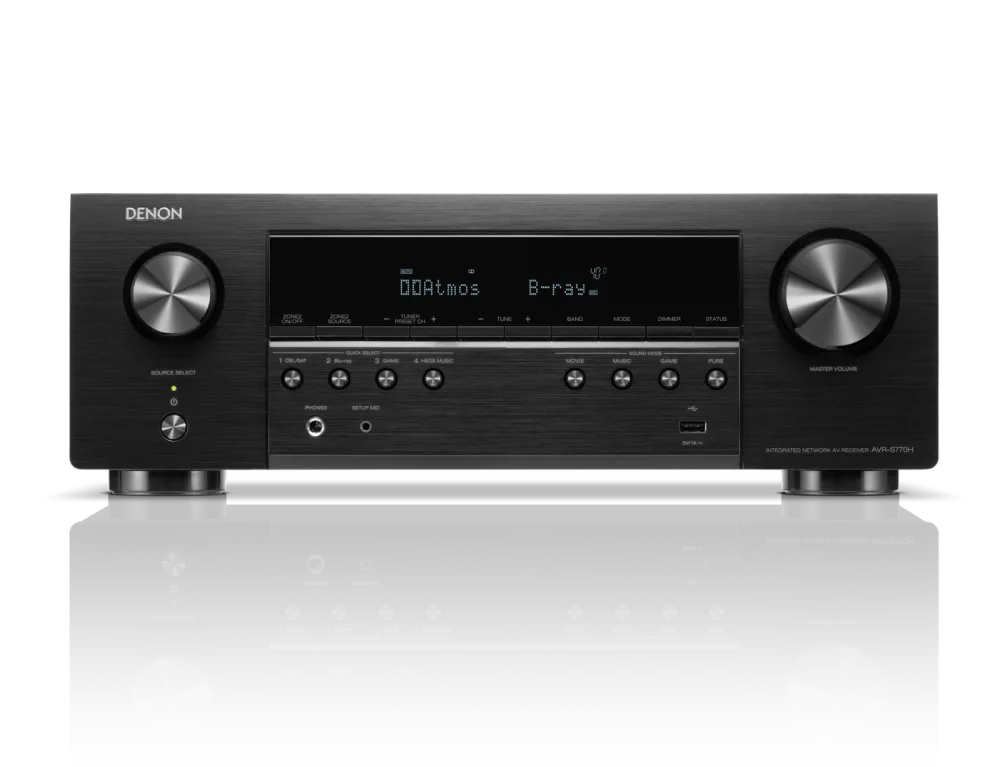
The Denon AVR-S770H is the value AV receiver that finishes a mid-priced Dolby Atmos build. It runs a 5.2.2 system natively, decodes every mainstream surround format including Dolby Atmos and DTS:X, and puts 8K/60 and 4K/120 passthrough on three of its six HDMI inputs. Its rated 75W per channel is modest, but paired with efficient speakers it drives a real 5.1.2 living-room system to satisfying levels — loud, though short of film reference. For a first Atmos receiver under $750, it's the sensible pick.
✅ Pros
- +True 5.2.2 Dolby Atmos and DTS:X with dedicated overhead processing
- +8K/60 and 4K/120 passthrough on three HDMI inputs — full-rate console gaming
- +Decodes every mainstream surround format, plus height virtualization
- +HEOS, AirPlay 2, Spotify Connect, and Bluetooth built in
- +Dedicated MM phono input with a SIGNAL GND post — a turntable connects with no separate preamp
- +Honest 75W/ch rating that's ample with efficient speakers
- +Clearest on-screen setup wizard in the class
- +Frequently street-priced below its $749 MSRP
❌ Cons
- −Tops out at 5.2.2 — no four-height Atmos layout
- −Audyssey MultEQ, not XT32; no Dirac Live upgrade path
- −Subwoofer preouts only — no full-channel preamp outputs for expansion
- −Only three of six HDMI inputs handle 8K/4K120
- −75W is limited with low-sensitivity, 4-ohm speakers in large rooms
The Denon AVR-S770H is the AV receiver to buy when you want real Dolby Atmos on a budget and you're pairing it with efficient speakers. It runs a 5.1.2 system natively, decodes every mainstream surround format, and passes 8K/60 and 4K/120 video on three of its six HDMI inputs. Its 75W-per-channel rating is modest, but with efficient speakers — a Klipsch Reference Premiere II front stage is the obvious match — it drives a full living-room system to levels most people never exceed. Read Klipsch sensitivity ratings as the half-space figures they are; the arithmetic is below. At an MSRP of $749 (frequently street-priced lower), it's the sensible first Atmos receiver.
The Denon AVR-S770H is available on Amazon at a $749 MSRP, frequently street-priced lower.
Key Specs at a Glance
The AVR-S770H is a 7.2-channel AV receiver that runs either a 7.2 or a 5.2.2 layout, rated at 75 watts per channel (8 ohms, two channels driven, 20Hz–20kHz, 0.08% THD). It has six HDMI inputs — three of them supporting 8K/60Hz and 4K/120Hz — and one HDMI output with eARC. Video passthrough covers 8K/60Hz, 4K/120Hz, HDCP 2.3, Dolby Vision, HDR10+, HLG, and Dynamic HDR. It decodes Dolby Atmos, Dolby TrueHD, DTS:X, DTS-HD Master Audio, and DTS Neural:X, and adds Dolby Atmos Height Virtualization plus DTS Virtual:X for pseudo-height. Room correction is Audyssey MultEQ. Streaming and multi-room run on HEOS Built-in, AirPlay 2, Spotify Connect, Bluetooth, dual-band Wi-Fi, and Ethernet, with Alexa, Google Assistant, and Siri support via AirPlay 2 / HEOS. Analog connectivity includes a dedicated moving-magnet phono input with a SIGNAL GND terminal, whose stage Denon rates at 2.5 mV input sensitivity, ±1 dB RIAA deviation from 20 Hz to 20 kHz, 74 dB S/N (IHF-A), and 0.03% distortion at 1 kHz. There are two subwoofer preouts and no full-channel preouts. It measures 17.1" W × 6.0" H × 13.3" D, weighs 19.0 lb, and lists at $749.
What the S770H Gets Right for the Money
Budget AV receivers usually cut a corner that hurts later — no Atmos, no 4K/120 for gaming, or a surround decoder that's missing half the formats. The AVR-S770H avoids the corners that actually matter at this price.
Real Dolby Atmos, not just virtualization. The S770H runs a 5.2.2 layout — five ear-level speakers, two height channels, and up to two subwoofers. That's a true Dolby Atmos and DTS:X system with dedicated overhead processing, not the fake-height trickery some cheaper units rely on. If you already own a pair of Atmos elevation modules or in-ceiling speakers, this receiver drives them properly.
8K and 4K/120 for current consoles. Three of the six HDMI inputs handle 8K/60Hz and 4K/120Hz passthrough with HDCP 2.3, so a PS5 or Xbox Series X gets full-rate 4K/120 gaming through the receiver. The single output carries eARC, so lossless Atmos from your TV's apps flows back to the receiver on one cable.
Every mainstream surround format decodes. Dolby Atmos, Dolby TrueHD, DTS:X, DTS-HD Master Audio, and DTS Neural:X are all here. Add Dolby Atmos Height Virtualization and DTS Virtual:X for pseudo-height when you don't have overhead speakers. For streaming, Blu-ray, and 4K disc, nothing mainstream is missing.
HEOS multi-room built in. HEOS handles whole-home audio alongside other Denon and Marantz gear, and AirPlay 2, Spotify Connect, and Bluetooth stream directly from a phone. Setup uses Denon's on-screen Setup Assistant, which remains the clearest wizard in the category.
A real phono input, with a ground post. The S770H has a dedicated Phono input and a SIGNAL GND terminal beside it — the one input on the back panel that comes with its own screw post, and a feature plenty of receivers at this price drop. A turntable connects straight to the receiver with no separate preamp in the chain. Denon also publishes the stage's numbers rather than just listing the jack: 2.5 mV input sensitivity, ±1 dB RIAA deviation from 20 Hz to 20 kHz, 74 dB S/N (IHF-A), and 0.03% distortion at 1 kHz. Set against the 200 mV the line inputs need for the same output, that 2.5 mV implies roughly 38 dB of gain in the built-in stage — squarely in the normal range for a moving-magnet phono preamp. Our guide to connecting a turntable to speakers covers what that gain is doing and, more usefully, how to avoid running two phono stages in series.
Sound Quality
75 watts is honest — and enough with the right speakers. The 75W/ch rating is measured the correct way: 8 ohms, two channels driven, 20Hz–20kHz, at 0.08% THD, not the inflated single-channel, 1kHz, 10%-THD figure some brands publish. Seventy-five watts is modest on paper, but power requirements are relative to speaker sensitivity. Pair the S770H with a high-sensitivity design and its 75 watts go further than the number suggests — though not as far as the spec sheets imply. The Klipsch Reference Premiere II line is rated from 92 dB to 98 dB depending on the model, but Klipsch measures sensitivity half-space, and the one model in the line with an independent anechoic measurement — the Klipsch RP-600M II — returns 86 dB against its rated 94.5 dB. On the measured figure, 75 watts per channel puts a pair at roughly 98 dB peaks at a 10-foot seat. That is loud, and it is enough for most rooms at most volumes, but it is about 7 dB short of film reference level. Pair the S770H with low-sensitivity, 4-ohm bookshelves in a large room instead and you will find its limit considerably sooner.
Audyssey MultEQ calibration is quick and reliable. The included microphone and eight measurement positions get speaker distances, levels, crossovers, and EQ set in about ten minutes. This is standard MultEQ — not the higher-resolution XT32 found on Denon's X-series — so the room correction is coarser and there's no Dirac Live upgrade path. For most rooms it's a clear improvement over running uncorrected; for a dedicated, treated room it's the receiver's biggest compromise.
Dialogue and overhead effects land. Denon's center-channel processing keeps dialogue clean through busy scenes, and with a proper pair of height speakers the 5.2.2 layout places overhead effects — rain, aircraft, a storm rolling across the ceiling — with convincing direction. This is the payoff of a real Atmos receiver over a soundbar.
Stereo music is a competent second job. Pure Direct mode bypasses video processing and tone controls for two-channel listening. With good front speakers it's clean and present — not a substitute for a dedicated stereo amp, but a respectable everyday music source.
Where It Pairs Best: A Klipsch 5.1.2 System
The S770H makes the most sense as the engine for a value Dolby Atmos build. It's the natural, lower-cost alternative to the Denon AVR-X3800H for anyone who doesn't need nine channels or four height speakers.
A clean 5.1.2 system it can drive end to end pairs Klipsch RP-6000F II floorstanders (or RP-600M II bookshelves) up front, a Klipsch RP-504C II center, a pair of Klipsch RP-500SA II Atmos elevation modules for height, and an SVS SB-1000 Pro on one of the two subwoofer outputs.
Because the Klipsch Reference Premiere II speakers are a benign 8-ohm load, the S770H drives them without difficulty. Keep the expectation honest, though: Klipsch rates the line half-space, and on the one model in it with an independent anechoic measurement, 75 watts reaches roughly 98 dB peaks at a 10-foot seat rather than film reference level.
Limitations Worth Knowing
5.2.2 is the ceiling — no four-height Atmos. The S770H amplifies seven channels and tops out at 5.2.2. You cannot build a 5.1.4 or 7.1.4 system with four overhead speakers. If a four-height Atmos layout is the goal, step up to the AVR-X3800H (9.4 channels) instead.
Audyssey MultEQ, not XT32 — and no Dirac. The room correction is the base MultEQ resolution, and there's no paid Dirac Live upgrade path. This is the main technical gap versus Denon's X-series.
Subwoofer preouts only. The two independent sub outputs are the only preouts. There are no full-channel preamp outputs, so you can't add an external amplifier to drive more demanding speakers or expand the system's power later.
Only three of six HDMI inputs are 8K. Six inputs is generous, but three are limited to 4K. If you have several 4K/120 or 8K sources, plan which devices get the three high-bandwidth inputs.
Modest power for hard-to-drive speakers. With efficient speakers it's plenty; with low-sensitivity, 4-ohm designs in a large room, 75W runs short. Match it to speakers accordingly.
The phono input is MM only, and the ground wire is not automatic. Denon's manual is explicit on both points. The unit "is compatible with turntables equipped with a moving magnet (MM) phono cartridge," and for a low-output moving-coil cartridge you should "use a commercially available MC head amp or a step-up transformer" — a 0.3 mV MC runs about 18 dB below the level this input is built for, which plays as a tonally correct record that needs an unusual amount of volume. On the ground post, Denon's own warning is more useful than the advice usually handed out: "The earth terminal (SIGNAL GND) of this unit is not for safety grounding purposes. If this terminal is connected when there is a lot of noise, the noise can be reduced. Note that depending on the turntable, connecting the ground line may have the reverse effect of increasing noise." Treat it as a hum control to try both ways, not a connection you are obliged to make.
Who Should Buy the Denon AVR-S770H
Buy it if you're building a first Dolby Atmos system in 5.1 or 5.1.2 and want it done properly rather than virtualized; you're pairing it with efficient, benign-load speakers and listening at normal-to-loud levels rather than chasing film reference; you want 4K/120 gaming passthrough for a PS5 or Xbox Series X without paying for a flagship receiver; and you want HEOS multi-room, AirPlay 2, and Bluetooth in one box under $750.
Step up to the Denon AVR-X3800H if you want a 5.1.4 or 7.1.2 system with four overhead speakers, Audyssey MultEQ XT32 and a Dirac Live upgrade path, or full-channel preouts to add external amplification later.
Consider a soundbar like the Sonos Arc Ultra instead if you don't want to run speaker wire or place multiple speakers, and simplicity matters more than the ceiling of true multi-speaker Atmos.
Denon AVR-S770H vs. AVR-X3800H vs. Onkyo TX-NR6100
Against its two closest reference points, the S770H is the value choice. It runs 7.2 channels internally with a 5.2.2 maximum Atmos layout, 75W (8Ω, two channels, 20Hz–20kHz), three of six HDMI inputs at 8K, Audyssey MultEQ, subwoofer-only preouts, at a $749 MSRP. The Denon AVR-X3800H steps up to 9.4 channels and a 7.1.4 layout (11.4 processing), 105W, six of seven HDMI inputs at 8K, Audyssey MultEQ XT32 with an optional Dirac path, and full 11.4 preouts, at $1,699. The Onkyo TX-NR6100 is the closest rival at the price: 7.2 channels, a 5.2.2 layout, 100W, three of six 8K inputs, AccuEQ with an optional Dirac path, and sub-only preouts, at $899.
The AVR-S770H is the value pick — the most receiver you need for a 5.1.2 system, and no more. The AVR-X3800H is the upgrade when you want four height channels, XT32/Dirac, and expansion headroom. The Onkyo TX-NR6100 is the closest rival at the price, with a bit more power and a Dirac path, but a busier interface.
Bottom Line
The Denon AVR-S770H is the receiver that makes a proper Dolby Atmos system affordable. It won't build a four-height home cinema, and its room correction is the entry tier — but for a 5.1 or 5.1.2 system paired with efficient speakers at sane listening levels, it does everything that matters: real Atmos, full-rate 4K/120 gaming, every mainstream surround format, and clean multi-room streaming. Matched to a Klipsch Reference Premiere II front stage, it's the value half of a system that punches well above its combined price.
The Denon AVR-S770H is available on Amazon at a $749 MSRP.
Our Verdict
The Denon AVR-S770H is the value AV receiver that finishes a mid-priced Dolby Atmos build. It runs a 5.2.2 system natively, decodes every mainstream surround format including Dolby Atmos and DTS:X, and puts 8K/60 and 4K/120 passthrough on three of its six HDMI inputs. Its rated 75W per channel is modest, but paired with efficient speakers it drives a real 5.1.2 living-room system to satisfying levels — loud, though short of film reference. For a first Atmos receiver under $750, it's the sensible pick.
Ready to buy the Denon AVR-S770H?
Buy on Amazon →Affiliate link — we may earn a commission at no extra cost to you.