Passive vs Powered vs Active Speakers: Which Should You Buy in 2026?
Published 2026-07-13 · By NetAudioHub Editorial
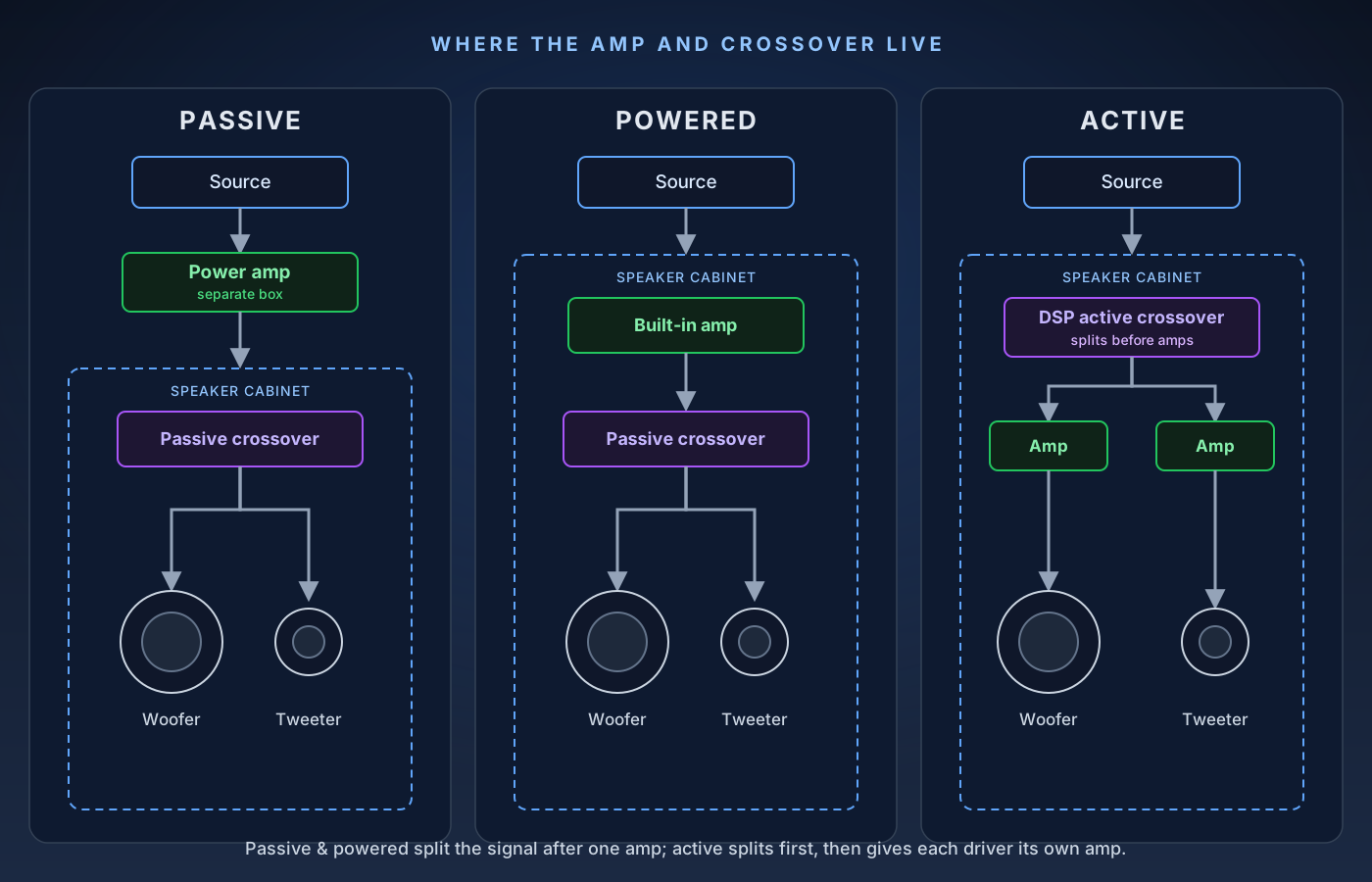
Powered and active speakers are not the same thing. The difference comes down to two questions — is the amp inside the speaker, and does the crossover sit before or after amplification? Here's what changes inside the box, and the right pick for a desk, hi-fi, home theater, turntable, or streaming setup.
The verdict up front: most people should buy either passive speakers plus a separate amp/receiver (if you already own gear or want to upgrade piece by piece) or a set of powered speakers (if you want one box, one power cable, and done). "Powered" and "active" are not the same thing — powered means the amp is built in but the speaker still uses an ordinary passive crossover; active means each driver gets its own dedicated amplifier fed by a crossover that splits the signal before amplification. True active designs sound cleaner and more consistent because the engineer controls the whole chain, but you pay for it and you can't swap the amp later. For a desk, buy powered or active compact speakers. For a turntable or a simple streaming setup, buy powered speakers with the inputs you need. For a growing hi-fi or home theater system where you want to upgrade the amp and speakers independently, buy passive. Below: exactly what differs inside the box, and the right pick for each use case — with real models and current prices.
The Three Categories, Defined
This is the part almost every buying guide gets wrong, because manufacturers use "powered" and "active" interchangeably in their marketing. They are not interchangeable. The difference is real and it's about where two components live: the amplifier and the crossover.
A crossover is the filter that splits the full-range audio signal and sends the low frequencies to the woofer and the high frequencies to the tweeter. Every multi-driver speaker has one. The question is where it sits in the chain and what kind it is.
Passive speakers have no amplifier inside. You feed them an already-amplified signal over speaker wire from a separate integrated amp, stereo receiver, or AV receiver. Inside the cabinet, a passive crossover — a network of capacitors, inductors, and resistors — splits that high-power signal and routes it to each driver. This is the traditional bookshelf or tower speaker. Examples: KEF Q3 Meta, ELAC Debut 2.0 B6.2, Klipsch RP-600M II.
Powered speakers have the amplifier built into the cabinet (usually into one speaker of the pair, which then feeds the second over a speaker cable). But — and this is the key point — the signal is amplified first, then handed to an ordinary passive crossover inside the box, exactly like a passive speaker. You've just moved the amp inside the enclosure. One power cord, no separate receiver. Examples: Klipsch The Fives, Kanto YU6, Audioengine A5+, Edifier R1280T.
Active speakers flip the order. The crossover — usually implemented in DSP (digital signal processing) — splits the low-power signal into frequency bands before amplification. Then a separate, dedicated amplifier drives each driver directly. A two-way active speaker has two amps per cabinet: one for the tweeter, one for the woofer. This is how professional studio monitors are built, and how KEF's wireless flagships work. Examples: KEF LSX II, KEF LS50 Wireless II, SVS Prime Wireless Pro, and virtually every powered studio monitor from Genelec, JBL, Kali, and Neumann.
Here's the one-line test: an active speaker has one amplifier per driver and the crossover comes before amplification. If it has a built-in amp but a single amp channel feeding a passive crossover, it's powered, not active — no matter what the box says.
What Actually Differs
Four things change as you move from passive to powered to active.
Where the crossover sits — and what it costs you. A passive crossover works on a high-power signal. That means the capacitors and inductors have to be large, and they burn a little power and introduce small phase and impedance quirks. A passive crossover is a compromise the designer tunes by ear and measurement. An active (DSP) crossover operates on a low-level signal before amplification, so it can be far more precise — steep slopes, exact phase alignment, driver-specific time correction, even room EQ — none of which a passive network can do cleanly. This is the core engineering argument for active designs, and it's why studios use them.
How many amplifiers you have, and how well matched they are. In a passive or powered speaker, one amplifier drives the whole speaker through the crossover, so the woofer and tweeter share it. In an active speaker, each driver has its own amp sized exactly for that driver — for example, the KEF LS50 Wireless II uses a 280W Class D amp for the mid/bass driver and a 100W Class A/B amp for the tweeter, per speaker. The engineer matches amp, driver, and crossover as one system. Nothing is left to whatever receiver you happened to buy.
Who controls the sound — you or the manufacturer. Passive speakers give you freedom: pick any amp, upgrade it later, voice the system to taste. Active speakers give you consistency: the manufacturer optimized the entire chain and you can't (and don't need to) touch it. Powered speakers sit in between — the amp is chosen for you, but it's still a conventional amp-plus-passive-crossover design, so it behaves like a passive speaker that came with its own receiver.
What you can and can't upgrade. With passive speakers you can keep the speakers and upgrade the amp, or vice versa. With powered and active speakers the amplifier is welded to the speaker's lifespan — if the built-in amp or DSP board fails out of warranty, the speaker is often done. That's the real long-term trade-off for the all-in-one convenience.
One more note on terminology: a lot of genuinely active speakers are marketed as "powered," and some merely powered speakers are marketed as "active." The SVS Prime Wireless Pro is sold as a "powered" speaker but is actually active — it runs four 50W amplifiers (one per driver, both speakers) fed by a digital crossover. Meanwhile the Edifier R1280T is labeled "2.0 Active" but is really a powered speaker: one amp channel per cabinet feeding a passive crossover. Read the amp-per-driver test above, not the marketing.
Passive Speakers: When to Buy
Passive speakers are the default of traditional hi-fi and home theater for a reason: flexibility and scale.
Buy passive if:
- You already own — or want to buy — a receiver or amp. Every AV receiver and stereo integrated amp on the market drives passive speakers. If you're building a 5.1 surround system, passive is effectively mandatory: the AVR is the brain and amplifier for all channels.
- You want to upgrade in stages. Better amp this year, better speakers next year, a second subwoofer after that. Passive systems are modular.
- You want the widest possible choice. The overwhelming majority of well-regarded speakers — and essentially all high-end ones above a certain price — are passive.
- You care about matching amp power and impedance to the room. This is a real skill and a real advantage; see our guide to 4-ohm vs 8-ohm speakers and AVR pairing.
The catch: you have to buy and house an amp or receiver, run speaker wire, and the total box count and cabling go up. Budget for the amp as part of the system, not an afterthought — a $600 pair of speakers starved by a $150 receiver won't show what it can do.
Good passive picks in 2026:
- Budget bookshelf: ELAC Debut 2.0 B6.2 — the value benchmark. See our full review.
- Lively, efficient bookshelf: Klipsch RP-600M II, rated 94.5 dB (86 dB measured anechoic), ideal for AVR-driven rooms. Review here.
- Neutral, great imaging: KEF Q3 Meta — point-source Uni-Q driver, more neutral than the Klipsch.
- A receiver to drive them: the Denon AVR-X3800H is a strong home-theater brain; a simpler stereo integrated works for two-channel.
For the passive-vs-passive question of standmount versus tower, we cover that in depth in Bookshelf vs Floorstanding Speakers.
Powered Speakers: When to Buy
Powered speakers are the "one box, done" answer. The amp is inside; you plug in a source and a wall outlet and you have sound. They dominate the desktop, the turntable-plus-speakers setup, and the small living room.
Buy powered if:
- You want the fewest boxes. No separate receiver, no rack. A pair of speakers, a power cord, a source.
- You're feeding them a turntable, a TV, or a streamer. Most modern powered pairs include the inputs people actually use: a phono preamp for a turntable, HDMI ARC for a TV, optical, Bluetooth, and often a subwoofer output.
- You value convenience over infinite upgrade paths. You're buying a finished product, not a platform.
The catch: the amplifier's quality and power are fixed at what the manufacturer chose, and you can't upgrade it. If the amp board dies after the warranty, the speaker usually goes with it.
Good powered picks in 2026:
- Turntable-friendly all-rounder: Kanto YU6 — around $469.99/pair, with a built-in (switchable) phono preamp, Bluetooth, dual optical inputs, and a subwoofer output. The single most versatile "plug the turntable straight in" pair at its price.
- Audiophile-leaning, analog amps: Audioengine A5+ — about $399 wired / $499 for the Bluetooth "Wireless" version; Class A/B amplification, no HDMI.
- Living-room / TV replacement: Klipsch The Fives II — $1,399.99/pair, shipping since April 2026; adds HDMI 2.1 with eARC, Wi-Fi streaming, Dirac Live room correction, and a switchable MM phono input. Effectively a stereo pair that can replace a soundbar and take your turntable directly.
- Budget desktop/turntable: Edifier R1280T — about $149/pair, 21W + 21W, dual RCA inputs; a legitimate first hi-fi on a tight budget (and, per above, "powered," not truly active despite the label).
If you're weighing a powered stereo pair against a soundbar for the TV, read our soundbar-vs-surround-sound comparison and How to Connect a Soundbar to a TV first — the connection logic (HDMI ARC/eARC) is the same either way.
Active Speakers: When to Buy
Active speakers are the engineer's-choice design: amp-per-driver, crossover before amplification, the whole chain optimized as one system. They're what mastering and mixing rooms use, and increasingly what premium wireless "hi-fi in two boxes" systems use.
Buy active if:
- You want the cleanest, most consistent sound for the money in a compact form. The DSP crossover and driver-matched amps do things a passive network simply can't — precise phase alignment, steep slopes, built-in room EQ.
- You want a genuine hi-fi system in two boxes. Modern active speakers like the KEF LSX II and LS50 Wireless II fold the streamer, DAC, crossover, and amps into the speakers themselves.
- You're setting up a desk for critical listening or production. Studio monitors from Genelec, JBL, Kali, and Neumann are active by design and are the reference for accuracy at close range.
The catch: cost and lock-in. You're paying for multiple amplifiers and DSP, and — like powered speakers — you can't upgrade or replace the amplification separately.
Good active picks in 2026:
- Compact desktop/hi-fi crossover: KEF LSX II — $1,499.99/pair (the stripped-down LSX II LT is $999.99/pair); dedicated amps for the Uni-Q tweeter and mid/bass driver, HDMI ARC, USB-C, Wi-Fi and Bluetooth streaming. The LT drops the 3.5mm analog input and powers the second speaker over USB-C but is sonically identical — the value pick of the two.
- Reference-grade wireless system: KEF LS50 Wireless II — around $2,800–$3,000/pair; 380W per speaker split across two amps (280W mid/bass + 100W tweeter). One of the best two-box systems you can buy.
- Active value pick (marketed as "powered"): SVS Prime Wireless Pro — $899.99/pair MSRP (often discounted); four 50W amps (one per driver), digital crossover, HDMI input, and a subwoofer output.
- Desktop production/critical listening: any well-reviewed active studio monitor (e.g., JBL 3-Series, Kali LP-series, Genelec). Priced across a wide range depending on woofer size and brand — audition at the size that fits your desk distance.
By Use Case: What to Actually Buy
| Use case | Best category | Why | Example |
|---|---|---|---|
| Desktop / computer | Powered or active compact | Small footprint, USB-C/Bluetooth, no receiver on the desk | Kanto ORA (desktop powered, ~$349) or active studio monitors |
| Bookshelf / two-channel hi-fi | Passive (upgrade path) or active (all-in-one) | Passive if you want to tune the amp; active if you want two-box simplicity | KEF Q3 Meta + a WiiM Amp, or the KEF LSX II LT |
| Home theater (5.1 / 7.1 / Atmos) | Passive | The AVR must drive and process all channels together | Klipsch RP-600M II + Denon AVR-X3800H |
| Turntable setup | Powered with phono input | Built-in phono preamp = plug the deck straight in | Kanto YU6 or Klipsch The Fives II |
| Streaming-first (Wi-Fi/Bluetooth) | Powered or active with streaming built in | The streamer/DAC is inside the speaker | SVS Prime Wireless Pro or KEF LSX II |
| TV audio upgrade (stereo) | Powered with HDMI ARC/eARC | Replaces a soundbar with real stereo separation | Klipsch The Fives II |
A few notes on the table:
- Home theater is the one place passive still rules outright. Surround processing, bass management, and room correction all live in the AV receiver, which then amplifies passive speakers. There's no mainstream "active 5.1 speaker set" that plugs into a TV and does Atmos decoding — you build that around an AVR and passive speakers.
- Turntables need a phono stage somewhere. A powered speaker with a built-in phono preamp (like the Kanto YU6) lets you connect the turntable directly. Without one, you'll need a separate phono preamp between the deck and the speakers, or a turntable with its own built-in preamp.
- Desktop is where active shines cheapest. At close range you don't need much power, and the precision of an active/DSP crossover pays off in imaging. Even the "powered" desktop options are getting DSP-tuned. The KEF LSX II LT is the version of this we reviewed: Uni-Q drivers, HDMI ARC, optical, USB-C and analog inputs, with bass that rolls off below 60 Hz and wants a subwoofer.
- The amp side of "passive" has changed too. A passive pair no longer implies a receiver. The WiiM Amp is $299 for 60W per channel into 8 ohms with room correction, a subwoofer output and full streaming built in — but it has HDMI ARC rather than eARC, so it is a two-channel answer, not a surround one.
- The Fives II blur the categories on purpose. Klipsch's powered pair put an HDMI input with 8K passthrough, eARC, Atmos decoding and a phono stage inside the speaker — closer to a small AV receiver in two boxes than to a traditional powered monitor.
Common Points of Confusion
"Powered and active mean the same thing." No — this is the single most common mistake, and the reason for this whole article. Both have a built-in amp. Only active puts the crossover before amplification and gives each driver its own amp. See the amp-per-driver test above.
"Active speakers are always better." Better-engineered on paper, yes. But a great passive speaker on a good amp can outperform a mediocre active one, and passive gives you an upgrade path an active pair never will. "Better" depends on your priorities: absolute performance-per-dollar in a compact box favors active; flexibility and scaling favor passive.
"Powered/active speakers don't need a subwoofer." Same as any small speaker — most compact powered and active speakers roll off in the 45–55 Hz region and benefit from a sub. Many include a dedicated subwoofer output for exactly this. Pair one with something like the SVS SB-1000 Pro and dial it in using our subwoofer placement guide.
"I can bi-amp my passive speakers to make them active." Not quite. Bi-amping a passive speaker still runs the signal through the passive crossover — you're just using two amps into the same network. A true active setup requires an electronic crossover before the amps, which passive speakers don't have. It's a different architecture, not a wiring trick.
"Wireless means active." Wireless refers to how the signal gets to the speaker (Wi-Fi/Bluetooth); active refers to what happens inside it. Most wireless hi-fi speakers happen to be active, but the two words describe different things.
How to Decide in Under a Minute
Ask, in order:
- Are you building home theater (surround/Atmos)? If yes, buy passive speakers and an AV receiver. Stop here.
- Do you want the fewest boxes and a finished product? If yes, buy powered (or active) speakers with the inputs you need — phono for a turntable, HDMI ARC for a TV, Wi-Fi for streaming.
- Do you want to upgrade the amp and speakers separately over time, or hand-pick the amplifier? If yes, buy passive and add a receiver or integrated amp.
- Is this a desk, or do you want the best sound-per-dollar in two boxes with no receiver? Lean active — a DSP crossover with amp-per-driver is exactly what this scenario rewards.
- On a tight budget and just want good sound now? A budget powered pair like the Edifier R1280T or a used passive pair plus a cheap amp will both get you there; powered is simpler.
For most readers the honest answer is: home theater → passive; everything compact and modern → powered or active. Match the inputs to your source and you're done.
Related
Affiliate disclosure: NetAudioHub links to retailers including Amazon. We earn a small commission on qualifying purchases at no extra cost to you.