Bookshelf vs Floorstanding Speakers: Which Is Right for Your Room in 2026
Published 2026-06-05 · By NetAudioHub Editorial
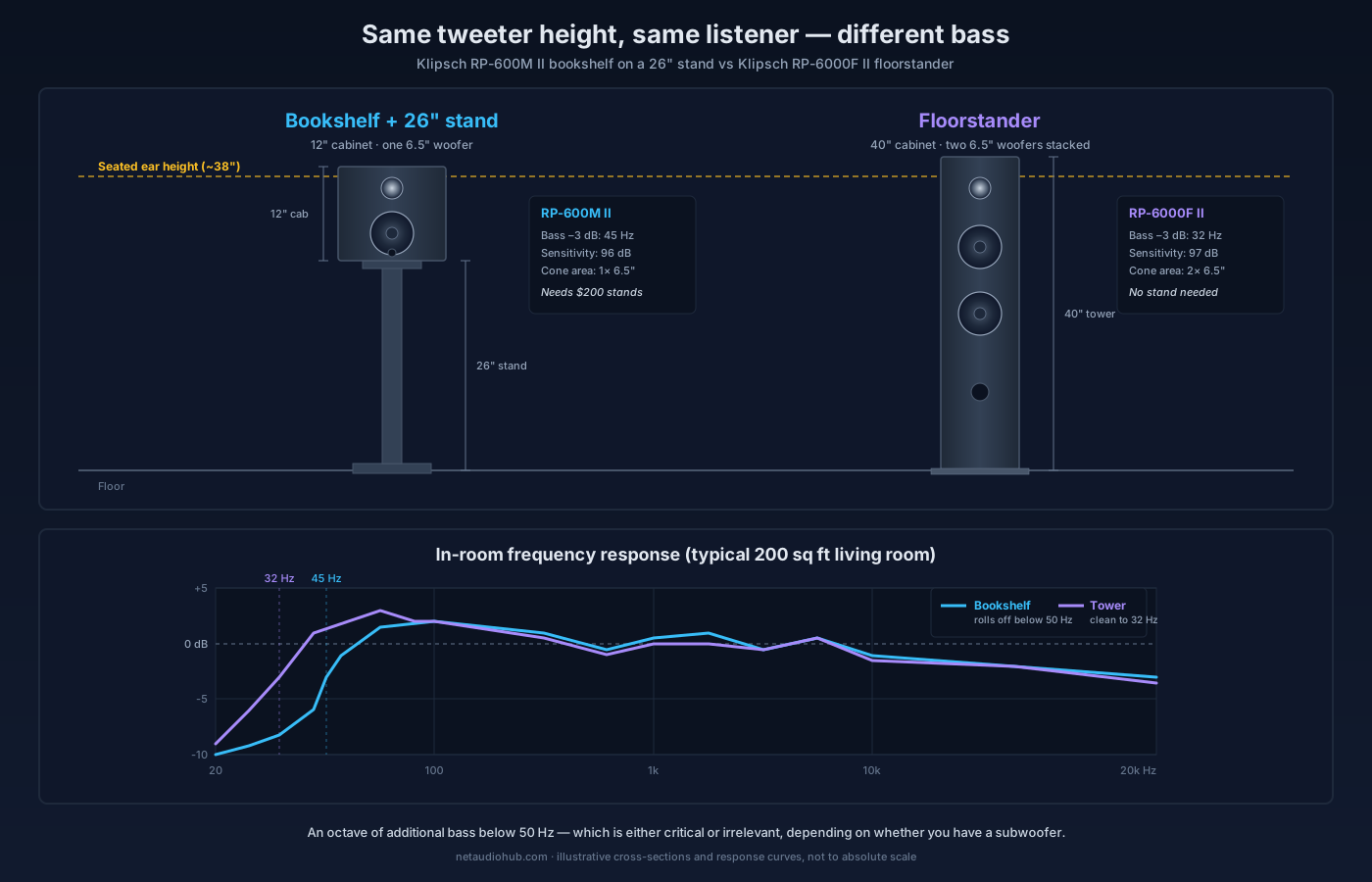
If you have a subwoofer and a normal-sized room, bookshelves on good stands deliver 90% of what a floorstander does for half the price. Towers win when you're running 2.0 stereo without a sub, your room is over 250 sq ft, you cross the sub below 80 Hz, or you listen loud in a big space.
The verdict up front: if you're adding a subwoofer — and for any modern home theater you almost certainly are — bookshelf speakers on good stands deliver 90% of what a floorstander gives you for half the price and a tenth of the floor space. The floorstander wins when you want full-range stereo without a subwoofer, when your room is over 250 square feet, when you cross to the sub at 60 Hz or lower, or when you want the bass impact at moderate volume levels that a small woofer simply cannot produce. For a 2.1 or 5.1 system with a competent sub in a typical 150–250 sq ft living room, get the bookshelves — you'll spend less, place them more easily, and your sub will be doing most of the work below 80 Hz anyway. For a 2.0 stereo room with no plan to add a sub, or a 7.2 home theater in a great room over 300 sq ft, get the towers. Below: what actually differs between the two designs, the cost math after stands, room sizing rules, and the best models in each category for 2026.
What Actually Differs
A "bookshelf" speaker (also called a standmount or monitor) is a two-way or three-way enclosure typically 12–18 inches tall, designed to sit on a dedicated speaker stand or shelf. A "floorstanding" or tower speaker is the same idea scaled up — usually 36–48 inches tall, with multiple woofers stacked below the tweeter, and a larger internal volume.
The differences fall into five categories that actually matter when you're choosing between them.
Bass extension. The biggest difference. A single 5.5–6.5" woofer in a bookshelf can produce usable output down to roughly 45–55 Hz, with anything below 50 Hz needing room reinforcement to be audible. A tower with two or three 6.5" woofers, or a single 8" woofer, gets to 32–38 Hz cleanly. The Klipsch RP-600M II bookshelf is rated 44 Hz – 25 kHz (±3 dB). The matching RP-6000F II floorstander is rated 38 Hz – 25 kHz (±3 dB). Within one family that gain is modest — roughly a quarter-octave — but across the market the spread between a 50 Hz bookshelf and a 32 Hz tower is about two-thirds of an octave, which is either critical or irrelevant depending on whether you have a subwoofer.
Sensitivity and SPL capability. Floorstanders are typically 1–4 dB more sensitive than their matching bookshelves, because multiple woofers move more air for the same input voltage. The RP-600M II is rated 94.5 dB and the RP-6000F II 96 dB — both Klipsch half-space ratings, so they are comparable to each other but not to a conventionally rated speaker; the RP-600M II measures 86 dB anechoic. More importantly, the tower can keep that sensitivity at louder volumes — the bookshelf woofer hits its mechanical limit and starts to compress at high SPL while the tower's larger cone area keeps moving cleanly. If you listen at reference levels in a big room, this matters. If you listen at 75–85 dB in a normal living room, it doesn't.
Floor space and visual footprint. A bookshelf on a 26" stand occupies roughly 11"x14" of floor area. A typical tower occupies 9"x16" — slightly less actual floor area, surprisingly, but it's 40 inches tall and dominates the room visually. Some buyers prefer the look of a tower as a statement piece. Many partners prefer the bookshelf-on-stand profile because the speaker visually "ends" at ear height and looks less furniture-like.
Amp power requirements. Both speaker types need clean amp power. Bookshelves are generally more forgiving of cheap amplifiers because they handle less low-frequency content (which is what murders cheap amps). Floorstanders with multiple woofers asked to play full-range music benefit from amplifiers with 80–150 watts per channel of clean continuous power and good current delivery. If you're building around a budget AVR like the Denon AVR-S970H, that 90W/ch rating drops to ~50W/ch with five channels driven and is fine for bookshelves but starts to feel underfed when driving a pair of large towers in a big room.
Total cost after stands. The hidden cost in bookshelf buying. A pair of $550 bookshelves and a pair of $200 stands is $750 before the speaker wire reaches them. A pair of $800 towers is $800. The cost gap between bookshelves-on-stands and matching towers is often $50–$200 — far smaller than the sticker prices suggest.
When to Buy Bookshelves
You're adding a subwoofer. This is the dominant case for most buyers. If you have a competent sub crossed at 80 Hz — the THX-standard crossover used by virtually all AV receiver auto-setup routines — your speakers are not doing meaningful work below 80 Hz anyway. The sub handles the bottom two octaves. The speakers handle midrange and treble. A bookshelf that's flat to 60 Hz and rolls off below that is functionally identical to a tower in this configuration. Save the $200 and put it toward a better sub.
Your room is under 250 sq ft. Small rooms favor bookshelves for two reasons. First, a tower's deep bass excites room modes — peaks and nulls in the bass response at specific frequencies — more aggressively because there's more low-frequency energy entering the room. A small room with strong modes ends up worse with a tower than with a bookshelf-plus-sub, because the sub can be placed and EQ'd independently for cleaner bass at the listening position. Second, the visual scale of a 40-inch tower in a small room is overwhelming.
You can't pull the speakers away from the wall. Most towers are ported, with the port firing rearward or downward. They want at least 12 inches of breathing room behind them — preferably more. A bookshelf on a stand can sit much closer to a wall (some are even designed for on-wall use), and the stand itself can be filled with sand or shot to control resonance regardless of room geometry. Check which way the port faces before you assume a bookshelf solves it, though: plenty are rear-ported too. The ELAC Debut 2.0 B6.2 is the one we reach for in this situation because its port fires forward, which is what actually lets it sit on a real bookshelf or near a wall without bass bloat.
You're building a satellite-and-sub 5.1 or 7.1 system. If you've decided the sub is doing all the bass duty, identical bookshelves all around — fronts, surrounds, and possibly the center on its side — give you the most consistent timbre between channels. Mixing towers up front and bookshelves in the back works fine but introduces small voicing differences between front and surround channels.
Best bookshelf speakers in 2026 by price tier:
- Under $400/pair: Q Acoustics 3030i — 6.5" woofer in a sealed cabinet, smooth voicing, no nonsense. Or the ELAC Debut 2.0 B6.2 at $379 — an Andrew Jones design with a front port and a 6.5" aramid woofer that runs cleanly to about 44 Hz, though the horn-loaded Klipsch below is not the easier amplifier load its sensitivity number suggests — the ELAC's 87 dB is a conventional full-space rating, while Klipsch quotes half-space, and the RP-600M II measures 86 dB anechoic.
- Under $700/pair: Klipsch RP-600M II — lively horn-loaded character, ideal for AVR-driven 5.1 systems. See our full review.
- Under $1,000/pair: KEF Q3 Meta — point-source Uni-Q driver, exceptional imaging, more neutral than the Klipsch.
- Under $1,500/pair: Polk Reserve R200 — ring-radiator tweeter, well-engineered crossover, scales above its price.
- Under $2,500/pair: KEF LS50 Meta — the reference small-room standmount, used in mastering studios and high-end stereo rooms alike.
Don't forget the stands. Plan on $150–$250 for a decent pair of stands like the Sanus Steel Series BF-31 or the Monoprice Monolith 28". The right height puts the tweeter at seated ear level — typically 36–40 inches off the floor for a couch, so 26–28" stands are the common pick.
When to Buy Floorstanders
You're running a 2.0 stereo setup without a subwoofer. This is the case where towers clearly win. A bookshelf without a sub gives you music that's missing its bottom octave — kick drum thump, double bass fundamentals, organ pedal notes. A good floorstander brings those back. If you're a vinyl listener with an integrated amp and no plan to add a sub, get towers.
Your room is over 250 sq ft, especially open-plan great rooms. Large rooms swallow bass output. A bookshelf-plus-sub combination still works, but you'll need a larger sub (or two) to fill the room, and the speakers themselves can sound thin at moderate volume levels in a big space. A pair of towers fills a great room more naturally and gives you usable bass even with the sub turned off or absent.
You want to cross the sub lower than 80 Hz. Some buyers — especially two-channel music listeners — prefer to run their main speakers full-range and bring the sub in only below 50–60 Hz to fill the bottom octave. This requires speakers with clean output to at least 40 Hz, which means towers. A bookshelf crossed at 60 Hz is being asked for output it doesn't have.
You listen at high SPL in big rooms. If you regularly watch action movies at -10 dB from reference (peaks of 95–100 dB at the listening position) in a 350 sq ft room, towers have the headroom to deliver that without the cone compression and dynamic squashing that a bookshelf would suffer. Most people don't listen this loud most of the time, but if you do, get towers.
The visual statement matters to you. A pair of beautiful towers — Sonus faber, Focal, KEF Reference — is furniture-grade decor as well as audio gear. A bookshelf-on-stand is more utilitarian. Neither is wrong, but they signal different things.
Best floorstanding speakers in 2026 by price tier:
- Under $700/pair: ELAC Debut 2.0 F6.2 — triple 6.5" woofers, surprisingly clean bass for the money, the budget pick that beats things twice its price.
- Under $1,000/pair: Klipsch RP-6000F II — dual 6.5" woofers, 96 dB rated sensitivity (half-space — easy to drive, but not by as much as that number implies beside a conventionally rated rival), the go-to AVR-friendly tower. See our full review.
- Under $1,500/pair: Q Acoustics 5040 — point-source C³ continuous coaxial driver, exceptional imaging, more refined than the Klipsch but less dynamic.
- Under $2,500/pair: Polk Reserve R700 — three 8" woofers and a ring-radiator tweeter, full-range performance that competes with $4K speakers.
- Under $5,000/pair: KEF R5 Meta — the entry point into the genuinely high-end KEF lineup, Uni-Q driver with two dedicated woofers, true reference-grade sound.
The Room-Size Rule of Thumb
A simple sizing heuristic that works for most rooms:
| Room area | Room type | Recommendation |
|---|---|---|
| Under 150 sq ft | Small bedroom, dorm, office | Bookshelves on stands. No sub or a single small sub like the SVS SB-1000 Pro. |
| 150–250 sq ft | Typical living room | Bookshelves on stands plus a competent sub. This is the sweet spot for the bookshelf approach. |
| 250–400 sq ft | Larger living room, open dining/kitchen connection | Either choice works. Bookshelves with two subs is often better than towers with one. Towers with one good sub is simpler. |
| 400+ sq ft | Great room, dedicated home theater | Towers, ideally with two subwoofers placed for even bass distribution across the seating area. |
These are starting points. Open-plan rooms behave like larger rooms than their square footage suggests because the sound bleeds into adjacent spaces. Heavily furnished rooms behave smaller because soft surfaces absorb energy.
What About the Center and Surrounds?
For home theater, the front left and right choice cascades into the rest of the system.
If you choose bookshelf fronts, you should match with a center channel from the same line — for example, the Klipsch RP-504C II if you're running RP-600M IIs. Surrounds can be matching bookshelves on stands or in-wall versions for a cleaner installation. The system stays compact.
If you choose floorstanding fronts, you still need a center, which becomes the limiting factor. Towers can play loud and deep, but the center has to keep up tonally. A modest center like the Klipsch RP-404C II paired with RP-6000F II towers will sound tonally mismatched at high volume — the towers will out-dynamic the center, and dialogue will sound smaller than the music and effects around it. Plan to spend at least 60–80% of the tower's price on the center.
In both cases, surrounds can be a tier smaller than the fronts. They're playing ambient effects most of the time, not full-range content.
Common Myths
"Floorstanders sound bigger." They don't necessarily sound bigger — they reach lower. Soundstage size is determined by speaker placement, room acoustics, and crossover design, not by speaker height. A well-set-up bookshelf pair on tall stands can image as wide and deep as any tower.
"Bookshelves can't do home theater." Studio reference monitors are bookshelves. Mixing rooms for major films often use Genelec or Neumann two-way standmounts with separate subs. Bookshelves can absolutely do home theater — they just need a good sub and proper level matching.
"Towers don't need subs." Most towers reach 32–38 Hz at -3 dB in an anechoic chamber. In a real room, that often becomes 28–35 Hz with room gain. For movies, you still want output to 20 Hz (LFE content commonly extends that low), and almost no tower under $5,000 does that cleanly. A subwoofer helps even a tower system.
"More expensive bookshelves beat cheap towers." Sometimes true for refinement, almost never true for raw bass output. A $1,500 bookshelf doesn't outplay a $1,500 tower in the bottom octave because cabinet volume and cone area are doing physical work that the bookshelf design can't match. Don't expect a high-end small speaker to compete with a competent large speaker on bass.
"You need to bi-wire your towers." Bi-wiring (running two pairs of wires to a pair of binding posts that share the same crossover) is essentially a non-effect in blind testing. Bi-amping (running separate amps for the high and low sections) has measurable but small benefits in specific designs. For 99% of buyers, single-wire with quality 14 AWG speaker wire is the right answer.
How to Decide in Five Minutes
Ask yourself, in order:
- Will you have a subwoofer? If yes, the case for bookshelves gets much stronger. If no, towers are likely the right call unless your room is tiny.
- How big is the room? Under 250 sq ft, bookshelves are fine. Over 400 sq ft, towers help. In between, it's preference and budget.
- What's your total budget for L/R? If you have $1,000 total for the pair including stands, you'll get more speaker buying $750 bookshelves and $200 stands than buying $1,000 towers. If you have $2,500+, the tower premium becomes easier to justify because the bookshelf+stand combo no longer saves you much.
- What does your partner think? Real consideration. Towers are bigger visual commitments. If household harmony depends on minimizing the speaker footprint, bookshelves on slim stands win.
- Do you cross your sub above or below 80 Hz? If above 80 Hz (most home theater), bookshelves are functionally equivalent. If below 80 Hz (some music setups), you need towers.
If you answered "yes sub, normal room, normal budget, partner-conscious, 80 Hz crossover" — get bookshelves. That's most readers.
Related
Affiliate disclosure: NetAudioHub links to retailers including Amazon. We earn a small commission on qualifying purchases at no extra cost to you.