Klipsch RP-500SA II Review: The Atmos Module That Finishes the Reference Premiere II System
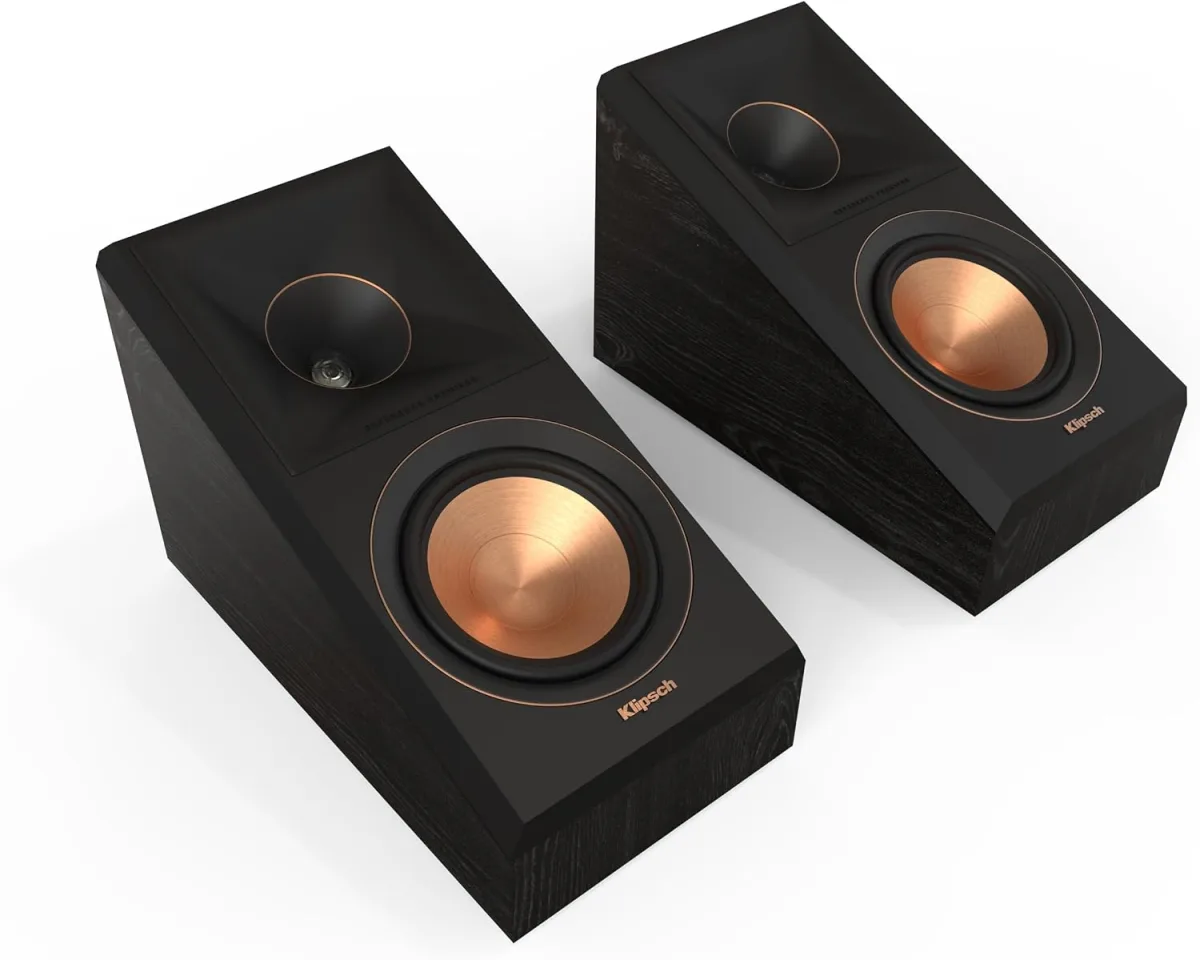
The Klipsch RP-500SA II is a switchable Dolby Atmos elevation / surround speaker with a 1" Titanium LTS tweeter and 5.25" Cerametallic woofer. The matching height channel for the RP-600M II, RP-6000F II, and RP-504C II — this is how you turn a 5.1 into a real 5.1.2.
✅ Pros
- +Horn-loaded 1-inch Titanium LTS tweeter gives the reflected height layer real clarity vs. soft-dome upfiring modules
- +Timbre-matches the RP-600M II, RP-6000F II, and RP-504C II — overhead-to-front-stage pans stay seamless
- +Switchable Atmos/Surround crossover makes it two speakers in one: upfiring height or on-wall surround
- +Built-in keyhole mount for easy wall-mount surround duty
- +Sealed cabinet, internally braced — tight, controlled within its band
- +Ebony and Walnut finishes match the rest of the Reference Premiere II line
- +Light (9.6 lb) and stable on top of a floorstander or bookshelf
- +5-year parts and labor warranty
❌ Cons
- −Upfiring is inherently a compromise versus in-ceiling Atmos
- −Effect depends entirely on a flat, reasonably-height ceiling
- −No published frequency-response or sensitivity figure to spec-compare
- −Requires an Atmos-capable AVR with a spare channel pair (not plug-and-play)
- −Only worth the premium on a Klipsch Reference Premiere II front stage
- −Vinyl finishes (not real wood veneer) at this price
The Klipsch RP-500SA II is the correct way to add Dolby Atmos height to a Reference Premiere II front stage — as long as you understand what upfiring Atmos can and can't do. It pairs a 1-inch Titanium LTS tweeter on the same 90°×90° Hybrid Cross-Section Tractrix Horn used across the rest of the line with a single 5.25-inch Cerametallic woofer, tuned to bounce a phantom height layer off your ceiling. Flip the switchable crossover and it doubles as an on-wall surround with the built-in keyhole mount. The one thing it does that a generic upfiring module can't: it timbre-matches the Klipsch RP-600M II bookshelves, RP-6000F II floorstanders, and RP-504C II center, so overhead effects panning down into the front stage don't change character. At around $449.99 a pair, it's the last piece that turns a Klipsch 5.1 into a real 5.1.2.
The Klipsch RP-500SA II is available on Amazon in Ebony (ASIN B09VCLD7HF) or Walnut at around $449.99 per pair.
Key Specs at a Glance
The RP-500SA II is a 2-way passive, sealed Dolby Atmos elevation / surround speaker sold as a pair. The tweeter is a 1" (25.4mm) Titanium LTS vented diaphragm loaded into a 90°×90° Hybrid Cross-Section Tractrix Horn; the woofer is a single 5.25" (133mm) Cerametallic (copper-spun) cone with Faraday rings. A switchable crossover on the back panel selects Dolby Atmos (upfiring) mode or Dolby Surround (on-wall) mode. Power handling is 75W continuous / 300W peak, and it is 8 Ω compatible. The enclosure is sealed, internally braced MDF; it sits on top of a front/surround speaker for upfiring or uses a keyhole wall-mount for on-wall duty, with a removable magnetic grille. Dimensions are 8.53" H × 6.81" W × 12.60" D, 9.6 lb (4.35 kg) each, available in Ebony or Walnut vinyl with a satin-painted baffle, backed by a 5-year parts-and-labor warranty at roughly $449.99/pair street (list price seen up to ~$649.99).
A note on frequency response and sensitivity: unlike Klipsch's direct-radiating speakers, the RP-500SA II's official spec sheet lists frequency response and sensitivity as "conforms to Dolby Atmos specifications" rather than a single number. That's normal for a Dolby-licensed upfiring module — the meaningful performance target is the reflected in-room response Dolby certifies, not an on-axis anechoic curve. We've marked anything Klipsch doesn't publish rather than guess at it.
What "Dolby Atmos Elevation" Actually Means
Before the review proper, the physics, because it decides whether this speaker is right for you. A ceiling-mounted Atmos speaker fires straight down at your head. An elevation or upfiring module like the RP-500SA II sits on top of your front (or surround) speakers, fires up at an angle, and uses the ceiling as a mirror — the sound bounces off the ceiling and arrives at your ears as if it came from above. Dolby engineers the driver angle and an internal crossover specifically so that reflection lands correctly for a seated listener.
This works, and it works better than most people expect on the first "rain scene" or helicopter flyover. But it is a reflection, and reflections are lossy. You need a flat, reflective ceiling 7.5 to 12 feet high — vaulted ceilings, exposed beams, popcorn texture, or acoustic tiles scatter the bounce and the height image collapses. The effect is diffuse, not pinpoint: in-ceiling speakers can place a discrete object "above and slightly left," while upfiring gives you a convincing height layer — ambience, rain, a jet passing over — more than a sharply localized point. And higher ceilings weaken it: at 8 feet it's excellent, but at 12 feet the reflection travels far enough that level and focus drop off.
If you can run in-wall/in-ceiling wiring, in-ceiling speakers are the better Atmos solution and it isn't close — we cover that trade-off in our Atmos: in-ceiling vs. upfiring vs. height speakers explainer. The RP-500SA II exists for the very common case where running wire through the ceiling is impossible (rental, concrete ceiling, finished drywall you won't cut) — and in that case, it's the right tool.
The Switchable Crossover: Two Speakers in One Box
The single most useful feature the II inherits and refines is the switchable crossover on the back panel. It has two positions. In Dolby Atmos mode, it voices the driver for the upfiring, ceiling-bounce use case — this is what you use when the RP-500SA II sits on top of your RP-600M II or RP-6000F II fronts and fires at the ceiling. In Dolby Surround mode, it voices it as a direct-radiating speaker; in this mode, use the built-in keyhole mount to hang it on the wall as a side or rear surround channel.
That flexibility is why this speaker is a smart buy even if your Atmos plan changes. Start today with the pair firing upward as your ".2" height layer in a 5.1.2. Later, if you decide to run dedicated in-ceiling height speakers, flip these two to Surround mode, wall-mount them, and promote your setup to a 7.1.2 — the same speakers become your surround-back channels. Nothing gets orphaned.
One thing to get right: the switch has to match how the speaker is deployed. Upfiring on top of a speaker means Atmos mode; wall-mounted as a surround means Surround mode. Running it upfiring but leaving it in Surround mode (or vice versa) is the most common setup mistake, and it noticeably dulls the effect.
Sound Quality
Judged as an Atmos height layer, the RP-500SA II is convincing. On a proper 8–9 foot flat ceiling, the ceiling-bounce trick lands. Rain in Blade Runner 2049 comes from above and around rather than from the wall in front of you. A helicopter crossing the frame travels overhead with a believable sense of altitude. Because Klipsch horn-loads the tweeter, the height information has more clarity and "reach" than the soft-dome drivers in a lot of competing upfiring modules — the reflected treble doesn't turn to mush after the ceiling bounce.
The timbre match is the real payoff. This is what separates a matching module from a $150 generic. When a sound object pans from an overhead height channel down into the front stage — a very common Atmos gesture — it stays the same sound. The horn-loaded tweeter and Cerametallic woofer share the voicing of the RP-600M II, RP-6000F II, and RP-504C II. With mismatched height speakers, that same pan changes tone as it moves, and the illusion breaks. With the matched RP-500SA II, the dome you hear "up there" is the same dome you hear "down there."
As an on-wall surround in Surround mode, it's a straightforwardly good small Klipsch. Flipped to Surround mode and wall-mounted, it behaves like a compact direct-radiating Reference Premiere II speaker: forward, articulate on effects, timbre-matched to the fronts. For surround duty in a small-to-medium room it's more than enough.
Where it's honest about limits: it is a 5.25-inch two-way — it does not, and is not meant to, produce deep bass. Height channels carry effects and ambience, not LFE. Every serious Atmos setup crosses the height channels high (100–120 Hz is typical) and lets the subwoofer handle everything below. Do that, and the RP-500SA II never gets asked to do something it can't.
In a 5.1.2 / 7.1.4 System
As the ".2" in a 5.1.2 anchored by RP-600M II fronts, this is the textbook use. Set the pair on top of the front bookshelves, switch to Atmos mode, and configure them as Front Height (Dolby's recommended position for upfiring modules) in your AVR. A Denon AVR-X2800H or Marantz Cinema 70s drives them easily — both are 7.2-channel receivers that support a 5.1.2 layout, and both will happily power a pair of 8-ohm-compatible height channels alongside the front stage.
Check your AVR's channel count before you buy. A 5.1.2 layout needs a receiver with at least seven amplified channels (five bed + two height). The Yamaha RX-V6A and the AVRs above all qualify. A basic 5.1-only receiver does not — you'd need to step up before the RP-500SA II has anything to plug into.
In a 5.1.2, the recommended signal chain is RP-6000F II or RP-600M II fronts, RP-504C II center, RP-500M or on-wall surrounds, an RP-500SA II pair as front height, and a sub like the SVS SB-1000 Pro doing all the low end. Cross the height channels at 100–120 Hz. Run Audyssey/Dirac/YPAO after install — room correction matters more for upfiring height channels than for any direct speaker, because the ceiling reflection introduces timing and level quirks the AVR needs to measure and correct.
For a 7.1.4, buy two pairs: one pair upfiring on the fronts (front height), one pair upfiring on the surrounds (rear height). This is the most Klipsch RP-500SA II gives you, and on a good ceiling a four-object height layer from matched modules is genuinely immersive. If you're going this far, seriously price out in-ceiling speakers first — but if the ceiling can't be cut, four RP-500SA II is the answer.
As a surround-only speaker in Surround mode, in a 5.1 or 7.1 with no height layer, it's a fine choice too — but at ~$449.99/pair you're paying partly for the Atmos flexibility. If you know you'll never do height, the direct-radiating RP-500M bookshelf is the more focused surround for the money.
Setup and Placement
The RP-500SA II lives or dies on setup more than almost any speaker we review, because it depends on a reflection you can't see. Ceiling first: flat drywall or plaster, 7.5–12 ft, ideally 8–10 ft. Vaulted, beamed, textured, or acoustic-tile ceilings will disappoint you no matter what else you do; if that's your ceiling, this is not your speaker. Set it directly on top of the front/surround speaker, as far forward on the cabinet top as it stably sits, tweeter/baffle aimed up and slightly toward the listening area — the included rubber feet keep it from sliding.
Flip the crossover to match the job: Atmos mode for upfiring, Surround mode for wall-mount. Get this wrong and the effect goes flat. Assign the right channel in the AVR — for upfiring modules on the fronts, choose Front Dolby / Front Height, not "Top Middle" or "Ceiling," because those presets assume actual in-ceiling speakers and apply the wrong delay. Cross them high, 100 to 120 Hz; these are not full-range and shouldn't try to be, so send everything below to the sub. Run room correction, then verify by ear: play an Atmos demo disc or a known scene, and if height sounds like it's coming from the front wall rather than above, your ceiling, the mode switch, or the AVR channel assignment is wrong — in that order of likelihood. Speaker wire: 16 gauge is fine, since height channels carry limited power and the runs up to the top of a floorstander are short.
Limitations Worth Knowing
Upfiring is a compromise, full stop. If you can run in-ceiling speakers, do that instead — the localization and consistency are meaningfully better. The RP-500SA II is the best answer to "I can't cut my ceiling," not the best Atmos answer in absolute terms. It is ceiling-dependent: no flat, reflective, reasonably-height ceiling means no effect, and there is no setting that fixes a vaulted or textured ceiling.
There's no published FR/sensitivity number — Klipsch specs it as "conforms to Dolby Atmos specifications." That's legitimate for a Dolby-tuned module, but it means you can't spec-compare it head-to-head with a direct-radiating speaker on a data sheet. It also needs an Atmos-capable AVR with a spare channel pair; this is not a plug-into-anything speaker, so confirm your receiver supports at least 5.1.2 before buying. It's not a surround upgrade in disguise either — in Surround mode it's a good compact surround, but if surrounds are all you want, a dedicated bookshelf surround is a better value. Finally, it's a single-brand commitment: the whole reason to pay for the matched module is timbre-matching to Klipsch Reference Premiere II fronts. On a non-Klipsch front stage, most of the value evaporates — buy your fronts' matching height module instead.
Who Should Buy the Klipsch RP-500SA II
Buy it if you own (or are buying) Klipsch RP-600M II, RP-6000F II, or RP-8000F II fronts and want to add Atmos height; you have a flat ceiling roughly 8–10 ft high; you have an Atmos-capable AVR with at least a 5.1.2 channel count — Denon AVR-X2800H, Marantz Cinema 70s, Yamaha RX-V6A, or better; you can't (or won't) run in-ceiling wiring; and you value the flexibility of a module that can later become a surround.
Run in-ceiling speakers instead if you can fish wire through the ceiling — in-ceiling Atmos beats upfiring on localization and consistency (see our Atmos placement explainer) — or if your ceiling is vaulted, beamed, or textured, where upfiring simply won't work. Buy the direct-radiating RP-500M instead if you only want surround channels and have no plans for a height layer; it's the more focused surround for the money. And consider a soundbar instead if you don't have an AVR and don't want one — a Sonos Arc Ultra or Samsung HW-Q990D delivers upfiring Atmos in a complete, no-wiring package.
Klipsch RP-500SA II vs. the Original RP-500SA
The original RP-500SA is still around used and remains a capable module. The II brings the Reference Premiere II family updates: the new 90°×90° Hybrid Cross-Section Tractrix Horn (wider, more consistent dispersion), the redesigned Cerametallic woofer with Faraday rings (lower distortion), and voicing matched to the II-generation fronts. Buy the II new if you're building a Reference Premiere II system, or you already own RP-600M II / RP-6000F II / RP-504C II and need to timbre-match the height channels to them. Buy the original RP-500SA used if your fronts are the original (non-II) Reference Premiere line — match the generation of your fronts. Mixing II modules with original fronts works, but the seamless timbre match is the whole point, and it's tightest within a generation.
Bottom Line
The Klipsch RP-500SA II isn't magic, and it doesn't pretend to be — upfiring Atmos is a reflection trick with real limits, and this review has been blunt about them. But if your fronts are Klipsch Reference Premiere II, your ceiling is flat and a sane height, and cutting the ceiling for in-ceiling speakers is off the table, this is the correct height module: horn-loaded clarity, a genuine timbre match to the rest of your system, and a switchable crossover that keeps it useful even if your plans change. At around $449.99 a pair, it's the piece that turns a Klipsch 5.1 into a 5.1.2 you'll actually notice.
The Klipsch RP-500SA II is available on Amazon in Ebony or Walnut at around $449.99 per pair.
Our Verdict
The Klipsch RP-500SA II is a switchable Dolby Atmos elevation / surround speaker with a 1" Titanium LTS tweeter and 5.25" Cerametallic woofer. The matching height channel for the RP-600M II, RP-6000F II, and RP-504C II — this is how you turn a 5.1 into a real 5.1.2.
Ready to buy the Klipsch RP-500SA II?
Buy on Amazon →Affiliate link — we may earn a commission at no extra cost to you.