Audyssey vs Dirac Live vs YPAO: Which AV Receiver Room Correction Actually Works in 2026
Published 2026-06-03 · By NetAudioHub Editorial
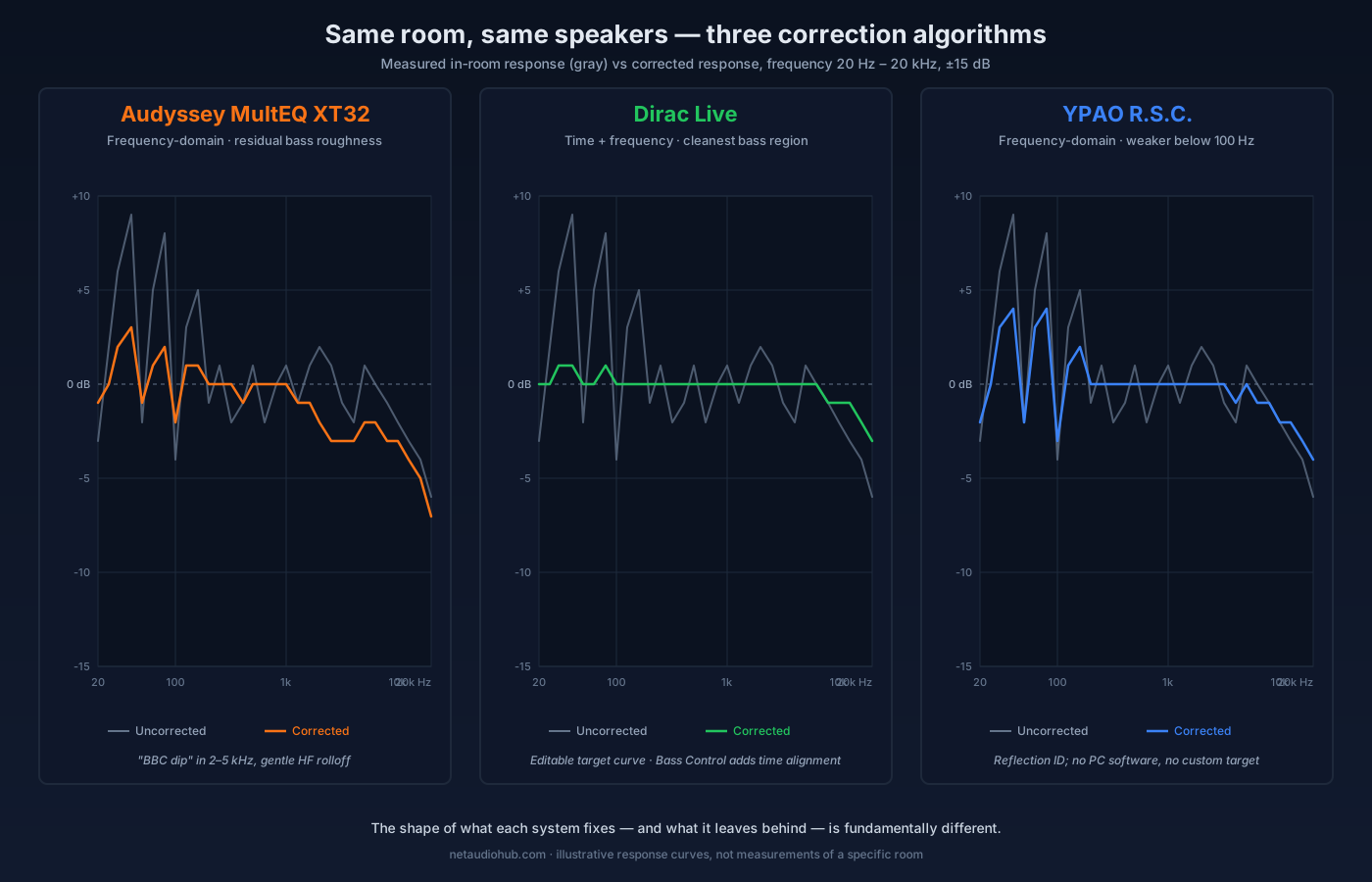
Dirac Live is the most capable, Audyssey MultEQ XT32 with MultEQ-X gets close for half the money, and YPAO is the most forgiving. Here is what each system actually does, where each one falls short, and which receivers ship with which version.
The verdict up front: Dirac Live is technically the most capable of the three — it corrects in both time and frequency, handles multiple subwoofers cleanly, and gives you full target-curve control on a PC. Audyssey MultEQ XT32, especially with the paid MultEQ-X PC software, gets close enough that the difference is hard to hear in most rooms — and it ships on a much wider range of receivers at much lower prices. YPAO is the simplest of the three to run and the most forgiving of bad measurement technique, but its top-tier R.S.C. version is still doing less math than the other two. Which one matters for your purchase: if you can spend $2,500+ on the receiver and you want the cleanest possible bass with multiple subs, look at a Dirac-equipped Onkyo or Pioneer Elite. If you're under $2,000, get a Denon with Audyssey XT32 and add MultEQ-X for $199 — you'll spend less than the Dirac receiver and get 90% of the result. If you already own Yamaha gear or strongly prefer the brand, an Aventage with YPAO R.S.C. is fine — just measure carefully and consider an external miniDSP for the sub. Below: what each system actually does, where each one falls short, and which receivers ship with which version in 2026.
What Room Correction Is Actually Doing
Every speaker, in every real room, produces a response curve that looks nothing like the flat line on the spec sheet. The room adds its own signature: bass modes that boost some frequencies 10+ dB at certain seats and cancel others 15+ dB, early reflections off side walls and ceilings that smear stereo imaging, and a treble rolloff that varies with carpet, drapes, and furniture.
Room correction software runs three steps:
- Measure — a microphone at the listening position(s) captures a test signal (typically a logarithmic sweep) so the software can compute the impulse response and frequency response of every speaker.
- Compute — the software calculates a digital filter that, when applied to the audio going into the speaker, will produce a response closer to a target curve at the listening position.
- Apply — the receiver runs that filter on every audio stream in real time.
The three big consumer correction systems — Audyssey, Dirac Live, and YPAO — do all three steps. They differ in the math behind step 2, the quality of the mic in step 1, the flexibility you have to edit the target curve, and how they handle problems that the math alone cannot solve (deep modal nulls, time-of-arrival errors from multiple subs, asymmetric rooms).
To understand the comparison, you need one more distinction: frequency-domain correction vs time-domain correction.
Frequency-domain correction (the simpler approach) treats the room's effect as a fixed boost or cut at each frequency. It builds a graphic-EQ-style filter: cut 8 dB at 56 Hz, boost 3 dB at 2.1 kHz, etc. This handles steady-state response well but does nothing about the timing of reflections — the way a wall reflection arrives 4 milliseconds after the direct sound and smears the impulse.
Time-domain correction (the harder approach) treats the room's effect as a full impulse response that needs to be deconvolved. It builds a FIR filter that, in principle, can correct both the frequency response and the time-of-arrival smearing — making the impulse at the listening position behave more like the impulse at the speaker.
Audyssey is primarily frequency-domain with some time alignment. YPAO is primarily frequency-domain. Dirac is genuinely time-domain. That is the single most important technical difference between the three.
Audyssey
Found on: Denon and Marantz AV receivers, the entire range from entry to flagship.
Versions, low to high:
- Audyssey MultEQ — entry tier, on cheaper Denon AVR-S models. Coarse filter resolution, no per-channel detail.
- Audyssey MultEQ XT — mid tier. Better resolution, supports 8-point measurement.
- Audyssey MultEQ XT32 — top tier on consumer Denon/Marantz. Highest filter resolution available in Audyssey (10,000+ taps below 500 Hz on the main channels), independent EQ for two subwoofers, and the best chance of cleaning up bass without external help.
What it does well. The measurement workflow is automated and forgiving. You plug in the included tabletop mic, place it at 8 listening positions across the seating area (Audyssey averages across them), and the receiver handles the rest. Levels, distances, speaker sizes, crossovers, and EQ are all set in roughly 15 minutes. Out of the box, XT32 delivers a clear improvement over no correction in almost every room.
What it does poorly. Stock Audyssey applies a target curve that includes a "BBC dip" — a few dB of attenuation in the 2–5 kHz presence region that some listeners find dull. The default high-frequency rolloff is also more aggressive than most calibrators consider neutral. You can't change this from the receiver's menu. Stock Audyssey also has limited per-channel customization and no insight into what filters were actually generated.
The two upgrades that change Audyssey's reputation:
- Audyssey MultEQ Editor App (~$20, iOS/Android). Lets you change the high-frequency rolloff cutoff, override individual channel curves, and disable midrange compensation. A modest improvement over stock.
- Audyssey MultEQ-X ($199 Windows app, released 2022). This is the one that matters. It lets you run measurements from a Windows laptop with a calibrated USB mic (typically a miniDSP UMIK-1), define a custom target curve, choose how high in frequency you want EQ applied per channel, and inspect the resulting filters. With MultEQ-X, an XT32-equipped Denon or Marantz produces results that are very close to Dirac Live in blind tests, especially in the bass region where it matters most.
Limits even at the top. Audyssey is still primarily frequency-domain. It will not correct impulse-response timing the way Dirac does. With two subwoofers it can EQ each one independently (a big advantage over base Audyssey or YPAO) but it doesn't time-align them in the way Dirac Bass Control does — for that, most calibrators recommend an external miniDSP 2x4 HD ahead of the subs.
Best Audyssey receivers in 2026:
- Denon AVR-X3800H (~$1,700) — entry into XT32. Nine amplified channels, 11.4 processing, dual sub outputs. The cheapest way to get the good Audyssey.
- Denon AVR-X4800H (~$2,500) — XT32 plus optional Dirac Live upgrade. Best-of-both-worlds receiver. See below.
- Marantz Cinema 40 (~$3,500) — XT32 in Marantz's HDAM-equipped chassis with a warmer character. Same room correction tech, different sound signature.
Dirac Live
Found on: Onkyo flagship and step-down models, Pioneer Elite, NAD, Anthem, Storm Audio, JBL Synthesis, and (as a paid upgrade) the top Denon X-series and Marantz Cinema receivers since 2024.
Versions:
- Dirac Live (frequency- and time-domain correction up to a user-selectable cutoff, default 500 Hz).
- Dirac Live Bass Control — a separate paid module ($349 typical) that handles multiple subwoofers as a coordinated system, with time alignment, level matching, and joint EQ across up to 4 sub outputs. Best in class for multi-sub setups.
- Dirac Live Active Room Treatment (ART) — the newest tier (2024), uses the main speakers themselves to actively cancel low-frequency modes between speakers and subs. Available on a small but growing list of flagships.
What it does well. Dirac is the only mainstream consumer correction system that genuinely corrects the impulse response, not just the frequency response. In practice, this shows up as tighter, more focused bass and cleaner transient detail (a kick drum sounds like a kick drum, not a kick drum smeared by 4 ms of room reflection). With Bass Control and two or more subs placed reasonably, Dirac flattens the in-room bass response across the seating area better than any other consumer system.
The PC application is also far more transparent than Audyssey. You see the measured impulse response per channel, you see the target curve, you can edit the target curve in real time, you choose the correction frequency range, you choose how many filter taps. None of this requires extra paid software — the Dirac Live PC app comes with the receiver license.
What it does less well. Dirac is more sensitive to measurement technique. Mic stand placement matters more, mic angle (typically 90° from horizontal, pointed at the ceiling) matters more, and a bad measurement set produces noticeably worse results than a bad Audyssey set. A calibrated mic like the miniDSP UMIK-1 is strongly recommended; the bundled mic with the receiver is usually fine but the UMIK-1 with its individual calibration file is better.
Receiver cost is the other constraint. Dirac-equipped models start at around $2,500 and the Bass Control upgrade is another $349. You can hit this with a Denon X4800H upgrade path, but you've spent $3,000+ before you've added a single sub.
Best Dirac Live receivers in 2026:
- Onkyo TX-RZ70 (~$2,800) — 11.2 channels, 200W per channel, Dirac Live built in, Bass Control available as a paid upgrade. The most amplifier-per-dollar Dirac receiver.
- Pioneer Elite VSX-LX805 (~$3,000) — sister product to the Onkyo with the same Dirac Live implementation, plus Pioneer's MCACC as a fallback. Same chassis, same chip set, slightly different tuning.
- Denon AVR-X4800H with Dirac Live upgrade (~$2,500 + $349) — the most flexible option. Get Audyssey XT32 free, add Dirac Live when you want it, and you've still spent less than a flagship-only Dirac receiver.
YPAO
Found on: Yamaha receivers across the line, from V-series to flagship Aventage.
Versions:
- YPAO (basic) — single-position measurement, frequency-domain correction, level/distance/SPL.
- YPAO Multi-Point — averages across multiple seating positions.
- YPAO with R.S.C. (Reflected Sound Control) — adds reflection detection and selective correction of early reflections. Yamaha's flagship room correction.
- YPAO Volume / YPAO Bass — runtime adjustments (loudness compensation at low volume, bass enhancement).
What it does well. YPAO is the most forgiving system of the three for users who do not want to think about measurement technique. The included mic is simple, the on-screen setup wizard is direct, and the system produces a usable result with one or two measurements. R.S.C. on the Aventage line genuinely does identify and correct early reflections, which the other two systems do not specifically target.
What it does less well. YPAO does not have a PC application equivalent to Dirac Live or MultEQ-X. You cannot define a custom target curve, you cannot inspect the generated filters, and you cannot run measurements from a calibrated mic. What you measure with the included mic at the receiver is what you get. For users who want to dial in their room manually, that's a real limitation.
YPAO's multi-sub support is also weaker. The top Aventage models support two sub outputs, but they are summed and corrected as a pair rather than independently EQed (the way Audyssey XT32 does) or jointly time-aligned (the way Dirac Bass Control does). With two well-placed subs in a friendly room, the result is fine; in a difficult room, an external sub processor closes a real gap.
Best YPAO receivers in 2026:
- Yamaha RX-V6A (~$700) — basic YPAO, 7.2 channels, Atmos and DTS:X. Solid entry point if you're already in the Yamaha ecosystem.
- Yamaha RX-A4A (~$1,400) — Aventage build quality, YPAO R.S.C., 7.2 channels. The sweet spot for YPAO if you want the good version.
- Yamaha RX-A6A (~$2,200) — 9.2 channels, full YPAO R.S.C. with high-precision EQ, two independent sub outputs. Yamaha's most capable consumer correction setup.
Side-by-Side: How They Actually Compare
| Capability | Audyssey MultEQ XT32 | Dirac Live | YPAO R.S.C. |
|---|---|---|---|
| Correction domain | Frequency (some time alignment) | Frequency + time (full impulse) | Frequency (with reflection ID) |
| Default measurement positions | 8 | 9 (configurable) | Up to 8 (model dependent) |
| Custom target curve from box | No (paid upgrade only) | Yes, included | No |
| PC software included with receiver | No (Editor app $20; MultEQ-X $199) | Yes | No |
| Independent EQ for multiple subs | Yes (2 subs) | Yes (Bass Control add-on, up to 4) | Limited (summed, top models) |
| Joint time alignment of subs | No | Yes (Bass Control) | No |
| Calibrated USB mic supported | Only with MultEQ-X | Yes (UMIK-1 recommended) | No |
| Receiver entry price | ~$1,700 (Denon X3800H) | ~$2,500 (Denon X4800H + Dirac) | ~$700 (Yamaha RX-V6A) |
| Best-in-class for | Wide receiver selection at moderate price | Critical listening, multi-sub, transparency | Set-and-forget simplicity in Yamaha gear |
The hierarchy that experienced calibrators tend to settle on:
- Dirac Live with Bass Control, properly measured with a UMIK-1. Best result, biggest investment.
- Audyssey MultEQ XT32 with MultEQ-X, properly measured with a UMIK-1. Close enough that most listeners cannot reliably tell it apart from Dirac in the same room.
- Dirac Live stock (without Bass Control, default settings). Still very good.
- Audyssey MultEQ XT32 stock. Good, sometimes a little dull in the presence region.
- YPAO R.S.C. Fine; not the same league as the top two.
- Base Audyssey MultEQ / base YPAO. Better than nothing, clearly behind the rest.
In real listening, the difference between (1) and (2) is small enough that the receiver choice probably matters more than the correction choice. The difference between (2) and (5) is large and audible.
What Room Correction Cannot Fix
Two important limits — these apply to every system, no matter how expensive:
- A null is unfixable by EQ. A 25 dB cancellation null at 53 Hz at your listening seat is a geometric problem, not an EQ problem. No filter can boost a frequency that the room is actively cancelling at that location — you'd need infinite power. The fix is either to move the sub, add a second sub at a position that fills the null, or move the seat. See our dual subwoofer explainer and subwoofer placement how-to.
- Bad speakers don't get fixed. Room correction can flatten in-room response. It cannot un-distort a speaker with audible breakup, fix a tweeter with a peak that smears every cymbal, or compensate for a bookshelf placed on a soft surface that's absorbing midbass. Spend on the speakers first; correction only does its job when the speakers are decent and placed correctly.
Buying Guide by Budget
Under $1,000 — basic Audyssey or YPAO is the floor. Denon AVR-X2800H (Audyssey MultEQ XT, not XT32) or the Yamaha RX-V6A (check current price) (basic YPAO), which is 7.2 channels at 100W each for around $650. There is a fourth system in this tier that this guide has not covered: the Onkyo TX-NR6100 at around $649 runs AccuEQ Advance, and the thing to know before buying it is that it has no Dirac Live upgrade path at all — the step-up TX-RZ50 is where that starts. You're getting room correction that's noticeably better than no correction, but you're below the threshold where the top algorithms matter most.
$1,500–$2,000 — Audyssey XT32 is the value pick. The Denon AVR-X3800H (check current price), which ships with MultEQ XT32 including Sub EQ HT and keeps a paid Dirac Live upgrade open if you later decide you want it. Add MultEQ-X for Windows ($199) and a miniDSP UMIK-1 ($89). Total package: roughly $2,000 with the best Audyssey configuration available. Most listeners will not hear a clear improvement over this short of dropping into ART-tier flagships.
$2,500–$3,500 — Dirac Live makes sense. Pick the Onkyo TX-RZ70 for max power per dollar, the Pioneer Elite VSX-LX805 for the Elite badge and slightly warmer voicing, or the Denon AVR-X4800H with the optional Dirac Live upgrade if you want flexibility to switch between Audyssey and Dirac. Add Dirac Live Bass Control ($349) if you're running two subs.
$5,000+ — multiple correction systems, ART-tier flagships. Denon AVR-A1H and Marantz Cinema 30 both ship with Audyssey XT32 and offer Dirac Live with Bass Control as upgrades. Anthem AVM 70 / 90 processors use Anthem's own ARC Genesis (a frequency-domain system in the same general class as MultEQ-X, well regarded by calibrators). At this tier the receiver matters more than the correction algorithm.
The Bottom Line
If you have a fixed budget and your room is one of the trickier ones — long rectangular living room, sofa against the back wall, two subs, mixed listening for movies and music — Dirac Live with Bass Control is the system designed for your problem and the one most calibrators would pick. If your budget is tighter or you already own Denon or Marantz gear, Audyssey MultEQ XT32 with the MultEQ-X PC software gets you most of the way there for half the money. YPAO is a perfectly acceptable system that doesn't have the same depth of customization as the other two — get the Aventage version if you go Yamaha, and consider an external sub processor if you go past a single sub.
The bigger lesson for shoppers: room correction is a feature on a spec sheet, but the version of room correction is what actually matters. "Audyssey" on a $500 receiver and "Audyssey MultEQ XT32 with MultEQ-X" on a $1,700 receiver are not the same product. When comparing AVRs, look up the exact correction version before you buy, not just the brand name.
Related Reading
- Dual Subwoofers: When a Second Sub Is Actually Worth It — why room correction alone can't fix bass at multiple seats.
- How to Position Your Subwoofer for Better Bass Response — the subwoofer crawl method, step by step.
- Atmos In-Ceiling vs Upfiring vs Height Speakers — why height channel choice changes what your correction software has to do.
Affiliate disclosure: NetAudioHub links to retailers including Amazon. We earn a small commission on qualifying purchases at no extra cost to you.