Klipsch R-121SW Review: A Bigger Box, the Same Amplifier, and a Spec That Lost Its Tolerance
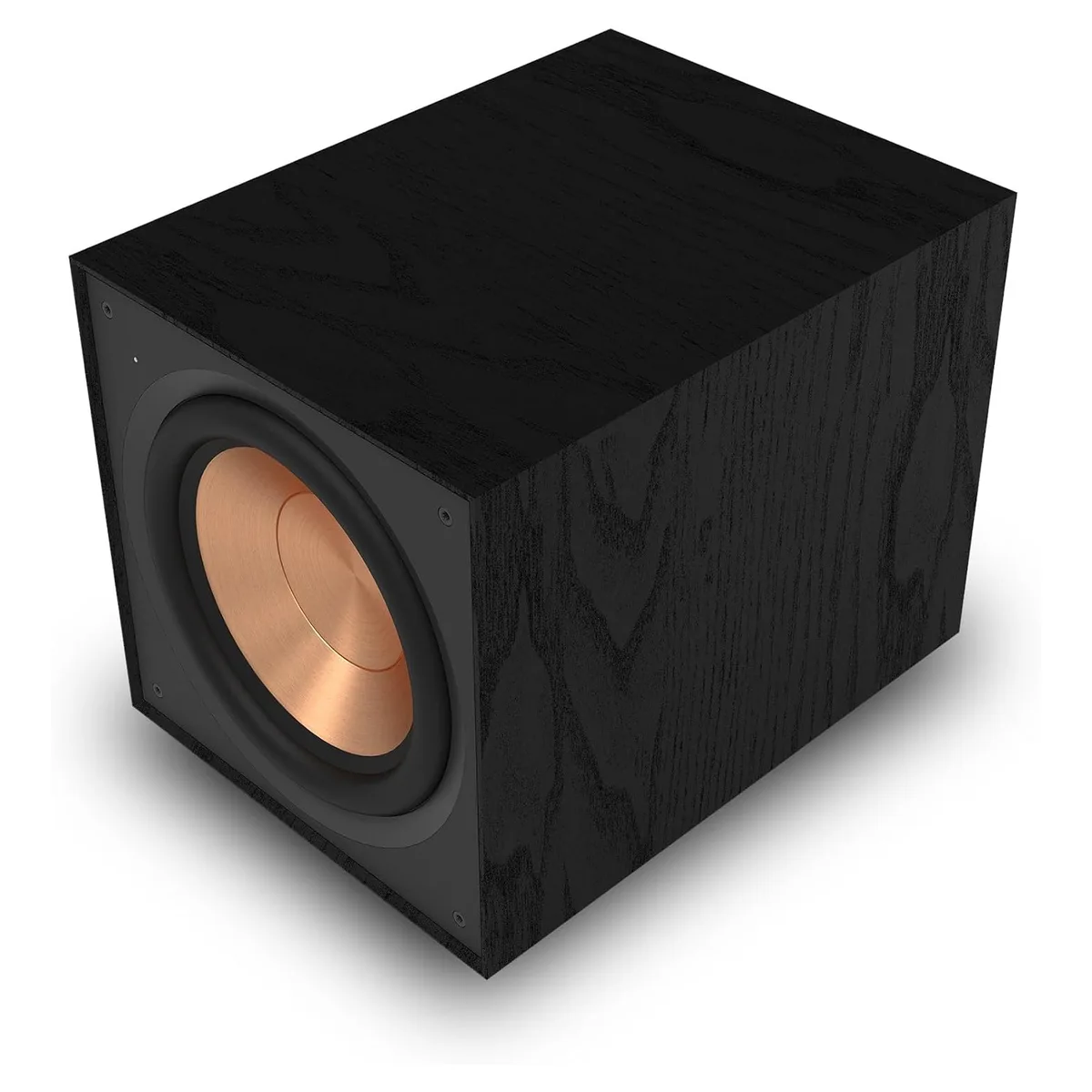
The Klipsch R-121SW is the sub-$500 12-inch ported subwoofer this site did not have, and it is a good one — but Klipsch's own spec sheets say the thing you are paying extra for is a bigger box and a new cone, not a better amplifier. Lay the R-121SW's spec sheet beside the outgoing R-120SW's and the amplifier row is identical on both: All Digital, 200 W continuous, 400 W peak, same four controls. What changed is a cabinet 18 percent larger by external volume and a thermoformed crystalline polymer cone in place of the old injection-moulded graphite one, and Klipsch credits those with 2 dB more maximum output and 1 Hz more extension. The problem is the 1 Hz. The 2018 sheet published 29 Hz to 120 Hz plus or minus 3 dB. The 2021 sheet publishes 28 Hz to 120 Hz with no tolerance at all, and renamed the row from a response figure to a range. A number without a tolerance cannot be compared to a number with one, including the company's own previous number, so the headline improvement is not something a buyer can verify. At $449.99 it is still a lot of ported 12-inch subwoofer, and independent burst testing backs up the mid-bass claim. But the outgoing R-120SW is $265.05 as we write this, and 2 dB is a small thing to pay $185 for. Read the measured numbers before you pay the premium.
✅ Pros
- +A genuine 12-inch ported subwoofer with a 22 Hz measured port tuning for $449.99, which is the cheapest route to real low-end output we currently recommend
- +Independent CEA-2010 testing backs the mid-bass claim: 111.2 dB averaged across 40–80 Hz on Audioholics' 2 m RMS basis, which converts to 120.2 dB at 1 m peak
- +The cabinet is 18 percent larger than the R-120SW's and 3/4-inch MDF with a redesigned brace, which is where the generational improvement actually lives
- +Klipsch publishes real spec sheets for both generations, which is what made this comparison possible at all — more than most brands in this bracket do
- +Five-year coverage on the woofer and cabinet, which is the half of the warranty most brands shorten
- +Simple analogue controls that get out of the way of a receiver's room calibration
- +Healthy Amazon listing: 4.7 stars across 223 ratings with a live new-condition buy box
❌ Cons
- −Klipsch publishes the frequency figure with no tolerance at all — the outgoing R-120SW's sheet said +/- 3 dB and the current one says nothing, so the headline 1 Hz improvement cannot be verified against the company's own previous number
- −"Maximum acoustic output: 118 dB" carries no frequency, distance or distortion limit, and measured data shows the same sub is 12.8 dB quieter at 25 Hz than across 40–80 Hz
- −The amplifier is unchanged from the 2018 model — identical 200 W / 400 W All Digital spec and identical control set — despite marketing that reads like a redesign
- −No DSP, no app, no parametric EQ and no presets, at a price $150 below an SVS that has all four
- −Two-year electronics warranty, and the whole warranty is void the moment the sub changes hands
- −No speaker-level inputs and no line outputs, so no high-level hookup and no daisy-chaining
- −The rear-firing port needs clearance behind it, which rules out the tight-against-a-wall placements people buy a 16-inch-wide box hoping to use
- −Its own predecessor is $265.05 today, which makes the claimed 2 dB cost $184.94
- −Audioholics reports that sub-$500 rivals it has tested match or beat its measured output
Key Specs at a Glance
| Spec | R-121SW |
|---|---|
| Price | $449.99 on Amazon, 2026-10-08 |
| Cabinet | Bass-reflex via rear-firing port |
| Driver | 12-inch high-excursion spun-copper thermoformed crystalline polymer (TCP) |
| Amplifier | All Digital, 200 W continuous / 400 W peak |
| Amplifier controls | Volume, low-pass, 0/180 phase, auto power on |
| Frequency range | 28–120 Hz (Klipsch publishes no tolerance for this figure) |
| Maximum acoustic output | 118 dB (Klipsch publishes no frequency, distance or distortion limit) |
| Port tuning | 22 Hz (Audioholics' measurement, not a Klipsch figure) |
| Enclosure material | MDF, 3/4-inch, with a redesigned brace |
| Inputs | Line level / LFE RCA jacks |
| Outputs | None published |
| DSP, app, parametric EQ | None |
| Dimensions (H × W × D) | 16.6" × 16" × 19.7" (421 × 406 × 500 mm) |
| Weight | 35 lb (16.0 kg) |
| Finish | Black textured wood grain vinyl only |
| Warranty | 2 years electronics, 5 years woofer / cabinet / non-electrical, non-transferable |
Every figure above except the port tuning is Klipsch's own, read out of the R-121SW spec sheet PDF on 2026-10-08.
What Klipsch Changed, and What It Did Not
Klipsch still sells the R-120SW. Its product page is live, it is not on the discontinued list, and it has eleven times as many Amazon ratings as its replacement. But that page now opens with a banner reading "Want the latest? Shop the New Reference R-121SW Subwoofer Now", and the current Reference Subwoofers manual covers only the R-101SW and the R-121SW. The R-120SW is being superseded, not retired, which makes "what actually changed?" a question with money attached to it.
Klipsch publishes a one-page spec sheet for each. Here is every row they share.
| Spec | R-120SW (2018 sheet) | R-121SW (2021 sheet) |
|---|---|---|
| Frequency | 29–120 Hz +/- 3 dB | 28–120 Hz, no tolerance given |
| Maximum acoustic output | 116 dB | 118 dB |
| Amplifier | All Digital | All Digital |
| Amplifier power (cont/peak) | 200 W / 400 W | 200 W / 400 W |
| Amplifier features | Volume, low-pass, 0/180 phase, auto power on | Volume, low-pass, 0/180 phase, auto power on |
| Driver | 12-inch high-excursion spun-copper IMG | 12-inch high-excursion spun-copper TCP |
| Enclosure material | MDF | MDF |
| Height | 16.5" (419 mm) | 16.6" (421 mm) |
| Width | 14" (356 mm) | 16" (406 mm) |
| Depth | 19.2" (488 mm) | 19.7" (500 mm) |
Read the amplifier rows first, because they are the ones that upend the marketing. "All Digital" on both. 200 W continuous and 400 W peak on both. The same four controls, in the same order, in the same words. Klipsch did not give this subwoofer a bigger amplifier. It gave it the same amplifier.
So the claimed 2 dB has to come from the other two rows, and both of them are real changes. The cone material went from injection-moulded graphite to thermoformed crystalline polymer, which is the same material migration Klipsch ran across the rest of the Reference line. And the box got meaningfully bigger — not in the dimension you notice in a photograph, but in the one that matters acoustically:
- External volume goes from 4,435 to 5,232 cubic inches, which is 72.7 to 85.7 litres, an increase of 18 percent
- Footprint goes from 268.8 to 315.2 square inches, an increase of 17 percent
- Almost all of it is width: 14 inches to 16 inches, with height and depth moving by a tenth and a half-inch respectively
In a ported alignment, internal volume and port tuning are most of what sets how low and how loud a box plays. An 18 percent larger cabinet with the same amplifier plausibly buys you a couple of decibels. What we cannot tell you is how the 2 dB splits between the cone and the cabinet, because Klipsch does not publish anything that would let anyone work it out, and we have not measured both subwoofers ourselves. The honest statement is the narrow one: the amplifier is not the reason, and Klipsch's own documents are what rule it out.
One practical consequence of the extra two inches is worth flagging before you order. If you have been planning around an R-120SW-sized gap in a cabinet or under a console, measure again. Two inches of width is the difference between fits and does not fit more often than people expect.
The Tolerance That Disappeared
This is the part of the spec sheet that should change how you read the rest of it.
The 2018 R-120SW sheet publishes the frequency figure as 29 Hz to 120 Hz, plus or minus 3 dB. The 2021 R-121SW sheet publishes 28 Hz to 120 Hz — and that is the whole entry. There is no plus or minus anything. The row label also changed, from a response figure to "FREQUENCY RANGE".
A frequency limit without a tolerance is not a specification, it is a number. Depending on whether a manufacturer means −3 dB, ±3 dB, −6 dB or −10 dB, the same subwoofer can honestly be advertised across a spread of roughly an octave. This is a standing rule for us: we will not put a frequency limit in a comparison table unless we can say which tolerance it was measured to. It is why the row above reads "28–120 Hz, no tolerance given" rather than "28 Hz".
The specific consequence here is that the headline generational improvement cannot be checked. You cannot say the R-121SW reaches 1 Hz lower than the R-120SW, because the old figure is a ±3 dB figure and the new one is unqualified. They are not measured on stated-comparable terms, so the difference between them is not a measurement of anything.
And it is worth noticing how small a difference it would be even if the two numbers were comparable. 29 Hz to 28 Hz is 0.05 of an octave — about a twentieth of a step. Nobody has ever heard a twentieth of an octave. If you find yourself weighing this subwoofer against another on the strength of a 1 Hz difference in a rated extension figure, the specification has successfully distracted you.
We will also note, because it is the sort of thing that gets missed, that nearly every third-party page we found while researching this review quotes the R-121SW's figure as "28 Hz ±3 dB". Klipsch's current spec sheet does not say that. Somewhere between the 2018 document and the retail listings, a tolerance that the manufacturer deliberately stopped printing has been put back on its behalf.
What the Measured Numbers Say
Klipsch's "maximum acoustic output: 118 dB" has the same problem, in a larger size. There is no frequency attached to it, no measurement distance, and no distortion limit. A subwoofer's maximum output varies enormously with frequency — that is essentially the whole engineering problem — so a single number with no frequency is not a claim anyone can falsify.
The useful figures come from outside the company. Audioholics ran CEA-2010 burst testing on the R-121SW and published three results, along with the convention it uses: the numbers are referenced to 2-metre RMS, which is 9 dB below the 1-metre peak basis CEA-2010 normally reports. Converting them to that 1-metre peak basis is our arithmetic on their stated convention, so here are both columns:
| Measurement | As Audioholics publishes it (2 m RMS) | Converted to 1 m peak (our arithmetic) |
|---|---|---|
| CEA-2010 at 25 Hz | 98.4 dB | 107.4 dB |
| CEA-2010 at 31.5 Hz | 102.3 dB | 111.3 dB |
| CEA-2010-A averaged 40–80 Hz | 111.2 dB | 120.2 dB |
Now put Klipsch's 118 dB next to that column and the picture resolves into something more interesting than a caught exaggeration.
Across 40 to 80 Hz, the measured 1-metre peak average is 120.2 dB — above the number on the spec sheet. Klipsch's 118 dB is not a fiction. It is simply not a number about deep bass. At 25 Hz, where a subwoofer is doing the job you bought it for, the same sub measures 107.4 dB on the same basis. That is 12.8 dB below the mid-bass figure, from one box, in one test session.
This is the single most useful thing we can tell you about reading subwoofer specifications in this price class. A maximum-output number with no frequency attached will be a mid-bass number, because that is where every subwoofer is loudest, and the gap between that and what the same sub does an octave and a half lower is routinely more than 10 dB. When Klipsch says the R-121SW gained 2 dB on the R-120SW, the 2 dB is presumably on the same unstated basis — which means it is very likely a mid-bass improvement, and it tells you nothing about the bottom octave.
Audioholics also measured the port tuning at 22 Hz, which is low for the money and is the most genuinely encouraging number in this review. A 22 Hz tuning is what lets a $449.99 ported box do anything at all below 30 Hz. It also means the cliff below tuning is steep, in the way all ported subwoofers are steep — if you want to understand the trade you are making, we have written it up at length in sealed vs ported subwoofers.
One caution Audioholics raises that we are going to repeat rather than bury: it notes that other subwoofers it has tested under $500, specifically the RSL Speedwoofer 10S MKII and the BIC Acoustech PL-300, match or exceed the R-121SW's measured output. We have not tested those and they are not on this site, so we are passing along someone else's finding rather than confirming it. But it is the right context for a 4-out-of-5 rating: this is a good subwoofer in a competitive bracket, not an uncontested one.
The $185 Question
Here is the decision almost everyone reading this review is actually making, with the prices we verified on 2026-10-08.
| R-120SW (outgoing) | R-121SW (current) | |
|---|---|---|
| Amazon price, 2026-10-08 | $265.05 | $449.99 |
| Amazon rating | 4.8 stars, 2,851 ratings | 4.7 stars, 223 ratings |
| Amplifier | 200 W / 400 W, All Digital | 200 W / 400 W, All Digital |
| Driver | 12-inch spun-copper IMG | 12-inch spun-copper TCP |
| Maximum acoustic output (Klipsch) | 116 dB | 118 dB |
| External volume | 72.7 L | 85.7 L |
| Width | 14" | 16" |
The R-121SW costs $184.94 more, a 70 percent premium, and what Klipsch claims in exchange is 2 dB. Run that the way we ran the SVS ladder in our PB-1000 Pro review and it comes to 1.08 dB per $100.
That number deserves a fence around it. It is computed from Klipsch's own figures on Klipsch's own unstated basis, so it is valid for comparing these two Klipsch subwoofers to each other and for nothing else. We are not going to set it beside the SVS figures from that review, because SVS's output numbers are measured on a different undisclosed basis and putting the two in one sentence would be arithmetic dressed up as a comparison.
Within that fence, the answer is reasonably clear. If your room is small or mid-sized and you are buying your first subwoofer, the R-120SW at $265.05 is the better purchase today, and it is the one we would buy. You give up a claimed 2 dB on an unstated basis and a twentieth of an octave of rated extension, and you keep $185 — which, if you want to spend it on bass, goes considerably further toward a second subwoofer than toward a slightly larger first one. Our piece on when a second subwoofer is actually worth it makes that case properly, and two well-placed R-120SWs for $530 is a genuinely strong 2026 answer to a difficult room.
Buy the R-121SW instead if your room is large enough that you expect to run a single sub near its limits, if you want the current model with the full warranty clock and the current manual, or — honestly — if the R-120SW's price has moved by the time you read this. A $185 gap is the entire argument here, and clearance pricing on an outgoing model is exactly the kind of thing that changes without notice. Check both before you buy.
Setup, Controls, and the Rear Port
The R-121SW is an analogue subwoofer and makes no apology for it. You get a volume knob, a low-pass filter, a 0/180 phase switch and an auto power-on setting. There is no app, no DSP, no parametric EQ, no presets and no room correction. At $449.99 that is a real gap against the SVS SB-1000 Pro at $599, which gives you a Bluetooth app, three bands of parametric EQ, continuously variable phase and three storable presets for $150 more.
In practice it matters less than the feature list suggests, provided you let your receiver do the work. Set the sub's low-pass filter fully clockwise so it stops filtering, set phase to 0, and let the receiver's calibration take over — our how-tos on running Audyssey room calibration, setting your speaker crossover frequency and setting levels and distances with an SPL meter cover the order of operations. What you lose without an app is the ability to fix the one peak or null the calibration missed; if you own a measurement mic and want that control anyway, calibrating a subwoofer with miniDSP and REW is the external route.
Two connection notes before you order a cable. Klipsch lists the inputs as line level / LFE RCA jacks and publishes no outputs at all, so there is no pass-through and no daisy-chaining a second sub from this one. And there are no speaker-level inputs — which is worth saying plainly, because Klipsch's own documentation disagrees with itself on the point. The English connections section of the current Reference Subwoofers manual describes only a LINE IN connection, but the French, Spanish and German sections of the same PDF each additionally describe connecting the sub to the receiver's speaker terminals via a high-level connection. The spec sheet sides with the English text: RCA only. If you are coming from an older subwoofer and were planning to drive this one from speaker outputs, you cannot.
The port fires out of the back, and this is the placement constraint that will actually affect how it sounds in your room. A rear-firing port wants breathing room behind the cabinet; shove it hard against a wall and you will get port compression and a boomy, one-note character that people usually blame on the subwoofer rather than on the four inches of air it did not have. Give it some clearance, and treat placement as the first thing you optimise rather than the last — where to place a subwoofer and positioning a subwoofer for best bass response are both worth reading before you commit to a corner, and placement is worth more decibels in a real room than the 2 dB this review has spent its time on. Set the crossover deliberately too: why 80 Hz is the standard crossover explains when to move off the default.
The warranty is the last thing worth knowing and it is not one of the product's strengths. Klipsch covers its non-Reference-Premiere subwoofers for two years on electronics and five years on the woofer, cabinet and non-electrical parts. The two-year half is the half that covers the amplifier, which is the part of a powered subwoofer that actually fails. Klipsch's warranty also "terminates if the original retail purchaser sells or otherwise transfers this product", so it is worth nothing on the used market and nothing to whoever you sell it to. SVS, for comparison, covers the SB-1000 Pro and PB-1000 Pro for five years unconditionally and adds a 45-day in-home trial.
Pros
- A genuine 12-inch ported subwoofer with a 22 Hz measured port tuning for $449.99, which is the cheapest route to real low-end output we currently recommend
- Independent CEA-2010 testing backs the mid-bass claim: 111.2 dB averaged across 40–80 Hz on Audioholics' 2 m RMS basis, which converts to 120.2 dB at 1 m peak
- The cabinet is 18 percent larger than the R-120SW's and 3/4-inch MDF with a redesigned brace, which is where the generational improvement actually lives
- Klipsch publishes real spec sheets for both generations, which is what made this comparison possible at all — more than most brands in this bracket do
- Five-year coverage on the woofer and cabinet, which is the half of the warranty most brands shorten
- Simple analogue controls that get out of the way of a receiver's room calibration
- Healthy Amazon listing: 4.7 stars across 223 ratings with a live new-condition buy box
Cons
- Klipsch publishes the frequency figure with no tolerance at all — the outgoing R-120SW's sheet said +/- 3 dB and the current one says nothing, so the headline 1 Hz improvement cannot be verified against the company's own previous number
- "Maximum acoustic output: 118 dB" carries no frequency, distance or distortion limit, and measured data shows the same sub is 12.8 dB quieter at 25 Hz than across 40–80 Hz
- The amplifier is unchanged from the 2018 model — identical 200 W / 400 W All Digital spec and identical control set — despite marketing that reads like a redesign
- No DSP, no app, no parametric EQ and no presets, at a price $150 below an SVS that has all four
- Two-year electronics warranty, and the whole warranty is void the moment the sub changes hands
- No speaker-level inputs and no line outputs, so no high-level hookup and no daisy-chaining
- The rear-firing port needs clearance behind it, which rules out the tight-against-a-wall placements people buy a 16-inch-wide box hoping to use
- Its own predecessor is $265.05 today, which makes the claimed 2 dB cost $184.94
- Audioholics reports that sub-$500 rivals it has tested match or beat its measured output
How It Compares
| R-121SW | SVS SB-1000 Pro | SVS PB-1000 Pro | SVS 3000 Micro | |
|---|---|---|---|---|
| Price | $449.99 | $599.99 | $849.99 | $999.99 |
| Cabinet | Ported, rear-firing | Sealed | Ported, dual front | Sealed |
| Driver | 1 × 12" | 1 × 12" | 1 × 12" | 2 × 9" dual-opposing |
| Amplifier | 200 W cont / 400 W peak | 325 W RMS | 325 W RMS | 1,200 W RMS |
| Rated extension | 28 Hz, no tolerance published | 20 Hz at ±3 dB | 17 Hz at ±3 dB | 20 Hz at ±3 dB |
| Max output | Not comparable across brands | Not comparable across brands | Not comparable across brands | Not comparable across brands |
| Parametric EQ | None | 3-band | 3-band | 6-band |
| App control | None | Bluetooth | Bluetooth | WiFi + Bluetooth |
| Inputs | RCA line/LFE only | RCA, speaker level | RCA, speaker level | RCA, XLR |
| Size (H × W × D) | 16.6" × 16" × 19.7" | 13.5" × 13" × 14.76" | 18.9" × 15" × 20" | 10.9" × 11.8" × 10.8" |
| Weight | 35 lb | 26 lb | 42.5 lb | 22.5 lb |
| Warranty | 2 yr electronics, 5 yr driver/cabinet | 5 yr unconditional | 5 yr unconditional | 5 yr unconditional |
The max-output row is blank on purpose. Klipsch publishes a figure with no frequency, distance or distortion limit; SVS publishes a figure at 30 Hz with no distance or standard. Neither company says enough for the two to be set against each other, and printing them side by side would imply a comparison that the published data does not support. The extension row is labelled rather than bare for the same reason — three of those four numbers are ±3 dB figures and one is not a tolerance-qualified figure at all.
Read across and the shape of the market is clear enough. The R-121SW is the cheapest way onto this table by $150, and it is a ported 12-inch where the next cheapest is sealed. What the extra $150 buys at the SB-1000 Pro is not more output — it is a specification you can check, app DSP, parametric EQ, speaker-level inputs and a warranty three years longer. Whether that is worth $150 depends entirely on whether you are the sort of person who will ever open the app. Plenty of people genuinely are not, and for them the Klipsch is the better-value purchase.
As a system partner, the R-121SW is the natural subwoofer under Klipsch's own Reference and Reference Premiere speakers, including RP-600M II bookshelves, RP-6000F II towers and an RP-504C II centre — a match of voicing as much as anything else. It works just as well under Polk Reserve R200 bookshelves or ELAC Debut 3.0 DF63 floorstanders, both of which want help below 50 Hz regardless of what their own extension specs claim. On the receiver side it behaves like any RCA-input subwoofer with a Denon AVR-S770H, a Denon AVR-X3800H or an Onkyo TX-NR6100, and if you are assembling the system from nothing our walkthrough on setting up a 5.1 surround system covers the order to do it in.
Who Should Buy It
Buy the R-121SW if you want a ported 12-inch subwoofer for under $500, you have a mid-sized to large room, you have four inches of clearance behind wherever it is going, and you are content to let a receiver's room calibration do the tuning. It is the most output per dollar on this site, and the 22 Hz port tuning means it genuinely reaches into the bottom octave rather than just claiming to.
Buy the outgoing R-120SW instead — at $265.05 as of 2026-10-08 — if your room is small or mid-sized, or if you would rather put the $185 toward a second subwoofer later. Same amplifier, two inches narrower, a claimed 2 dB quieter on a basis nobody has disclosed. For most rooms that is the better buy today, and we would not feel clever talking anyone out of it.
Buy the SVS SB-1000 Pro at $599.99 if you listen to more music than movies, if you want a specification published with its tolerance attached, or if app-based parametric EQ is something you will actually use. Step up to the PB-1000 Pro at $849.99 if movies are the point and you have the floor space, and to the 3000 Micro R|Evolution if space is the binding constraint and budget is not.
Do not buy any of them before you have read where to place a subwoofer. In a normal room, placement is worth more than the entire difference between the two Klipsch subwoofers in this review.
The Bottom Line
The R-121SW is a good subwoofer sold with a weaker set of documents than the product deserves. The hardware story is straightforward and fine: same amplifier as the model it replaces, a new cone, a cabinet 18 percent bigger, and a 22 Hz port tuning that lets a $449.99 box do real work in the bottom octave. Independent burst testing says the mid-bass claim is sound.
What keeps it at four stars is everything around the hardware. Klipsch stopped printing the tolerance on its frequency figure between one generation and the next, which means the improvement it is advertising cannot be checked against its own previous number. Its maximum-output figure has no frequency attached, and the measured data shows why that matters: the same subwoofer is 12.8 dB quieter at 25 Hz than it is across 40 to 80 Hz. There is no DSP or app at a price where the obvious rival has both, the warranty on the amplifier runs out at two years and dies entirely if you sell it, and the company's own outgoing model is sitting at $265.05 offering the same amplifier for $185 less.
None of that makes this a bad purchase. It makes it a purchase you should go into with the real numbers rather than the printed ones — which, to Klipsch's credit, is only possible because it publishes spec sheets for both generations and lets anyone lay them side by side.
Our Verdict
The Klipsch R-121SW is the sub-$500 12-inch ported subwoofer this site did not have, and it is a good one — but Klipsch's own spec sheets say the thing you are paying extra for is a bigger box and a new cone, not a better amplifier. Lay the R-121SW's spec sheet beside the outgoing R-120SW's and the amplifier row is identical on both: All Digital, 200 W continuous, 400 W peak, same four controls. What changed is a cabinet 18 percent larger by external volume and a thermoformed crystalline polymer cone in place of the old injection-moulded graphite one, and Klipsch credits those with 2 dB more maximum output and 1 Hz more extension. The problem is the 1 Hz. The 2018 sheet published 29 Hz to 120 Hz plus or minus 3 dB. The 2021 sheet publishes 28 Hz to 120 Hz with no tolerance at all, and renamed the row from a response figure to a range. A number without a tolerance cannot be compared to a number with one, including the company's own previous number, so the headline improvement is not something a buyer can verify. At $449.99 it is still a lot of ported 12-inch subwoofer, and independent burst testing backs up the mid-bass claim. But the outgoing R-120SW is $265.05 as we write this, and 2 dB is a small thing to pay $185 for. Read the measured numbers before you pay the premium.
Ready to buy the Klipsch R-121SW?
Buy on Amazon →Affiliate link — we may earn a commission at no extra cost to you.