SVS 3000 Micro R|Evolution Review: The Compact Sub That Stopped Compromising
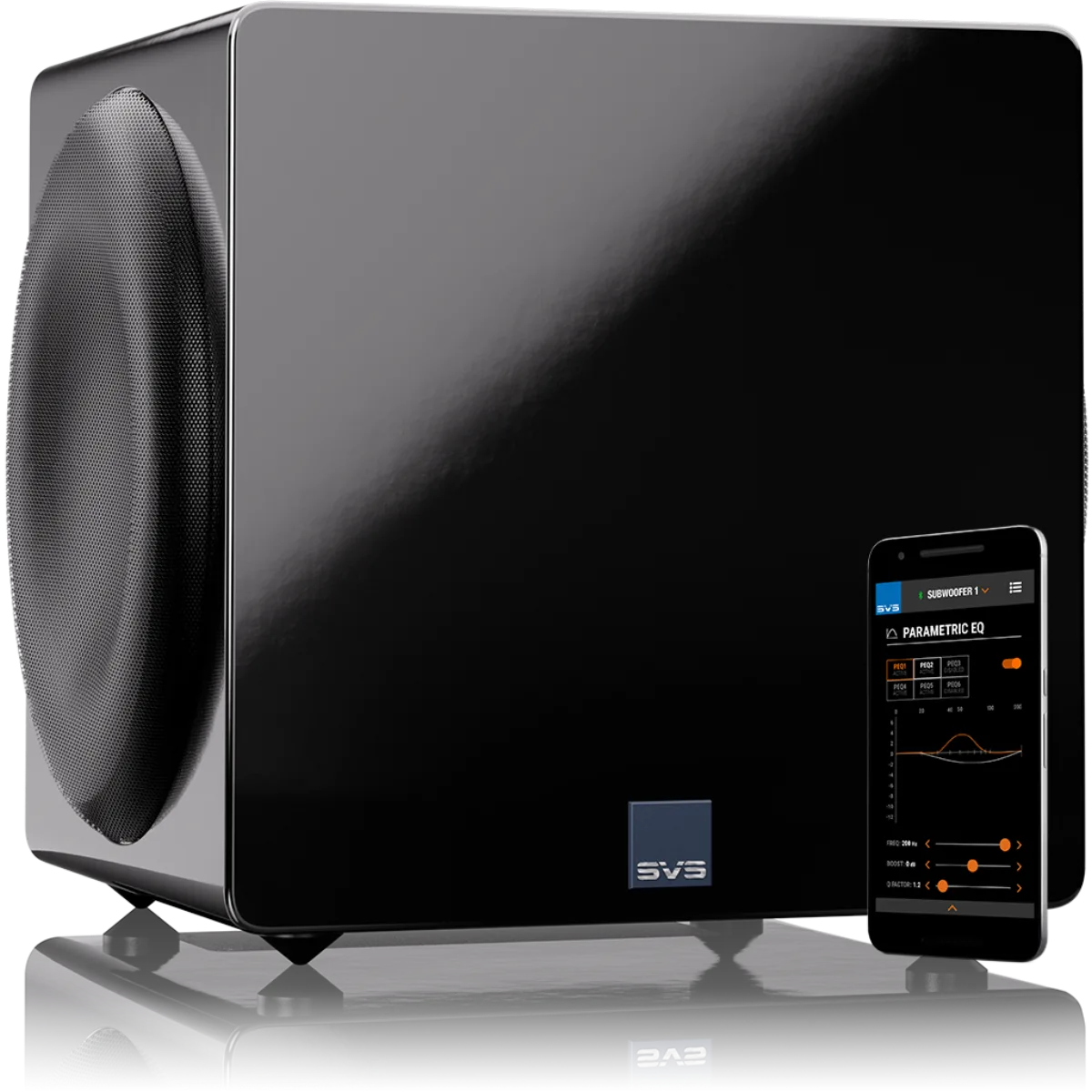
The SVS 3000 Micro R|Evolution packs dual-opposing 9-inch drivers, a 1,200W RMS MOSFET amp, XLR inputs, and full app DSP into an 11-inch sealed cube. Deep, tight bass from a sub that hides anywhere — for $999.99.
✅ Pros
- +Dual-opposing, force-balanced 9" drivers — big output, near-zero cabinet vibration
- +1,200W RMS / 4,000W+ peak MOSFET amp with real headroom at volume
- +20 Hz (±3 dB) with usable extension to 17 Hz from an 11-inch cube
- +Balanced XLR inputs added alongside RCA
- +WiFi + Bluetooth app with 6-band parametric EQ and room gain compensation
- +Fits where full-size subs can't — shelf, cabinet, behind a couch
- +Furniture-grade Piano Gloss Black and White finishes
- +5-year unconditional warranty and 45-day in-home trial
❌ Cons
- −Expensive — $999.99, a clear premium for the compact design
- −Not sized for large (4,000+ cu ft) or dedicated theater rooms
- −Side-firing drivers need clearance on both faces
- −Gloss-only finishes show fingerprints
The SVS 3000 Micro R|Evolution is the compact subwoofer that finally stopped compromising. SVS took the original 3000 Micro's clever dual-opposing, force-balanced layout and rebuilt it around larger dual 9-inch drivers, a 1,200W RMS MOSFET amplifier with 4,000W+ of peak headroom, and a faster 295 MHz DSP engine. The result is clean, room-correctable output to 20 Hz — with usable extension to 17 Hz — from a sealed cube that measures under a foot on every side and can sit on a shelf, behind a couch, or beside a credenza without announcing itself. At $999.99 it is not cheap, but nothing else this small hits this hard this cleanly, and the addition of balanced XLR inputs and a 6-band parametric EQ makes it a genuine tool, not a lifestyle toy.
The SVS 3000 Micro R|Evolution is available on Amazon at a $999.99 MSRP.
Key Specs at a Glance
The 3000 Micro R|Evolution uses dual-opposing, force-balanced 9-inch active drivers in a sealed cabinet, driven by a 1,200W RMS / 4,000W+ peak MOSFET amplifier. Frequency response is 20 Hz – 230 Hz (±3 dB) with usable low-frequency extension to 17 Hz and a rated max output of 108.2 dB at 30 Hz. DSP runs on a 295 MHz Analog Devices audio processor, controlled through the SVS Subwoofer Control app over WiFi or Bluetooth (Android/iOS), which exposes a 6-band parametric EQ plus room gain compensation. Inputs are unbalanced RCA, balanced XLR, IR, and USB (for the optional wireless transmitter), with an RCA output; phase is continuously variable and polarity switchable 0° / 180°. It measures 10.9" × 11.8" × 10.8" (H×W×D), weighs 22.5 lb, and ships in Piano Gloss Black or Piano Gloss White. SVS backs it with a 5-year unconditional warranty (the SVS Bill of Rights) and a 45-day risk-free in-home trial. MSRP is $999.99.
What Changed From the Original 3000 Micro
The original 3000 Micro was a small miracle: two 8-inch drivers mounted back-to-back so their reaction forces cancel, letting an ultra-compact sealed box play deep without walking across the floor. The R|Evolution keeps that idea and upgrades nearly every part around it.
Bigger drivers, in the same footprint. The 8-inch drivers become 9-inch drivers, still dual-opposing and force-balanced, so the cabinet stays a compact cube while moving noticeably more air. That's the single biggest reason the R|Evolution digs lower and plays louder than the sub it replaces.
More than double the amplifier. The original's 800W RMS Sledge amp gives way to a 1,200W RMS MOSFET design with 4,000W+ of peak output. That headroom is what keeps deep transients — the sub-bass hit under an explosion, the pedal note under an organ passage — clean instead of compressed when you push the volume.
A faster DSP and a deeper EQ. SVS moved to a 295 MHz Analog Devices DSP and expanded the parametric EQ from three bands to six. In practice that means you can chase down more than one room-mode problem at once — say, a 32 Hz null and a 58 Hz peak — without robbing Peter to pay Paul.
Balanced XLR inputs and WiFi. This is the upgrade enthusiasts asked for. The R|Evolution adds balanced XLR inputs alongside the RCA pair, and the SVS app now connects over WiFi as well as Bluetooth. Both were absent on the original, and both matter for cleaner long cable runs and more reliable app control.
If you own the original 3000 Micro and it's already integrated well in your room, this is not an urgent upgrade. If you're buying new and the budget stretches, the R|Evolution is the better sub in every measurable way.
What Makes the R|Evolution Stand Out
Force-balanced design means it stays put. Two drivers firing in opposite directions cancel each other's reaction forces, so the cabinet barely vibrates even at reference output. That's why a 22.5 lb, sub-foot cube can sit on a media console or a bookshelf without buzzing the furniture or walking during a loud scene — something a conventional single-driver sub this size simply cannot do.
Sealed accuracy, now with real depth. Sealed subs trade a little maximum extension for a cleaner, faster, better-controlled response — the alignment audio reviewers consistently prefer for two-channel music and for blending with bookshelves and towers. The R|Evolution's larger drivers and bigger amp close most of the depth gap: 20 Hz at ±3 dB with usable output to 17 Hz is genuine subterranean reach for a box this small.
Full app DSP that's actually a tool. The SVS Subwoofer Control app exposes volume, low-pass filter, continuously variable phase, polarity, room gain compensation, power management, and a 6-band parametric EQ with adjustable Q. Connect over WiFi or Bluetooth. If you own a measurement mic and REW, this is enough surgical control to flatten a difficult room. If you don't, the defaults get most rooms most of the way there.
It goes where a full-size sub can't. The whole point of the Micro line is placement freedom. At roughly 11 inches on every side, the R|Evolution fits on a shelf, inside a cabinet, behind a sofa, or tucked beside an equipment rack — locations that are off-limits to an 18-inch ported tower. For apartments, mixed-use living rooms, and rooms where a big black box is a non-starter with the household, that flexibility is the entire value proposition.
Sound Quality
Extension is honest, and it's deeper than the box suggests. SVS rates the R|Evolution at 20 Hz (±3 dB) with usable extension to 17 Hz, and unlike a lot of subwoofer marketing, the number holds up. Test tones at 25 Hz and 20 Hz are clearly felt without audible distortion at moderate-to-high volume, and the sub hints convincingly at the 17-18 Hz infrasonic range where most compact sealed subs simply give up. SVS quotes a max output of 108.2 dB at 30 Hz — plenty for a small-to-medium room.
Tight, fast, and musical. The sealed alignment plus the vibration-free cabinet is what you hear first. Bass starts and stops with the source: kick drums hit and release cleanly, bass guitar notes are articulated rather than smeared into one continuous rumble, and film explosions have shape and decay instead of a single sustained boom. This is the character that lets a home theater sub double as a serious music sub.
Headroom you can hear. The jump from 800W to 1,200W RMS (and 4,000W+ peak) is not a spec-sheet flex. When a scene layers a deep LFE hit on top of an already-loud mix, the R|Evolution keeps the low end composed where the original 3000 Micro would start to strain. That composure at volume is the clearest sonic dividend of the new amplifier.
Room correction is where the 6-band EQ earns its keep. Small rooms have big bass problems — modal peaks and nulls that no amount of placement fully fixes. The expanded parametric EQ lets you notch more than one problem frequency at a time, and the room gain compensation tames the boundary reinforcement you get when the sub sits near a wall or in a cabinet (which, given its size, it often will). Feed it a flat baseline and let Audyssey, Dirac, or YPAO handle the crossover, then use the SVS app for the surgical fixes calibration missed.
It pairs cleanly with an AVR's calibration. Audyssey MultEQ XT32, Dirac Live, and YPAO all see the R|Evolution as a well-behaved sub. Set the app to a flat starting point (low-pass wide open for LFE, room gain off, EQ flat), run your receiver's auto-calibration, then layer room-specific tweaks on top. A capable AVR like the Denon AVR-X3800H with dual independent sub outputs makes this especially easy.
Connectivity and Setup
Inputs. Both unbalanced RCA (10 kohm) and balanced XLR are provided — the XLR pair is the headline addition over the original, and it's the right call for long cable runs where you want to reject hum. There's an RCA output for chaining or feeding a second sub, plus IR and a USB port that accepts SVS's optional SoundPath tri-band wireless transmitter if you'd rather not run a cable to the sub at all.
App control over WiFi or Bluetooth. Pair once and the sub remembers it. WiFi connectivity means the app stays reachable without standing next to the sub — a real quality-of-life upgrade over the Bluetooth-only original. Audio remains wired (or optional wireless via the SoundPath adapter); the app connection is for control only.
Placement. This is the sub's whole reason to exist. At 10.9" × 11.8" × 10.8" and 22.5 lb, it fits on a shelf, in a cabinet, behind a couch, or beside a rack. The force-balanced drivers mean you don't have to worry about the cabinet buzzing whatever surface it sits on. Because the drivers are side-firing rather than front-firing, keep a few inches of clearance on both driver faces.
Finishes. Piano Gloss Black and Piano Gloss White. Both are furniture-grade — appropriate, since a sub this small often sits in view rather than hidden.
Setup time. Run one cable from your AVR's sub-out (XLR if your receiver has a balanced pre-out, otherwise RCA), connect the app over WiFi, run your receiver's room calibration, then fine-tune with the parametric EQ. About 20-30 minutes if you know your AVR.
Limitations Worth Knowing
It's a $999.99 subwoofer. The R|Evolution costs $400 more than an SVS SB-1000 Pro and is priced against ported subs that move far more air. You are paying a real premium for the compact, vibration-free, place-anywhere design. If size isn't a constraint in your room, a larger sub gives you more output per dollar.
It won't pressurize a large or dedicated theater room. Dual 9-inch sealed drivers are tuned for small-to-medium spaces — roughly up to 3,000 cu ft. For a 4,000+ cu ft room or a dedicated theater where you want chest-thumping, wall-flexing LFE, a ported sub like the SVS PB-1000 Pro or a 13-inch-plus design will do it better. Two 3000 Micro R|Evolutions in a large room is an option SVS supports and one that smooths in-room response, but it's also a $2,000 solution.
Side-firing drivers need clearance. The dual-opposing layout is what keeps the cabinet still, but it means you can't push both driver faces flush against furniture. Plan a few inches of breathing room on each side.
Gloss-only finishes show fingerprints. Both finishes are piano gloss. They look superb and they show every smudge — worth knowing for a sub that will likely sit out in the open rather than hidden away.
Who Should Buy the SVS 3000 Micro R|Evolution
Buy it if you want serious, room-correctable bass but a full-size subwoofer is a non-starter — apartment, mixed-use living room, or a household that won't tolerate a big black box; you listen to music as seriously as you watch movies and want the tight, fast character of a sealed sub; you want balanced XLR inputs and a deep parametric EQ in a compact sub, a combination almost nothing else this size offers; or you have a Denon, Marantz, Onkyo, or Yamaha receiver with Audyssey, Dirac, or YPAO and want a sub that integrates cleanly with auto-calibration.
Consider the SVS SB-1000 Pro instead if you have room for a slightly larger sealed cube and want to save $400 — the SB-1000 Pro is the value benchmark and gives up surprisingly little. Consider the SVS PB-1000 Pro or a larger sub instead if your room is 3,000+ cu ft or a dedicated theater and maximum output matters more than compact placement. Consider the Sonos Sub 4 instead if your system is built around Sonos and you value wireless ecosystem integration over the R|Evolution's DSP depth and wired flexibility.
SVS 3000 Micro R|Evolution vs. SVS SB-1000 Pro vs. Sonos Sub 4
All three are sealed subwoofers, but they solve different problems. The 3000 Micro R|Evolution uses dual-opposing 9-inch drivers and a 1,200W RMS / 4,000W+ peak amp, rated 20-230 Hz (±3 dB), with the SVS app (6-band PEQ, WiFi + Bluetooth), RCA and XLR inputs plus optional wireless, in a 10.9" × 11.8" × 10.8" cabinet at $999.99. The SVS SB-1000 Pro is the value pick — a single 12-inch driver and a 325W / 820W peak amp, rated 20-270 Hz (±3 dB), with the SVS app (3-band PEQ, Bluetooth) and RCA + LFE inputs, in a larger 13.5" × 13" × 14.76" cabinet for $599.99. The Sonos Sub 4 uses dual force-canceling drivers rated down to ~25 Hz, tuned through the Sonos app, and connects wirelessly to Sonos gear only, in a 15.3" × 12" × 6.2" cabinet at $799.00.
The SB-1000 Pro is the pick if you can fit the slightly larger cabinet and want more bass per dollar. The Sonos Sub 4 is the choice for a Sonos-first system where wireless ecosystem integration beats wired flexibility and DSP depth. The SVS 3000 Micro R|Evolution is the one to buy when the sub has to be small, has to be still, and still has to hit hard.
Bottom Line
The SVS 3000 Micro R|Evolution is the compact subwoofer for people who refused to accept the usual compact-sub compromises. Dual-opposing 9-inch drivers and a 1,200W MOSFET amp deliver clean output to 20 Hz — with a hint of the octave below — from a sealed cube that hides on a shelf and never buzzes the furniture. The added balanced XLR inputs, WiFi app control, and 6-band parametric EQ turn it from a clever lifestyle sub into a genuine integration tool.
It costs $999.99, and it's worth it in exactly one scenario: when placement freedom is non-negotiable. If you have the space for a bigger box, the SB-1000 Pro gives you more bass per dollar. But if the sub has to disappear into a real living room and still anchor a 5.1 or Atmos system with tight, deep, correctable bass, nothing else this small does it this well.
The SVS 3000 Micro R|Evolution is available on Amazon at a $999.99 MSRP.
Related Reading
Pair it with a capable AVR like the Denon AVR-X3800H, or floorstanders like the Klipsch RP-6000F II. If the budget is tighter, the SVS SB-1000 Pro is the value benchmark; for a Sonos-first system, see the Sonos Sub 4 review.
Our Verdict
The SVS 3000 Micro R|Evolution packs dual-opposing 9-inch drivers, a 1,200W RMS MOSFET amp, XLR inputs, and full app DSP into an 11-inch sealed cube. Deep, tight bass from a sub that hides anywhere — for $999.99.
Ready to buy the SVS 3000 Micro R|Evolution?
Buy on Amazon →Affiliate link — we may earn a commission at no extra cost to you.