How to Position a Subwoofer for Best Bass Response
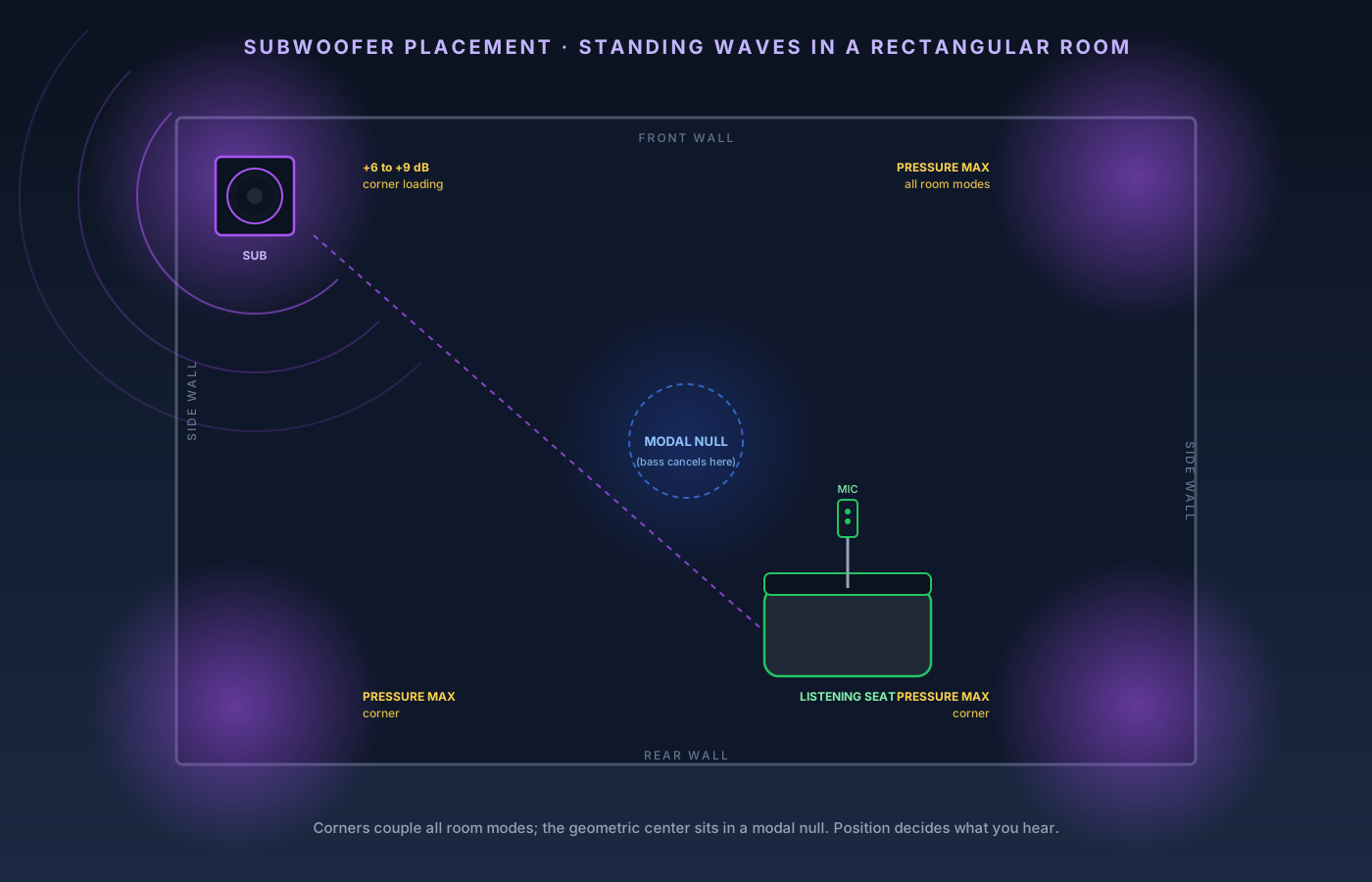
A subwoofer's biggest enemy is the room it lives in, not the price tag on the box. Room modes — standing waves between pairs of parallel surfaces — create pressure peaks where bass piles up and nulls where bass cancels itself out. Swing the same sub between a great position and a bad one in the same room and the in-room frequency response can vary by 20 dB or more at the listening seat. A $1,500 sub in the wrong position sounds worse than a $500 SVS SB-1000 Pro in the right one. This guide walks through placement decisions that matter, in order: corner loading vs. wall midpoints, the subwoofer crawl, the geometric trap of the room center, crossover and phase setup, dual-sub strategies, and verification with reference content.
10-Step Overview
- 1
Understand why placement matters more than the sub itself
Bass wavelengths are long — a 40 Hz tone is 28 feet, longer than most rooms. When a wavelength matches a room dimension, the wave reflects off the far wall and either reinforces itself in phase (a pressure peak, or 'mode') or cancels (a null). Every rectangular room has three sets of axial modes — front-to-back, side-to-side, floor-to-ceiling — plus higher-order tangential and oblique modes, producing a 3D pressure map below roughly 200 Hz. Placement decides which modes the sub excites. You cannot EQ a deep null away — adding gain at a frequency the room is canceling only heats the voice coil. Physical position first, EQ second.
- 2
Start with corner loading as a baseline
Place the sub in a front-wall corner first. Corner placement produces maximum output (boundary reinforcement of +6 to +9 dB) and excites every room mode — the loudest and most coupled position, but also the most likely to overemphasize whatever resonance your room has at 50 or 70 Hz. If the corner sounds reasonably even, you may be done. In most rooms you'll hear a boom or a one-note quality and want to refine. Either way, the corner is the right baseline before the crawl.
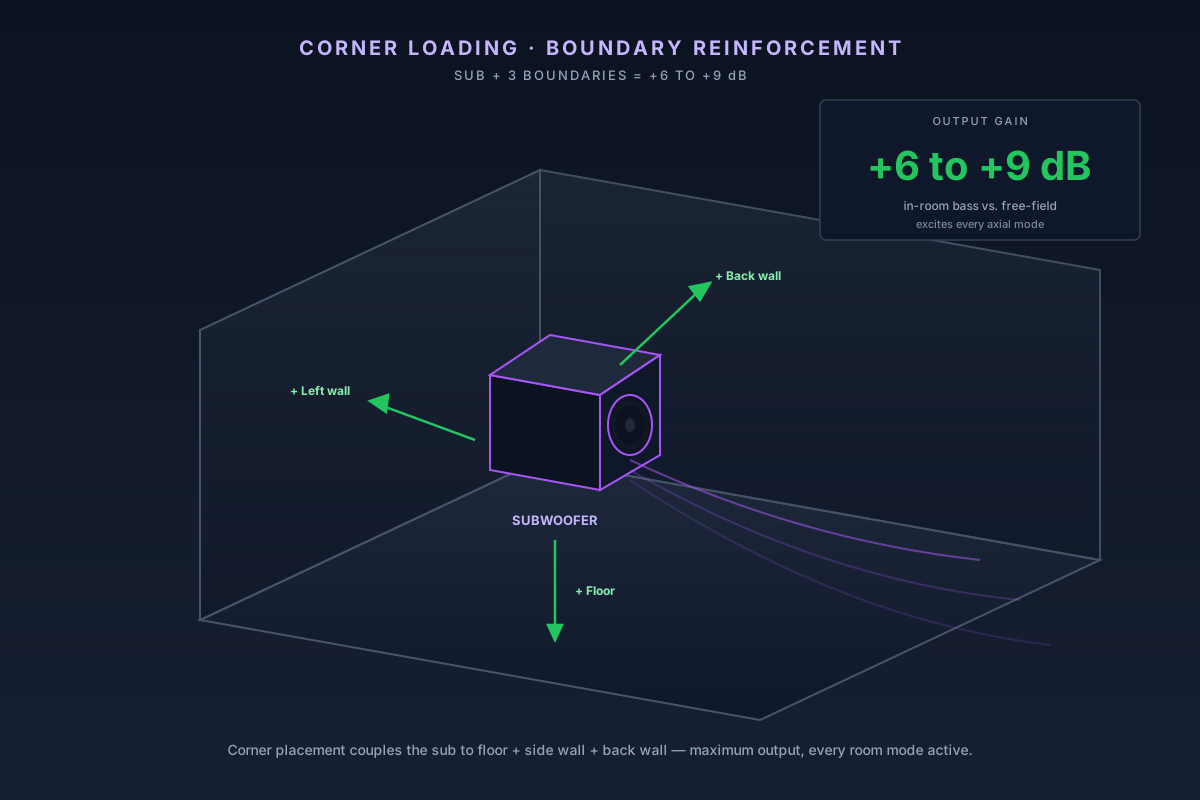
Corner loading: a sub in a corner couples with three pairs of parallel boundaries, producing the loudest in-room bass — and exciting every axial room mode. Check Price on Amazon →Recommended Product
SVS SB-1000 Pro Sealed Subwoofer
Sealed 12-inch driver with 325W Sledge amp, app-based 3-band parametric EQ for room correction, and a small 13.5-inch cabinet that fits real rooms — the cheapest sub that gets the DSP fundamentals right for rooms up to ~3,000 cu ft.
- 3
Run the subwoofer crawl to find the best position
This trick exploits acoustic reciprocity: a sound source and a listener can be swapped without changing the response between them. Move the sub onto your primary listening seat at roughly ear height. Play a bass-heavy track on loop (a sub test sweep, Telarc's '1812 Overture,' or anything with varied bass content). Crawl around the room perimeter on hands and knees at floor level, pausing 5–10 seconds at each candidate position — corners, wall midpoints, anywhere you'd physically put the sub. Listen for evenness across the bass range, not for maximum volume. The smoothest-sounding floor position is where the sub goes. Mark it with painter's tape. The crawl is unscientific compared to a calibrated measurement, but it costs nothing, takes 15 minutes, and gets you 80% of the way to the optimal position in any room.
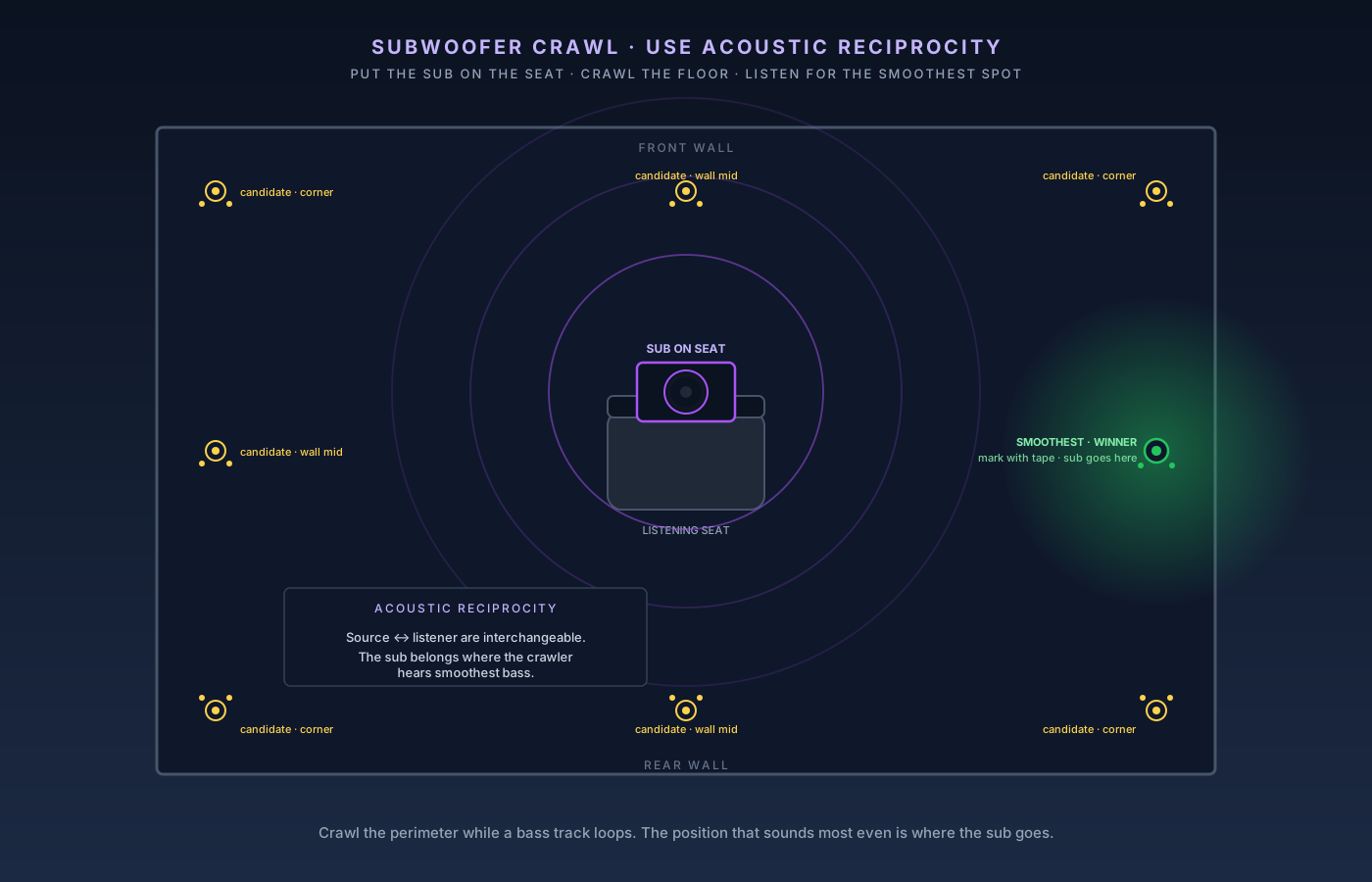
The crawl: swap sub and listener via reciprocity. The position where bass sounds smoothest at floor level is where the sub goes. - 4
Avoid the geometric center of the room
Whatever the crawl tells you, do not put the sub at the exact center of any room dimension. The geometric center is a null for the lowest axial modes — wavelengths that fit exactly twice between parallel walls cancel themselves out there. Bass disappears at center. Same rule applies to the listening seat: move at least 18–24 inches off-center along one or both axes if you can. Rooms where the seat must be central (sofa floating in the middle of a square room) are the worst case and usually need dual subs or EQ to compensate.
- 5
Set the LFE crossover to 80 Hz on the AVR
With the sub placed, go to the AV receiver's bass management. Set every speaker to Small and the LFE crossover to 80 Hz. This is the THX and Dolby reference and is correct for the overwhelming majority of setups — even ones with large floor-standing mains. Human directional hearing drops sharply below 80 Hz, so everything under 80 Hz going to a single sub does not collapse the soundstage. Mains' woofers stop trying to reproduce the lowest octave (which they almost never do well), and the crossover slopes are designed assuming both mains and sub cross at the same frequency. Setting mains to Large and the sub to LFE-only breaks that assumption.
- 6
Bypass the subwoofer's internal low-pass filter
Most subs ship with the internal low-pass (the 'Crossover' dial) set near 80 Hz. If you're using the AVR's bass management — which you should be — set the sub's own low-pass to its maximum value (often 120 or 160 Hz) or to LFE / Bypass on subs that offer that mode. Running two low-pass filters in series stacks the slopes and creates a dip just above the crossover, audible as missing bass right where the mains hand off to the sub. Let the AVR do all the filtering and let the sub run wide-open above the AVR's cutoff.
- 7
Dial in phase or polarity
Phase aligns the sub with the mains so they combine constructively, not destructively, in the 60–100 Hz overlap. Subs offer one of three controls: a 0°/180° polarity switch, a continuous phase dial (0–180°), or a distance/delay setting that the AVR's room correction sets automatically. To set by ear, play a track with strong bass between 60 and 100 Hz (kick drum, low male vocal), sit at the listening seat, and toggle the polarity or rotate the dial. One position will sound noticeably louder and fuller in the overlap region — that's correct. If the difference is subtle, have someone else flip the switch while you listen; confirmation bias is real. If your AVR's room correction handles distance/delay automatically and the result sounds right, leave it.
- 8
Use two subs for the smoothest in-room bass
A single sub favors certain modes and suffers from others. Two subs placed correctly excite different modal patterns and partially cancel each other's worst peaks, producing a measurably smoother response across more seats. The Harman research is the most-cited result in modern bass setup: two subs at midpoints of opposite walls (or in diagonally opposite corners) cancel the lowest even-order axial modes and reduce seat-to-seat variation by 5–8 dB across a typical sofa. Two cheaper subs beat one expensive sub in almost every room. Front-and-rear placement also works and is easier in long rooms. Co-located subs (both in the same corner) only add output, not smoothness — skip unless you specifically need more SPL.
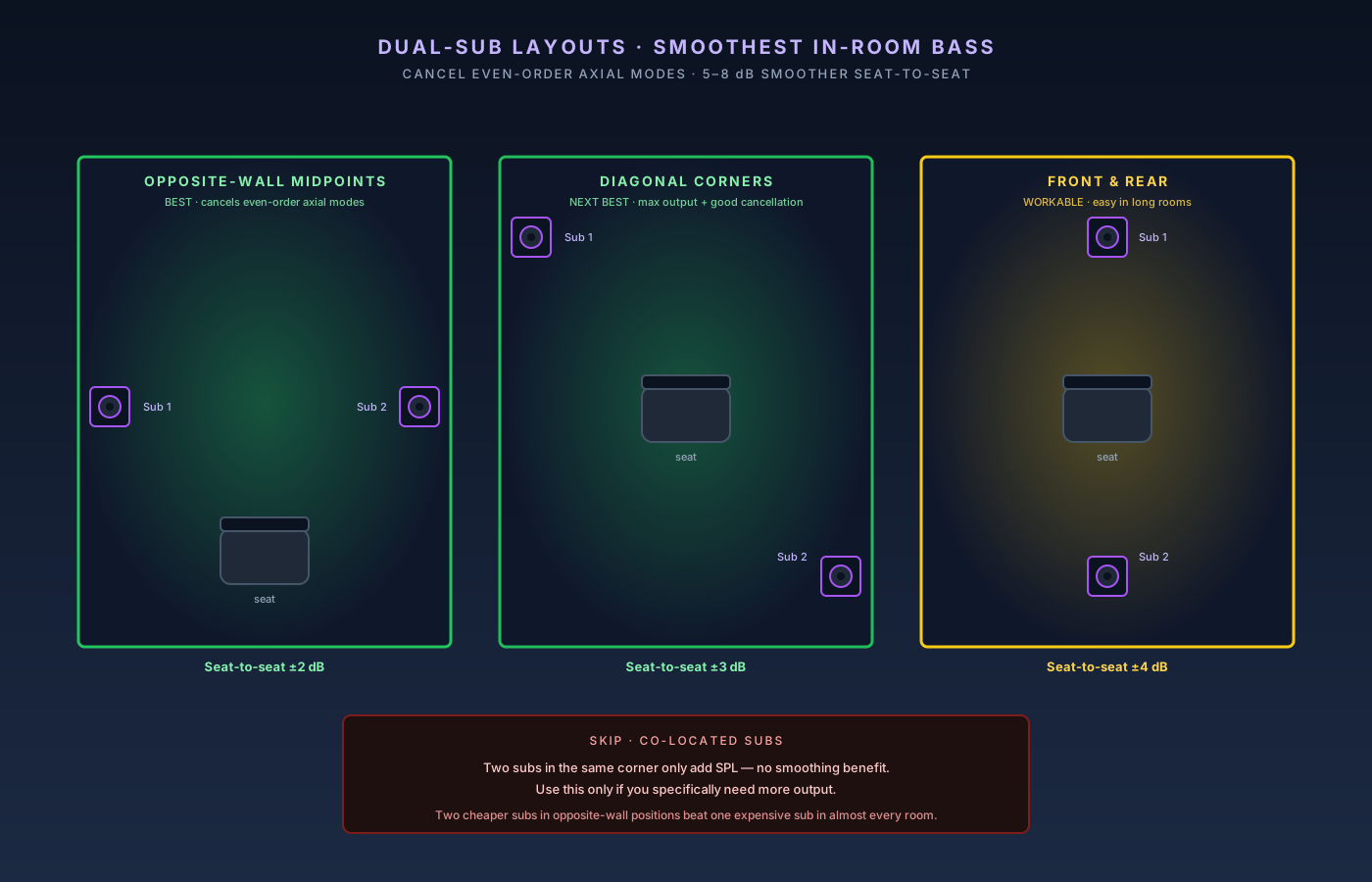
Dual-sub layouts: opposite-wall midpoints (best), diagonal corners (next best), front-and-rear (workable in long rooms). Co-located subs only add output. Check Price on Amazon →Recommended Product
miniDSP UMIK-1 USB Measurement Microphone
Factory-calibrated per unit and USB-powered (no preamp required). Works directly with Room EQ Wizard (REW) for measurement and with Dirac Live for room correction — the easiest way to verify dual-sub placement and trim residual peaks with EQ.
- 9
Run room correction after placement
Run your AVR's room correction (Audyssey MultEQ XT/XT32, Dirac Live, YPAO, MCACC) after physical placement is finalized, not before. Correction algorithms are far more effective at trimming peaks than at filling nulls — try to 'fix' a placement-induced 15 dB null by adding 15 dB of EQ and you just heat the voice coil. Place the calibration mic at the primary seat at ear height, run the routine, and let it set distances, crossovers, and EQ. After it finishes, recheck the crossover is still at 80 Hz (some routines re-set it), all speakers are still Small, and the sub level is roughly at reference (often 75 dB at the seat) on a sound-level meter.
- 10
Verify with reference tracks and a sweep
Final check is content. Play tracks you know well that have strong, varied bass — a symphonic score with deep LFE (Hans Zimmer's Dune, Interstellar's 'No Time for Caution'), a bass-heavy electronic track (Massive Attack 'Angel,' Daft Punk 'Veridis Quo'), and a 20–120 Hz subwoofer sweep test track. The sweep should glide continuously, without audible peaks or dropouts. Walk around the listening area while a reference track plays — bass should remain present and roughly even across every seat. When the same kick drum hits with the same weight everywhere on the sofa and a sub-bass sweep glides without dropouts, you're done.
The placement order that gets it right
- Corner-load the sub as a baseline.
- Run the subwoofer crawl from the listening seat and mark the winning position.
- Stay off the geometric center of the room with both the sub and the seat.
- Set the AVR crossover to 80 Hz and all speakers to Small.
- Bypass the sub's internal low-pass.
- Dial phase by ear at the listening seat.
- Add a second sub at the opposite wall midpoint or diagonal corner — two cheap subs beat one expensive one.
- Run room correction last, after physical placement is finalized.
If you only do one thing on this list, do the crawl. The position you find for free in fifteen minutes is worth more than every DSP feature you'd pay extra for. And once you have a position that's working, the SVS SB-1000 Pro — or two of them — gives you the cleanest path from \"a sub in the room\" to \"the room sounds like a home theater.\"
What to do next
- How to set speaker crossover frequency — the 80 Hz rule, and when to break it.
- How to run Audyssey room calibration — the correction pass that comes after placement, done properly.
- How to set up a 5.1 surround sound system — where the sub fits in the whole build.