WiiM Amp Review: The $299 Streaming Amp That Makes the Sonos Amp Look Overpriced
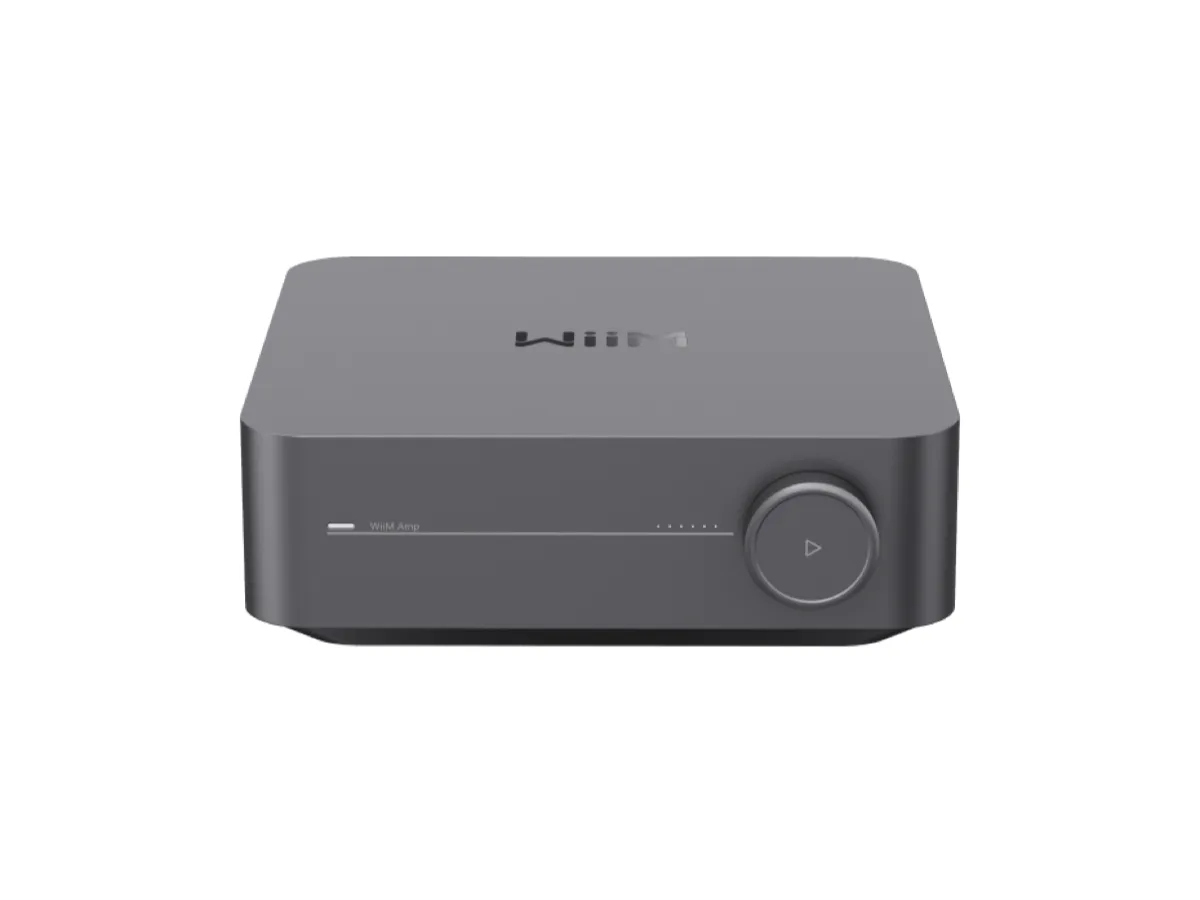
The WiiM Amp packs a TI TPA3255 class-D power section (60W/ch at 8Ω), an ESS ES9018K2M DAC, HDMI ARC, subwoofer out, RoomFit room correction, and Roon Ready streaming into one $299 box. It undercuts the Sonos Amp by $400 while matching or beating it on features.
✅ Pros
- +Outstanding value — a real 60W/ch class-D amp, ESS DAC, HDMI ARC, and room correction in one box for $299
- +Drives passive speakers directly; 120W/ch into 4Ω handles lower-impedance designs well
- +Best-in-class streaming coverage: AirPlay 2, Google Cast, Spotify/TIDAL Connect, Roon Ready, DLNA
- +Subwoofer output with auto-detect and adjustable 30–250 Hz crossover for a clean 2.1 system
- +AI RoomFit room correction plus 26 presets and 10-band graphic and parametric EQ
- +Excellent, fast WiiM Home app with a strong record of firmware updates
- +Compact chassis (roughly a hardback book) that hides easily on a shelf
- +Undercuts the Sonos Amp by $400 while adding Roon Ready and higher-res playback
❌ Cons
- −HDMI ARC, not eARC — no lossless/Atmos bitstream passthrough; not for surround home theater
- −No front-panel display — control is app-first (a status ring is all the hardware shows)
- −Single ESS ES9018K2M DAC — the pricier Amp Pro/Ultra use better ESS Sabre converters
- −Network/digital playback caps at 24-bit/192kHz PCM (no native DSD)
- −10/100 Ethernet rather than gigabit (fine for audio, but worth noting)
- −Multi-room ecosystem is younger and smaller than Sonos'
Verdict: The WiiM Amp is the streaming integrated amp to buy if you want one small box that turns a pair of passive speakers into a full streaming system. For $299 it combines a TI TPA3255 class-D power section (60W per channel into 8 ohms, 120W into 4 ohms), an ESS ES9018K2M DAC, HDMI ARC for your TV, a subwoofer output with a real crossover, and AI RoomFit room correction — then adds every streaming protocol that matters, including Roon Ready. It undercuts the $699 Sonos Amp by $400 while matching or beating it on features and format support. Go in knowing what it isn't: its HDMI is ARC rather than eARC, it uses a single DAC rather than the ESS Sabre in the step-up Amp Pro, and there's no front-panel display.
Check the current price on Amazon →
Key Specs at a Glance
| Spec | Detail |
|---|---|
| Product Type | Streaming integrated amplifier (streamer + DAC + power amp) |
| Power Output | 60W/channel @ 8Ω, 120W/channel @ 4Ω (load only — WiiM publishes no THD or bandwidth condition) |
| Amplifier | TI TPA3255 class-D |
| DAC | ESS ES9018K2M |
| SNR (analog out) | 108 dB |
| THD+N | -92 dB (0.0025%) at 5W |
| Digital Inputs | HDMI ARC, Optical/TOSLINK, USB (local drive) |
| Analog Inputs | RCA line-in |
| Outputs | Passive speaker terminals, subwoofer out (auto-detect, 30–250 Hz adjustable crossover), USB Audio Out |
| Max Resolution | Up to 24-bit/192kHz PCM |
| File Formats | MP3, AAC, ALAC, APE, FLAC, AIFF, WAV, WMA, OGG |
| Room Correction | AI RoomFit |
| EQ | 26 presets, 10-band graphic EQ, 10-band parametric EQ |
| Streaming | AirPlay 2, Google Cast, Spotify Connect, TIDAL Connect, Alexa Cast, DLNA, Roon Ready |
| Voice | Alexa (via Alexa Cast) |
| Wireless | Wi-Fi (2.4/5GHz dual-band), Bluetooth 5.1, 10/100 Ethernet |
| Multi-Room | WiiM multi-room (groups with other WiiM devices) |
| App | WiiM Home (iOS/Android) |
| Dimensions | 217 × 190 × 64 mm |
| Weight | 1.84 kg (4.06 lbs) |
| MSRP | $299 USD (frequently street-priced lower) |
What the WiiM Amp Actually Is
The single most important thing to understand: the WiiM Amp is a complete system in one box. It's a network streamer, a DAC, and a power amplifier fused together, with speaker terminals on the back. Connect a pair of passive bookshelf or floorstanding speakers directly to it, join it to Wi-Fi, and you have a full streaming hi-fi — no separate amp, no separate streamer, no rack of components.
That framing matters because WiiM's lineup can be confusing. If you already own an amplifier or a pair of active/powered speakers and just want a modern front end, you want the WiiM Ultra instead — it's a preamp/DAC with a bigger touchscreen and a phono input, but no power section. The Amp goes the other way: it spends its budget on the built-in class-D power stage so it can drive passive speakers on its own.
For the target buyer — someone with (or about to buy) a pair of passive speakers who wants the simplest possible path to streaming — that's exactly the right split. You get a genuinely capable amp and a full streaming platform for the price most brands charge for a bare streamer alone.
Power and Sound Quality
The Amp's power section is built around the TI TPA3255, a well-regarded class-D chip, rated at 60 watts per channel into 8 ohms and 120 watts per channel into 4 ohms. Be clear on what that rating does and does not say: WiiM publishes the load and nothing else — no distortion figure and no bandwidth — so it is not directly comparable to an AVR's FTC-conditioned number. The 0.002% THD+N WiiM quotes is an analog-output measurement, not the condition attached to the power rating. In practice that's more than enough to drive most bookshelf speakers and the majority of floorstanders to satisfying levels in a normal-sized room. The doubling into 4 ohms means it handles lower-impedance and harder-to-drive speakers better than the on-paper wattage suggests — worth knowing if you're pairing it with a 4-ohm design (see our guide to speaker impedance and AVR/amp pairing).
Digital-to-analog conversion is handled by an ESS ES9018K2M DAC with a published 108 dB signal-to-noise ratio and THD+N of -92 dB (0.0025%) at 5W. That's clean, quiet performance for the class. The Amp sounds neutral and composed, with a black noise floor and none of the harshness that used to define budget class-D. It won't out-resolve separates costing many times more, and network/digital playback tops out at 24-bit/192kHz PCM rather than DSD, but for streaming and TV duty it's transparent enough that the electronics stop being the conversation and the speakers become the limiting factor — which is exactly how it should be at this price.
If you want a step up in DAC quality specifically, that's the main reason to look at the Amp Pro, which swaps in an ESS Sabre DAC. For most buyers pairing the Amp with sub-$500 speakers, the standard unit's DAC is not the bottleneck.
Connectivity: The Real Story
The Amp's back panel is where the value becomes obvious. WiiM packed a small system's worth of I/O into a box the size of a hardback book:
- Speaker terminals — proper binding posts for a pair of passive speakers. This is the whole point: no external amp required.
- HDMI ARC — connect it to your TV and route TV audio out to your speakers. It handles PCM and downmixes to stereo, so the Amp doubles as a simple, high-quality replacement for a soundbar. Note the important limit below.
- Subwoofer output — a dedicated sub out with auto-detecting cable insert and a user-adjustable 30–250 Hz crossover, plus bass management in the app. That lets you build a clean 2.1 system with real low-end integration, not just a full-range dump to the sub.
- Optical and RCA line-in — for a TV without ARC, a CD player, or another source component.
- USB — for local playback from a drive, plus a USB Audio Out to feed an external DAC if you ever outgrow the internal one.
The one connectivity caveat: ARC, not eARC
The HDMI port is ARC, not eARC. That means it handles the stereo/PCM audio your TV sends back over ARC, but not the high-bandwidth lossless bitstreams (Dolby TrueHD, DTS-HD MA, or full Atmos) that eARC carries. For a stereo-plus-sub music-and-TV setup that's usually a non-issue — the Amp plays the stereo signal cleanly and drives your speakers — but if you're building a true multichannel surround home theater, this is not the box for that job. See our explainer on eARC vs. ARC for what each standard actually carries; if surround is the goal, an AV receiver is the right category instead.
Streaming and the WiiM Home App
The real control surface is the WiiM Home app (iOS/Android), and it's one of the best in the category. It's fast, stable, and genuinely deep: source switching, EQ, room correction, multi-room grouping, and per-service streaming all live in one clean interface. WiiM has also earned a reputation for shipping frequent, meaningful firmware updates — features and fixes keep arriving after purchase, which is not something you can say about most budget audio hardware.
Streaming coverage is comprehensive. AirPlay 2, Google Cast, Spotify Connect, and TIDAL Connect are all native, so you can cast straight from those apps without touching the WiiM interface. Roon Ready certification means it slots into a Roon setup as an endpoint. Amazon Music (via Alexa Cast), internet radio, and other services are handled inside the WiiM Home app, and DLNA support covers local-library users. Alexa voice control is built in through Alexa Cast.
There's no front-panel display — a small status ring around the volume knob is all you get on the hardware itself. If a screen matters to you (album art, VU meters, at-a-glance status), that's a reason to consider the Amp Ultra, which adds a 3.5-inch touchscreen. For most buyers who control everything from the app anyway, the missing display is a non-issue.
RoomFit Room Correction and EQ
Room correction at $299 — in a box that also includes the amplifier — is close to unheard of, and the Amp includes it. AI RoomFit is WiiM's automated system: your speakers play test tones, a microphone captures the result, and the WiiM Home app builds a custom EQ profile to tame the room's peaks and dips. On top of RoomFit, you get a stack of manual tools: 26 EQ presets, a 10-band graphic EQ, and a 10-band parametric EQ for precise control over frequency, bandwidth, and gain.
It's not a full Dirac Live or Audyssey MultEQ XT32 replacement — the correction is applied to a two-channel (plus sub) system rather than a multi-speaker surround array — but for its intended use it's genuinely effective and, at this price and in this form factor, remarkable. Combined with the subwoofer crossover, it makes dialing in a 2.1 system in a real, imperfect room far easier than it has any right to be.
Setup and Living With It
Setup is about as painless as network audio gets. Wire up your speakers, power the Amp on, open the WiiM Home app, and it walks you through joining Wi-Fi (or plug in Ethernet for the most stable connection), signing into your streaming services, and running RoomFit. The whole first-time process takes 15–20 minutes, most of which is typing in service logins.
Day to day, you rarely fight the device. Casting from Spotify or TIDAL is instant. The TV (ARC), optical, and line inputs appear as sources you select from the app. Multi-room grouping with other WiiM units is a couple of taps. The compact chassis — roughly the footprint of a hardback book at 217 × 190 × 64 mm and just over 4 lbs — means it hides easily on a shelf or under a TV.
The dual-band Wi-Fi and Bluetooth 5.1 are stable in normal use, though the Ethernet port is 10/100 rather than gigabit — irrelevant for audio streaming bandwidth, but worth noting if you expected a gigabit jack. As always with a streamer, a wired Ethernet connection is the most reliable option if you can run one.
WiiM Amp vs. the Alternatives
The Amp competes with the Sonos Amp and, within WiiM's own lineup, with the step-up Amp Pro and Amp Ultra. Here's how it stacks up on verified specs:
| WiiM Amp | WiiM Amp Pro | WiiM Amp Ultra | Sonos Amp | |
|---|---|---|---|---|
| Type | Streaming integrated amp | Streaming integrated amp | Streaming integrated amp | Streaming integrated amp |
| Power (8Ω) | 60W/ch | 60W/ch | 100W/ch | 125W/ch |
| Power (4Ω) | 120W/ch | 120W/ch | ~200W/ch | — |
| DAC | ESS ES9018K2M | ESS ES9038Q2M | ESS ES9039Q2M | Proprietary |
| Display | None (status ring) | Color LCD | 3.5" touchscreen | None |
| HDMI | ARC | ARC | ARC | HDMI ARC |
| Subwoofer Out | Yes | Yes | Yes | Yes (Sonos Sub / sub out) |
| Room Correction | RoomFit + parametric EQ | RoomFit + parametric EQ | RoomFit + parametric EQ | Trueplay (iOS) |
| Roon Ready | Yes | Yes | Yes | No |
| Max PCM | 24/192 | 24/192 | 24/192 | 24/48 |
| MSRP | $299 | $379 | $529 | $699 |
Sonos Amp ($699) is the obvious rival, and the WiiM undercuts it by $400. The Sonos has slightly more rated power (125W/ch into 8Ω) and the polished Sonos multi-room ecosystem, which is more mature across a whole-home install. But it's limited to 24-bit/48kHz playback, has no Roon Ready support, and costs more than twice as much. For a single stereo zone, the value gap is enormous, and most listeners in side-by-side comparisons describe the difference in sound as small.
WiiM Amp Pro ($379) is the pick if you want a better DAC and a small front display for $80 more. It keeps the same 60W/ch power section but upgrades to an ESS ES9038Q2M Sabre DAC and adds a color LCD. If your speakers are revealing enough to benefit from the better converter, it's the sweet spot.
WiiM Amp Ultra ($529) is the step-up in muscle and features: 100W/ch into 8Ω from a dual-TPA3255 design, an ESS ES9039Q2M DAC, and a proper 3.5-inch touchscreen. Buy it if you have harder-to-drive or larger speakers, a bigger room, or you simply want the screen.
And if you already own an amplifier, don't buy any of these — get the WiiM Ultra streaming preamp instead ($329), which adds a phono input and a larger screen but leaves out the power section you don't need.
The pattern is clear: the standard Amp is the value leader. Nothing near its price gives you this combination of a real power section, a clean DAC, HDMI ARC, subwoofer management, room correction, and a full Roon-Ready streaming stack in one box.
Who Should Buy the WiiM Amp
Buy it if:
- You have (or are buying) a pair of passive bookshelf or floorstanding speakers and want one small box that streams and drives them — no separate amp needed.
- You want to replace a soundbar with real stereo speakers and a sub, using HDMI ARC from your TV.
- You stream from a mix of services — AirPlay 2, Spotify, TIDAL, Amazon Music — and want them native, plus Roon Ready endpoint support.
- You want to add a subwoofer for a clean 2.1 setup with a real crossover and bass management.
- You value room correction and deep EQ without paying flagship prices or losing a rack to separates.
Consider the WiiM Amp Pro instead if:
- You want a better ESS Sabre DAC and a small front display, and $80 more is fine.
Consider the WiiM Amp Ultra instead if:
- You have larger or harder-to-drive speakers, a bigger room, or you want a 3.5-inch touchscreen and 100W/ch.
Consider the WiiM Ultra (preamp) instead if:
- You already own an amplifier or active speakers and just need a modern streaming front end with a phono input.
Skip a streaming amp entirely and get an AV receiver if:
- Your real goal is multichannel surround sound with lossless Atmos/DTS:X. The Amp's ARC and stereo focus aren't built for that.
Bottom Line
The WiiM Amp is the clearest value story in streaming audio right now. For $299 it does the work of a streamer, a DAC, and an integrated amp combined: a clean ESS DAC, a genuinely capable 60W-per-channel class-D power section, HDMI ARC, a subwoofer output with a real crossover, room correction, and a full streaming platform with Roon Ready. Pair it with a good set of passive bookshelf speakers — something like the Klipsch RP-600M II or ELAC Debut 2.0 B6.2 — add a sub like the SVS SB-1000 Pro, and you have a complete, modern hi-fi for a fraction of what separates would cost.
The compromises are honest and easy to plan around: it's ARC not eARC, there's no screen, and the single DAC is a notch below the pricier models. None of that undercuts what it is — the best-value streaming integrated amp you can buy in 2026, and an easy recommendation for anyone building a streaming system around passive speakers.
Rating: 4.6 / 5
Check the current price on Amazon ($299) →
Related Reading
Our Verdict
The WiiM Amp packs a TI TPA3255 class-D power section (60W/ch at 8Ω), an ESS ES9018K2M DAC, HDMI ARC, subwoofer out, RoomFit room correction, and Roon Ready streaming into one $299 box. It undercuts the Sonos Amp by $400 while matching or beating it on features.
Ready to buy the WiiM Amp?
Buy on Amazon →Affiliate link — we may earn a commission at no extra cost to you.