SVS PB-1000 Pro Review: The Best $250 Step in SVS's Subwoofer Ladder
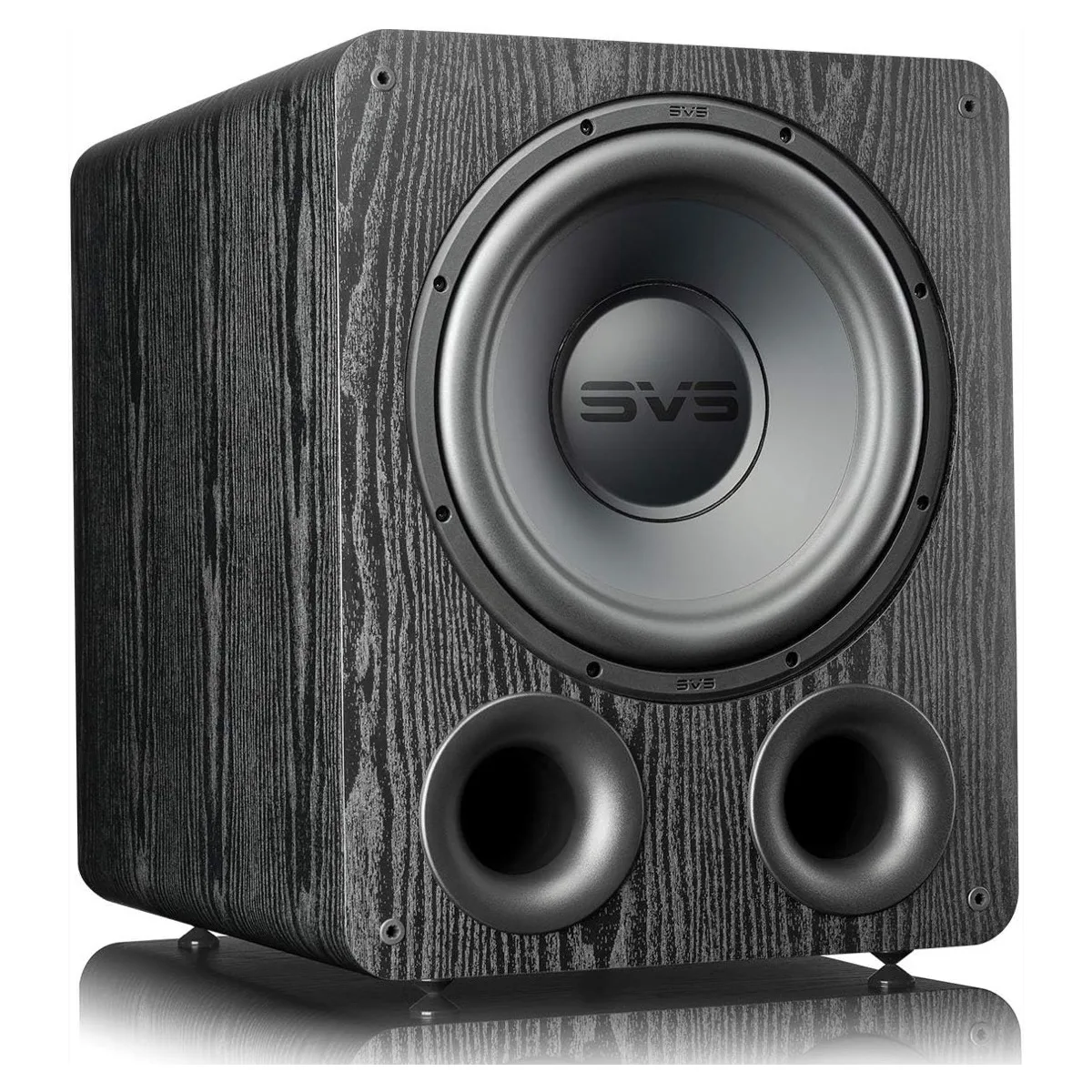
The SVS PB-1000 Pro is the subwoofer that makes the rest of SVS's lineup easy to understand, because it is the cheapest decibel SVS sells. It costs $250 more than the sealed SB-1000 Pro we already recommend, and for that money you do not get a bigger driver or a bigger amplifier — both models use a 12-inch driver and the identical 325-watt Sledge STA-325D amplifier. You get a ported cabinet, and by SVS's own published numbers that cabinet is worth 7.2 dB more output at 30 Hz. Nothing else in the 1000 and 2000 Pro range comes close to that return: the next step up, to the PB-2000 Pro, costs $350 and buys 4.8 dB. On a decibel-per-dollar basis the sealed-to-ported step is better than twice as good as the step above it, and if you are building a system where movies matter more than furniture, it is the obvious place to spend. What you pay in exchange is space and nothing else, and you should be honest with yourself about it, because it is a lot: the cabinet is 2.2 times the volume of the SB-1000 Pro's and it comes in one finish, a black ash vinyl, with no gloss option. The app is Bluetooth-only and its parametric EQ has three bands where newer SVS models have six. Measure your floor before you spend the money.
✅ Pros
- +The same 325 W Sledge STA-325D amplifier and the same 12-inch driver size as the sealed SB-1000 Pro, in a cabinet SVS's own numbers say plays 7.2 dB louder at 30 Hz
- +The best decibel-per-dollar step in the 1000/2000 Pro range by better than 2× — 2.9 dB per $100, against 1.4 dB per $100 for the step above it
- +Port plugs included, with a published sealed-mode spec (19–260 Hz ±3 dB) that is marginally deeper than the dedicated sealed model's — one sub, two alignments
- +A genuinely stronger motor than the sealed sibling's: Y35 ferrite against Y30, and 21% more motor mass
- +Full SVS app DSP — 3-band parametric EQ with adjustable Q, room gain compensation, continuously variable phase, three storable presets
- +5-year unconditional warranty and a 45-day in-home trial, which on a subwoofer this size is not a small thing
- +The single-unit Amazon listing is healthy and well-reviewed: 4.8 stars across 288 ratings, at a dollar under SVS's direct price
❌ Cons
- −The cabinet is 2.2× the volume of the SB-1000 Pro's and 1.6× the weight — 18.9" × 15" × 20" and 42.5 lb is furniture, not a side table
- −One finish, Black Ash vinyl. The sealed SB-1000 Pro offers Piano Gloss Black and White; the ported model does not
- −The app is Bluetooth-only — no WiFi, no network grouping, no smart-home control
- −Three bands of parametric EQ, where SVS's newer R|Evolution models ship six
- −No balanced XLR input
- −SVS publishes no measurement distance or standard for its max-output figures, so they cannot be compared against any other brand's
- −Amazon's search results bury the single-unit listing behind a pair listing and a bundle, both of which cost more per subwoofer than buying one
Key Specs at a Glance
| Spec | PB-1000 Pro |
|---|---|
| Price | $849.99 MSRP ($849.00 on Amazon, 2026-10-01) |
| Cabinet | Ported, dual 2.5-inch front ports, port plugs included |
| Driver | 12-inch high-excursion, dual Y35 ferrite magnet motor |
| Amplifier | Sledge STA-325D, 325 W RMS, 820+ W peak, Class D with discrete MOSFET output |
| DSP | 50 MHz Analog Devices audio DSP |
| Frequency response | 17–260 Hz ±3 dB (standard), 19–260 Hz ±3 dB (ports plugged) |
| Usable low-frequency extension | 16 Hz (SVS's figure; SVS does not define "usable") |
| Max output at 30 Hz | 123.5 dB (SVS's figure) |
| Inputs | Stereo RCA, speaker level, 3–12 V trigger, USB (powers optional wireless adapter) |
| Outputs | Stereo RCA |
| Control | SVS Subwoofer Control app over Bluetooth; 3-band parametric EQ, room gain, presets |
| Dimensions | 18.9" H × 15" W × 20" D with grille |
| Weight | 42.5 lb |
| Finish | Black Ash only |
| Warranty | 5-year unconditional (SVS Bill of Rights), 45-day in-home trial |
Every figure above is SVS's own, read from its product page on 2026-10-01.
The Comparison SVS Ran For Us
Reviewing a subwoofer usually means arguing about variables nobody controlled. Different driver, different amplifier, different DSP, different cabinet, different price — and then somebody tells you the port is why it sounds the way it does.
That is not the situation here, and it is the reason this particular subwoofer is worth writing about. The PB-1000 Pro and the sealed SVS SB-1000 Pro share a driver size, an amplifier, a DSP, an app, a warranty and a product family. SVS built the controlled experiment and published both sides of it. One is sealed, one is ported, and the gap between them is as close to a clean measurement of what a port is worth as a consumer audio company is ever going to hand you.
Here is what SVS publishes, on identical fields, for the three subwoofers that bracket this one.
| SB-1000 Pro | PB-1000 Pro | PB-2000 Pro | |
|---|---|---|---|
| MSRP | $599.99 | $849.99 | $1,199.99 |
| Cabinet | Sealed | Ported | Ported |
| Driver | 12" | 12" | 12" |
| Amplifier RMS | 325 W | 325 W | 550 W |
| Amplifier peak | 820+ W | 820+ W | 1,500+ W |
| Frequency response (±3 dB) | 20–270 Hz | 17–260 Hz | 16–290 Hz |
| Usable LF extension | 18 Hz | 16 Hz | 15 Hz |
| Max output at 30 Hz | 116.3 dB | 123.5 dB | 128.3 dB |
| Dimensions (H × W × D) | 13.5" × 13" × 14.76" | 18.9" × 15" × 20" | 20.9" × 17.3" × 23.6" |
| Weight | 26 lb | 42.5 lb | 64.8 lb |
| Finishes | Piano Gloss Black, Piano Gloss White, Black Ash | Black Ash | Black Ash |
A note on the output column before we lean on it. SVS publishes "Max Low Frequency Output at 30Hz" for all three models but does not state the measurement distance or the standard it used. That makes the figure useless for comparing an SVS sub to a Klipsch or a Polk, and we are not going to use it that way. What it is good for is comparing these three to each other, because they are one vendor's numbers on one field measured one way. Every output claim in this review stays inside that boundary.
What the Port Is Actually Worth
Read the first two columns again and notice what does not change. Same driver size. Same amplifier, down to the model number. Same peak power. The PB-1000 Pro's amplifier is not a step up from the SB-1000 Pro's — it is the same Sledge STA-325D part.
So the 7.2 dB gap at 30 Hz is not horsepower. It is the cabinet.
7.2 dB is a bigger number than it looks. In acoustic power terms it is a factor of 5.2. Put differently: two identical subwoofers playing the same signal from the same spot gain you about 6 dB, so two sealed SB-1000 Pros, stacked, would still land roughly 1.2 dB short of one PB-1000 Pro — for $1,199.98 against $849.99. That comparison has a real assumption baked into it (the +6 dB figure holds for co-located subs; spread them around the room and you are trading peak output for smoother response, which is usually the better trade and is the subject of our piece on when a second subwoofer is actually worth it). But as a sanity check on where the money goes, it holds up.
Now the step above. Going from the PB-1000 Pro to the PB-2000 Pro costs $350 and buys 4.8 dB. Run both steps as decibels per hundred dollars:
- SB-1000 Pro to PB-1000 Pro: 7.2 dB for $250, or 2.9 dB per $100
- PB-1000 Pro to PB-2000 Pro: 4.8 dB for $350, or 1.4 dB per $100
The sealed-to-ported step is better than twice as efficient as the ported-to-bigger-ported step. That is the single most useful thing we can tell you about this subwoofer, and it is computed entirely from SVS's own published figures, which is why we put them in a table you can check.
Why Extension Is the Wrong Thing to Shop On
SVS's marketing copy for the PB-1000 Pro leads with "deeper bass extension down to a guttural 17Hz." The SB-1000 Pro's leads with "deep bass extension down to 20Hz." A buyer skimming both pages concludes the ported sub goes 3 Hz deeper and wonders whether 3 Hz is worth $250.
It is the wrong question, twice over.
First, 3 Hz at the bottom of the audible range is a smaller interval than it sounds. From 20 Hz to 17 Hz is 0.23 of an octave — not quite a quarter step. The same two subs measured on SVS's looser "usable low-frequency extension" field read 18 Hz and 16 Hz, which is 0.17 of an octave. Either way, extension is not where the $250 went.
Second, and more to the point, SVS prints a footnote on both product pages that says the quiet part out loud: "Frequency response graph does not denote maximum output capability." A response curve tells you how deep a sub reaches at some modest reference level. It tells you nothing about how loud it can go when it gets there. The 7.2 dB figure is the one that describes what you will actually hear during a movie, and it is buried in structured page data rather than printed in the spec summary.
This is also a good moment to flag a smaller inconsistency. SVS publishes two different low-end numbers for every model on the same page — a ±3 dB "frequency response" figure and a "usable low frequency extension" figure — and defines the first but not the second. For the PB-1000 Pro that is 17 Hz and 16 Hz. They are not interchangeable, and a sub rated to one standard cannot be compared with a sub rated to the other. Our standing rule is to say which figure a number is or leave it out of the table, which is why both appear above with labels.
The Trick That Makes This Sub More Flexible Than Its Sibling
The PB-1000 Pro ships with port plugs, and SVS publishes a separate response spec for the plugged configuration: 19–260 Hz ±3 dB, against 17–260 Hz with the ports open.
Look at what that means next to the sealed sub. Plugged, the PB-1000 Pro is a sealed subwoofer rated to 19 Hz. The actual sealed SB-1000 Pro is rated to 20 Hz. The ported box, closed up, measures marginally deeper than the purpose-built sealed box — because it is 2.2 times the internal volume, and in a sealed alignment volume is exactly what buys you extension.
The practical upshot is that the PB-1000 Pro is the more flexible of the two, not the more specialised one. If you buy it for movies and later decide you mostly listen to music and want the faster, more gradual roll-off a sealed alignment gives, you push in the plugs and you have a sealed subwoofer that gives up almost nothing to the dedicated one. The reverse is not available: you cannot add a port to an SB-1000 Pro.
If the sealed-versus-ported distinction itself is new to you, we have written it up at length in sealed vs ported subwoofers. The short version is that ported trades group delay and a steep cliff below tuning for substantially more output above it, and that modern DSP and plug-able ports have blurred a line that used to be absolute. The PB-1000 Pro is the blurring, in a box.
Why a 12-Inch Driver Is Not the Story
Both 1000 Pro models use a 12-inch driver. Both quote nearly identical excursion: 13.1 mm Xmax on the ported model, 13.3 mm on the sealed one. Same diameter, same travel, same air displaced.
What differs is the motor. SVS's own driver specifications list a Y35 ferrite magnet assembly in the PB-1000 Pro against a Y30 in the SB-1000 Pro, and the whole motor is heavier: 6.91 lb against 5.73 lb, a 21 percent increase. The complete woofer assembly goes from 8.33 lb to 9.26 lb.
That is a real, published, often-overlooked difference, and it is worth knowing because the common assumption — that the two models are the same driver in different boxes — is simply not true. What we cannot tell you is why, because SVS does not say anywhere we could find. The plausible reading is that a ported alignment presents a different mechanical load across the band than a sealed one and SVS tuned a different motor for it, but we want to be clear that this is our inference from the published part numbers, not a claim SVS makes or a measurement we ran.
What we can say without inferring anything is that driver diameter is not the variable doing the work here. Two subs with the same cone, the same excursion and the same amplifier differ by 7.2 dB because of the cabinet.
Setup, DSP, and the App
Connections are stereo RCA in and out, speaker-level stereo input for older receivers, a 3–12 V trigger, and a USB port that exists to power SVS's optional wireless adapter. There is no balanced XLR input — that arrived on SVS's newer R|Evolution models and did not reach back to the 1000 Pro line.
The SVS Subwoofer Control app connects over Bluetooth and exposes continuously variable phase, a low-pass filter, polarity, room gain compensation, a 3-band parametric EQ with adjustable Q, and three storable presets switchable from the sub's front panel or the phone. It is the same app and the same feature set as the SB-1000 Pro, with one addition: because this sub has ports, it carries the standard-versus-sealed tuning modes with response curves matched to each.
One caution while you are comparing SVS product pages, because we hit it ourselves. SVS's SB-1000 Pro page lists "Variable port tuning modes with customized frequency response curves for 'Standard' and 'Sealed'" in its app feature list. The SB-1000 Pro is a sealed subwoofer with no ports and no port plugs; that bullet has been copied across from the ported model's page. It is a vendor copy-paste error, not a product feature, and if you read the two app sections side by side looking for differences you will not find the one that actually exists.
Two further notes on living with it. Bluetooth-only control means no WiFi, no multi-sub grouping over the network, and no smart-home integration — fine in practice, since you set a sub up once, but worth knowing if you expected parity with SVS's newer models. And three EQ bands is enough to chase down the one or two worst room modes but not enough to do real corrective work; SVS's 3000 Micro R|Evolution has six.
For integration, set the app to a neutral baseline — low-pass at LFE, room gain off, EQ flat — and let your receiver's calibration run first. Our how-tos on running Audyssey room calibration, setting your speaker crossover frequency and setting levels and distances with an SPL meter cover the order of operations. Afterwards, use the app's PEQ for the specific peak or null the calibration did not catch; if you own a measurement mic and want to go further, calibrating a subwoofer with miniDSP and REW is the deeper path.
Placement matters more than any of it. A 42.5 lb ported box in the wrong corner will sound worse than a sealed sub in the right one. Start with where to place a subwoofer and positioning a subwoofer for best bass response, and set the crossover deliberately rather than by default — why 80 Hz is the standard crossover explains when to move off it.
Pros
- The same 325 W Sledge STA-325D amplifier and the same 12-inch driver size as the sealed SB-1000 Pro, in a cabinet SVS's own numbers say plays 7.2 dB louder at 30 Hz
- The best decibel-per-dollar step in the 1000/2000 Pro range by better than 2× — 2.9 dB per $100, against 1.4 dB per $100 for the step above it
- Port plugs included, with a published sealed-mode spec (19–260 Hz ±3 dB) that is marginally deeper than the dedicated sealed model's — one sub, two alignments
- A genuinely stronger motor than the sealed sibling's: Y35 ferrite against Y30, and 21% more motor mass
- Full SVS app DSP — 3-band parametric EQ with adjustable Q, room gain compensation, continuously variable phase, three storable presets
- 5-year unconditional warranty and a 45-day in-home trial, which on a subwoofer this size is not a small thing
- The single-unit Amazon listing is healthy and well-reviewed: 4.8 stars across 288 ratings, at a dollar under SVS's direct price
Cons
- The cabinet is 2.2× the volume of the SB-1000 Pro's and 1.6× the weight — 18.9" × 15" × 20" and 42.5 lb is furniture, not a side table
- One finish, Black Ash vinyl. The sealed SB-1000 Pro offers Piano Gloss Black and White; the ported model does not
- The app is Bluetooth-only — no WiFi, no network grouping, no smart-home control
- Three bands of parametric EQ, where SVS's newer R|Evolution models ship six
- No balanced XLR input
- SVS publishes no measurement distance or standard for its max-output figures, so they cannot be compared against any other brand's
- Amazon's search results bury the single-unit listing behind a pair listing and a bundle, both of which cost more per subwoofer than buying one
How It Compares
| PB-1000 Pro | SB-1000 Pro | 3000 Micro R|Evolution | Sonos Sub 4 | |
|---|---|---|---|---|
| Price | $849.99 | $599.99 | $999.99 | $799.00 |
| Cabinet | Ported | Sealed | Sealed | Sealed |
| Driver | 1 × 12" | 1 × 12" | 2 × 9" dual-opposing | Dual force-cancelling |
| Amplifier | 325 W RMS | 325 W RMS | 1,200 W RMS | Not published |
| Response (±3 dB) | 17–260 Hz | 20–270 Hz | 20–230 Hz | ~25 Hz (sealed) |
| Max output at 30 Hz | 123.5 dB | 116.3 dB | 108.2 dB | Not published |
| Parametric EQ | 3-band | 3-band | 6-band | Trueplay, automatic |
| Control | Bluetooth app | Bluetooth app | WiFi + Bluetooth app | Sonos app, WiFi 6 |
| Inputs | RCA, speaker level | RCA, speaker level | RCA, XLR | Wireless only |
| Size (H × W × D) | 18.9" × 15" × 20" | 13.5" × 13" × 14.76" | 10.9" × 11.8" × 10.8" | Floor-standing slot |
| Weight | 42.5 lb | 26 lb | 22.5 lb | — |
The output row needs its caveat repeated: the three SVS figures are comparable to each other and to nothing else, and Sonos does not publish an equivalent number at all.
Read across that table and the trade is clear. The 3000 Micro R|Evolution costs $150 more than the PB-1000 Pro and gives up 15.3 dB at 30 Hz, and it is worth every dollar if your constraint is space — it is a cube under a foot on every side with four times the amplifier and twice the EQ bands. The PB-1000 Pro is the opposite bargain: more output than anything near it, in a box you have to find room for. The Sonos Sub 4 is not really in the same conversation, since it only works inside a Sonos system.
Against speakers, the PB-1000 Pro pairs naturally with anything that needs the bottom octave handed off. It is a sensible match under Klipsch RP-6000F II towers, and it is the obvious partner for a pair of ELAC Debut 3.0 DF63 floorstanders or Polk Reserve R200 bookshelves, both of which measure well above their rated extension claims and genuinely want a sub below 50 Hz. On the receiver side it behaves like any well-mannered RCA-input sub with a Denon AVR-S770H or a Denon AVR-X3800H, and if you are building the system from scratch our guide to setting up a 5.1 surround system covers the order to do it in.
How to Actually Buy One
This part is messier than it should be, so here are the three live Amazon listings with the prices we verified on 2026-10-01.
Single subwoofer, Black Ash — ASIN B08X4ZRQC4, $849.00. This is the one to buy, and it is the link at the top and bottom of this review. It is a dollar under SVS's own $849.99, has a healthy new-condition buy box, and carries 4.8 stars across 288 ratings.
Pair — ASIN B08ZV6GTX9, $1,498.00. That works out to $749 each, which is $200 less than buying two at the single price and the cheapest route to dual subs if that is your plan. But read the rating before you click: 3.8 stars from 22 ratings, and the distribution is strange — 69 percent five-star, zero four-star, zero three-star, and 31 percent split between one and two stars. A rating that is bimodal with nothing in the middle is almost never a verdict on how a product sounds. The same subwoofer, sold one at a time, holds 4.8 stars across 288 ratings. Our read is that this is a freight outcome, not a product outcome — two 42.5 lb boxes on one pallet either arrive intact or they do not. Buy the pair if you want the $200, and inspect both cabinets before the return window closes.
Single plus SoundPath Wireless Audio Adapter — ASIN B0DYQ4B5SP, $1,028.00. A $179 premium over the bare sub for SVS's wireless transmitter kit. Only worth it if running a cable to the subwoofer's position is genuinely impractical; otherwise a $20 RCA cable does the same job better.
One pre-flight note for anyone checking our work: searching Amazon for "SVS PB-1000 Pro" does not surface the single-unit listing on the first page. The pair and the bundle outrank it. We only found B08X4ZRQC4 by filtering the search to the SVS brand.
Who Should Buy It
Buy the PB-1000 Pro if you watch movies in a room of roughly 2,000 to 4,000 cubic feet, you have somewhere to put a box the size of a large ottoman, and you want the most output per dollar SVS sells. It is the right sub for a 5.1 or 7.1 system built around real speakers rather than a soundbar, and the right first sub for anyone who has decided that the low end is the part of their system that is missing.
Buy the SB-1000 Pro instead if you listen to more music than movies, your room is under about 2,000 cubic feet, you want a gloss finish, or — most likely — you simply do not have room for the ported cabinet. It gives up 7.2 dB at 30 Hz and saves you $250 and more than half the floor space. That is a perfectly sound trade and we still rate it slightly higher as a product.
Buy the 3000 Micro R|Evolution if space is the binding constraint and budget is not.
Step up to the PB-2000 Pro only if your room is genuinely large — past roughly 4,000 cubic feet — or you already know you want reference-level output. The 4.8 dB it adds is real, but you are paying $350 for it, and in most rooms a second PB-1000 Pro placed well would do more for the sound than one louder subwoofer.
The Bottom Line
The PB-1000 Pro is an easy subwoofer to recommend and an unusually easy one to explain, because SVS sells its own control group. Same driver size, same amplifier, same DSP, same app, same warranty, $250 apart, and 7.2 dB between them at 30 Hz. The port is the product.
What keeps it off the top of our ratings is not performance. It is the small stuff that accumulates: one finish, a Bluetooth-only app, three EQ bands where the rest of the market has moved to more, no balanced input, and a cabinet that will dictate where your furniture goes rather than the other way round. None of that changes the arithmetic. If you have the floor space, this is the cheapest serious bass on the market from a company that publishes enough of its own numbers for you to check the claim yourself.
Our Verdict
The SVS PB-1000 Pro is the subwoofer that makes the rest of SVS's lineup easy to understand, because it is the cheapest decibel SVS sells. It costs $250 more than the sealed SB-1000 Pro we already recommend, and for that money you do not get a bigger driver or a bigger amplifier — both models use a 12-inch driver and the identical 325-watt Sledge STA-325D amplifier. You get a ported cabinet, and by SVS's own published numbers that cabinet is worth 7.2 dB more output at 30 Hz. Nothing else in the 1000 and 2000 Pro range comes close to that return: the next step up, to the PB-2000 Pro, costs $350 and buys 4.8 dB. On a decibel-per-dollar basis the sealed-to-ported step is better than twice as good as the step above it, and if you are building a system where movies matter more than furniture, it is the obvious place to spend. What you pay in exchange is space and nothing else, and you should be honest with yourself about it, because it is a lot: the cabinet is 2.2 times the volume of the SB-1000 Pro's and it comes in one finish, a black ash vinyl, with no gloss option. The app is Bluetooth-only and its parametric EQ has three bands where newer SVS models have six. Measure your floor before you spend the money.
Ready to buy the SVS PB-1000 Pro?
Buy on Amazon →Affiliate link — we may earn a commission at no extra cost to you.