In-Ceiling vs Upfiring vs Dedicated Height Speakers for Dolby Atmos: Which Path Is Right for Your Room in 2026?
Published 2026-05-29 · By NetAudioHub Editorial
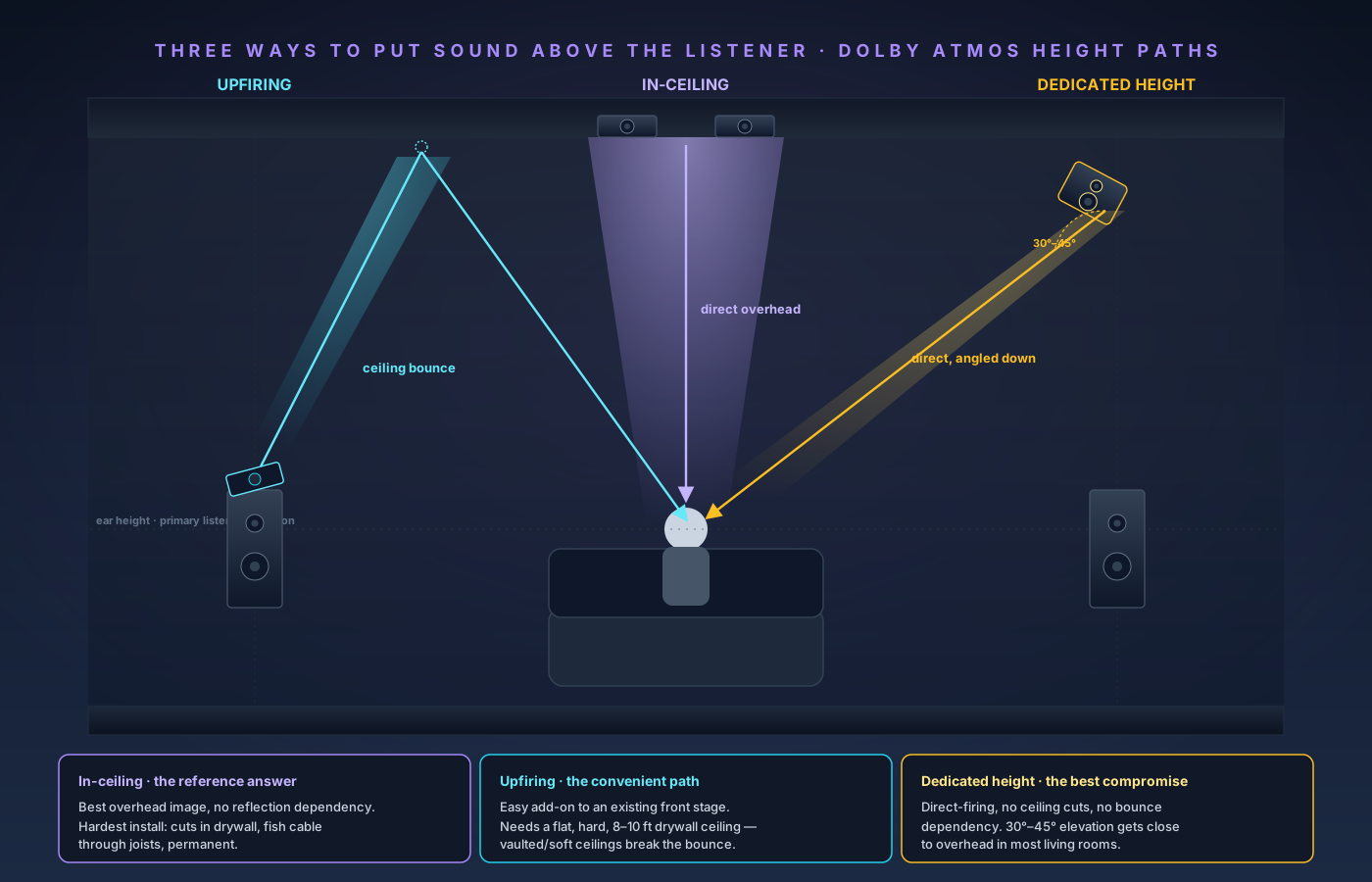
In-ceiling speakers are the reference for dedicated theater rooms. Dedicated wall-mounted height speakers are the best compromise for most living rooms. Upfiring modules work when the ceiling cooperates. Soundbars get you Atmos with the lowest effort. Here is the honest hierarchy and a decision tree for your room.
The verdict up front: in-ceiling speakers produce the most accurate Atmos overhead image and are the right answer for any dedicated theater room — if you can cut into the ceiling. Upfiring modules (the kind that sit on top of your front bookshelf speakers or come built into a soundbar) are the convenient choice and work surprisingly well, but only if you have a flat, hard, 8–10 ft ceiling above the listening position. Dedicated height speakers — small bookshelves mounted high on the front wall or near the ceiling — are the best compromise for most living rooms: they give you a real height channel without ceiling surgery or ceiling dependency. Soundbars with built-in upfiring drivers are the lowest-effort path and the right pick for renters and small rooms, but they sacrifice image precision compared to the other three. This guide walks through what each option actually does, the ceiling and room constraints that make or break each one, the typical sound-quality gap between them, and exactly what to buy for each scenario.
Why Height Speakers Are the Hard Part of Atmos
Dolby Atmos is the first consumer surround format that treats sound as objects in three-dimensional space, not as channels assigned to fixed speaker positions. A helicopter overhead in a Dolby Atmos mix is not "left rear height" — it is a coordinate that the renderer maps onto whatever speakers you happen to have. That flexibility is the format's strength and its honesty problem.
For Atmos to deliver a believable overhead image, your system has to put sound above the listener's ears. Not in front of them, not behind them — above. That is the one job a 5.1 system cannot do, and it is the entire reason Atmos exists.
How you put sound above the listener is the single biggest decision in an Atmos build, and the choice is mostly about the room. There are four practical paths, and a fifth that mostly doesn't count:
- In-ceiling speakers — flush-mounted in the ceiling, firing straight down or slightly angled toward the seats.
- Dedicated height speakers — small on-wall or shelf speakers mounted high on the front and rear walls, near the ceiling.
- Upfiring Atmos modules — angled drivers that sit on top of your front (and sometimes surround) speakers, firing up at the ceiling so the sound bounces down to the listener.
- A soundbar with built-in upfiring drivers — a single chassis solution with one or more upward-firing drivers in the bar itself (and sometimes in the surround satellites).
- Forward-only soundbars that claim "virtual Atmos" — purely psychoacoustic. Not a real height channel. Skip.
Each of the first four is a legitimate Atmos delivery method. They are not interchangeable.
In-Ceiling Speakers: The Reference Answer
In-ceiling speakers are the option Dolby itself uses for the reference Atmos demonstration rooms. A speaker mounted in the ceiling above the listener fires sound at the listener directly. There is no reflection, no ceiling-surface dependency, no compromise in the path between driver and ear. The overhead image is unambiguous and the localization is precise — a helicopter sounds like it is above you, not like it is coming from somewhere above.
The technical reason this works so well: an in-ceiling speaker controls the direct-arrival angle of the sound at the listening position. Upfiring modules depend on the ceiling to reflect sound back down at the right angle, and reflections lose energy, smear in time, and pick up the room's acoustic signature on the way. A direct-firing in-ceiling speaker has none of that — it is the same kind of direct, controlled delivery you expect from a front main speaker, just rotated 90 degrees.
What you give up
In-ceiling speakers are an installation problem, not a budget problem. You are cutting holes in drywall, fishing speaker cable through joists, and committing to speaker positions that you cannot move. In a finished room with no attic access above, this is a 1–2 day project for an installer and a much longer project as a DIY job. In a rental, it is generally not an option at all.
The other constraint is the ceiling's structure. Joist spacing dictates where you can mount speakers — typically 16 inches on center for new construction, 24 inches for older homes. Most in-ceiling speakers fit a standard cutout of about 8 inches diameter, but the speaker's depth (typically 3.5–6 inches) has to fit between the ceiling drywall and any obstructions above (HVAC ducts, plumbing, electrical). Verify your ceiling cavity before buying.
You also need an AV receiver with enough discrete amplifier channels and the correct speaker configuration. A 5.1.2 Atmos layout requires 7 discrete amplifier channels (5 main + 2 height). A 5.1.4 layout requires 9. A 7.1.4 layout requires 11. Most modern AVRs at $1,000+ ship with at least 9 amplifier channels and can drive a 5.1.4 setup out of the box; the Denon AVR-X2800H is the budget anchor at 7 channels for a 5.1.2 build.
Placement and Dolby's spec
Dolby's official Atmos guidelines call for in-ceiling speakers at specific angles relative to the primary listening position:
- Top Front / Top Rear (5.1.4 and 7.1.4): the front pair should be at an elevation angle of 30°–55° above the listener; the rear pair at 125°–150° measured from the front. Roughly: front pair about 2–3 feet in front of the seat overhead, rear pair about 2–3 feet behind.
- Top Middle (5.1.2): if you only have two ceiling speakers, place them directly above the primary seat, slightly forward of center, at an elevation angle of 65°–100°.
Most in-ceiling speakers either fire straight down or have a small angled tweeter (pivotable up to about 15°) that lets you aim the high-frequency driver at the seat. Pivot the tweeter toward the primary listening position for the cleanest image.
What to buy
The in-ceiling market is mature and unglamorous. Look for:
- A 5.25-inch or 6.5-inch woofer for two-channel duty (most Atmos overhead) or 8-inch for full-range duty in larger rooms.
- A pivoting tweeter — important. Cheap fixed-tweeter in-ceilings sound dull off-axis.
- An angled (in-wall-angled) variant if your ceiling is sloped or vaulted — most manufacturers offer the same driver in both flush and angled enclosures.
- Timbre-matching to your other speakers — same brand if possible. A Klipsch front stage with budget in-ceiling Atmos sounds tonally disconnected; a Klipsch in-ceiling Atmos pair sounds like part of the same system.
The reference picks at three budget tiers:
- Budget ($150–200 per pair): Polk Audio MC60 or Pioneer S-IC61 series, 6.5-inch woofer with pivoting tweeter. (Polk RC80i is the older, larger, slightly more polished version — still available on Amazon, search Polk RC80i.)
- Mid-range ($400–600 per pair): Klipsch CDT-5650-C II or Definitive Technology DI 6.5R — pivoting tweeter, timbre-matched to most popular front-stage families. (Search Klipsch CDT-5650-C II.)
- High-end ($800+ per pair): Klipsch PRO-180RPC LCR (8-inch in-ceiling LCR), SVS Prime Elevation when used as in-ceiling, or in-ceiling versions of MartinLogan or KEF.
If you already own a Klipsch RP-600M II front stage and a Klipsch RP-504C II center, the Klipsch CDT-5650-C II in-ceiling pair is the timbre-matched ceiling option — same tractrix horn design, same voicing.
Dedicated Height Speakers: The Best Compromise
A dedicated height speaker is a small bookshelf, satellite, or wall-mount speaker installed high on the front and/or rear walls — typically within about 12 inches of the ceiling — angled down toward the listening seat. The sound arrives at the listener from above at an angle, just not from directly overhead.
This is the option most home-theater enthusiasts settle on once they discover the constraints of the other paths.
Why it works
Dolby's Atmos guidelines for dedicated height speakers (the original "Front Height" and "Rear Height" channel positions inherited from pre-Atmos DTS:X and Auro-3D layouts) call for an elevation angle of 30°–45° above the listener — close enough to "overhead" that the Atmos renderer can convincingly place objects above you. The speaker is direct-firing, just like an in-ceiling, so there is no reflection-path dependency.
The install is easier than in-ceiling — you are drilling for a small wall bracket, not cutting a hole. No fishing cable through joists (you can run it along the wall and conceal it in a paintable raceway). No ceiling-cavity gymnastics. You can re-aim or relocate the speakers if you move the listening position.
What you give up
Two things. First, the overhead image is angled, not overhead. A skilled listener will hear the difference between true ceiling-mounted Atmos and front/rear wall height channels — height effects feel slightly forward (or slightly behind) rather than precisely above. Most listeners do not notice the difference once the room is calibrated.
Second, wall geometry matters. If your front wall is 9 feet tall and your seats are 12 feet back, a height speaker mounted near the ceiling delivers a beautiful 30°–40° elevation angle. If your front wall is only 8 feet tall and your seats are 8 feet back, the elevation angle drops to about 25°, which is on the low end of Dolby's spec — usable but not ideal. Measure before you commit.
Placement
For a 5.1.2 setup, mount two height speakers on the front wall, directly above your front mains (or as close to that vertical line as possible), within 12 inches of the ceiling, angled down toward the primary listening seat. For 5.1.4 or 7.1.4, add a rear pair above and slightly behind the surround speakers, again within 12 inches of the ceiling.
Toe-in matters more than for in-ceilings. Angle each height speaker so its drivers point at the seat, not parallel to the floor.
What to buy
The current best-in-class dedicated height speaker is the SVS Prime Elevation, designed specifically for this role. It has a 4.5-inch woofer and a 1-inch tweeter in a small wedge-shaped cabinet with a built-in mount that can attach to the wall, ceiling, or top of a bookshelf speaker at the correct angle. Roughly $400/pair.
Other strong options:
- Klipsch RP-500SA II — primarily marketed as an upfiring Atmos module (next section) but explicitly designed to also mount on a wall as a dedicated height speaker. Switchable mode. Same driver complement as the rest of the Reference Premiere II line, so it timbre-matches the RP-600M II and RP-504C II.
- Definitive Technology Dymension DM45 — mid-range, on-wall ready.
- Any small bookshelf speaker the size of a Klipsch RP-500M or KEF Q150 will work, mounted on a wall bracket. The trick is getting the bracket geometry right — a $25 universal speaker wall bracket with vertical and horizontal pivot is plenty.
Dedicated height speakers are the path I recommend for most living-room Atmos builds: better-than-upfiring image quality, no ceiling cutting, no ceiling dependency, and they survive room rearrangements.
Upfiring Atmos Modules: The Convenient Path
An upfiring Atmos module is an angled-driver speaker that sits on top of your front (and sometimes surround) main speakers and fires sound up at the ceiling, where it reflects down to the listener. The pitch is simple: no holes in the ceiling, no drilling into the wall, no extra wiring runs beyond a single short cable from the module to the AVR's height-channel binding posts. You set the module on top of your existing front bookshelf or floorstander and you are done.
The principle has been around since the original Atmos consumer rollout in 2014. Some implementations are excellent. Others are marketing.
How it actually works
The upfiring driver is angled upward — typically about 15°–20° from vertical, tuned to bounce sound off a flat ceiling at the correct angle to reach the listener with an elevation of roughly 45°–60°. The module's tuning includes psychoacoustic processing (specifically a height-cue filter applied by the AVR or in the module's passive crossover) that emphasizes the spectral cues your ear uses to localize sounds as "above."
When the ceiling cooperates — flat, hard (drywall, plaster, sealed plywood), and at the right height — upfiring works well enough that many listeners cannot tell the difference between upfiring and dedicated height speakers in a blind test. Dolby officially endorses the approach.
When upfiring breaks
Three things kill upfiring Atmos:
- Soft or absorptive ceilings. Acoustic tile, popcorn texture, exposed beams, or fabric-covered ceilings absorb the reflection. The sound never makes it back to the listener with enough energy to register. If your ceiling looks like a corporate office, upfiring is not your option.
- Sloped, vaulted, or open ceilings. The upfiring driver is tuned for a flat horizontal ceiling. A sloped ceiling bounces the sound in the wrong direction — either back to the front wall (where it dies) or to the rear of the room (where it misses the listening seat).
- Ceiling too high or too low. Optimal ceiling height for upfiring Atmos is roughly 7.5–12 feet. Below 7.5 ft, the bounce path is so short that the sound feels frontal rather than overhead. Above 12 ft, the bounce energy attenuates too much by the time it reaches the seat. Cathedral ceilings (15+ ft) are essentially incompatible with upfiring.
Even when the ceiling cooperates, the image is less precise than direct-firing height speakers. Localization is approximate — "somewhere above and to the left" rather than "precisely above and to the left." For movies, this is usually fine. For music in Atmos (Dolby Atmos Music on Apple Music, Amazon Music) the looseness shows up as a less coherent overhead presence.
What to buy
The dominant standalone module on the market for a serious system is the Klipsch RP-500SA II — same Tractrix horn voicing as the rest of the Reference Premiere II family, switchable between upfiring and on-wall-height modes, and timbre-matched to the RP-600M II and RP-504C II. (Check current price on Amazon.) Its horn-loaded 1-inch titanium tweeter is the specific reason to pick it over a soft-dome module: the reflected height layer arrives with more clarity than a soft dome puts into the same bounce. Our review is also blunt about the two conditions above — the effect depends entirely on a flat, reasonably-height ceiling, and Klipsch publishes no frequency-response or sensitivity figure for it to spec-compare.
Other module options:
- SVS Prime Elevation — the same speaker referenced in the dedicated-height section also works as an upfiring module when laid on its back on top of a front speaker. Most versatile single-speaker option.
- Polk Audio Signature Elite ES90 — budget upfiring module, decent on the right ceiling.
- Definitive Technology A90 or Dymension DM90 — mid-range upfiring with optional integration plates for Definitive towers.
If you are buying Klipsch front speakers, buy the matching Klipsch modules. If you are mixing brands, the SVS Prime Elevation is the safest universal pick because it has the most usable mounting modes.
Soundbars with Upfiring Drivers: The Lowest-Effort Atmos
A modern Atmos soundbar replaces the entire front stage and the height channels with a single bar (and sometimes a wireless subwoofer and detachable surrounds). The upfiring drivers are built into the soundbar chassis — typically two or four firing up at the ceiling from positions left and right of center.
The reality
This is the path that gets the vast majority of consumer Atmos systems sold, and it is the right path for renters, small rooms, and households that will never tolerate visible wires. The convenience is real, the setup is one HDMI cable plus a power cord, and the better units sound legitimately impressive.
The compromise is image precision and dynamic range. A soundbar with two upfiring drivers can give you a sense of overhead presence — rain that comes from above, a passing jet that crosses the ceiling — but it cannot deliver discrete, precisely-localized height objects the way two well-placed direct-firing speakers can. The upfiring drivers in a soundbar are smaller, lower-power, and spaced closer together than a dedicated height-speaker pair would be. The ceiling-bounce constraints from the standalone-module section all still apply.
The best Atmos soundbars in 2026:
- Sonos Arc Ultra — 9 drivers including dedicated upfiring height channels, 5.1.2 in a single bar, pairs with Sonos Sub 4 and Era 300 surrounds for a wireless 5.1.4 build. The most polished sounding single-bar option.
- Samsung HW-Q990D — a full 11.1.4 system including upfiring drivers in both the main bar and the rear satellites. The most complete soundbar Atmos system money buys. Pairs natively with Samsung TVs (Q-Symphony) and is the right pick for Samsung households who do not get Dolby Vision but do get HDR10+.
- JBL Bar 1000 — a true 7.1.4 with upfiring drivers in both the main bar and the detachable surround satellites. The closest a soundbar gets to a four-corner discrete height system.
- Sony HT-A7000 (check current price) — 7.1.2 in a single chassis, with two upfiring drivers, and seven front-firing drivers behind them. Its 360 Spatial Sound Mapping widens the stage past the bar itself, but only with Sony's own SA-RS surround speakers, and it needs a separate subwoofer for real low end.
- Klipsch Cinema 1200 — five drivers in the bar plus two upfiring drivers, 5.1.4 with detachable wireless surrounds.
Match the soundbar to the room. Skip Atmos soundbars entirely in rooms with vaulted, beamed, or absorptive ceilings — pay for the bar's front-firing performance instead and treat the height drivers as a bonus that occasionally pays off.
The Sound-Quality Hierarchy, Honestly
You will read reviewers describe the difference between in-ceiling and upfiring Atmos as "transformative" or "totally different." That is not quite true on a well-set-up system in a real living room. The actual hierarchy, in order:
- In-ceiling speakers at Dolby-spec angles, timbre-matched to the front stage, calibrated with Audyssey/Dirac/YPAO. The reference. Overhead localization is unambiguous, the image is stable across the seating area, and the sound has the dynamic range of a direct-firing speaker.
- Dedicated wall-mounted height speakers at 30°–45° elevation. Very close to in-ceiling for typical home-theater content. The image feels slightly forward (front-height) or slightly behind (rear-height) rather than precisely above, but in a treated room the gap to in-ceiling is small.
- Upfiring Atmos modules on top of front speakers, with a flat 8–10 ft drywall ceiling. The image is approximate but the overhead presence is real. Surprisingly close to dedicated height speakers in many rooms. In bad rooms (high ceiling, soft ceiling), this drops to "nominal Atmos" — height information is encoded and decoded but the listener can't localize it.
- Soundbar with built-in upfiring drivers, same ceiling assumptions. The system can convey that something is overhead but rarely where overhead. Good enough for movies, marginal for music in Atmos.
- Soundbar with no upfiring drivers, "virtual Atmos." Psychoacoustic processing. The system is decoding Atmos but the height information is being faked through forward-firing drivers. Skip unless the budget literally cannot support an upfiring soundbar.
The biggest factor in Atmos picture quality (audio quality, in this case) is not which of the top three paths you pick. It is whether you calibrated the system, whether your AVR's speaker distances are right to within 6 inches, and whether the room has any acoustic treatment at all. A well-calibrated upfiring system in a treated room beats a misaligned in-ceiling system in an untreated room.
How to Decide for Your Room
A short decision tree:
- Do you have a dedicated theater room or a finished basement where you can cut into the ceiling, and are you committing to a permanent install? Build a 5.1.4 or 7.1.4 with in-ceiling speakers. This is the reference answer and is no longer expensive — $400–800 per pair for capable in-ceilings, plus an AVR with 9+ amp channels.
- Do you have a normal living room with a flat 8–10 ft drywall ceiling, and you want real Atmos without holes in the ceiling? Build a 5.1.2 (or 5.1.4 if your budget reaches) with dedicated wall-mounted height speakers — SVS Prime Elevation or Klipsch RP-500SA II in on-wall mode. This is the path I recommend for most living rooms.
- Do you already own front bookshelf speakers, the ceiling is flat and drywall, and you do not want to drill anything? Buy upfiring modules that match your front speakers — Klipsch RP-500SA II for a Klipsch front stage, SVS Prime Elevation otherwise. Cheapest path to real Atmos from an existing 5.1 system.
- Are you renting, in a small apartment, or do you want a one-box solution? Get an Atmos soundbar with real upfiring drivers — the Sonos Arc Ultra, JBL Bar 1000, or Samsung HW-Q990D, depending on budget and TV brand.
- Do you have a vaulted, beamed, or soft acoustic-tile ceiling? Skip upfiring. Either install in-ceiling speakers (if possible), dedicated wall-mounted height speakers (the safest fallback), or accept that your room is hostile to Atmos overhead and prioritize a great 5.1 system instead.
What About 5.1.2 vs 5.1.4 vs 7.1.4?
A brief layout note since the height-speaker count interacts with the path you choose:
- 5.1.2 — two height channels, typically front. The minimum to qualify as Atmos. Works well with two upfiring modules or two dedicated front-height speakers. Most common consumer Atmos layout.
- 5.1.4 — four height channels, two front and two rear. The sweet spot. Front-to-back overhead pans (a helicopter flying overhead from front to back) sound correct, not approximate. Worth the upgrade from 5.1.2 if you have the AVR channels and room space.
- 7.1.4 — adds rear surrounds plus four heights. Best for larger rooms where the listening seat is well forward of the back wall.
The path you pick scales similarly across all layouts — you can do an entirely upfiring 5.1.4 (four upfiring modules on top of four floor-standing speakers), entirely in-ceiling, or mixed (in-ceiling front, upfiring rear if the rear of the room has a less-suitable ceiling). Dolby explicitly supports mixed layouts. The renderer doesn't care.
A 5.1.4 build with a Denon AVR-X2800H (or a 9-channel sibling) plus four dedicated wall-mounted height speakers and a SVS SB-1000 Pro for low end is the closest thing to a "build once" Atmos setup at a real-world price. The 9-channel sibling worth naming is the Denon AVR-X3800H: nine internal channels drive a 5.1.4 outright, and its eleven channels of processing mean 7.1.4 is reachable later — but only by adding an external two-channel amp, which is the sort of thing worth knowing before you commit to a layout.
What About Atmos Music?
A footnote because it changes the calculus slightly. Dolby Atmos Music — available on Apple Music, Amazon Music HD, and Tidal — uses the same height channels for music mixes. Vocals are commonly placed slightly above and in front; instruments fan out around the listener with notable height content.
For music, image precision matters more than for movies. Music mixes assume the height channels are exactly where Dolby says they should be — same elevation angles, same toe-in, same level-matched volume as the main channels. Upfiring's "approximate overhead" is fine for film effects but feels mushy on music mixes. If you listen to a lot of Atmos Music, lean toward in-ceiling or dedicated height speakers over upfiring modules.
For movies, all three direct-firing options (in-ceiling, dedicated height, upfiring with a good ceiling) are within 90% of each other. Most listeners cannot distinguish them in a blind test on a typical movie scene.
A Calibration Reminder
Whatever path you pick, the system has to be calibrated. Auto-calibration on a modern AVR (Audyssey on Denon, Dirac Live on premium Denon/NAD/Anthem, YPAO on Yamaha) accounts for speaker distance, level, and crossover. Always run it after installing height speakers. The renderer's overhead image collapses if a height channel is 6 dB hotter than the front stage, or if the AVR thinks a height speaker is 10 feet away when it is actually 7.
The short version:
- Mic at ear height in the primary seat.
- Run the full auto-calibration sweep — do not skip the multi-position measurements.
- After calibration, verify the AVR shows the correct speaker configuration (e.g. "5.1.2 — Front Height" or "5.1.4 — Top Front + Top Rear").
- Play a known Atmos demo scene and verify the height effects feel above you. Adjust toe-in or level trim if they don't.
TL;DR
- In-ceiling speakers — best image, hardest install, the reference answer for dedicated theater rooms. Requires cutting into drywall and an AVR with enough channels.
- Dedicated wall-mounted height speakers — second-best image, much easier install, the right answer for most living rooms. SVS Prime Elevation or Klipsch RP-500SA II in on-wall mode are the picks.
- Upfiring Atmos modules — convenient, no holes, works well if the ceiling cooperates (flat, hard, 8–10 ft). Klipsch RP-500SA II is the go-to module for a serious system.
- Atmos soundbar with upfiring drivers — lowest effort, lowest precision. The Sonos Arc Ultra, JBL Bar 1000, and Samsung HW-Q990D are the best in class.
- "Virtual Atmos" forward-only soundbars — skip. Not a real height channel.
The ceiling above your sofa decides this for you more than any review can. Look up before you spend.
Related Reading
Affiliate disclosure: NetAudioHub links to retailers including Amazon. We earn a small commission on qualifying purchases at no extra cost to you.