Speaker Impedance Explained: 4-Ohm vs 6-Ohm vs 8-Ohm and Why It Actually Matters for AVR Pairing
Published 2026-06-15 · By NetAudioHub Editorial
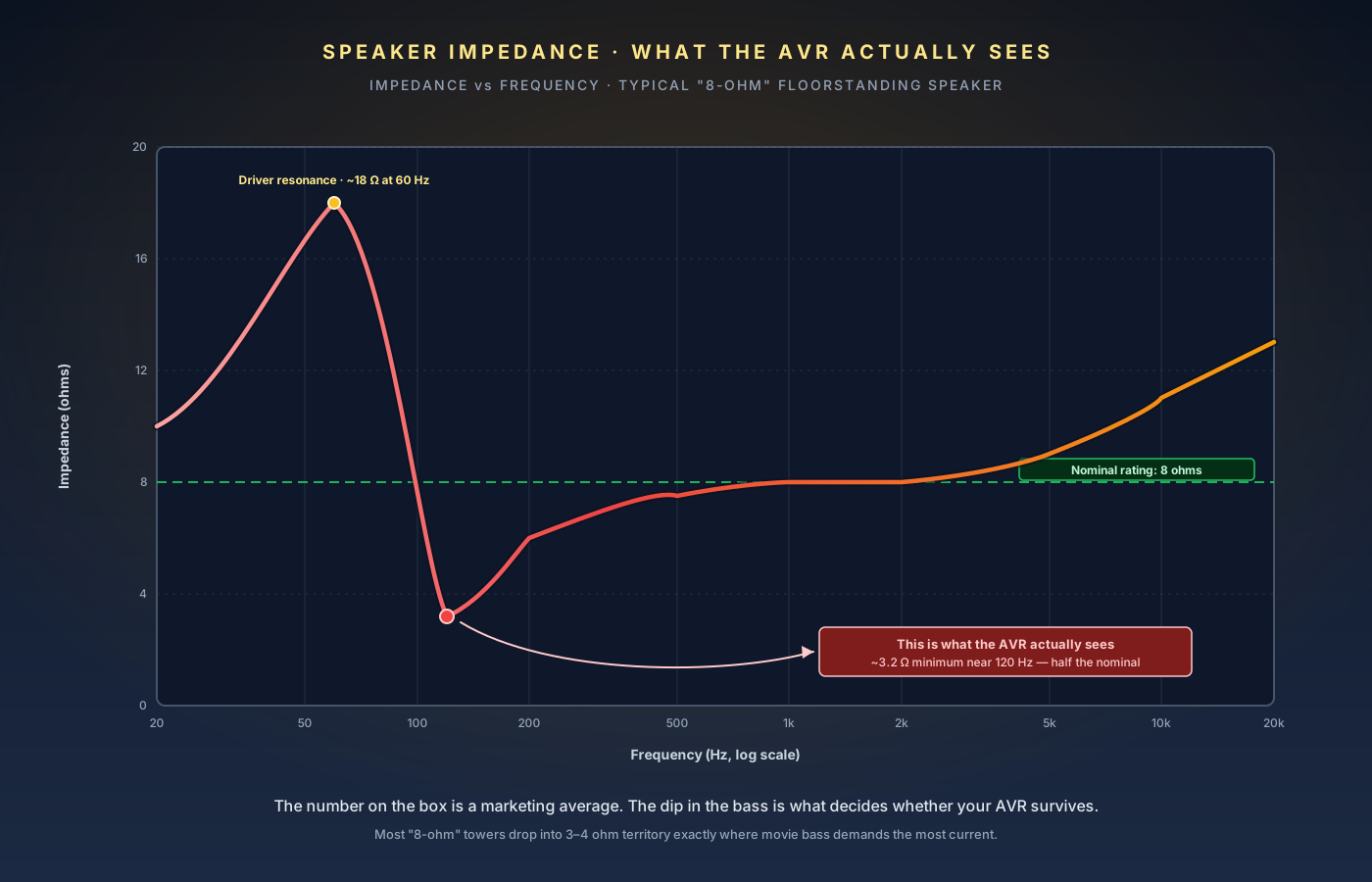
Speaker impedance is the load your AVR has to drive — and the number on the spec sheet is a marketing average that hides the real dip. Here is what the impedance curve actually shows, why a 'nominal 8-ohm' tower can punish a mid-range AVR, and how to pick a receiver that survives the load.
The verdict up front: speaker impedance is the electrical "load" your AVR has to drive, measured in ohms. The number printed on the back of the speaker is a *nominal* rating — a marketing average that obscures the real picture. Every speaker's impedance varies wildly with frequency, dipping low at exactly the frequencies that demand the most current (typically 80–250 Hz). A "nominal 8-ohm" tower can drop to 3 ohms in the bass; a "6-ohm" speaker can sit at 4 ohms for half its operating range. Mid-range AVRs are designed primarily for 6–8 ohm loads. Push them into a 4-ohm dip at high volume and one of three things happens: protection shutdown, audible distortion, or — in rare cases on the cheapest receivers — a fried amp section. This post explains what impedance actually is, why the dip matters more than the nominal rating, how to read AVR power specs honestly, and how to pick a receiver that will reliably drive whatever speakers you buy.
What Impedance Actually Is
Impedance is the opposition a speaker presents to the alternating current flowing from your amplifier. It is measured in ohms (Ω), the same unit as DC resistance, but unlike a resistor's flat value, a speaker's impedance changes constantly with frequency.
The reason is physics. A speaker is not a resistor — it is a complex electrical and mechanical system. Its driver has a coil of wire (an inductor), a moving cone (a mass on a spring), and a crossover network (capacitors and inductors that route the right frequencies to the right drivers). Each of those elements stores or releases energy differently at different frequencies. The combined effect is an impedance curve that looks like a heart-rate trace, not a flat line.
Three things matter on that curve:
The minimum impedance. This is the lowest dip in the curve, almost always somewhere in the upper bass or lower midrange (typically 80–300 Hz). It is the value that decides how much current the amplifier has to deliver, and it is the value that determines whether the amp survives a high-volume bass note.
The phase angle at the minimum. Impedance is a vector with magnitude and angle. A 4-ohm load with a 60-degree phase shift is much harder to drive than a 4-ohm load that is purely resistive, because the amp has to deliver current and voltage that are out of step with each other. Real-world speaker measurements published by Stereophile and ASR include this. Manufacturers do not advertise it.
The nominal rating. The single number printed on the spec sheet. The IEC standard (IEC 60268-5) requires that the minimum impedance not drop below 80% of the nominal rating. So a "nominal 8-ohm" speaker is allowed to dip to 6.4 ohms. In practice, many manufacturers ignore this. Plenty of "8-ohm" speakers measure below 4 ohms at their minimum. The labeling is closer to a guideline than a guarantee.
Ohm's law (V = I × R) makes the current-draw consequence simple. If your amplifier is delivering 10 volts of swing into a 4-ohm dip, it has to supply 2.5 amps of current. The same 10 volts into 8 ohms requires only 1.25 amps. Halving impedance doubles the current demand. Doubling current demand quadruples the heat dissipated by the amp's output transistors (P = I² × R inside the transistor). That heat — not the speaker — is what kills cheap amps.
Why the Industry Uses 8 Ohms
8 ohms became the consumer-audio standard for one reason: it is the load that lets a modest amplifier deliver a respectable voltage swing without melting. Tube amplifiers from the 1950s and early transistor amps from the 1960s could handle 8-ohm loads comfortably. They struggled with 4-ohm loads because the lower impedance demanded more current than their output stages were sized for.
That convention stuck. Today, almost all consumer towers, bookshelves, center channels, and surrounds are sold as 6-ohm or 8-ohm. Almost all mass-market AVRs are designed and rated assuming 6-ohm minimum nominal loads. The only common exceptions are:
- High-end European speakers. Many B&W, Focal, Dynaudio, Magico, and KEF Reference models are explicitly designed as 4-ohm loads with dips down to 2.5–3 ohms.
- Older studio monitors and PA-style speakers. Often 4 ohms by design.
- Some Klipsch Reference Premiere and Heritage models. Officially 8-ohm but with dips into the low-4-ohm range that act like 4-ohm loads from the amplifier's perspective.
If you buy mid-priced consumer speakers — Polk Signature Elite, Klipsch Reference, ELAC Debut/Uni-Fi, Wharfedale Diamond, Q Acoustics, Bowers & Wilkins 600 Series — they are almost certainly nominal 8-ohm or 6-ohm, with minimum dips that the AVR can handle if it is not asked to play at ear-splitting volume.
If you buy higher-end audiophile towers, especially anything with three or more woofers, multiple drivers in parallel, or low-sensitivity ratings (under 87 dB), you are statistically more likely to have a true 4-ohm load that will test a mid-range AVR.
What "4-Ohm Compatible" on an AVR Actually Means
Open the manual of a $700 Denon or Marantz or Yamaha AVR and you will find a sentence like "Capable of driving 4-ohm speakers — set the speaker impedance switch in the menu to LOW." Open the manual of an $1,800 model and the wording shifts to something like "Stable operation with 4-ohm loads, 8-ohm or 6-ohm rated power output." These two sentences describe wildly different products. Here is what is going on.
The impedance menu setting. Mid-range AVRs almost universally include a setting like "Speaker Impedance: 8Ω / 6Ω / 4Ω." Setting it to 4Ω does not magically make the amp stronger. It does one or both of two things:
- Caps the maximum output voltage. The AVR reduces its rail voltage or limits the volume control's maximum gain, so the amplifier never has to deliver enough current to drive a 4-ohm load past its safe operating area. In practice, you lose 3–6 dB of usable headroom on the top end.
- Adjusts the protection circuit's trigger threshold. Some AVRs use the setting to tell the protection system "expect lower impedance, do not shut down as aggressively." This is less restrictive but only delays the shutdown.
Either way, you are not getting a more powerful amp — you are getting either a quieter one or a louder one with a hair-trigger shutoff. The setting is a safety mechanism, not an upgrade path.
FTC and CTA-2010 power ratings. The number on the box ("125W per channel") is calculated under very specific conditions: typically two channels driven, 8 ohms, 20 Hz to 20 kHz, less than 0.08% THD. Drop the load to 4 ohms and the same amp can deliver more power in theory — about 1.5x to 1.8x — but only if the power supply has the current reserves to support it. On most consumer AVRs, the power supply is the bottleneck, and the all-channels-driven output into 4 ohms can actually be less than the two-channel-driven output into 8 ohms.
Real-world stress testing. Audioholics and Crutchfield have measured dozens of AVRs into 4-ohm loads at high output. The pattern is consistent. Entry-level AVRs ($400–$700) can drive 4-ohm speakers at conversation volumes without issue but will protect-shutdown during a loud movie scene. Mid-range AVRs ($800–$1,500) handle 4-ohm loads through normal listening but may run hot and engage thermal protection after an hour of high-volume material. Higher-end AVRs ($1,800+) with discrete output stages, larger toroidal or oversized EI transformers, and active cooling can handle 4-ohm loads indefinitely.
If a "4-ohm compatible" sticker on a $500 AVR is what's making you confident about pairing it with B&W 603 S3 towers, the sticker is selling you confidence the amp cannot back up.
How to Read the Impedance Curve
Real speaker impedance curves are published by independent reviewers, not manufacturers. The two most reliable sources are Stereophile (John Atkinson's measurement section) and Audio Science Review (ASR, which uses a Klippel near-field system). Both publish two key plots:
Magnitude vs frequency. The line graph of how many ohms the speaker presents at every frequency from 20 Hz to 20 kHz.
Phase vs frequency. How far the current lags or leads the voltage. Combined with impedance magnitude, this defines the actual "difficulty" of driving the load.
When you look at these plots, pay attention to:
- The minimum impedance. Anything under 4 ohms in the bass region demands a robust amp.
- Where the minimum sits. A 3.5-ohm dip at 60 Hz (a frequency carried by movie bass) is brutal. A 3.5-ohm dip at 5 kHz (rarely demanded with full power) is less of a concern.
- The "EPDR" or equivalent peak dissipation resistance. Some reviewers calculate this from impedance and phase combined. EPDR below 3 ohms anywhere in the bass region is a flag for "this needs a serious amp."
If the speaker you are considering is not on Stereophile or ASR, ask the manufacturer for the impedance curve directly. A few honest companies (KEF, Genelec, Revel, some Focal lines) publish them on their product pages. Most do not. The absence of a published curve is itself information — it usually means the curve is uglier than the spec sheet implies.
For context, here are nominal vs measured impedance minimums for popular speakers in 2026:
| Speaker | Nominal | Measured minimum | Where the dip sits |
|---|---|---|---|
| Klipsch RP-6000F II | 8 Ω | 3.4 Ω | ~120 Hz |
| Polk Signature Elite ES60 | 8 Ω | 3.8 Ω | ~100 Hz |
| ELAC Debut Reference DFR-52 | 6 Ω | 4.1 Ω | ~150 Hz |
| KEF R5 Meta | 8 Ω | 3.2 Ω | ~70 Hz |
| B&W 603 S3 | 8 Ω | 3.0 Ω | ~80 Hz |
| Focal Aria Evo X No.3 | 8 Ω | 2.9 Ω | ~95 Hz |
| Wharfedale Diamond 12.4 | 6 Ω | 4.6 Ω | ~180 Hz |
| Q Acoustics 5040 | 6 Ω | 4.0 Ω | ~140 Hz |
The takeaway: almost every "8-ohm" floorstander you would actually buy in 2026 is electrically a 4-ohm load through the bass. The KEF, B&W, and Focal entries are arguably 3-ohm loads.
The Three Failure Modes
When an AVR is asked to drive a load it cannot handle at the volume you want, one of three things happens.
1. Protection shutdown. The AVR detects either over-current (the output stage is sourcing more amperage than its safe operating area allows) or over-temperature (heat sink past threshold). It mutes the output and either displays a protect message or just goes silent until you power-cycle it. This is the friendly failure mode — annoying, repeatable, but the amp survives. Most modern AVRs from Denon, Marantz, Yamaha, Onkyo, and Pioneer protect aggressively. The penalty is that loud movie scenes — especially Atmos action mixes with heavy mid-bass content — will drop out at exactly the wrong moment.
2. Audible distortion. The amp is delivering all the current it can, but the load demands more. The output waveform clips — the peaks get flattened — and you hear it as harsh, gritty distortion. Sustained clipping into a low-impedance load also stresses tweeters disproportionately (because clipping shifts spectral energy upward), which is the actual mechanism behind the audiophile cliché that "underpowered amps blow tweeters." A 4-ohm tower paired with an AVR running out of headroom can in fact damage the tower's tweeter over a long enough listening session.
3. Catastrophic failure. Rare on modern AVRs because the protection circuits are good, but possible on the cheapest budget receivers with marginal protection. The output transistors thermally run away — they conduct more current as they heat up, which heats them up more — and either short or open. The result is usually one or two dead channels.
For a vivid demonstration, search YouTube for "AVR thermal shutdown 4 ohm" and you will find dozens of homeowners discovering this with their new home-theater system. The pattern is always the same: bought a "125W per channel" AVR, paired it with attractive-looking 8-ohm-labeled towers from a brand known for low-impedance dips, set the volume to where movie dialogue is intelligible, hit a bass-heavy scene, lost the system mid-movie.
How to Pick an AVR That Survives the Load
A few practical rules.
Look at the all-channels-driven power spec, not the two-channels-driven spec. Some AVRs publish both. Marantz Cinema 50 and Denon AVR-X3800H, for example, list 110W × 2 (8Ω, 0.08% THD) and a separate "Power Output (8Ω, 2ch driven, 0.08% THD): 110W" and "(6Ω, 5ch driven, 0.7% THD): 90W." The latter is closer to reality. If the manufacturer is unwilling to publish all-channels-driven power, that is itself a signal.
Look at the AVR's weight. This sounds like a joke. It is not. The single biggest cost in an AVR's bill of materials is the power transformer and the heat sinks. Both are heavy. A 30-lb AVR has dramatically more power-supply headroom than a 17-lb AVR at the same price tier. A Marantz Cinema 30 weighs 35 lb because of its toroidal transformer; a Yamaha RX-A8A weighs 41 lb for similar reasons; those mass numbers are why those AVRs can drive 4-ohm loads. A featherweight 18-lb AVR at $700 cannot deliver continuous power into a difficult load, regardless of what the back panel sticker says.
Prefer THX Certified Select or Ultra ratings when available. THX-certified amplifiers are spec'd to drive THX-rated speakers (typically 4-ohm minimum) at THX reference level (105 dB peaks at the listening position) without protection shutdown. Not every good AVR has THX certification, but the certification is a real test, not a marketing claim.
Look for an external amplifier pre-out. Mid-range AVRs that include front-channel or all-channel pre-outs let you offload the hardest-working channels (typically front L/R/C) to a separate stereo or multichannel power amp. This is the standard escape hatch when you want a flexible AVR but speakers that need more amp than the AVR has. The pre-outs themselves are inexpensive on the manufacturer's side and their presence indicates the design team expected enthusiasts to upgrade.
Concrete pairings for 2026. A short cheat sheet for current-gen speakers and AVRs:
| Speaker (front L/R) | Minimum AVR class | Notes |
|---|---|---|
| Klipsch RP-6000F II / RP-8000F II | Mid-range ($800+) | Sensitive (96 dB), so power demand is moderate despite the dip. See the Klipsch RP-6000F II review. |
| Polk Signature Elite ES50/ES60 | Entry to mid ($500+) | Mid-sensitivity (88 dB), 4-ohm dip is shallow. Forgiving load. |
| ELAC Debut Reference DFR-52 | Mid-range ($800+) | Stays above 4 ohms. Standard load. |
| KEF R5 Meta / R7 Meta | Higher-end ($1,500+) | Real 3.2-ohm dip and low sensitivity (86 dB). Demands genuine power. |
| B&W 603 S3 / 702 S3 | Higher-end ($1,500+) or separate amp | Notorious 3-ohm dip plus phase nastiness around 80 Hz. The classic "AVR killer." |
| Focal Aria Evo X No.3 / No.4 | Higher-end ($1,800+) or separate amp | True 4-ohm load, low-impedance dip in mid-bass. |
| SVS Ultra Tower (current gen) | Mid-range ($800+) | Friendly 6-ohm load, 4.4 ohm minimum. |
If the AVR you already own is at the entry-level end and you are eyeing speakers from the higher-end row, the answer is not "buy a different AVR." It is "buy the speakers you want and add a $500–$900 multichannel power amp on the L/R/C pre-outs." A used Outlaw Audio Model 7220 or a new Buckeye Hypex 3-channel amp will solve the problem for less than upgrading the entire AVR. We will cover separate power amps in a future post.
When 4-Ohm Speakers Are Worth the Trouble
It is fair to ask whether a 4-ohm speaker is worth the AVR headache at all. The honest answer: usually yes, if the speaker is genuinely good. Here is the trade-off.
Why speaker designers go low-impedance. A speaker's impedance is largely set by the number of woofers wired in parallel, the type of crossover network, and the voice-coil DC resistance of the drivers. To get a deeper, more extended low-frequency response from a tower of a given cabinet size, designers often parallel two or three woofers, which automatically halves or thirds the impedance in the bass region. That is the entire reason B&W 603, KEF R7, Focal Aria, and Klipsch RP-8000F all dip into 3-ohm territory — they have multiple parallel woofers contributing to bass output.
A speaker engineered to stay above 6 ohms across the entire band, with the same cabinet volume, will usually have less bass extension and lower sensitivity. The 4-ohm design is not a flaw. It is a deliberate trade in favor of bass response.
When the trade is wrong for you. If you have an existing AVR you like, no room to add a separate amp, and a listening position close to the speakers, a 6-ohm or 8-ohm tower with a published minimum above 4 ohms is the safer call. ELAC Debut Reference and Wharfedale Diamond series are good examples — they sound good, they cost less, and they will not punish a $700 AVR.
When the trade is right for you. If you are building a dedicated home theater room, you have either a higher-end AVR or budget for a separate power amp, and you are listening at moderate-to-loud volumes, the low-impedance audiophile towers reward the effort. The bass weight, the soundstage depth, the dynamics at scale — those are what the 3-ohm dip is paying for. You are not buying speakers; you are buying the room-filling capability that requires multiple parallel woofers.
The framing that matters is: impedance is a system-level question. Speakers and amps are matched together, not specified in isolation.
Common Misconceptions
A few things people get wrong that deserve correction.
"Lower impedance speakers are louder." False as stated. What matters for loudness is sensitivity (dB SPL per 2.83V at 1 meter), not impedance. A 4-ohm 84 dB speaker is quieter per watt than an 8-ohm 90 dB speaker. The reason 4-ohm speakers sometimes seem louder is that 2.83V into 4 ohms is 2 watts, while 2.83V into 8 ohms is 1 watt — the standard sensitivity measurement gives the 4-ohm speaker a 3 dB head start that is purely a measurement artifact. When equalized for actual watts delivered, sensitivity is sensitivity.
"Connecting two 8-ohm speakers in parallel makes them 4 ohms — that's fine." Risky. Parallel wiring of two speakers to one AVR channel is generally discouraged because it does drop the impedance and it makes the load reactance even more complex. Multi-zone B speakers on dedicated speaker A+B outputs handle this with internal protection. Manually paralleling two pairs of towers to the same channel is a way to find your AVR's protection circuit fast.
"A more powerful AVR has more current." Not necessarily. AVR power ratings are measured into 8 ohms with limited channels driven. A 125W × 7 AVR might deliver 200W into a single channel at 4 ohms — or it might collapse to 80W. The power-supply transformer's VA rating matters more than the per-channel wattage. Heavy AVR = more current; light AVR = less current; per-channel marketing wattage tells you less than you would think.
"Tube amps don't care about impedance." They care differently. Tube amps use output transformers with specific taps for 4, 8, and 16 ohms. They are far more tolerant of mismatch than solid-state amps (the worst-case is suboptimal power transfer, not destruction), but they are also rare in home-theater contexts and outside the scope of an AVR discussion.
"Bi-amping doubles the power." It does not. Bi-amping (using two AVR channels per speaker, one for highs, one for lows) splits the existing power between two channels of the same AVR, drawing from the same power supply. The benefit is marginal — slightly lower distortion at extreme levels — and it costs you two channels you could use for surrounds. A separate dedicated stereo amp on the L/R is dramatically better than bi-amping from the AVR.
Quick FAQ
Can I run my 4-ohm speakers with an entry-level AVR if I just keep the volume down?
Yes, but you are leaving headroom on the table. At moderate listening volumes (60–75 dB average), most entry-level AVRs will not have issues with a 4-ohm load. The problem appears on movie peaks (95–105 dB SPL peaks at the listening position), which is where bass-heavy mid-impedance dips cause shutdowns. If you watch movies quietly, a $500 AVR with 4-ohm speakers is fine. If you watch them loud, it is not.
Does the impedance switch on the back of my AVR actually do anything?
Yes — it caps maximum output voltage to reduce current demand. It does not increase the amp's capability. Treat it as a safety brake, not a tuning option. Most online communities and manufacturer support staff recommend leaving it on 8Ω even when running 6-ohm speakers, because the protection circuit will catch genuine over-current regardless.
My speaker says "4–8 ohms" on the back. What does that mean?
It is a non-answer. The manufacturer is telling you the impedance varies (which is true of every speaker) without committing to a nominal rating. Look up an independent measurement or assume it is a real 4-ohm load and amp accordingly.
Do passive subwoofers count toward this calculation?
Yes, but most home theater subs are powered (active) and connect via line-level RCA to the AVR's LFE output, not via speaker wire. Powered subs do not present an impedance load to the AVR. Only the rare passive sub driven from the AVR's speaker outputs counts.
Are Atmos height speakers easier to drive?
Generally yes. Ceiling speakers and upfiring modules are usually smaller, single-driver designs with simpler crossovers, and they almost always stay 6–8 ohms with shallow dips. The L/R/C trio is where impedance demands are concentrated.
How does this interact with bi-wiring vs single-wiring?
It does not. Bi-wiring (using two pairs of speaker cables but a single amplifier channel per speaker) does not change the impedance the amp sees. It is mostly an aesthetic choice. Bi-amping (two amp channels per speaker) splits frequencies but, as noted above, does not double power.
Bottom Line
The number on the box is a hint. The dip in the impedance curve is the reality. Most current-gen "8-ohm" home-theater towers dip into 3- to 4-ohm territory in the upper bass, and most mid-range AVRs can handle that load at normal listening volumes but will protect-shutdown at theater reference levels.
The two practical rules:
- For "8-ohm" speakers with no published curve and a price under $1,500/pair, a $800–$1,500 mid-range AVR (Denon AVR-X3800H, Marantz Cinema 50, Yamaha RX-A6A) is almost certainly enough.
- For speakers from KEF, B&W, Focal, and high-end ELAC or Wharfedale, either move up to a $1,800+ AVR with a serious power supply (Marantz Cinema 30, Denon AVR-X6800H, Anthem MRX 1140) or pair a mid-range AVR with a separate stereo power amp on the L/R pre-outs.
The most expensive mistake in home-theater purchasing is matching premium speakers to a budget AVR and discovering — usually one explosion into a 4-ohm dip later — that the cheap part has to be replaced anyway. Spend the impedance research time before you buy, not after.
Related:
Amazon picks for AVRs that handle real 4-ohm loads (affiliate links use tag `webstore0fd1-20`):
- Denon AVR-X3800H — solid 9.4-channel option for mixed 6/8-ohm and shallow 4-ohm dips.
- Marantz Cinema 50 — toroidal transformer, comfortable with 4-ohm towers at high SPL.
- Yamaha RX-A6A AVENTAGE — heavy chassis, robust power supply, handles low-impedance loads reliably.
- Marantz Cinema 30 — flagship-class for the most demanding speakers and dedicated rooms.
When you cross into actual 3-ohm-and-below territory, the better answer is a mid-range AVR plus a separate multichannel power amp on the front channels. That comparison is its own future post.
Affiliate disclosure: NetAudioHub links to retailers including Amazon. We earn a small commission on qualifying purchases at no extra cost to you.