Polk Reserve R350 Review: A Very Good Speaker Aimed the Wrong Way
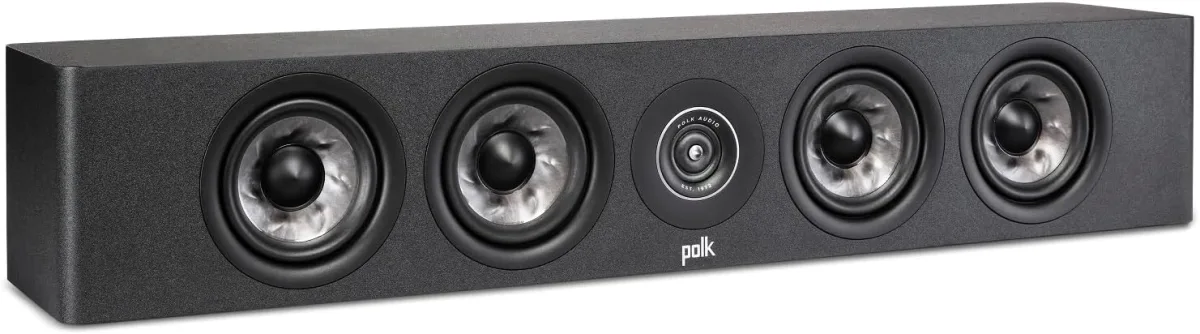
The Polk Reserve R350 is a genuinely well-made speaker that is very hard to recommend for the job printed on the box. It is beautifully finished, it is only 5.5 inches tall, it is the only wall-mountable center in Polk's Reserve line, and its four small woofers give it power handling that a compact center cannot match. On-axis it measures well and sounds clean. The problem is geometry. Spreading four woofers across 30 inches of baffle on either side of a tweeter guarantees that those woofers cancel one another for anybody not sitting directly in front of the speaker, and independent anechoic measurement of this exact model found an unusually severe case of it, with energy draining out of a wide band from roughly 200 Hz to 2 kHz as soon as you move off the center seat. That band is where dialogue lives, and dialogue is the entire reason a center channel exists. Polk also markets a second use for the R350: rotate it vertically and run a pair as left and right. In that orientation the same measurements are good, because the cancellation moves into the vertical plane where nobody's head goes. So this is a speaker with a real and legitimate use case that is not the one its name describes. Buy two and stand them up. If you need a center channel, Polk's own R400 is the better speaker and was cheaper than the R350 on Amazon the day we checked.
✅ Pros
- +Genuinely excellent on-axis measured performance — clean tonality with no obvious need for EQ
- +Outstanding power handling and distortion behaviour for its size, thanks to four drivers sharing the load
- +Sealed enclosure means bass compresses gracefully at volume instead of collapsing
- +The only wall-mountable center in Polk's Reserve line, with keyhole slots for horizontal or vertical mounting
- +Only 5.5" tall and 7.4" deep — fits under a wall-mounted TV or on a shallow shelf where nothing else in this class will
- +Excellent build: cross-braced cabinet, magnetic anti-diffraction grille, nickel-plated five-way binding posts
- +Three finishes including white, which is rare in home theater speakers
- +Measures well and works genuinely nicely when used vertically as a left or right channel, which is Polk's own secondary recommendation
❌ Cons
- −Independent Klippel anechoic measurement concludes it is unsuitable as a center channel for anyone not seated dead centre, with energy lost across roughly 200 Hz to 2 kHz off-axis
- −That loss band is the dialogue band — the single job a center channel exists to do
- −Four woofers spread across a 30-inch baffle is the worst-case geometry for horizontal lobing; Polk's staggered 1,400 Hz crossover mitigates it but does not solve it
- −Worst bass extension of the three Reserve centers at 75 Hz (−3 dB), despite being the widest and costing $150 more than the R300
- −Headline "50 Hz – 50 kHz" spec carries no stated tolerance and is 25 Hz optimistic versus Polk's own −3 dB figure
- −Polk's own spec table says "IMAX Certified: No" while the Amazon listing sells it as "IMAX Enhanced"
- −At $649 it is priced above the better-measuring, better-extending R400, which was cheaper on Amazon the day we checked
- −30 inches wide will not fit on many TV stands or under many wall mounts, which partly defeats the slim-profile purpose
- −Sold individually, so a vertical L/R pair is $1,298 and you still need a center
Key Specs at a Glance
| Spec | Detail |
|---|---|
| Type | Passive low-profile L/C/R center channel, sold individually |
| Price | $649 MSRP; $649.00 on Amazon at the time of writing |
| Tweeter | 1" Pinnacle Ring Radiator |
| Woofers | Four 4" Turbine Cone |
| Overall Frequency Response | 50 Hz – 50 kHz (tolerance not stated) |
| Frequency Response (−3 dB) | 75 Hz – 35 kHz |
| Crossover, tweeter to mid | 2,700 Hz |
| Crossover, mid to mid-bass | 1,400 Hz |
| Sensitivity | 87 dB (2.83 V / 1 m) |
| Minimum Impedance | 3.9 Ω (rated for 8/6/4 Ω amplifier outputs) |
| Recommended Amp Power | 25 – 200 W |
| Enclosure | Fully sealed, no port |
| Dimensions (W×H×D) | 30" × 5.5" × 7.4" (762 × 141 × 187.5 mm), including feet |
| Weight | 20 lb (9 kg) each |
| Wall-Mountable | Yes, keyhole slots, horizontal or vertical |
| Binding Posts | Single pair, nickel-plated 5-way |
| Hi-Res Certified | Yes |
| IMAX Certified | No, per Polk's own spec table |
| Finishes | Black, Walnut, White |
What Polk Actually Built
The Reserve range is Polk's step-up line, above Signature Elite and below Legend. It contains three center channels, and the R350 is the odd one out.
The R300 is a conventional compact center: two 5.25-inch woofers flanking a tweeter, 19 inches wide, $499. The R400 is the big one: two 6.5-inch woofers, 24.2 inches wide, ported, 32.8 pounds, $699. The R350 sits between them at $649 and takes a completely different approach. Instead of two larger woofers it uses four small ones, and instead of a deep box it uses a very shallow one — 5.5 inches tall and 7.4 inches deep, but 30 inches wide. It is the widest speaker in the Reserve line and the shallowest.
That shape is the product. It exists to fit under a wall-mounted TV or on the thin shelf of a modern media console where a 13.8-inch-deep R400 simply will not go, and it is the only Reserve center with keyhole mounts so you can hang it. Polk's drivers are the same ones used across the range: the Pinnacle Ring Radiator tweeter with its distinctive pointed center, and the Turbine Cone woofer with its molded rib geometry. Build quality is genuinely good. The cabinet is cross-braced, the grille is magnetic, and the binding posts are proper nickel-plated five-ways.
Polk also pitches a second use, and this turns out to matter a great deal. From Polk's own product page: "it serves beautifully as a center channel and it can also be used as your left and right channel as needed. Just flip the speaker vertically and you get a multi-transducer Left or Right channel speaker."
Hold on to that sentence. We are going to come back to it.
The Number Polk Puts First, and the Number Polk Puts Second
Polk's spec table lists two frequency-response figures, and the gap between them is the largest we have seen on a current speaker page.
The headline number is 50 Hz – 50 kHz. No tolerance is attached to it. Two rows below, the table gives "Frequency Response (−3 dB limits): 75 Hz – 35 kHz."
Seventy-five hertz is the real number. The 50 Hz figure is at some unstated and much looser tolerance, and a 25 Hz difference at the bottom of the range is not a rounding detail — it is the difference between a speaker that can carry male dialogue and low music unassisted and one that cannot. To be fair to Polk, it does publish the honest figure, in the same table, for anyone who scrolls. Plenty of manufacturers do not. But the ordering is not an accident.
Two consequences follow. First, the R350 is a sealed box with no port, which means its roll-off below 75 Hz is a gentle 12 dB per octave rather than the steeper cliff of a ported design, so it degrades gracefully rather than falling off a shelf. Second, you must cross it over to a subwoofer. Set your receiver's center channel crossover to 80 Hz and leave it there — our explainer on the 80 Hz crossover covers why that specific number is the default, and our crossover how-to walks through setting it per channel. Running the R350 as "Large" with no sub is not an option this speaker supports.
There is a mirror-image problem at the top. Polk's Hi-Res marketing copy on the same page claims "a minimum support of 40kHz." The −3 dB ceiling in the spec table is 35 kHz. Neither number is audible, so this one is trivia rather than a real complaint, but it is the same pattern twice on one page.
It is also worth noting how the R350 compares to its own siblings on this measure, because the result is counterintuitive. The 30-inch R350 reaches 75 Hz. The 19-inch, $150-cheaper R300 reaches 65 Hz. The 24.2-inch R400 reaches 48 Hz. The widest, most expensive-looking center in the line has the least bass extension of the three, because width is not volume — the R350's cabinet is only 5.5 inches tall and 7.4 inches deep, and that is what sets its internal air volume. You are paying for the form factor, not for output.
Where the IMAX Badge Comes From, and Where It Does Not
Polk's own spec table for the R350 contains this row:
IMAX Certified: No.
The Amazon listing title for the same speaker reads, in part, "Dolby Atmos & IMAX Enhanced." The third bullet under "About this item" repeats it: "Hi-Res Audio Cert, Dolby Atmos & IMAX Enhanced." And Polk's own product page, several screens above its own spec table, carries a feature heading that says "IMAX Enhanced Compatible" with copy promising "an unforgettably huge and dynamic home theater experience."
This is not a case of a retailer embellishing a manufacturer's claim. Polk publishes both statements on the same page, and the load is being carried entirely by the word "compatible." IMAX Enhanced is a licensed certification program with a published loudspeaker specification — one that Polk itself helped write during the development of its Legend series. Certification is a thing a manufacturer either has for a given model or does not.
The clean way to see it is to look across Polk's own line. Pull up the three Reserve center channels and read the same row on each spec table:
| Model | Polk's own "IMAX Certified" row |
|---|---|
| Reserve R300 | No |
| Reserve R350 | No |
| Reserve R400 | Yes |
Polk knows exactly which of its centers are certified, publishes the distinction accurately, and then markets the uncertified one with a word that sounds like the certification. If IMAX Enhanced matters to you, the R400 is the one that has it.
While we are here: the same Amazon bullet claims the R350 "support[s] DSD, WAV, ALAC, MQA." The R350 is a passive loudspeaker with two binding posts. It has no decoder, no DAC, and no concept of a file format. That bullet is boilerplate copied across a product line, and it is harmless, but it is a reasonable signal of how carefully the listing was written.
The Real Problem: Four Woofers and One Couch
Everything above is a quibble. This section is the review.
In October 2021, Amir Majidimehr at Audio Science Review put an R350 on a Klippel Near-field Scanner — a robotic rig that takes over a thousand measurements around a speaker and mathematically removes the room, producing anechoic data more accurate than most anechoic chambers. The results are the only independent, standards-compliant measurements of this speaker we are aware of, and they are not ambiguous.
On-axis, the R350 is fine. In Amir's words: "While the are some wiggles on-axis, our ears are not very sensitive to them so overall tonality should be very good."
Then the directivity data arrives. "Directivity Index though gets messy around 1 kHz," and in the early-reflections window, "We are losing energy in a wide band from 200 Hz to 2 kHz." The cause is stated plainly: the horizontal response "is backward of typical 2-way speaker and is caused by the extended 'MTM' configuration of this speaker," with cancellation occurring between the mid-woofers depending on the listening angle.
The listening test matched the graphs. Amir sat 8 to 9 feet back — a normal viewing distance — and moved one seat over. "Wow, was this a dramatic change. Despite sitting some 8 to 9 feet away (3 meters), just moving one seating position would cause a massive suck out in response. You would hear bass and treble but the middle would fall out causing a somewhat hollow sound."
His conclusion: "This completely rules out this speaker for its intended purpose: center speaker. Unless you are single and listen in one spot, the R350 simply is not good for this use." And: "As it is, I can't recommend the Polk Reserve R350."
Before going further, the obvious objection: that measurement is from 2021. It still applies, and here is why we are confident. The R350 we bought a listing for this week is the same ASIN Amir's loaner would have carried, B092RB85VT, a 2021-era identifier. Polk's part number is still 300031. The published spec table — driver complement, crossover points, −3 dB limits, cabinet dimensions, sealed enclosure — is identical to what Polk published then. There is no R350 II and no revision note anywhere on Polk's site. This is the same speaker, still on sale, at a price that has gone up rather than down; Amir quoted $599 in 2021 and Amazon lists $649 today.
Why the Off-Axis Problem Is Worse Than It Sounds
It is worth understanding the mechanism, because it tells you exactly who this speaker will and will not work for, and because you can check the arithmetic yourself.
When two drivers reproduce the same signal from different points on a baffle, a listener off to one side hears one of them slightly later than the other. At the frequency where that delay equals half a wavelength, the two arrivals cancel. The null frequency is f = c / (2 d sin θ), where c is the speed of sound, d is the centre-to-centre distance between the two drivers, and θ is your angle off the speaker's axis.
Everything in that equation works against a wide center channel. The bigger d gets, the lower the first null falls — and a 30-inch baffle makes d very large indeed.
Polk does not publish driver positions, so we estimated them from the published 30-inch cabinet width and Polk's own product photography: roughly 16.5 inches between the centres of the outer woofer pair, and roughly 7.5 inches between the inner pair. Those are estimates, and the table below is illustrative physics rather than measurement. But it lands in the right place, which is the point.
| Seat offset at 10 ft | Angle off axis | Outer-pair null | Inner-pair null |
|---|---|---|---|
| 1 ft | 5.7° | 4,113 Hz | 9,048 Hz |
| 2 ft | 11.3° | 2,087 Hz | 4,590 Hz |
| 3 ft | 16.7° | 1,424 Hz | 3,133 Hz |
| 4 ft | 21.8° | 1,102 Hz | 2,424 Hz |
| 5 ft | 26.6° | 915 Hz | 2,013 Hz |
| 6 ft | 31.0° | 795 Hz | 1,750 Hz |
Read the third row. A listener three feet off centre — the middle cushion of a three-seat sofa, in other words, not some extreme corner seat — puts a cancellation at about 1,424 Hz. That is squarely inside the band that carries consonant definition and vocal presence. By five feet off, there are nulls at roughly 915 Hz and 2,013 Hz simultaneously, which is why the effect reads as "hollow" rather than merely "dull." And both of those figures sit comfortably inside the 200 Hz to 2 kHz loss band the Klippel data actually measured, which is a reassuring sign that the simple model is describing the right phenomenon.
Polk did try to mitigate this. Look again at the spec table: there are two crossover points, 2,700 Hz and 1,400 Hz. That second figure is the tell. Rolling the outer woofer pair off early, so that only the inner pair carries up through the midrange, is the textbook fix for exactly this problem — it effectively shrinks d as frequency rises. Polk applied the standard remedy. The measurements say it was not enough, which is unsurprising given how much baffle there is to work with.
One thing this section is not saying: that Polk is uniquely at fault, or that other horizontal centers are immune. Any center channel with woofers flanking a tweeter has this geometry, including the Klipsch RP-504C II we reviewed and liked, which also uses four woofers in a horizontal array. Klipsch's 90°×90° Tractrix horn takes control of dispersion above its 1,950 Hz crossover, which helps in the treble, but we have not seen independent spinorama data for that model and we are not going to claim it escapes the physics below the crossover. What makes the R350 notable is that it has been measured, the measurement is severe, and the cabinet is unusually wide. If you want a center that avoids the problem structurally rather than mitigating it, the answer is a three-way design with a dedicated midrange driver, or a coaxial mid-tweeter — which is precisely what Amir recommends and what none of Polk's Reserve centers offer.
The Orientation Nobody Reads the Box For
Here is the part that turns this from a hit piece into a buying recommendation.
Buried in the same measurement set, immediately after the horizontal data, is this: "As noted, vertically the situation is pretty good actually."
Of course it is. Rotate the R350 ninety degrees and the four woofers stack in a vertical column. The cancellation does not disappear — it moves into the vertical plane, where the only thing that changes your angle is standing up. Horizontally, a vertical array behaves like a single narrow source and radiates evenly across the couch. This is the reason serious floorstanders stack their drivers vertically and the reason horizontal centers have been a known compromise for thirty years.
And it is exactly what Polk suggests on its own product page: flip it vertically and use it as a left or right channel. Amir agrees without hedging: "Using vertically on each side of the speaker is fine."
So the R350 has a real, well-supported use case. A pair of them, stood on end, flanking a wall-mounted TV, wall-hung on their keyhole slots, is a legitimately good and genuinely unusual product — a 5.5-inch-deep main speaker with four woofers of cone area and 87 dB sensitivity that disappears against a wall. Very little else does that. If you are building around a wall-mounted display and depth is your binding constraint, this is a speaker worth knowing about.
The catch is the price of admission. Two R350s is $1,298 before you have bought a center at all, and you will still want one — the same physics that makes a vertical pair work makes a horizontal R350 a poor center. Which means the honest version of the R350 recommendation is: buy two, use them vertically as mains or as large surrounds, and buy something else for the centre.
Living With It: Power, Placement, and Amplifier Load
If you buy one anyway, a few practical notes.
Amplifier load. Polk publishes a 3.9 Ω minimum impedance and 87 dB sensitivity. That is a moderately demanding combination and it runs in the family — the Polk Reserve R200 bookshelf we reviewed posts almost identical figures. It is not a hard load in absolute terms, but it is not the easy 8 Ω, 96 dB ride a Klipsch Reference Premiere gives a receiver. A midrange AVR like the Denon AVR-S770H will drive it in a normal room; if you are running a full Reserve system at volume in a large space, a Denon AVR-X3800H or similar has more margin. Our 4 Ω vs 8 Ω impedance guide and speaker sensitivity explainer cover what those two numbers actually cost you in amplifier terms.
Power handling. This is the R350's real strength and it deserves credit. Four drivers share the excursion that two would otherwise do alone, and it shows: "Power handling was very good and I could not get the speaker to become distorted at listening levels I could tolerate." The sealed cabinet helps here too — with no port to unload the drivers, "low frequency response doesn't fall apart as we crank up the volume." For loud action movies in a mid-sized room, the R350 will not audibly strain.
Placement. If you must use it as a center, get it as close to ear height and as on-axis as you can, and accept that you are optimising for one seat. Toe-in does not help a horizontal array the way it helps a conventional speaker, because rotating the cabinet moves every seat's angle at once. Aim it at the primary seat. If your room has a single central listening position, the R350's weaknesses genuinely may not bother you — Amir's caveat was "unless you are single and listen in one spot," and that caveat is doing real work. It is also worth running room correction afterward; our Audyssey calibration how-to and room correction comparison cover the process, though be clear-eyed that no room correction system can fix a cancellation null — EQ cannot boost energy that two drivers have subtracted from each other.
Level matching. Whatever you do with it, set channel levels and distances properly afterward. Our SPL meter guide walks through it, and if the R350 is joining an existing system, our 5.1 setup guide covers the whole chain. The single pair of binding posts takes ordinary cable; 14 AWG is plenty at typical center-channel runs, and banana plugs make the shallow rear panel much easier to work behind.
Pros
- Genuinely excellent on-axis measured performance — clean tonality with no obvious need for EQ
- Outstanding power handling and distortion behaviour for its size, thanks to four drivers sharing the load
- Sealed enclosure means bass compresses gracefully at volume instead of collapsing
- The only wall-mountable center in Polk's Reserve line, with keyhole slots for horizontal or vertical mounting
- Only 5.5" tall and 7.4" deep — fits under a wall-mounted TV or on a shallow shelf where nothing else in this class will
- Excellent build: cross-braced cabinet, magnetic anti-diffraction grille, nickel-plated five-way binding posts
- Three finishes including white, which is rare in home theater speakers
- Measures well and works genuinely nicely when used vertically as a left or right channel, which is Polk's own secondary recommendation
Cons
- Independent Klippel anechoic measurement concludes it is unsuitable as a center channel for anyone not seated dead centre, with energy lost across roughly 200 Hz to 2 kHz off-axis
- That loss band is the dialogue band — the single job a center channel exists to do
- Four woofers spread across a 30-inch baffle is the worst-case geometry for horizontal lobing; Polk's staggered 1,400 Hz crossover mitigates it but does not solve it
- Worst bass extension of the three Reserve centers at 75 Hz (−3 dB), despite being the widest and costing $150 more than the R300
- Headline "50 Hz – 50 kHz" spec carries no stated tolerance and is 25 Hz optimistic versus Polk's own −3 dB figure
- Polk's own spec table says "IMAX Certified: No" while the Amazon listing sells it as "IMAX Enhanced"
- At $649 it is priced above the better-measuring, better-extending R400, which was cheaper on Amazon the day we checked
- 30 inches wide will not fit on many TV stands or under many wall mounts, which partly defeats the slim-profile purpose
- Sold individually, so a vertical L/R pair is $1,298 and you still need a center
How It Compares
All figures below come from each manufacturer's own published specifications. One caution on reading across the table: Polk quotes "−3 dB limits" while Klipsch quotes a ±3 dB window, and those are not identical conventions, so treat the low-frequency column as indicative rather than a strict ranking between brands. Within the three Polk models, the comparison is apples to apples.
| Polk R350 | Polk R400 | Polk R300 | Klipsch RP-504C II | |
|---|---|---|---|---|
| Price (MSRP) | $649 | $699 | $499 | $799 |
| Drivers | 4 × 4" + 1" tweeter | 2 × 6.5" + 1" tweeter | 2 × 5.25" + 1" tweeter | 4 × 5.25" + 1" horn tweeter |
| Low end | 75 Hz (−3 dB) | 48 Hz (−3 dB) | 65 Hz (−3 dB) | 50 Hz (±3 dB) |
| Sensitivity | 87 dB | 89 dB | 86.5 dB | 96 dB |
| Minimum impedance | 3.9 Ω | 4.1 Ω | 3.8 Ω | 8 Ω nominal |
| Enclosure | Sealed | Dual rear X-ports | Sealed | Rear Tractrix port |
| Width | 30" | 24.2" | 19" | 32.2" |
| Depth | 7.4" | 13.8" | 8.9" | 15.1" |
| Weight | 20 lb | 32.8 lb | 16.8 lb | 36.3 lb |
| Wall-mountable | Yes | No | No | No |
| IMAX Certified | No | Yes | No | Not claimed |
| Our rating | 3.5 / 5 | Not reviewed | Not reviewed | 4.5 / 5 |
The R400 is the interesting column. It is deeper and heavier and will not hang on a wall, but it reaches an octave lower, is 2 dB more sensitive, carries the IMAX certification the R350 does not, and uses two woofers instead of four in a cabinet six inches narrower — which is a structurally less severe version of the same geometry, not a cure for it, but meaningfully better odds. At the time of writing the walnut R400 was $629.99 on Amazon, sold by Amazon, against $649.00 for the R350; the black was $699.00 from a third-party seller. Both R400 finishes showed low stock, so treat those prices as a snapshot rather than a standing offer.
Check the price of the Polk Reserve R400 on Amazon → — or see all Polk Reserve center channel listings if stock has moved.
If you are willing to go up to $799 and depth is not your constraint, the Klipsch RP-504C II is the more capable speaker outright and its 96 dB sensitivity makes it far easier on a receiver. And if you are still deciding whether you need a discrete center at all, our piece on that question is worth ten minutes — for a narrow room with a two-seat couch, a well-matched pair of bookshelves run as a phantom center genuinely can beat a compromised horizontal one, and it sidesteps this entire problem.
Who Should Buy It
Buy a pair and stand them vertically if: you are building around a wall-mounted TV, depth is your binding constraint, and you want real multi-driver main or surround speakers that sit almost flush. This is the R350's best use and it is well supported by the measurements. Budget $1,298 for the pair plus a separate center.
Buy one as a center only if: you have a single primary seat, you sit on-axis, and nothing deeper than 7.4 inches will physically fit. In a one-chair room the off-axis behaviour genuinely may not matter to you. Go in knowing that is the trade.
Buy something else if: you have a sofa. That is most people. The R400 is the better center from the same brand at a similar price, the RP-504C II is the better center outright, and both are easier recommendations than a speaker whose own independent measurements say it does not do the job.
The Bottom Line
The Reserve R350 is a case study in how a design constraint can quietly eat a product. Polk needed a center channel thin enough to live under a wall-mounted TV, and the only way to get the cone area without depth was to go wide and use four small drivers. The cabinet work is good, the drivers are good, the on-axis measurements are good, and the power handling is better than good. Every individual decision was defensible.
But the resulting geometry — four woofers spread across two and a half feet of baffle, flanking a tweeter, reproducing dialogue for a room full of people sitting at different angles — is the one arrangement a center channel should avoid, and independent measurement confirms it is a severe case rather than a theoretical one. Polk saw it coming and staggered the crossover at 1,400 Hz to fight it. It was not enough.
What saves the R350 from being simply a bad product is that Polk also tells you, on its own product page, about the orientation in which it works well. Stand it on end, use a pair as left and right, and the same speaker measures cleanly and does something almost nothing else does. That is a real recommendation, and it is why this earns 3.5 out of 5 rather than something lower.
Just do not buy it for the job in its name. For that, spend less on Polk's own R400 and get more speaker.
Check the current price of the Polk Reserve R350 on Amazon →
Our Verdict
The Polk Reserve R350 is a genuinely well-made speaker that is very hard to recommend for the job printed on the box. It is beautifully finished, it is only 5.5 inches tall, it is the only wall-mountable center in Polk's Reserve line, and its four small woofers give it power handling that a compact center cannot match. On-axis it measures well and sounds clean. The problem is geometry. Spreading four woofers across 30 inches of baffle on either side of a tweeter guarantees that those woofers cancel one another for anybody not sitting directly in front of the speaker, and independent anechoic measurement of this exact model found an unusually severe case of it, with energy draining out of a wide band from roughly 200 Hz to 2 kHz as soon as you move off the center seat. That band is where dialogue lives, and dialogue is the entire reason a center channel exists. Polk also markets a second use for the R350: rotate it vertically and run a pair as left and right. In that orientation the same measurements are good, because the cancellation moves into the vertical plane where nobody's head goes. So this is a speaker with a real and legitimate use case that is not the one its name describes. Buy two and stand them up. If you need a center channel, Polk's own R400 is the better speaker and was cheaper than the R350 on Amazon the day we checked.
Ready to buy the Polk Audio Reserve R350?
Buy on Amazon →Affiliate link — we may earn a commission at no extra cost to you.