Sealed vs Ported Subwoofers: Which Bass Is Right for Your Room?
Published 2026-07-25 · By NetAudioHub Editorial
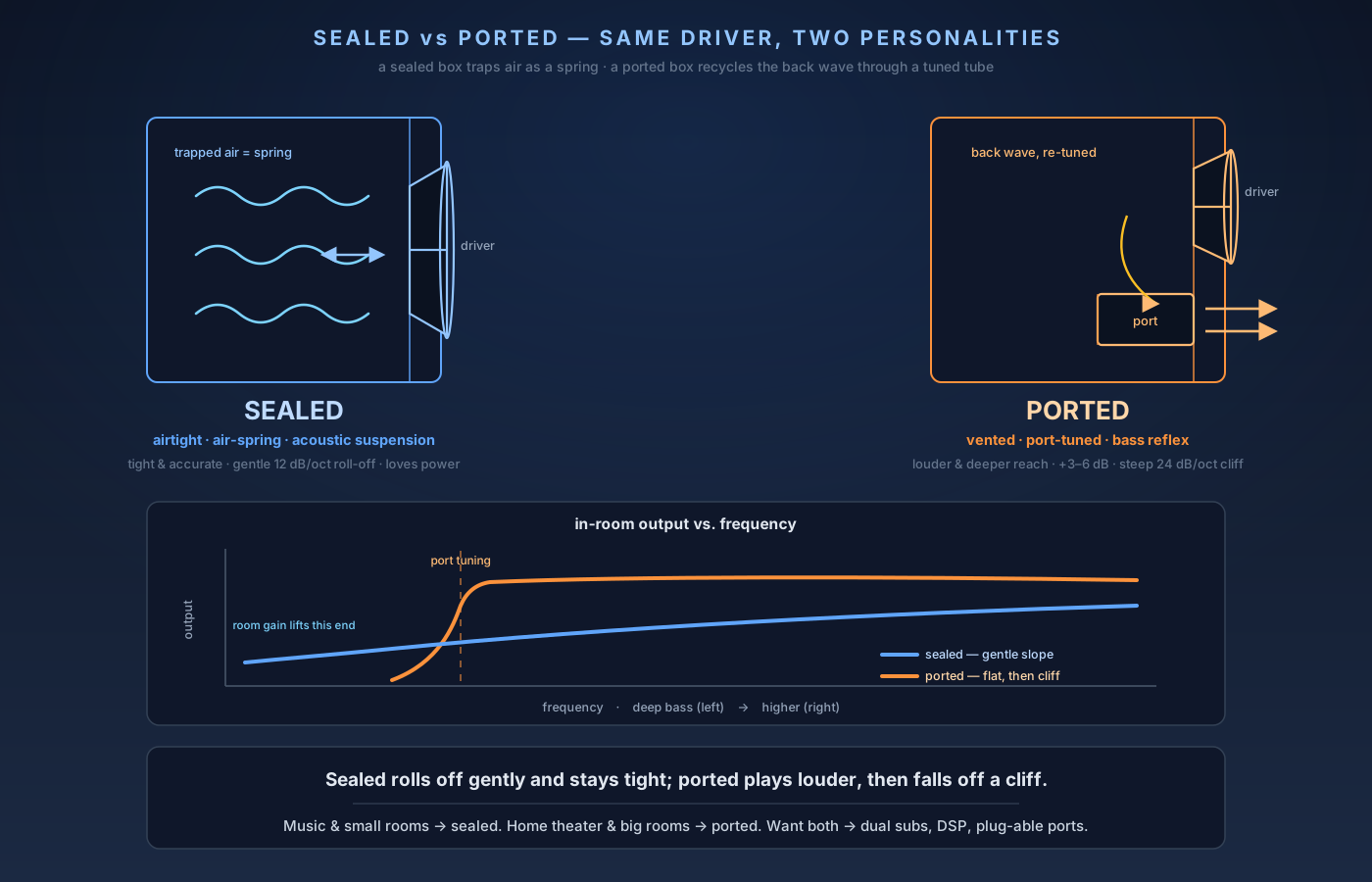
A sealed sub traps air as a spring — tight, accurate, and deceptively deep in a real room. A ported sub adds a tuned tube that recycles the back wave into extra output — louder and more efficient, with a hard cliff below its tuning frequency. Here's how each one actually works, what blurs the line (room gain, DSP, passive radiators, dual subs), and which to buy for music vs. movies.
The verdict up front: a sealed subwoofer is an airtight box where the trapped air acts like a spring on the driver. It rolls off gently, stays tight and accurate on quick bass notes, and — because that gradual slope tends to line up with the natural bass boost of a room — it often reaches deeper in your actual room than the spec sheet suggests. A ported subwoofer adds a tuned tube (the port) that recycles the driver's rear sound wave into extra output near the port's tuning frequency. That makes it noticeably louder and more efficient, especially for the low, chest-hitting rumble in movies — but below the port's tuning point its output falls off a cliff. The short version: buy sealed if you care most about tight, accurate bass, listen mostly to music, or have a small-to-medium room; buy ported if you want maximum movie slam and volume, have a larger room, or love feeling the low end. Everything else — room gain, DSP, passive radiators, and running two subs — is about bending those two default personalities toward each other. Here's how each one actually works and how to pick.
What the Enclosure Actually Does
A subwoofer driver is a cone that moves back and forth to push air. The problem is that a cone radiates sound from both sides — the front and the back — and those two waves are out of phase. Let them meet in open air and they cancel, killing your bass. The whole job of a subwoofer cabinet is to do something useful with that backward-firing wave. Sealed and ported enclosures solve it two different ways, and that single design choice drives every difference you'll hear.
A sealed subwoofer (also called acoustic suspension) simply traps the back wave inside an airtight box. That sealed pocket of air behaves like a spring: as the cone pushes in, the air resists; as it pulls out, the air helps pull it back. This air-spring adds control. The driver can't overshoot, so bass notes start and stop crisply. The trade-off is efficiency — the trapped back wave is energy that's absorbed and turned into heat rather than sound, so a sealed sub needs more amplifier power to hit the same loudness as a ported design.
A ported subwoofer (also called bass reflex or vented) cuts a hole and fits a tube — the port — tuned to a specific frequency. Near that tuning frequency the port flips the back wave back into phase with the front of the cone, so the two waves add together instead of cancelling. The result is a big jump in output right where the port is tuned, for free, without more amplifier power. That's why ported subs are louder and more efficient. The catch: below the tuning frequency the port stops helping and starts working against the driver, so output drops fast — typically twice as steeply as a sealed sub's gentle fade.
Sealed: Tight, Accurate, and Deceptively Deep
The signature of a sealed sub is control. Because the air-spring keeps the cone from overshooting, sealed subs excel at reproducing fast, distinct bass — a kick drum, a plucked bass string, the leading edge of a note. Enthusiasts describe the sound as tight, punchy, and musical, and it's why sealed designs are the traditional favorite for two-channel and music-first systems.
The less obvious advantage is what happens in a real room. A sealed sub's output rolls off gradually as frequency drops — about 12 dB per octave. Every small-to-medium room, meanwhile, provides room gain: the walls, floor, and ceiling pressurize and naturally reinforce the deepest bass, boosting it as frequency falls. A sealed sub's gentle downward slope and the room's upward boost often cancel each other out, producing a response that stays flat and extends surprisingly deep — sometimes deeper in-room than a ported sub whose response has already fallen off its cliff. This is why a modest sealed sub can sound shockingly full in an apartment or a normal-sized living room.
Sealed subs are also usually smaller for a given driver, since they don't need cabinet volume for a port. Compact sealed subs like the SVS 3000 Micro lean on that plus dual passive radiators and DSP to pack real output into a box the size of a large cube. The cost of all this is raw ceiling: for the same driver and amp, a sealed sub simply won't play as loud in the deepest octaves as a ported one, and it demands more clean power to get there.
Ported: Louder, Lower Reach, More Slam
If a sealed sub's personality is control, a ported sub's is authority. The port's free output boost near its tuning frequency means a ported sub can play significantly louder — often 3 to 6 dB more in the range that matters for movies — from the same driver and amplifier. In practice that's the difference between hearing an explosion and feeling it in your chest.
Ported designs also let a sub reach a low anchored note it couldn't manage sealed. A sub tuned to, say, 20 Hz can put real, effortless output down at that tuning point — exactly where movie LFE (the ".1" low-frequency effects channel) lives. For a dedicated home theater, a large room, or anyone who wants the visceral rumble of a good action soundtrack, ported is the traditional pick. A ported sub like the SVS PB-1000 Pro is aimed squarely at that job.
The trade-offs are real, though. Below the port's tuning frequency, output collapses at roughly 24 dB per octave — a cliff, not a slope — and the driver also loses the port's control down there, so it can flap around unloaded on deep content the port can't support. Ported cabinets are bigger. And an undersized port can produce audible "chuffing" (turbulent air noise) at high volume. Ported subs also have slightly higher group delay — the bass lags a hair behind the signal — which is the technical root of the "ported bass isn't as tight" reputation. Modern designs minimize all of this, but the physics never fully goes away.
The Things That Blur the Line
The sealed-vs-ported choice isn't as absolute as it used to be, because several tricks let each design borrow from the other:
Pluggable ports. Many ported subs ship with foam plugs that let you seal the port and convert the sub toward sealed behavior — tighter response, gentler roll-off — when you want it. It's the closest thing to having both in one box, at the cost of some maximum output when plugged.
Passive radiators. A passive radiator is a driver with no motor — just a tuned, weighted cone — mounted in an otherwise sealed box. It boosts low-end output like a port but with no port tube to chuff, which is how compact subs get big output from a small, sealed-style cabinet. The SVS 3000 Micro's dual passive radiators are a good example.
DSP. Nearly every modern powered sub includes digital signal processing that can shape its native response — extending a sealed sub's reach with a low-end boost, or taming a ported sub's peak. DSP can't repeal physics (boosting deep bass still costs amplifier headroom and can push the driver toward its limits), but it narrows the gap enough that a well-designed sealed sub with a big amp and smart DSP can deliver movie-grade output that a decade ago required a port.
Two subs beat one. Whichever type you choose, adding a second sub does more for smooth, even bass across your seats than almost any single upgrade — it evens out the room's peaks and nulls. If you're deciding between one big ported sub and two smaller sealed subs at the same budget, two sealed is very often the better-sounding answer. We make the full case in our guide to when a second subwoofer is worth it.
How to Choose
Buy sealed if you listen mostly to music, want the tightest and most accurate bass, or have a small-to-medium or apartment-sized room. The gentle roll-off pairs beautifully with room gain, the transient control suits music and dialogue-clarity systems, and the smaller cabinet is easier to place. Give it a capable amp — sealed subs reward clean power.
Buy ported if you're building a home theater, want maximum movie slam and volume, or have a large room to fill. The efficiency and low-end reach are exactly what LFE-heavy soundtracks demand, and in a big space the extra output matters more than the last few percent of tightness. Look for a generously sized port to avoid chuffing, and confirm the tuning frequency reaches as low as you want to feel.
Want both? Look for a ported sub with plug-able ports, a sealed sub with lots of power and DSP, or — best of all — run two subs. And whichever you pick, remember that placement and room correction shape bass more than the enclosure type does. If dialogue and clarity are your real goal, a sub is only part of the fix; see why you can't hear movie dialogue and our 5.1 surround setup guide for the rest.
A Few Things That Trip People Up
"Ported means boomy" is outdated. Boomy bass is almost always a room problem — a peak at a room-mode frequency — not an enclosure problem. A well-designed ported sub with room correction can sound tight; a sealed sub in a bad spot can still sound boomy. Fix placement and EQ before blaming the box.
A bigger cabinet isn't automatically a better sub. Ported subs are larger because the port needs volume, not because size equals quality. A compact sealed or passive-radiator sub can outperform a big ported one on accuracy and, in the right room, on usable depth.
The port tuning frequency matters more than the "frequency response" number. A ported sub rated "down to 18 Hz" only delivers real output near its tuning point; below that it drops fast. Look at the tuning frequency and the roll-off, not just the lowest number on the box.
Sealed subs need power, not just a bigger driver. Because sealed designs are less efficient, amplifier headroom is what unlocks their depth and output. A sealed sub with an undersized amp will disappoint; the same driver with a big amp and DSP can be a monster.
Matching your sub to your speakers still matters. The sub handles the lowest octaves, but crossover and level matching to your main speakers determine whether it disappears into the system or draws attention to itself. Getting the whole chain right — including how your amp drives your speakers — is covered in our speaker impedance and AVR pairing guide.
The Bottom Line
Two boxes, one driver, two personalities. A sealed sub traps air as a spring: tight, accurate, gradual roll-off that plays deeper than the spec sheet in a real room — the music and accuracy pick, and a great fit for smaller spaces. A ported sub adds a tuned tube that recycles the back wave into extra output: louder, more efficient, more low-end slam for movies — with a hard cliff below its tuning frequency and a bigger cabinet to house it. Modern DSP, passive radiators, plug-able ports, and running dual subs all blur the old dividing line, so the honest answer for most people is: pick the personality that matches how you listen, give it enough power, place it well, and let room correction do the rest. Get that right and you'll feel the difference in every scene and every song.
Affiliate disclosure: NetAudioHub links to retailers including Amazon. We earn a small commission on qualifying purchases at no extra cost to you.