Denon AVR-X3800H Review: The Best 9.4-Channel AV Receiver Under $2,000
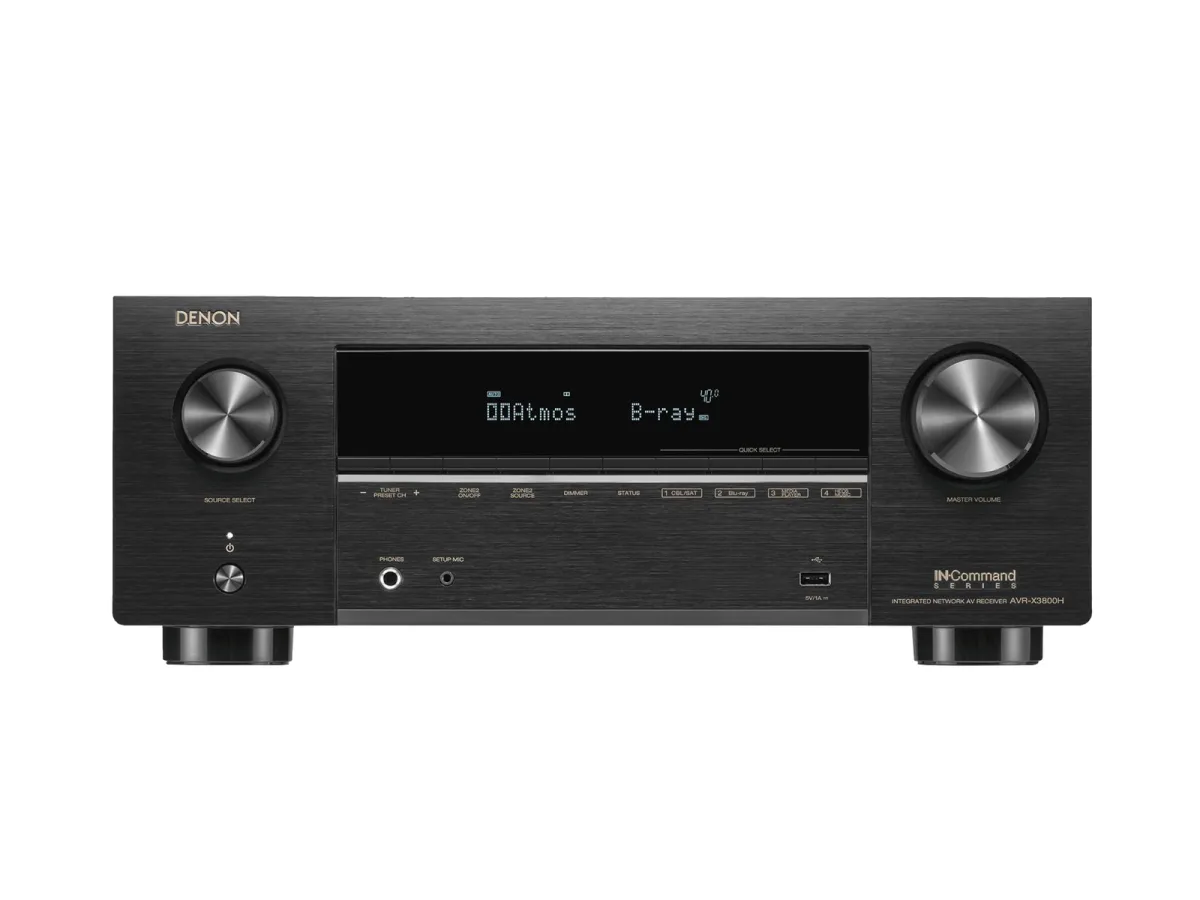
The Denon AVR-X3800H is the best 9.4-channel AV receiver under $2,000. It pairs full HDMI 2.1 — 8K/60, 4K/120, VRR, ALLM on six of seven inputs — with Dolby Atmos, DTS:X Pro, Auro-3D, IMAX Enhanced, Audyssey MultEQ XT32, and a paid Dirac Live upgrade path. For a 5.1.4 or 7.1.2 system in a real living room, nothing in this price band is more capable.
✅ Pros
- +9.4 internal channels, 11.4 processing — full Atmos/DTS:X support out of the box
- +Six HDMI 2.1 inputs (8K/60, 4K/120, VRR, ALLM) — most in its price class
- +Dirac Live upgrade path — best-in-class room correction available later
- +Auro-3D and IMAX Enhanced included
- +Audyssey MultEQ XT32 with Sub EQ HT calibration
- +HEOS, AirPlay 2, Spotify Connect, and TIDAL Connect built in
- +Dedicated MM phono input
- +Strong dialogue clarity and convincing Atmos overhead localization
❌ Cons
- −11.4 processing needs an external 2-channel amp to reach 7.1.4
- −Auro-3D and Dirac Live cost extra (~$199–$700 in upgrades)
- −Heavy and runs warm — shelving and ventilation matter
- −HEOS app, while functional, lags behind Sonos in polish
- −No HDMI 2.1 on the seventh input — a small but real cap
The Denon AVR-X3800H is the AV receiver to buy if you're building a real Dolby Atmos system and want it to last. It runs a 5.1.4 or 7.1.2 setup natively, processes 11.4 channels with an external 2-channel amp, supports every modern surround format including Auro-3D, and gives you full HDMI 2.1 — 8K/60, 4K/120, VRR, ALLM — on six of its seven inputs. At an MSRP of $1,699 (often street-priced lower), it's the most capable AV receiver under $2,000 in 2026.
The Denon AVR-X3800H is available on Amazon at a $1,699 MSRP, often street-priced lower.
Key Specs at a Glance
The AVR-X3800H is a 9.4-channel AV receiver that processes 11.4 channels with an external 2-channel amp, rated at 105 watts per channel (8 ohms, two channels driven, 20Hz–20kHz, 0.08% THD). It has seven HDMI inputs — six of them supporting the full HDMI 2.1 feature set (8K/60, 4K/120, VRR, ALLM, QFT, QMS) — and three HDMI outputs, two of which pass 8K. It decodes Dolby Atmos, Dolby Atmos Height Virtualization, DTS:X Pro, Auro-3D (a paid upgrade), and IMAX Enhanced. Room correction is Audyssey MultEQ XT32 with Sub EQ HT, with an optional Dirac Live upgrade ($349) and optional Dirac Live Bass Control. Streaming and multi-room run on HEOS, AirPlay 2, Spotify Connect, TIDAL Connect, and Bluetooth 5.0, with Alexa, Google Assistant, and Apple HomeKit support. It carries full 11.4-channel pre-outs and a dedicated MM phono input, measures 17.1" × 6.6" × 15.3", weighs 27.6 lb, and lists at $1,699.
What Makes the X3800H Stand Out
Mid-range AV receivers usually compromise somewhere — either on HDMI 2.1 input count, on processing channels, or on room correction quality. The X3800H doesn't compromise on any of these.
HDMI 2.1 done right. Six of the seven HDMI inputs support the full HDMI 2.1 feature set: 8K/60Hz, 4K/120Hz, VRR (Variable Refresh Rate), ALLM (Auto Low Latency Mode), QFT (Quick Frame Transport), and QMS (Quick Media Switching). Most receivers in this price range cap HDMI 2.1 features at two or three inputs. With six, you can connect a PS5, Xbox Series X, gaming PC, and an Apple TV without picking which one gets the premium connection.
11.4-channel processing. The X3800H amplifies nine channels internally and processes 11.4 channels at the pre-out stage. Add a stereo amplifier for the front pair and you can drive a full 7.1.4 system — front, center, surround, surround back, and four overhead Atmos speakers — with no gaps. For most users, the 9.4 amplification is enough on its own; the 11.4 processing is there if you grow.
Dirac Live as an upgrade path. Audyssey MultEQ XT32 is excellent on its own. Dirac Live, available as a $349 paid software upgrade, is widely considered the best room correction in consumer audio. The X3800H is one of the cheapest receivers that supports it. If you start with Audyssey and decide later you want Dirac, you don't have to buy a new receiver — you buy a license.
Auro-3D and IMAX Enhanced. The X3800H decodes every consumer surround format that exists. Dolby Atmos and DTS:X Pro are standard at this price. Auro-3D — a competing height-channel format used on some Blu-rays — and IMAX Enhanced — a tuning profile co-developed with IMAX — are not. Most receivers under $2,000 skip them.
Sound Quality
Power delivery is honest. The 105W/ch rating is measured the right way — 8 ohms, two channels driven, 20Hz–20kHz, at 0.08% THD. Many receivers publish much higher numbers under unrealistic conditions (1kHz only, one channel driven, 10% THD). At full surround load with all nine channels working, the X3800H will deliver less than 105W per channel — that's true of any AVR — but it has the headroom to drive 6-ohm tower speakers in a 3,000–4,000 cubic foot room without strain.
Audyssey calibration is reliable. MultEQ XT32 takes about 15 minutes with the included microphone and eight measurement positions. The result is consistent: speaker distances, levels, crossovers, and EQ all set automatically. The Audyssey MultEQ Editor app ($19.99) gives you per-speaker target curve control if you want to override the defaults — a worthwhile add-on for anyone willing to learn.
Dialogue clarity is excellent. Denon's center-channel processing has been a strength for years, and it shows here. With a properly calibrated center speaker, dialogue cuts through action sequences cleanly without needing the "Dialog Enhancer" crutch some receivers lean on.
Atmos performance is convincing in 5.1.4 or 7.1.2. The dedicated overhead processing routes effects to ceiling speakers (or up-firing modules) with proper localization. A storm rolling overhead, a helicopter passing, rain — the directional cues are clean. This is the area where a real receiver outperforms even the best soundbars.
Music performance is strong for an AVR. The X3800H runs a Pure Direct mode that bypasses video processing and DSP for stereo listening. With a quality pair of front speakers, two-channel music sounds clean and present — not the audiophile equal of a dedicated stereo amp, but a respectable second job for the unit.
Connectivity and Setup
Seven HDMI inputs, three outputs (two with 8K), and six inputs at full HDMI 2.1. Output 1 is the main display; outputs 2 and 3 can mirror or run a second zone. Dolby Vision, HDR10+, and Dynamic HDR all pass through cleanly. The 11.4-channel pre-outs let you add external amplification anywhere — most commonly to drive demanding front towers or to push the system to 11 channels — and the dual subwoofer outputs are independent, so Audyssey or Dirac can correct each sub separately.
For networking, there's wired Gigabit Ethernet and dual-band Wi-Fi. HEOS handles multi-room audio with other Denon and Marantz HEOS-enabled gear, and AirPlay 2, Spotify Connect, and TIDAL Connect work natively from a phone or tablet with no need to launch the receiver's own UI. A dedicated MM phono input connects a turntable directly without an external preamp. First-power setup, room calibration, and basic source labeling take about an hour, and the on-screen setup wizard is the cleanest in the business — better than Yamaha's, better than Onkyo's, and significantly better than the Marantz cousin, which uses an older interface.
Limitations Worth Knowing
11.4 processing requires an external amp. If you want a true 7.1.4 or 9.1.2 system, you need to add a stereo or three-channel amp. The step up — the AVR-X4800H — adds a tenth and eleventh internal channel. For most rooms, 9.4 internal is enough.
DTS:X Pro's full routing needs 11 channels. DTS:X Pro routes to 11 channels. With nine internal channels you get DTS:X (the 7.1.4 / 9.1.4 base format) but not the full Pro feature set unless you add an external amp.
Auro-3D and Dirac Live are paid upgrades. Decoding Auro-3D requires a one-time purchase from the Denon site (~$199). The hardware is Dirac-ready, but the license is $349 for Dirac Live and another $349 for Bass Control — factor in ~$700 if you want both.
Footprint and heat. At 27.6 lb and 17.1" wide, the X3800H needs real shelving and ventilation. It runs warm under heavy load, so leave about 4" of clearance above and behind the unit. The 12V triggers are configurable but limited, so double-check trigger capability against your specific automation setup.
Who Should Buy the Denon AVR-X3800H
Buy it if you're building a 5.1.4 or 7.1.2 Atmos system and want a receiver that won't be a bottleneck; you have multiple HDMI 2.1 sources (PS5, Xbox Series X, gaming PC, Apple TV 4K) and want all of them on premium inputs; you want a Dirac Live upgrade path without buying a $3,000+ receiver; you watch a mix of streaming, Blu-ray, and physical media; or you want one box that handles surround, music, and a turntable.
Consider the Denon AVR-X2800H instead if a 7.2-channel system is your goal and you'll never expand to four height channels, and the price difference matters more than the feature gap. Step up to the Denon AVR-X4800H if you want 11.4 channels of internal amplification with no external amp, your speakers are demanding (4-ohm towers, low sensitivity, large room), and the ~$1,000 step-up is in budget. Consider the Marantz Cinema 50 if you prefer Marantz's warmer house sound and HDAM amplifier section, and the more handsome aesthetics matter to you.
Denon AVR-X3800H vs. Onkyo TX-RZ50 vs. Marantz Cinema 50
Against its two closest rivals, the X3800H is the most flexible choice. It runs 9.4 channels internally with 11.4 processing, six HDMI 2.1 inputs, optional Dirac Live ($349), optional Auro-3D, IMAX Enhanced, and a phono input, at a $1,699 MSRP. The Onkyo TX-RZ50 is the value play: 9.2 internal channels, 11.2 processing, three HDMI 2.1 inputs, Dirac Live included, Auro-3D, IMAX Enhanced, and a phono input, at $1,899. The Marantz Cinema 50 shares the Denon's chassis family with a warmer tuning: 9.4 internal channels, 11.4 processing, six HDMI 2.1 inputs, optional Dirac Live, optional Auro-3D, IMAX Enhanced, and a phono input, at $2,499.
The Onkyo TX-RZ50 is the pick if you want Dirac Live included and don't need six HDMI 2.1 inputs. The Marantz Cinema 50 is the upgrade for Marantz's warmer sound signature and styling — same chassis family as the Denon, different tuning, $800 more. The Denon AVR-X3800H is the most flexible choice for the broadest range of buyers, and the best HDMI input array in the class.
Bottom Line
The Denon AVR-X3800H is what an AV receiver should be in 2026: future-proof on HDMI, exhaustive on surround formats, upgradeable on room correction, and powerful enough to drive a real living-room system without strain. If you're building a Dolby Atmos setup that you want to keep for the next decade, this is the receiver to start with. The competition is real — Onkyo gives you Dirac for free, Marantz gives you styling — but the Denon hits the right balance of features, performance, and price for the most buyers.
The Denon AVR-X3800H is available on Amazon at a $1,699 MSRP, often street-priced lower.
Related Reading
For system building, see How to Set Up Dolby Atmos at Home and, if you'd rather go the soundbar route, the Sonos Arc Ultra review.
Our Verdict
The Denon AVR-X3800H is the best 9.4-channel AV receiver under $2,000. It pairs full HDMI 2.1 — 8K/60, 4K/120, VRR, ALLM on six of seven inputs — with Dolby Atmos, DTS:X Pro, Auro-3D, IMAX Enhanced, Audyssey MultEQ XT32, and a paid Dirac Live upgrade path. For a 5.1.4 or 7.1.2 system in a real living room, nothing in this price band is more capable.
Ready to buy the Denon AVR-X3800H?
Buy on Amazon →Affiliate link — we may earn a commission at no extra cost to you.