Dual Subwoofers: When a Second Sub Is Actually Worth It (and When It's Not)
Published 2026-06-01 · By NetAudioHub Editorial
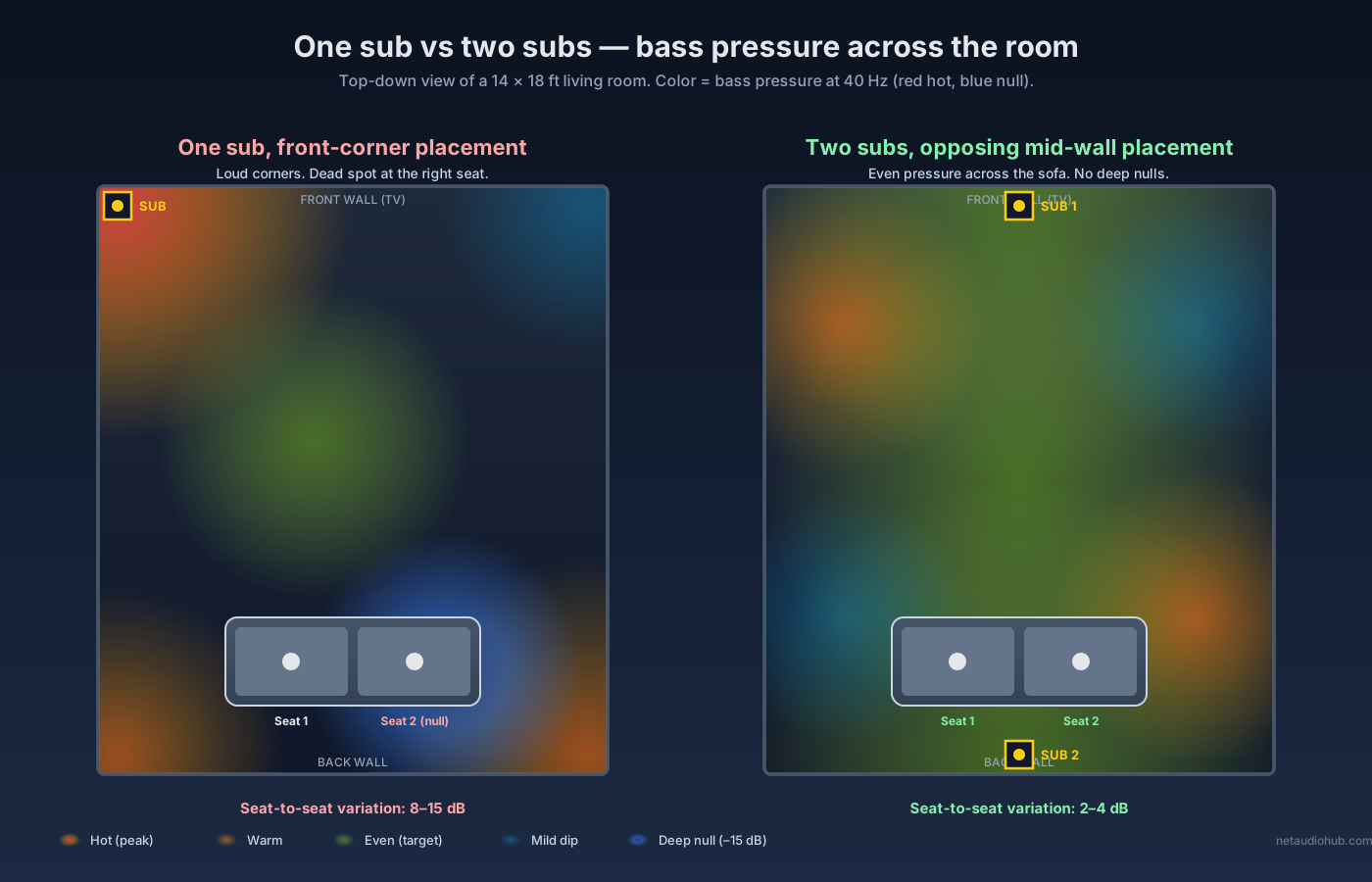
A second subwoofer does not make bass louder — it makes bass even at every seat. Here is the room-mode physics, the placement patterns that actually work, when dual subs are worth the money, when they are not, and what to buy at every budget.
The verdict up front: a second subwoofer does not make your bass louder — it makes your bass even. In any rectangular room, a single sub creates a bass-pressure map with hot spots and dead spots. Move one seat and the bass changes by 10–15 dB. A second sub, placed correctly, cancels the worst of those nulls and gives every seat on the sofa the same bass response. If you have a single listening chair in a small bedroom or apartment, one sub is fine — fix placement first, save the money. If you have a sofa with 2–4 listeners, a dedicated room with rear seating, or you have ever heard a movie scene where the bass disappeared at the wrong seat, dual subs are not a luxury upgrade — they are the cheapest, most measurable acoustic improvement you can make. Below: the physics, the placement strategies that actually work, when a second sub is worth the money, when it isn't, and what to buy at every budget.
Why One Sub Is Never Enough in a Real Room
Low-frequency sound in a room is not like high-frequency sound. A 5 kHz signal from a tweeter behaves like a flashlight beam — it travels in a straight line, reflects off surfaces, and dies off fairly quickly. A 40 Hz signal from a subwoofer behaves like a balloon being inflated — the wavelength is about 28 feet, larger than most rooms. The sound pressure does not "travel" through the room; it builds up the entire room into a single resonating air mass.
When that resonating air mass hits the walls, it reflects. The reflections interfere with the original wave. Where the reflected wave aligns with the original wave (peaks line up with peaks), the bass adds — you get a hot spot, sometimes 6–12 dB louder than average. Where the reflected wave opposes the original wave (peaks line up with troughs), the bass cancels — you get a null, sometimes 15–25 dB quieter than average.
These hot spots and nulls are called room modes. They are fixed in the room. They do not move when you move the sub. They are determined by the room's dimensions, period.
A typical 14 × 18 × 8 ft living room has its strongest modes at roughly 31 Hz (along the long dimension), 40 Hz (along the short dimension), and 70 Hz (vertical). Those frequencies happen to be exactly where movie explosions, kick drums, and bass guitar live. The result: in most untreated rooms with one sub, the bass is wildly different at every seat on the sofa. Move one cushion over and the kick drum loses 8 dB.
This is not a sub-quality problem. The most expensive single subwoofer in the world cannot fix this. The problem is geometric. The only ways to address it are:
- Move the sub to a position where the worst modes cancel less at the listening seats (the subwoofer crawl — see How to Position Your Subwoofer for Better Bass Response).
- Add a second sub at a position where its modal pattern is complementary to the first.
- Use room treatment (bass traps) to physically absorb the modes — slow, expensive, mostly impractical at home.
- Use parametric EQ to cut the peaks (Audyssey, Dirac Live, miniDSP). EQ can cut a peak; it cannot fill in a null without infinite power.
Option 2 is the single most cost-effective fix. A second sub placed correctly does what no amount of EQ and no single sub of any price can do: it changes the room's modal interference pattern itself.
What a Second Sub Actually Fixes
The empirical result, repeatedly demonstrated in research from Harman International (Welti and Devantier, 2002) and in every credible AV-forum measurement thread since: a single subwoofer in a typical rectangular room produces seat-to-seat bass variation of 8–15 dB in the 30–80 Hz range. Two subwoofers placed at the midpoints of opposing walls reduce that variation to 2–4 dB.
Translated to what you actually hear: with one sub, the bass at the center seat sounds full and weighty, the bass at the left seat sounds muddy, and the bass at the right seat sounds thin. With two subs, all three seats sound the same. The bass also sounds more natural even at the "best" seat, because the modal peaks are smaller and the room rings less.
What two subs do not do:
- They do not make the bass louder for the same amplifier headroom. Two subs each driven half as hard produce roughly the same SPL as one sub driven twice as hard.
- They do not extend frequency response lower. A pair of subs with a -3 dB point at 28 Hz still has a -3 dB point at 28 Hz.
- They do not fix problems above 80 Hz. Above the Schroeder frequency (typically 150–250 Hz in a residential room), the sound stops behaving modally and starts behaving like specular reflections — and the subwoofer is no longer doing the work in that range anyway.
Dual subs solve exactly one problem: modal smoothing across the listening area. They solve it better than any other technique.
When Dual Subs Are Worth It
In order of how confidently I'd recommend the upgrade:
1. You have a sofa with multiple listeners.
This is the biggest case. If two or three people sit on a sofa and watch movies together, a single sub is almost certainly giving each of them a noticeably different bass experience. Whoever is in the modal hot spot thinks the system sounds great. Whoever is in the null thinks it sounds thin. They are both right.
A second sub costs less than 90% of the room treatment that would otherwise be required to fix this. For any household where the sofa seats two or more, this is the highest-leverage acoustic upgrade available.
2. You have a dedicated home-theater room with multiple rows.
If you have a riser, a sectional, or recliners in two rows, the front row and back row are in completely different modal positions. A single sub almost never gives both rows similar bass. Two subs help substantially; four subs (one at the midpoint of each wall) are the reference solution for multi-row theater rooms. Industry installation guides from companies like SVS and Procella explicitly recommend four subs for any commercial-grade home theater build.
3. You listen to bass-heavy music or Atmos Music.
Single-sub null behavior is more audible on sustained tones than on transient effects. A kick drum that loses a few dB is hard to notice; a sustained 45 Hz organ note or a synth bass line that loses 15 dB at one seat is impossible to miss. If you actually listen to your sub for music (not just for movie LFE), dual subs improve the experience noticeably even at a single listening position because the modal peaks shrink too — the bass sounds tighter and less "boomy."
4. You have a long, narrow room.
Long rooms (the listening seat in the back half of a room that is 20+ feet long) have a particularly strong fundamental room mode that is hard to fight with a single sub. The first axial mode of a 22 ft room sits at about 26 Hz, and a single sub almost always either piles on it (creating a 50 Hz hump from the second harmonic) or sits in its null (losing 30 Hz response entirely). A second sub at the opposite end of the room nulls out the room's worst axial mode by design.
5. You already have one sub and you're considering "upgrading" to a bigger sub.
This is the case people most often get wrong. If you have an SVS SB-1000 Pro and you're tempted to sell it and buy a single SB-2000 Pro, stop. Buying a second SB-1000 Pro will improve your bass more than the single-sub upgrade will. A pair of smaller subs nearly always beats a single bigger sub in any room with multiple seats. The pair has the same total peak output (if they're driven at the same per-sub level) but with vastly smoother seat-to-seat response.
When a Second Sub Is Not Worth It
You have one chair and listen alone.
A single listener in a fixed position can solve almost all modal problems by moving the sub. The subwoofer crawl finds the position that gives the smoothest response at one specific seat. If you genuinely only ever listen from one seat, you can get to ±3 dB across most of the audible bass range with one sub and good EQ. A second sub at that point is a luxury, not a fix.
Your room is heavily treated already.
If you have invested in serious bass traps (corner-loaded Roxul, tuned panel absorbers, helmholtz resonators), you have already absorbed energy out of the modes. Adding a second sub still helps somewhat, but the marginal improvement is smaller because the room is closer to anechoic. This is rare in a residential setting but worth flagging — the benefit of dual subs scales with how live the room is.
You can't place a second sub anywhere useful.
If your room has the only usable sub location in the front-left corner (because of doorways, fireplaces, furniture, or HVAC), and there is genuinely no second position you can put a sub, a second sub stuck in the same corner as the first will give you about a 3 dB increase in output and no modal smoothing whatsoever. Two subs in the same corner are equivalent to one bigger sub, which is the worst of both worlds — same modal problem, twice the cost.
You are using a soundbar.
Most premium soundbars (the Sonos Arc Ultra with Sonos Sub 4, the Samsung HW-Q990D) only support a single wireless sub. Sonos has added dual-sub support to its ecosystem (two Sub 4s can pair with an Arc Ultra), and it is genuinely useful in a multi-seat room. But for soundbars without that support, you cannot add a second sub even if you want to. Verify your soundbar's manual before assuming.
Your AVR has only one sub output and no per-sub trim.
Older AVRs (pre-2018-ish) often have a single LFE/sub-out RCA. You can still run dual subs by splitting the signal with a Y-cable, but you lose per-sub level and delay calibration, which kills most of the benefit of a multi-sub setup. Either upgrade the AVR or accept the limitation. Modern AVRs (every Denon AVR-X3800H-class receiver, the Marantz Cinema series, and most Yamaha Aventage and Onkyo TX-RZ models) ship with two or more independent sub outputs with separate distance and trim calibration per sub. Audyssey MultEQ XT32 and Dirac Live will calibrate each sub independently if the AVR exposes them as discrete channels.
Where to Put Two Subs
The placement matters as much as the count. Two subs in the wrong positions can be worse than one sub in the right position. The three patterns that work, in order of effectiveness for typical rectangular rooms:
Pattern A — Opposing mid-walls (the Harman reference)
One sub at the midpoint of the front wall, one sub at the midpoint of the back wall. This is the configuration that produced the best seat-to-seat smoothness in the original Welti/Devantier research. The two subs are 180° out of phase from the room's perspective for the first axial mode (the one along the room's longest dimension), which means they cancel that mode at every seat.
Practical issues: the back-wall position is often blocked by a sofa or wall-mounted TV stand. If you can put the rear sub behind the sofa, against the back wall and near the floor, it works. If the only available position is the side of a sectional, the result is degraded but still better than a single front-corner sub in most cases.
Pattern B — Opposing mid-side-walls
One sub at the midpoint of the left wall, one sub at the midpoint of the right wall. This targets the lateral (short-dimension) modes instead of the front-to-back modes. Works well in rooms where the listening seat is centered between the side walls but offset front-to-back.
This is typically the second-best practical option after Pattern A. Easier to execute in a typical living room because side-wall midpoints are usually less obstructed than the back-wall midpoint.
Pattern C — Two front corners
Both subs in the front corners (front-left and front-right). This is the easiest pattern to execute and the one most listeners end up with because it hides the subs behind speakers and avoids wiring across the room.
It is not as smooth as Patterns A or B. It does help with the front-back asymmetry of a single front-corner sub, and it doubles the maximum output. But it does relatively little for the dominant axial modes because both subs are pressurizing the same end of the room. If this is the only pattern your room allows, it is still better than one corner sub — but Pattern A or B should be your goal if you can get there.
What about four subs?
Four subs at the midpoints of all four walls is the gold standard for theater-room evenness. The improvement from two to four subs is meaningful but smaller than the improvement from one to two. For a residential build, four subs starts to make sense if you have a dedicated theater room with two or more rows of seating. For a typical living room with a single sofa, the cost-benefit gets thin past two subs.
Match Them: Same Model, Same Settings
Use two of the same subwoofer, ideally bought new and from the same production run. Here's why:
- A pair of subs with different cabinets, drivers, or amplifiers have different group delay, different frequency response, and different power-compression curves. The room will sum them inconsistently. The modal cancellation math assumes both sources are coherent — different subs are not.
- Even setting per-sub trim and distance in the AVR cannot fully compensate for two subs that fundamentally play differently above 60 Hz. The crossover region will sound smeared.
- The price savings from mixing brands ("I have an SVS, let me add a cheap second one") almost always negate the benefit of the upgrade. If your budget supports only one premium sub, get one premium sub now and a second matching unit later. SVS and Rythmik both sell direct, so a matched pair is easy to acquire over time.
If you absolutely must mix — a leftover sub you can't sell, an inherited unit — put the better sub in the position that has the most modal authority (typically the corner closest to the listening seat) and use the second to fill in the opposite quadrant. EQ each one independently if your AVR supports it.
Calibration: Distance, Trim, Phase
A dual-sub setup is only as good as its calibration. The non-negotiable steps after physical placement:
- Run your AVR's auto-calibration (Audyssey MultEQ XT32, Dirac Live, YPAO with parametric, or Anthem ARC). Make sure both subs are detected as independent channels. The Denon AVR-X3800H-tier receivers all expose dual subs as separate calibration targets. Older XT (non-XT32) versions of Audyssey sometimes treat dual subs as a single channel, which loses the per-sub timing fix — verify in your AVR's setup menu.
- Verify per-sub distance. After auto-cal, check the speaker distance menu. Each sub should have a distance value within a few feet of its physical location. If the AVR reports both subs as the same distance (or a default like 12.0 ft), the auto-cal did not actually fix per-sub timing. Force a manual distance equal to the physical measurement plus the sub's known group delay (typically 4–6 feet for a ported sub at 80 Hz crossover).
- Verify per-sub trim. Each sub's level should be within 3 dB of the other after calibration. A 6+ dB difference means one sub is in a much stronger position than the other (or one is broken). Move the louder sub a bit before re-running calibration.
- Set crossover to 80 Hz. THX standard. The mains hand off bass below 80 Hz to the subs. With dual subs, an 80 Hz crossover ensures both subs are doing the same job in the same range.
- Check phase. Modern setups dispense with the 0/180° phase switch — auto-cal handles it via distance offsets. If you have an older AVR or a sub with a continuous-phase knob, after auto-cal play a 50–80 Hz sine wave and walk to the listening seat. Adjust the phase on one sub until the bass at the seat is loudest. Then re-run auto-cal to lock the distance correctly.
- Listen to a familiar test scene. The opening of Mad Max: Fury Road (the title-card thunder), the bass drop in Edge of Tomorrow at the helicopter scene, or the kick-drum track on Daft Punk's Random Access Memories. The bass should feel even across every seat on the sofa, not louder/quieter as you walk along it.
If you have a miniDSP unit or a miniDSP-equipped subwoofer build, parametric EQ on top of the AVR's calibration gets the response to ±2 dB across the listening area. Diminishing returns past that.
What to Buy: Dual-Sub Picks by Budget
Pairs only. Single subs are not the goal of this article.
Budget pair ($800–1,000 total)
A pair of Klipsch R-120SW or a pair of Polk Audio HTS 12 subs. 12-inch drivers, ported, around $400–500 each new. Not class-leading individually, but a matched pair smoothes the bass at every seat — which is the entire point.
For a budget DIY build, a pair of Monoprice Monolith THX-365IB in-wall subs is an option if you can do the in-wall install. Hidden, real performance, and the matched-pair behavior is built in.
Mid-range pair ($1,200–1,800 total)
A pair of SVS SB-1000 Pro. This is the recommendation for most rooms. 12-inch sealed driver, 325W RMS amplifier, room-correction app, around $600 each from SVS direct. A pair fits behind furniture (12.5" cube), works in most placement patterns, and is the same model so the matched-pair physics is correct.
We reviewed the SVS SB-1000 Pro in depth — the verdict was "the best single-sub-for-the-money under $700," and that verdict scales to dual-sub: two SB-1000 Pros at $1,200 outperform a single SVS SB-3000 at $1,100 in any multi-seat room.
Alternative at the same budget: a pair of RSL Speedwoofer 10S MKII — direct-from-manufacturer, $499 each, ported 10-inch with a strong following on AVS forum.
If the reason you have not bought a second sub is that there is nowhere to put it, the SVS 3000 Micro R|Evolution is the pick that changes the arithmetic. It is an 11-inch sealed cube with dual-opposing 9-inch drivers and a 1,200W amp that still measures 20 Hz (±3 dB), so a pair can occupy two positions a pair of 12-inch boxes never could — which is the whole point of dual subs. Two honest caveats from our review: at $999.99 each you are paying a clear premium for the compact cabinet, and the sealed design is not sized for rooms over about 4,000 cu ft. The side-firing drivers also need clearance on both faces, so "behind the couch" has to mean a few inches of it.
Premium pair ($2,400–3,200 total)
A pair of SVS PB-2000 Pro or SVS SB-2000 Pro at roughly $1,000–1,200 each. 12-inch driver, 550W amplifier, more headroom for large rooms. Ported (PB) for movie LFE-heavy use; sealed (SB) for music-first listening. Both pair to the SVS room-correction app.
For dedicated theater rooms, a pair of Rythmik FV15HP or Rythmik F12 subs — servo-controlled, exceptional time-domain performance, direct-from-manufacturer at around $1,000–1,400 each.
Soundbar ecosystems
A pair of Sonos Sub 4 paired with a Sonos Arc Ultra is the only mainstream soundbar setup that natively supports dual subs. It works — the Sub 4s are calibrated together by the Sonos app and produce real modal smoothing. Roughly $1,600 total for the pair of subs, $999 for the bar.
We covered the Sonos Sub 4 in depth — recommended pairing for any serious Sonos-based system in a room with a sofa.
How to Decide for Your Room
A short decision tree:
- Single seat, small room (under 14 × 12 ft), one listener? One sub is fine. Do the subwoofer crawl and skip this whole upgrade.
- Sofa with 2+ listeners, average living room (14 × 18 ft and up)? Dual subs are the highest-ROI acoustic upgrade you can make. Buy a matched pair — the SVS SB-1000 Pro pair is the default recommendation.
- Dedicated home theater with multiple rows? Plan for four subs from the start. Two subs is the minimum; four delivers the consistency commercial theater installers expect.
- Long narrow room (20+ ft long)? Skip straight to dual subs at opposite ends — Pattern A. The single-sub null at the far end of the room is otherwise unfixable.
- Soundbar setup? Verify your bar supports dual subs (Sonos Arc Ultra does; most others don't). If it doesn't, a second sub is impossible — focus on placement of the one sub instead.
- AVR-based system with a single LFE output and no per-sub calibration? Either upgrade the AVR first or stay with one sub. The benefit of dual subs requires per-sub calibration.
TL;DR
- A second sub does not make bass louder — it makes bass even at every seat. A single sub in any rectangular room produces 8–15 dB of seat-to-seat variation in the 30–80 Hz range. Two subs in opposing mid-wall positions cut that to 2–4 dB.
- Dual subs are worth it when you have multiple listeners on a sofa, multiple rows in a theater room, listen to bass-heavy music, or have a long narrow room. They are not worth it for single-seat setups, heavily treated rooms, or systems where you cannot place a second sub usefully.
- Use two of the same subwoofer. Mixing brands negates most of the benefit.
- Best placement is opposing mid-walls (front + back, or left + right). Two front corners is the fallback if that is all the room allows.
- Calibration matters: per-sub distance and trim must be set independently, which requires an AVR with two or more sub outputs treated as discrete channels.
- For most living-room builds, a pair of SVS SB-1000 Pro subs is the default recommendation. A pair of Sonos Sub 4 is the soundbar-ecosystem answer for Sonos Arc Ultra owners.
If you have one sub right now and a sofa with more than one cushion, the next upgrade is not a better sub. It is the same sub, twice.
Related Reading
Affiliate disclosure: NetAudioHub links to retailers including Amazon. We earn a small commission on qualifying purchases at no extra cost to you.