Klipsch RP-6000F II Review: The Floorstander That Earns a Real Home Theater
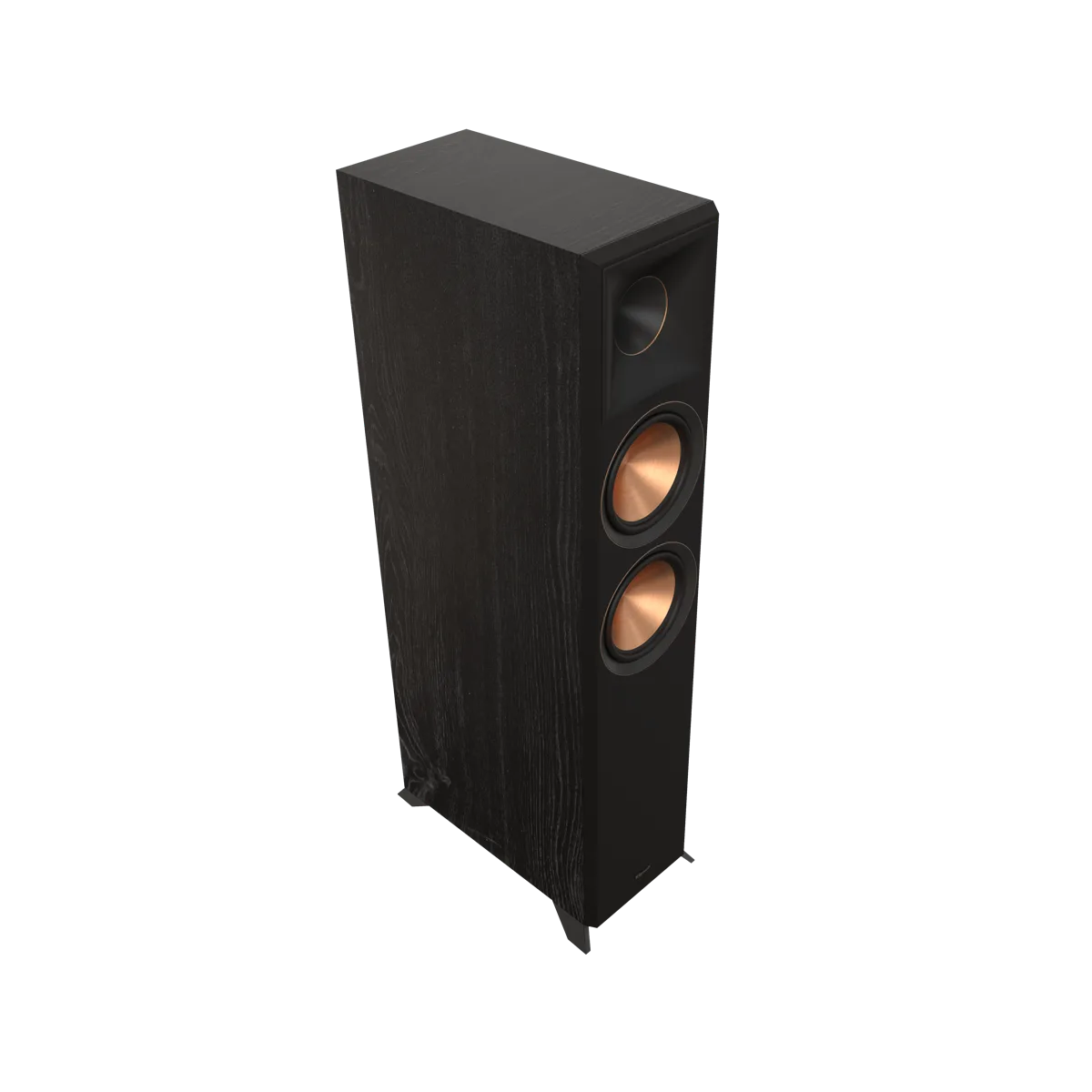
The Klipsch RP-6000F II pairs two 6.5" Cerametallic woofers and a 1" Titanium LTS tweeter on a 90°×90° Hybrid Tractrix Horn into a tower Klipsch rates at 96 dB, half-space. The front stage of choice for a Denon, Marantz, or Yamaha AVR-based 5.1 in a medium-to-large room.
✅ Pros
- +Two 6.5-inch Cerametallic woofers per cabinet deliver bass with body, weight, and dynamic headroom
- +38 Hz rated lower limit (±3 dB) — genuine low-bass reach for a compact tower, though it is a manufacturer figure
- +96 dB rated sensitivity (Klipsch, half-space) — matches the RP-504C II center exactly for clean timbre across the front stage
- +90°×90° Hybrid Tractrix Horn keeps off-axis seats hearing the same voicing as the sweet spot
- +1,770 Hz crossover puts the tweeter above the dialogue intelligibility band, where the horn excels
- +Front stage timbre-matches the RP-504C II center and RP-600M II bookshelves for a coherent 5.1
- +Dual binding posts give a bi-amp path if you upgrade to separates later
- +Flat top plate accepts RP-500SA Atmos modules cleanly for a 5.1.2 install
- +5-year parts and labor warranty
❌ Cons
- −Wants real volume to come fully alive — background listening is not its strong suit
- −Bright source material is exposed; older / compressed tracks can sound edgy
- −Rear port requires 12+ inches of wall clearance — no flush placement
- −Vinyl finishes (not real wood veneer) at $1,398/pair
- −Sensitive to listening axis — best with toed-in placement and a defined seating position
- −Only worth buying if your front speakers are (or will be) Klipsch Reference Premiere II — single-brand commitment
- −Sub still recommended for serious home theater LFE despite the 38 Hz rated lower limit
The Klipsch RP-6000F II is the floorstander to buy if you have a midrange AVR and a room bigger than a small living room. Two 6.5-inch Cerametallic woofers and a 1-inch Titanium LTS tweeter on a 90°×90° Hybrid Tractrix Horn deliver a rated 96 dB of sensitivity — matching the RP-504C II center exactly and sitting 1.5 dB above the Klipsch RP-600M II bookshelves — and because those are half-space ratings rather than the full-space figures most brands quote, a real AVR like the Denon AVR-X2800H or Marantz Cinema 70s drives them loud and clean without straining, but with less headroom in reserve than the sticker suggests. At $1,398/pair, the RP-6000F II is the step you take when the room is too big for bookshelves on stands, or when you want the front stage to reach into the 30s without leaning hard on the subwoofer. A rated ±3 dB point of 38 Hz means full-range stereo music works without a sub in most rooms — a manufacturer figure, not a measured one — and a clean handoff at 80 Hz to a sub like the SVS SB-1000 Pro gives you the headroom for movies.
Key Specs at a Glance
The RP-6000F II is a 2-way passive bass-reflex floorstander. The tweeter is a 1" (25.4mm) Titanium LTS vented diaphragm loaded into a 90°×90° Hybrid Cross-Section Tractrix Horn; the array is two 6.5" (165mm) Cerametallic (copper-spun) cones stacked below it. Crossover sits at 1,770 Hz. Frequency response is 38 Hz – 25 kHz (±3 dB), sensitivity is 96 dB @ 2.83V/1m — a half-space figure per Klipsch's footnote — power handling is 125W continuous / 500W peak, and nominal impedance is 8 Ω compatible. The cabinet is internally braced MDF with a rear-firing Tractrix port and dual gold-plated binding posts for bi-amp or bi-wire. Dimensions are 39.60" H × 9.29" W × 17.57" D, 49.4 lb each, available in Ebony or Walnut vinyl, with a 5-year parts-and-labor warranty at $699 USD each / $1,398 per pair.
What's New vs. the Original RP-6000F
The RP-6000F II is the 2023–2024 refresh of Klipsch's most-sold floorstander in the Reference Premiere line. The cabinet silhouette is recognizable — the same vinyl-wrapped tower with a copper-spun woofer pair and a horn-loaded tweeter — but the acoustic changes mirror what Klipsch did to the rest of the Reference Premiere II line.
The 90°×90° Hybrid Cross-Section Tractrix Horn is the single most important change. The flare is squared near the throat and rounded toward the mouth, which decouples horizontal and vertical dispersion. The practical effect is that the "Klipsch sweet spot" widens — off-axis listeners at the end of a couch hear noticeably less high-frequency rolloff than they did from the original RP-6000F, and the ceiling contributes less harsh first-reflection energy. A redesigned phase plug in the throat smooths the upper midrange; the original RP-6000F could sound slightly hot through 3–6 kHz on bright sources, and the II is smoother through the same band, which makes movie dialogue articulate without sibilance and lets compressed broadcast audio sit more comfortably. The revised Cerametallic woofers use the same copper-spun IMG recipe with updated cone geometry and surround for lower distortion at high excursion — on loud action scenes the cone signature is less audible. Improved cabinet bracing and port tuning round it out, and the port is quieter at high SPL — though on the rated low-frequency limit the II gives a little back rather than gaining: Klipsch rates the original at 34 Hz and the II at 38 Hz, both ±3 dB.
If you own the original RP-6000F and like how it sounds, don't upgrade for sound — the differences are real but they're refinements, not transformations. If you're building new today, the II is the version to buy because it timbre-matches the rest of the Reference Premiere II line and because the wider horn dispersion makes it a friendlier speaker in a multi-seat room.
Sound Quality
The horn defines the character, and it's grown up. The 1-inch Titanium LTS tweeter on the Hybrid Tractrix Horn loads the top end with more output per watt than a dome tweeter of the same size, but the II's revised flare and phase plug have rounded off the edges that older Reference Premiere generations were known for. Cymbals shimmer rather than splash. Acoustic guitar has the right amount of pick attack without sibilance. Movie dialogue projected from the left or right channel sits articulate and forward without the upper-mid hardness that the original RP-6000F could produce on bright streams.
Two 6.5-inch Cerametallic woofers per cabinet, summed, are the real story. The crossover at 1,770 Hz keeps the woofers handling the entire dialogue intelligibility band for male voices and the entire fundamental range of bass guitar, kick drum, and chest-weight movie effects. Two 6.5-inch cones working together have the moving area of a single 9-inch woofer but with substantially less mass per cone, which is why the RP-6000F II responds to a kick drum with the kind of immediacy you don't get from a single bigger driver. Bass lines are tuneful, not muddy. Kick drums hit cleanly. Synth bass extends usefully into the mid-30s before the port tuning gives up.
Dynamics are the headline, with a caveat on the number. Klipsch's 96 dB is measured half-space; the anechoic figure will be meaningfully lower, as it was on the two Reference Premiere models that have been independently measured. The dynamic behaviour is still real: a 75-watt-per-channel midrange AVR drives these loud and unstrained through the loudest peaks in a movie. What it will not do is reach film reference level with headroom to spare, whatever the 96 dB sticker implies. The RP-6000F II responds to a snare hit, a door slam, or a rifle shot with the kind of uncompressed snap you usually have to pay $3,000+ a pair to get from a low-sensitivity audiophile floorstander. That is the horn's controlled directivity and low compression at work, not an efficiency advantage — on a like-for-like anechoic basis, the gap to its non-horn competition is far smaller than the 96 dB sticker suggests.
Sub-less stereo is viable here. Klipsch rates the RP-6000F II to 38 Hz (±3 dB), which on paper covers kick-drum fundamentals and most bass guitar without leaning on a subwoofer. Read that as a rating, not a room result: the one speaker in this line with an independent bass measurement, the RP-600M II, is rated 44 Hz and measures −3 dB at 74.7 Hz. In a 15×20-foot room playing music at sane volumes, a pair of these makes a complete, satisfying 2.0 system. That's the case for the floorstander over the bookshelf if music is half your use case.
Where they're honest about limits: at very low listening volumes — late-night TV at -35 dB on the AVR — the horn's directivity is audible as a slight forwardness that softer-dome floorstanders don't have. The RP-6000F II rewards being played at real volume; if your primary use is background listening, a softer-dome floorstander may sound subjectively easier. The other honest limit is that this is still a ported speaker with a 38 Hz rated lower limit. For serious home-theater LFE (Dolby Atmos action movies, deep test scenes), you still want a real subwoofer. The RP-6000F II reaches lower than most bookshelves, but it doesn't replace a sub.
Timbre Matching Across the Reference Premiere II Line
This is the entire reason to buy a Klipsch RP-6000F II rather than a competing floorstander at the same price. Klipsch tunes the Reference Premiere II line — bookshelves, floorstanders, surrounds, Atmos modules, center — to the same voicing target. When a 5.1 or 5.1.2 mix pans a sound across the front stage and into the surrounds, the timbre should not change. With non-matching speakers, it usually does.
The RP-6000F II is voiced to match the Klipsch RP-504C II center channel ($799) — the appropriate-size center match, with the same 96 dB sensitivity, same horn family, and same Cerametallic woofers. This is the correct front stage for the RP-6000F II in a 5.1. It also matches the Klipsch RP-600M II bookshelves ($749/pair) — the matching surrounds, or the matching fronts for a separate room; rated sensitivity is within 1.5 dB (96 dB vs 94.5 dB) and the crossover band is similar enough that 7.1 pans are seamless. The smaller RP-500M works as compact surrounds, and the RP-500SA Atmos modules sit on top of the RP-6000F II flat top plate cleanly, which is one of the cleanest 5.1.2 installs you can do without ceiling cuts.
If your fronts are not Klipsch Reference Premiere II — and you're thinking about adding the RP-6000F II as fronts to an existing system with a different brand's center and surrounds — stop. Pair like-for-like. Cross-brand timbre mismatch across the front stage is more audible than any spec-sheet difference between brands. Either commit to the Reference Premiere II line as a system or stay with the family of your existing speakers.
In a 5.1 / 5.1.2 System
As the front stage in a 5.1 anchored by an RP-504C II center, the RP-6000F II is the right call without much debate. 96 dB rated sensitivity matches the center. 38 Hz lower limit means you can run them "large" if you really want to (most people shouldn't — see below) or cross them to a sub at 80 Hz for cleaner output above the crossover. A Marantz Cinema 70s, Denon AVR-X2800H, or step-up unit drives the full front stage to satisfying levels. Do not bank on film reference with headroom intact: 96 dB is Klipsch's half-space rating, and the anechoic figure that actually sets the wattage is meaningfully lower. Run Audyssey, Dirac, or YPAO room calibration after install — the high sensitivity of the Klipsch line means the receiver may set the front trims lower than you'd guess, which is normal.
Cross at 80 Hz, not 40 Hz. This is the most common mistake with capable floorstanders. The RP-6000F II is rated to 38 Hz, which tempts buyers to run them as full-range fronts and skip the sub crossover. Don't. The THX 80 Hz crossover is correct for a reason: the woofers play cleaner above 80 Hz when they're not also doing the deep LFE work, the sub is placed for room-mode optimization (which the fronts can't be), and the AVR's bass management handles room correction better with a defined crossover point. Set the fronts to "small" at 80 Hz in the AVR menu and let the SVS SB-1000 Pro or Sonos Sub 4 carry the bottom octave.
As the front stage in a 5.1.2 Atmos setup, the flat top plate of the RP-6000F II accepts a pair of RP-500SA Atmos modules cleanly. The modules sit directly on top, angled toward the ceiling, and reflect Atmos height channels off your ceiling back to the listening position. This is the lowest-friction Atmos install path that doesn't require cutting into ceiling drywall. The Reference Premiere II family voices the height channels to match — Klipsch is one of the few brands that ships matching Atmos modules in the same finish and voicing as the rest of the line.
As surrounds, don't. The RP-6000F II is far too large for surround duty in any normal room. If you want matching surrounds, use the smaller RP-500M (the right size for surround placement) or the RP-600M II on stands if you have the room.
In a 2.0 / 2.1 stereo-only setup, the RP-6000F II makes a complete system. The 38 Hz rated lower limit means you can run them sub-less for music in a small-to-medium room without feeling like the bottom is missing; in a large room, plan on the sub. Add a sub crossed at 60–70 Hz if you want movie LFE; cross higher to 80 Hz if movies are the primary use case.
Setup and Placement
A floorstander rewards correct placement more than a bookshelf does, because the lower frequencies it produces interact more strongly with room boundaries. Pull them off the wall: the rear Tractrix port needs at least 12 inches of clearance behind the cabinet to load correctly. Push the RP-6000F II flush against a wall and the port resonance turns into one-note boom in the 50–80 Hz region. 18+ inches of wall clearance is better. Toe them in: aim each speaker at, or just behind, the primary listening seat. The Hybrid Tractrix Horn rewards on-axis listening with the sharpest imaging; the II's wider dispersion does forgive off-axis seats more than the original, but the sweet spot is still real and the seated listener should be roughly on-axis with the tweeter.
The tweeter on the RP-6000F II sits about 37 inches off the floor with the included spikes installed. Most seated listeners' ears are at 38–42 inches. That's close enough that toe-in plus a small backward tilt (if needed) puts the listener on the tweeter axis. If you sit very low (deep recliner), tilt the speaker backward 2–3 degrees with the rear spikes higher than the fronts. Use the spikes on carpet, the rubber feet on hard floors — spikes pierce carpet to couple the speaker to the subfloor, which kills the rocking motion that softens transients; on hardwood or tile, the rubber feet protect the floor and the cabinet doesn't need the spike coupling.
Speaker wire 12 to 14 gauge: floorstander runs are usually longer than bookshelf runs because the speakers sit further from the AVR. 14-gauge for runs under 20 feet, 12-gauge for runs over 25 feet. The dual binding posts accept banana plugs cleanly. Don't bi-amp from a single AVR; the dual binding posts are there if you ever want to bi-amp from two separate stereo amplifiers. Bi-amping by splitting a single AVR's channel doesn't gain you anything meaningful and forces you to give up surround channels — leave the jumpers in place. And run AVR room calibration after install. Audyssey, Dirac, YPAO, MCACC — whatever your AVR uses. Floorstanders interact more aggressively with room modes than bookshelves do, and room correction is where you reclaim 5–10 dB of muddiness in the 60–120 Hz range.
Limitations Worth Knowing
Wants real volume to come alive. Same horn-loaded character as the rest of the Reference Premiere II line. At background-listening volumes, the horn's directivity is audible as a slight forwardness that softer-dome floorstanders don't have. Most viewers won't notice; some will.
Bright source material is exposed. The Hybrid Tractrix Horn is smoother than older Klipsch designs through 3–6 kHz, but it's still a horn. A poorly mastered or heavily compressed stream will sound noticeably edgy compared to a deliberately polite speaker. If most of your listening is low-bitrate streaming or older compressed CDs, audition first.
Rear port limits placement. Pull the speakers at least 12 inches off the back wall, ideally 18+. If your room layout forces flush-to-wall placement, look at a front-ported or sealed floorstander instead.
No Atmos integration on its own. The flat top plate accepts an RP-500SA module on top, but the RP-6000F II is not itself an Atmos-enabled speaker. If you want height channels without the separate modules, look at a different line.
Vinyl finish at $1,398/pair. Both the Ebony and Walnut finishes are textured vinyl wrap over MDF, not real wood veneer. The vinyl is well-applied and looks better than the price suggests, but if you're cross-shopping a real-veneer competitor, the finish is a visible step down.
Sub still recommended for serious home theater. The 38 Hz rated lower limit is good for a compact tower, but action movie LFE goes to 20 Hz and below. The RP-6000F II is not a substitute for a real subwoofer in a home theater. It's a complement.
Width and depth matter. At 16.79 inches deep with 12+ inches of port clearance behind, the speaker occupies about 29 inches of front-to-back room space per side. Tight rooms or narrow living rooms may not have the floor budget.
Who Should Buy the Klipsch RP-6000F II
Buy them if your room is medium to large (250+ square feet) and bookshelves on stands feel undersized, you already own (or are buying) a real AVR — Denon AVR-X2800H, Marantz Cinema 70s, Yamaha RX-V6A, or a step up, and you're building a 5.1 or 5.1.2 with a matching Klipsch RP-504C II center and RP-600M II (or RP-500M) surrounds. Buy them if music is at least half your use case and you want full-range stereo without leaning on a sub, you can give the rear port 12+ inches of wall clearance, and you watch movies and TV at real volume, not background-only.
Consider the Klipsch RP-600M II bookshelves on stands instead if your room is under 200 square feet — the floorstander's bottom octave will excite room modes you don't want — or you can't give the speakers 12 inches of wall clearance, or your AVR is a budget unit under $400 and you want to keep the system proportional.
Consider stepping up to the Klipsch RP-8000F II if your room is over 400 square feet, you want the largest possible front stage in the Reference Premiere II line, or you've already paired it with the larger RP-704C II center for that tier.
Consider a different brand if you're sensitive to horn coloration on bright source material — Polk Reserve R700, GoldenEar Triton One.R, or KEF R5 Meta are softer-treble alternatives. Or if your fronts aren't and won't be Klipsch Reference Premiere II, buy within the family of the rest of your speakers. And if you need flush-to-wall placement, front-ported or sealed designs forgive close-wall placement better.
Consider a soundbar-plus-sub system instead if you don't have an AVR and don't want one. The Sonos Arc Ultra, Samsung HW-Q990D, or JBL Bar 1000 are complete systems in a box and avoid the speaker-wire commitment entirely.
Klipsch RP-6000F II vs. Klipsch RP-600M II Bookshelves
These two are the central choice inside the Reference Premiere II line for the front stage. The RP-6000F II is a $1,398/pair floorstander with two 6.5-inch Cerametallic woofers per cabinet, a 38 Hz – 25 kHz frequency response, 125W / 500W peak power handling, and a 1,770 Hz crossover; the RP-600M II is a $749/pair bookshelf with one 6.5-inch Cerametallic woofer per cabinet, a 44 Hz – 25 kHz frequency response, 100W / 400W peak power handling, and a 1,500 Hz crossover. Both share the 1-inch Titanium LTS tweeter on a Hybrid Tractrix Horn. Klipsch rates the tower at 96 dB and the bookshelf at 94.5 dB, but both are half-space figures, so they are comparable to each other and not to a conventionally rated speaker — the bookshelf measures 86.0 dB anechoic.
Buy the floorstanders if your room is medium-to-large, music is half your use case, and you want full-range stereo without a sub. Buy the bookshelves on stands if your room is small to medium, you already have a subwoofer planned, you want the visual minimalism of speakers on stands, or budget pushes you toward putting the saved $650 into a better sub like the SVS SB-1000 Pro. The bookshelves give up real low-end extension and some headroom: Klipsch rates the bookshelf 44 Hz and the tower 38 Hz (both ±3 dB), and independent measurement puts the bookshelf's −3 dB point at 74.7 Hz, so a subwoofer matters considerably more with the pair on stands. Everything else is essentially identical between the two.
Klipsch RP-6000F II vs. Polk Reserve R700
The Klipsch RP-6000F II ($1,398/pair) is a 2-way passive floorstander with a 1" Titanium LTS tweeter on a Hybrid Tractrix Horn, two 6.5" Cerametallic woofers, 96 dB rated sensitivity (half-space — not directly comparable to Polk's figure), a 38 Hz – 25 kHz frequency response, and a rear-firing Tractrix port. The Polk Reserve R700 ($1,498/pair) is a 3-way passive floorstander with a 1" Pinnacle ring radiator tweeter, one 6.5" mid driver and two 8" Turbine Cone woofers, 89 dB sensitivity, a 30 Hz – 39 kHz frequency response, and a front-firing port.
These don't really compete on character — pick by what you want from the front stage. The Klipsch is the dynamic, forward, horn-loaded sound on a benign 8-ohm load that any AVR drives comfortably. The Polk is the gentler, lower-reaching, softer-treble sound that accepts close-wall placement (front-firing port) but presents the harder electrical load. Do not read the 96 dB against the Polk's 89 dB as a seven-decibel efficiency advantage: Klipsch measures half-space, and on the models in this line that have been measured independently the anechoic figure lands 7 to 8.5 dB lower, which puts the two far closer than the ratings suggest. If you watch a lot of action movies and want every kick drum to land like a kick drum, the Klipsch is the right answer. If you watch a lot of dialogue-driven drama and listen to a lot of acoustic music in a reflective room, the Polk is probably the right answer.
Klipsch RP-6000F II vs. the Original RP-6000F
The original RP-6000F is still in the secondary market at $700–900/pair used and remains a competent floorstander. The II adds the new Hybrid Tractrix Horn (wider dispersion, smoother top end), the redesigned phase plug (less sibilance in the 3–6 kHz band), revised Cerametallic woofers (lower distortion at high SPL), and a quieter port. It is not a gain on every axis. Against the original's own spec sheet the II gives up a little bass extension and a little sensitivity: Klipsch rates the original RP-6000F at 34 Hz and 97 dB, and the II at 38 Hz and 96 dB (both ±3 dB, both half-space).
Buy the II new if you're building a Reference Premiere II system from scratch or you already own RP-600M II bookshelves or the RP-504C II center — the II line timbre-matches itself, not the original line. Buy the original RP-6000F used if you own original-generation RP-600M, RP-504C, or RP-500SA speakers. Mixing II and original generations works but isn't seamless.
Bottom Line
The Klipsch RP-6000F II is the floorstander to buy if you have a midrange AVR, a medium-to-large room, and want a real front stage rather than a bookshelf-and-stand compromise. It is an easy, benign 8-ohm load for a Denon AVR-X2800H, Marantz Cinema 70s, or Yamaha RX-V6A — just read the 96 dB sticker as the half-space figure it is, which leaves less amplifier headroom in reserve than the number implies. The new Hybrid Tractrix Horn fixes the upper-midrange hardness that older Reference Premiere generations could produce. The 38 Hz rated lower limit makes the speaker viable for stereo music without a sub in a small-to-medium room. At $1,398/pair, this is the front stage you build a real 5.1 around — not the compromise.
Pair it with the matching RP-504C II center, an SVS SB-1000 Pro or Sonos Sub 4 sub crossed at 80 Hz, and a pair of RP-500M or RP-600M II surrounds, and you have a 5.1 home theater that sounds like one system rather than five mismatched parts. If your room is too small for floorstanders, the RP-600M II on stands is the right step down. If your fronts won't be Reference Premiere II at all, buy within the family of your existing speakers — the cross-brand timbre mismatch will be more audible than any spec-sheet difference between brands.
The Klipsch RP-6000F II is available on Amazon in Ebony or Walnut at $699 each / $1,398 per pair.
Corrections
Updated 2026-09-24. This review originally gave the RP-6000F II a 35 Hz low-frequency limit in eight places. 35 Hz is the rating for the larger RP-8000F II, not this speaker. Klipsch's v02 spec sheet for the RP-6000F II rates it at 38 Hz - 25 kHz (±3 dB). We have corrected it, and we are naming the change here rather than editing quietly.
What changed:
- Low-frequency extension: 35 Hz → 38 Hz (±3 dB). The wrong figure belonged to a different model in the same line. The review's own spec block already said 38 Hz, so the page contradicted itself.
- Sub-less stereo claims. Statements that full-range stereo "is real here" were written against the 35 Hz figure. 38 Hz is still good for a compact tower, but it is a manufacturer rating; the only Reference Premiere II speaker with an independent bass measurement, the RP-600M II, is rated 44 Hz and measures −3 dB at 74.7 Hz. We have qualified the claims rather than repeat them unconditionally.
- Generation comparison. We described the II as having a "slightly lower -3 dB point" than the original RP-6000F. That is backwards. Klipsch rates the original at 34 Hz and 97 dB and the II at 38 Hz and 96 dB, so the II trades a little extension and sensitivity for the new horn and lower distortion.
Sensitivity on this page (96 dB, half-space) was corrected separately and is right as published.
Our Verdict
The Klipsch RP-6000F II pairs two 6.5" Cerametallic woofers and a 1" Titanium LTS tweeter on a 90°×90° Hybrid Tractrix Horn into a tower Klipsch rates at 96 dB, half-space. The front stage of choice for a Denon, Marantz, or Yamaha AVR-based 5.1 in a medium-to-large room.
Ready to buy the Klipsch RP-6000F II?
Buy on Amazon →Affiliate link — we may earn a commission at no extra cost to you.