Where to Put Your Subwoofer: Room Modes, the Subwoofer Crawl, and Why the Corner Isn't Always King
Published 2026-09-20 · By NetAudioHub Editorial
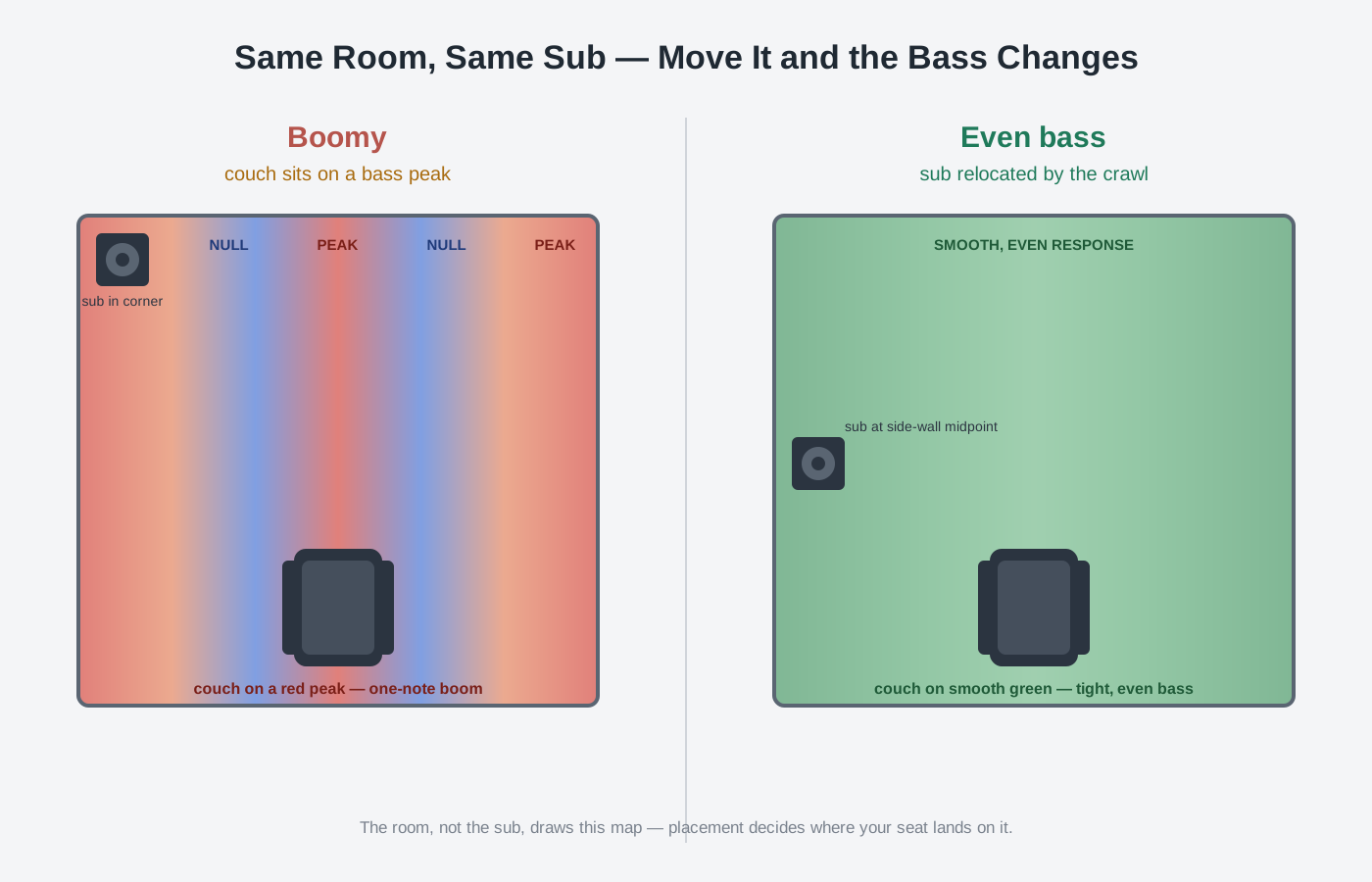
Buy a great subwoofer, drop it in the nearest corner, and you can still end up with bass that's boomy in one seat and gone in the next. That's not the sub — it's the room. Below roughly 80 Hz, sound wavelengths are so long they bounce between your walls and stack into standing waves, creating spots where bass piles up and spots where it cancels out. Where you put the sub decides which of those spots your couch lands in. Here's how room modes work, why the corner is a trade-off rather than a rule, and how the free 'subwoofer crawl' finds the smoothest spot in any room without a single piece of test gear.
The verdict up front: where you put your subwoofer shapes your bass more than which subwoofer you bought. Bass frequencies have wavelengths measured in feet — a 40 Hz tone is about 28 feet long — so instead of beaming at you the way treble does, they fill the room and bounce between opposite walls. Those reflections stack into standing waves (room modes): fixed patterns of spots where bass doubles up into a boomy peak and other spots where it cancels into a dead null. Move the sub and you move the pattern; move your seat and you land in a different part of it. The corner is the loudest spot but rarely the smoothest, and no amount of EQ can fill a null that placement created. The good news is that the fix costs nothing: the "subwoofer crawl" lets your own ears find the position that gives even bass at the seats that matter, and if one sub still can't cover a whole couch, a second sub — not a bigger one — is the real answer. Here's how the physics works and exactly how to find the spot.
The Counterintuitive Part: The Room Beats the Sub
Spend $800 on a subwoofer and it's natural to assume the sound you get is the sound you paid for. It isn't. In a small room — and every home listening room is "small" as far as deep bass is concerned — what you hear at your seat is the subwoofer plus everything the room does to it, and the room's contribution is enormous. The same sub, in the same room, can measure with a 15 dB swing between one spot and another three feet away. That's the difference between "tight and even" and "one-note boom that rattles the windows on some notes and vanishes on others."
This is the opposite of how the rest of your system behaves. Your tweeters and midrange fire mostly forward and you aim them at the seats. Bass doesn't work that way, and understanding why is what makes placement make sense.
Why Bass Is Different: Room Modes and Standing Waves
Two facts about low frequencies explain everything that follows.
First, deep bass is essentially non-directional. Below roughly 80 Hz the wavelengths are so long — 14 feet at 80 Hz, 28 feet at 40 Hz, 45 feet at 25 Hz — that your ears can't tell where the sound is coming from. This is exactly why home-theater bass management sends all the low stuff to one subwoofer you can place off to the side, and why the standard crossover point is 80 Hz. (If that idea is new, our subwoofer crossover explainer covers how bass management routes the lows.) Non-directional is great news for placement flexibility — you're not tied to a symmetrical spot the way you are with the front speakers.
Second, those long waves bounce. A 28-foot wave in a 14-foot-wide room reflects off the far wall and travels back into the wave still coming out of the sub. Where the two line up crest-to-crest, they add and get louder; where crest meets trough, they cancel and get quieter. Because the walls don't move, this pattern stands still in the room — hence standing wave, or room mode. Every room has a series of them, tied to its dimensions: the lowest mode along a wall sits at roughly 565 divided by that dimension in feet (so a 17-foot length has its fundamental mode near 33 Hz), with more modes stacked above it.
The result is a fixed three-dimensional map of loud spots (peaks) and dead spots (nulls) for each of those frequencies. Two things determine what you hear:
- Where the subwoofer sits decides how strongly it drives each mode. A sub in a pressure zone for a given mode excites it hard; a sub sitting at that mode's null barely excites it at all.
- Where you sit decides which part of the map your ears land in. Your couch might sit on a 45 Hz peak and a 63 Hz null at the same time — big, bloated mid-bass and thin, missing low bass.
Placement is simply the act of choosing a sub position and a seat position so the peaks and nulls at your ears are as small and as spread-out as possible. You can't eliminate room modes — they're physics — but you can dodge the worst of them.
The Corner Myth
The oldest rule of thumb is "put the sub in the corner," and it isn't wrong so much as incomplete. A corner is where three room boundaries meet, so it couples into the room with maximum efficiency — corner loading can add roughly 6–9 dB of output for free, and it excites every room mode strongly. If your only goal is maximum loudness from a small or underpowered sub, the corner delivers.
But "excites every mode strongly" is exactly the problem. The corner tends to produce the peakiest, boomiest in-room response — big humps at the modal frequencies and deep nulls between them. That's the classic "one-note bass" corner sound: impressive on the first movie explosion, fatiguing and uneven on everything else. The corner trades smoothness for output.
So treat the corner as one candidate, not the answer. If your sub has headroom to spare, a spot out along a wall — or the crawl-tested position below — usually sounds cleaner even though it measures a few dB quieter. You can always turn the volume up; you can't turn "boomy" down.
The Subwoofer Crawl: The Free Fix That Actually Works
Here's the trick that turns all this theory into a ten-minute job with zero test gear. The room's mode map is symmetric in a useful way: a spot where a sub sounds good is a spot where a listener hears good bass, and vice versa. So instead of moving a 40-pound subwoofer to a dozen candidate spots and listening from the couch each time, you do the reverse — put the sub where you sit and crawl around the room to find where its bass is smoothest. That spot is where the sub goes.
- Put the subwoofer on your primary seat. Right up on the couch cushion, roughly where your head is. It looks ridiculous. Do it anyway.
- Play something with steady, repetitive bass across a range of notes — a bass-heavy music track on repeat, or a slow sine sweep / bass test track. You want continuous low end, not one-off thumps.
- Set a sane crossover and level. Cross it over around 80 Hz and turn it up enough to clearly hear the bass, but not so loud the whole house shakes.
- Crawl the room on your hands and knees, ear at the height the sub will actually sit, along the walls and open floor where a sub could realistically live. Listen for where the bass is the most even and full across all the notes — not the loudest, the smoothest. You're listening for a spot where no single note booms out and none disappears.
- Mark the best spot and put the sub there. Then sit back down and confirm the bass is even at every seat you care about.
The crawl works because it lets your ears — which are very good at hearing "even vs. lumpy" — do the measuring. If you want to go further, a phone SPL-meter app or a cheap USB measurement mic with free room software turns the same job into a graph, and it's the honest way to confirm what your ears found.
A Rough Ranking of Common Spots
Every room is different, so this is a starting map, not a verdict. Crawl to confirm.
| Position | Output | Smoothness | Use when |
|---|---|---|---|
| Corner | Highest (+6–9 dB) | Worst — peaky, boomy | The sub is underpowered and you need every dB |
| Along the front wall, off-center | High | Better than the corner | A common, easy compromise for movies |
| Front wall, near a front speaker | Moderate | Good; keeps bass "attached" to the stage | Music-forward setups where you want bass to feel like it comes from the fronts |
| Midpoint of a side wall | Lower | Often very smooth | The crawl points here and you have the output to spare |
| Directly against your seat / behind the couch | Localized, strong at one seat | Great for one seat, uneven for others | A single-listener setup where only one chair matters |
Two hard rules regardless of spot: don't shove the sub into a cabinet or closed cubby (you'll get resonance and muddle), and don't assume symmetry helps — unlike the front speakers, a subwoofer does not need to be centered or mirrored, and forcing it into a "pretty" symmetric spot is how a lot of rooms end up boomy.
After Placement: Distance, Phase, and Crossover
Placement is 80% of the battle; these settings clean up the rest, and they only work after the sub is in a good spot.
- Run your AVR's auto-calibration (Audyssey, Dirac, YPAO, etc.). It sets the sub's distance/delay so its output arrives time-aligned with the speakers, sets levels, and applies EQ. Our room-correction comparison covers what each system can and can't do.
- Check phase/polarity. If the sub and the front speakers are fighting at the crossover region, flipping the sub's phase (0/180 switch, or the continuous dial on nicer subs) can turn a suck-out at 80 Hz into smooth blend. Set it by ear or by measurement after placement, not before.
- Set the crossover deliberately. 80 Hz is the standard for a reason; see the crossover guide if you're running small speakers or towers and want to tune it.
The critical thing to understand: EQ and room correction can shave down a peak, but they cannot fill a null. A null is acoustic cancellation — the energy is being destroyed at that spot, so boosting that frequency just makes the sub work harder without getting louder at your ears (and it eats headroom everywhere else). The only fix for a null is moving the sub or the seat. That's why placement comes first and EQ comes last.
When One Sub Can't Win: Add a Second, Not a Bigger One
Sometimes there's no single spot that's smooth at every seat — the couch is wide, or you have two rows, and one sub always leaves someone in a null. The instinct is to buy a bigger sub. That's the wrong upgrade: a bigger sub is louder, but it excites the exact same room modes, so the peaks and nulls stay right where they were.
The real fix is two subwoofers. Placed well — typically at the midpoints of opposing walls, or in two different corners — a pair excites the room's modes out of phase with each other, and the peaks and nulls partly average out. The result is bass that's markedly more even across the whole seating area, not just at one chair. Our dual-subwoofer guide covers when the second sub is worth it and how to place the pair. (Two modest subs almost always beat one big one for smoothness.)
When you are shopping, a sealed sub trades a little output for tighter, more even response that's a bit more placement-forgiving, while a ported sub digs deeper and plays louder at the cost of being fussier — our sealed vs. ported breakdown explains the trade. A well-reviewed sealed or compact ported sub with real DSP and a phase control — something in the class of the SVS SB-1000 Pro or a value pick like the Monoprice Monolith 10-inch THX — gives you the app EQ and phase adjustment that make dialing in placement much easier, and buying two of a modest model is usually the smarter spend than one flagship. (Compare current subwoofer prices on Amazon.)
The Bottom Line
Your subwoofer's job is to make deep bass; your room's job — whether you like it or not — is to reshape it into a fixed pattern of loud and dead spots. Placement is how you take control of that pattern. Skip the "just corner it" reflex: the corner is loudest but usually boomiest, and symmetry doesn't matter down here the way it does for your front speakers. Instead, spend ten minutes on the subwoofer crawl, put the sub where the bass is smoothest at the seats you actually use, then let auto-cal set distance, level, and phase. Remember that no EQ can fill a null — placement first, correction second. And if one sub can't cover a wide couch, reach for a second sub rather than a bigger one. Do that and a mid-priced subwoofer in a good spot will bury an expensive one in a bad one, every time.
Affiliate disclosure: NetAudioHub links to retailers including Amazon. We earn a small commission on qualifying purchases at no extra cost to you.