Klipsch RP-504C II Review: The Center Channel That Finishes the Reference Premiere II System
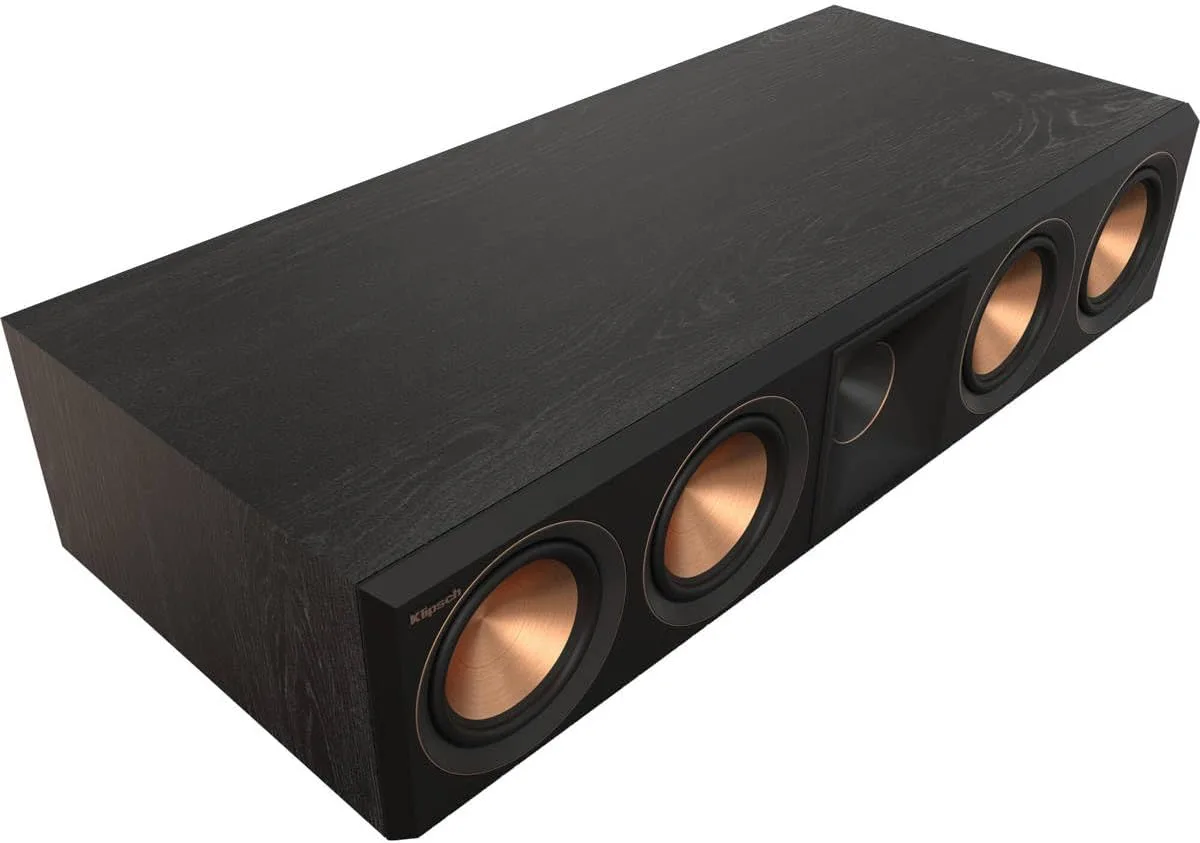
The Klipsch RP-504C II pairs four 5.25" Cerametallic woofers and a 1" Titanium LTS tweeter on a 90°×90° Hybrid Tractrix Horn. The matching center for the RP-600M II, RP-6000F II, and any Denon, Marantz, or Yamaha AVR-based 5.1.
✅ Pros
- +Four 5.25-inch Cerametallic woofers deliver dialogue with body, weight, and dynamic headroom
- +96 dB rated sensitivity (Klipsch, half-space) — within 1.5 dB of the rest of the Reference Premiere II line, so timbre stays consistent across the front stage
- +90°×90° Hybrid Tractrix Horn keeps off-axis seats hearing the same voicing as the sweet spot
- +1,950 Hz crossover puts the tweeter above the dialogue band, where the horn excels
- +50 Hz lower limit crosses cleanly to a sub at 80 Hz with no gap
- +Timbre-matches the RP-600M II, RP-6000F II, and RP-8000F II for a coherent front stage
- +5-year parts and labor warranty
- +6.94-inch height fits under most wall-mounted TVs
❌ Cons
- −Single binding posts — no bi-amp / bi-wire path
- −Wants real volume to come fully alive
- −32-inch width is too big for a 43-inch or smaller TV
- −Rear port requires 4+ inches of wall clearance
- −Vinyl finishes (not real wood veneer) at $799
- −Only useful if your front speakers are also Klipsch Reference Premiere II — single-brand commitment
The Klipsch RP-504C II is the right center channel for any AVR-based 5.1 built around Reference Premiere II. Four 5.25-inch Cerametallic woofers sit on either side of a 1-inch Titanium LTS tweeter loaded into the same 90°×90° Hybrid Cross-Section Tractrix Horn used across the rest of the line. Klipsch rates sensitivity at 96 dB (half-space) — identical to the RP-6000F II floorstanders and 1.5 dB above the Klipsch RP-600M II bookshelves at 94.5 dB — so a midrange AVR like the Denon AVR-X2800H or Marantz Cinema 70s drives the full front stage without timbre shifts when the mix pans across it. At $799, the RP-504C II is the obvious answer for anyone moving from a 2.1 setup to a real 5.1 with the same family of speakers. Dialogue sits forward and articulate, the horn keeps off-axis seats hearing the same voicing as the sweet spot, and the 50 Hz lower limit lets it cross to a sub like the SVS SB-1000 Pro at 80 Hz with room to spare.
Key Specs at a Glance
The RP-504C II is a 2-way passive bass-reflex center channel. The tweeter is a 1" (25.4mm) Titanium LTS vented diaphragm loaded into a 90°×90° Hybrid Cross-Section Tractrix Horn; the array is four 5.25" (133mm) Cerametallic (copper-spun) cones flanking it. Crossovers sit at 650 Hz and 1,950 Hz. Frequency response is 50 Hz – 25 kHz (±3 dB), sensitivity is 96 dB @ 2.83V/1m — a half-space figure per Klipsch's footnote; no independent anechoic measurement of this model exists, but on the two Reference Premiere models that have been measured the anechoic figure lands 7–8.5 dB lower — power handling is 150W continuous / 600W peak, and nominal impedance is 8 Ω. The cabinet is internally braced MDF with a rear-firing Tractrix port and a single pair of aluminum binding posts. Dimensions are 6.87" H × 32.06" W × 15.08" D, 36.3 lb, available in Ebony or Walnut vinyl, with a 5-year parts-and-labor warranty at $799 USD.
What's New vs. the Original RP-504C
The RP-504C II is the 2023–2024 refresh of Klipsch's best-selling Reference Premiere center. The cabinet silhouette is nearly identical, but the acoustic and material changes mirror what Klipsch did to the rest of the Reference Premiere II line.
The 90°×90° Hybrid Cross-Section Tractrix Horn is the single biggest change. The new horn flare is squared near the throat and rounded toward the mouth, which decouples horizontal and vertical dispersion. For a center channel that's the most important change Klipsch could make — it widens the seat-to-seat consistency of dialogue so the person on the end of the couch hears the same voice as the person dead center. A redesigned phase plug in the throat smooths the upper midrange; the original RP-504C could sound a touch sibilant on bright dialogue or compressed broadcast audio, and the II is smoother through the 3–6 kHz dialogue intelligibility band. The redesigned Cerametallic woofers use the same copper-spun IMG recipe with revised geometry and surround for lower distortion at high excursion — on loud scenes the cone signature is less audible. Improved bracing and aluminum binding posts round it out; marginal upgrades, but they're there.
If you own the original RP-504C and you're happy with it, don't upgrade for sound — the differences are real but they're refinements, not transformations. If you're building new today, the II is the correct version: it matches the dispersion behavior of the rest of the Reference Premiere II line, which is why timbre-matching across the front stage works.
Dialogue Performance
This is what a center channel is for, and the RP-504C II is good at it. The 1-inch Titanium LTS tweeter on the Hybrid Tractrix Horn loads the dialogue band with substantially more output per watt than a dome-only design. Voices sit forward of the room rather than spread across the wall behind the TV. Whispered dialogue stays intelligible at low volume because the horn focuses the energy toward the listening area instead of bouncing it off the ceiling. Shouted lines in action scenes don't compress or harden — the horn has the headroom and the woofers have the displacement to keep dynamics intact at home-theater reference levels.
The four-woofer array is a real advantage over a smaller two-woofer center. Crossover is at 1,950 Hz, which is right at the bottom of the dialogue intelligibility band — that means the woofers, not the tweeter, are doing most of the work for a man's speaking voice. Four 5.25-inch Cerametallic cones moving together have the cone area roughly equivalent to a single 10-inch driver, but with far less mass per cone. The practical result is that voices have body and chest weight without the boxy resonance that some smaller centers add to male vocals. Female voices stay clear without the upper-midrange hardness that older Klipsch designs could produce.
The horn keeps the seats consistent. The 90°×90° dispersion pattern is wider than the older RP-504C's, which means an end-of-couch listener hears the same balance as a center-of-couch listener. This is the single best reason to pay $799 for the II instead of a cheaper two-driver center: in a real living room with three or four seats, the difference is audible immediately on the first dialogue-heavy scene.
Where it's honest about its limits: the 50 Hz lower limit means you cannot run this center "large" in a real home-theater setup. Cross it to a sub at 80 Hz like every other speaker in the system. If you do that, the RP-504C II handles the dialogue band cleanly and hands the LFE off to where it belongs.
Timbre Matching Across the Front Stage
This is the entire reason to buy a matching center channel from the same line as your front speakers. Klipsch tunes the Reference Premiere II line — bookshelves, floorstanders, surrounds, Atmos modules, center — to the same voicing target. When a 5.1 or 7.1 mix pans a sound from the left front to the center to the right front, the timbre should not change. With non-matching centers, it usually does.
The RP-504C II is voiced to match the Klipsch RP-600M II bookshelves ($749/pair) — the natural pairing for most living rooms, within 1.5 dB on rated sensitivity (96 dB vs 94.5 dB) and with a crossover band close enough that pans are seamless. It also matches the RP-6000F II floorstanders ($1,398/pair) — the step up for larger rooms with the same horn, Cerametallic cones, and sensitivity — and the RP-8000F II floorstanders ($1,798/pair) for rooms above 400 sq ft, where the larger RP-704C II is the natural center but the RP-504C II is still a credible match. RP-500M surrounds and RP-500SA Atmos modules complete the family.
If your fronts are not Klipsch Reference Premiere II, don't buy this center. Pair like-for-like — KEF center with KEF fronts, Polk Reserve center with Polk Reserve fronts, ELAC Debut with ELAC Debut. The cross-brand timbre mismatch will be more audible than any spec-sheet difference between center channels.
In a 5.1 / 5.1.2 System
As the center in a 5.1 anchored by RP-600M II fronts, the RP-504C II is the right call without much debate. At 96 dB rated it sits 1.5 dB above the 94.5 dB fronts — close enough that room calibration trims it out. 50 Hz lower limit means an identical 80 Hz crossover to a sub. The horn keeps off-axis dialogue clear. A Marantz Cinema 70s or Denon AVR-X2800H drives the full front stage comfortably. Plan on loud rather than on film reference level, though: those Klipsch ratings are half-space figures, so the watts a 50-to-95-watt receiver has to find are more than the numbers imply. Run Audyssey or Dirac calibration after install — the high sensitivity of the Klipsch line means the receiver may set the center channel trim higher than the fronts to compensate for the horn's directivity, which is normal.
As the center in a 5.1.2 Atmos setup, add a pair of RP-500SA modules on top of the front bookshelves (or as separates if you can mount them at ceiling height). The Reference Premiere II family voices the height channels to match — Klipsch is one of the few brands that ships matching Atmos modules in the same finish and voicing as the rest of the line.
As the center in a budget 5.1 anchored by a Yamaha or budget Denon AVR, the RP-504C II is overkill. If you bought RP-600M II at $749, scaling down the center to a Polk Signa S4-class soundbar-as-center is a false economy — the timbre mismatch will be obvious. Either buy the matching center or buy a soundbar system end-to-end like the JBL Bar 1000.
As the center with RP-6000F II floorstanders, the RP-504C II is the appropriate size match. Klipsch makes a larger RP-704C II for the RP-8000F II tier; the RP-504C II is sized correctly for the RP-6000F II step.
Setup and Placement
A center channel lives or dies on placement. A few non-obvious things matter more than the spec sheet. Get the tweeter at ear height when seated, ideally — the RP-504C II is 6.94 inches tall, which fits cleanly under most wall-mounted TVs on a typical media console. Measure the gap between your TV's bottom edge and the top of your console: you need at least 7 inches plus a couple inches of clearance for the magnetic grille. Aim it: if the speaker sits below ear height on a console, tilt it up toward the listening seats. Klipsch sells small foam wedges; a folded piece of cardboard works as well. The Hybrid Tractrix Horn is most consistent when the tweeter is on-axis with the primary seat.
Don't put it inside a closed cabinet. The rear Tractrix port needs air; inside a closed shelf, the port resonance turns into boom. If the speaker absolutely has to sit in a cabinet, leave the back open or skip this center for a sealed alternative. Run AVR room calibration after install — Audyssey, Dirac, YPAO, MCACC, whatever your AVR uses. The center channel benefits more from EQ than the fronts because it sits in a different acoustic environment (under or above the TV, close to a wall). Speaker wire 14 gauge minimum: center channel cable runs are usually short, so gauge rarely bites here — series wire resistance matters in proportion to the speaker's impedance, not its sensitivity, and the RP-504C II is a benign 8-ohm nominal load. And set the center to "small" and cross at 80 Hz in the AVR menu — the RP-504C II goes to 50 Hz, but it's not a sub. THX 80 Hz crossover is correct here.
Limitations Worth Knowing
Single binding posts, no bi-amp. Unlike the RP-600M II bookshelves, which have dual binding posts for bi-amp/bi-wire, the RP-504C II is a single-post design. You can't bi-amp it from a separates rig. For 99% of buyers this doesn't matter, but if you were planning a future bi-amp upgrade, know that this center won't accept it.
Wants real volume to come alive. Same horn-loaded character as the rest of the Reference Premiere II line. At very low listening volumes (TV dialogue at -35 dB on the AVR), the horn's directivity becomes audible as a slight "forwardness" that softer-dome centers don't have. Most viewers won't notice; some will.
Width may not fit every console. At 32.19 inches wide, the RP-504C II is sized for a TV of about 55 inches or larger. On a 43-inch TV with a narrow stand, the center is visually too big. If you have a small TV and a small console, the smaller RP-404C II (or a different brand's compact center) is the right call.
Rear port limits placement. Like every Reference Premiere II speaker, the rear Tractrix port needs ~4 inches of clearance behind the cabinet to breathe. If your console is pushed against a wall, pull it forward.
No Atmos integration on its own. The center channel is a center channel, not an Atmos-enabled module. If you want height channels from the front, add RP-500SA modules separately.
Doesn't replace a real soundbar's simplicity. This is a passive speaker that needs an AVR. If your real constraint is "no AVR, no separate amp, no speaker wire," look at the Sonos Arc Ultra or Samsung HW-Q990D instead.
Who Should Buy the Klipsch RP-504C II
Buy it if you already own (or are buying) Klipsch RP-600M II, RP-6000F II, or RP-8000F II front speakers, and you're building a 5.1 or 5.1.2 anchored by a real AVR — Denon AVR-X2800H, Marantz Cinema 70s, Yamaha RX-V6A, or a step up. It's the right pick if you watch movies and TV more than half the time (dialogue intelligibility is the main reason this center exists), you have 32 inches of clear width on your media console, and you can give the rear port 4+ inches of clearance.
Consider the smaller Klipsch RP-404C II instead if your TV is 50 inches or smaller and the console doesn't accommodate a 32-inch wide center, or you want a less imposing visual footprint under the TV. Consider stepping up to the RP-704C II if your room is over 400 square feet and you have RP-8000F II floorstanders, or you want the most headroom and lowest cabinet resonance in the line. Consider a different brand's center if your fronts aren't Klipsch Reference Premiere II — pair to the family of your fronts. And consider a soundbar instead if you don't have an AVR and don't want one — the Sonos Arc Ultra, Samsung HW-Q990D, or JBL Bar 1000 are complete systems in a box.
Klipsch RP-504C II vs. the Original RP-504C
The original RP-504C is still available used at $400–500 per unit and remains a competent center. The II adds the new Hybrid Tractrix Horn (wider dispersion), the redesigned phase plug (smoother through dialogue band), revised Cerametallic woofers (lower distortion at high SPL), and incremental cabinet improvements. Buy the II new if you're building a Reference Premiere II system from scratch or you already own RP-600M II / RP-6000F II / RP-8000F II speakers and need to timbre-match. Buy the original RP-504C used if you own the original RP-600M (not II), RP-6000F (not II), or RP-8000F speakers — the originals timbre-match the original line, not the II line. Mixing II and original generations works but isn't as seamless.
Klipsch RP-504C II vs. Polk Reserve R400
The Klipsch RP-504C II ($799) is a passive 2-way bass-reflex center with a 1" Titanium LTS tweeter on a Hybrid Tractrix Horn, four 5.25" Cerametallic woofers, 96 dB rated sensitivity (half-space — not directly comparable to Polk's figure), and a 50 Hz – 25 kHz frequency response. The Polk Reserve R400 ($599) is also a passive 2-way bass-reflex center but uses a 1" Pinnacle ring radiator with one 6.5" Turbine Cone and four 4" mid/woofers, 89 dB sensitivity, and 53 Hz – 39 kHz frequency response. These don't compete directly — pick by what your front speakers are. If you own Polk Reserve fronts, the R400 is the right center. If you own Klipsch Reference Premiere II fronts, the RP-504C II is the right center. The R400 is the friendlier speaker at low volume, and it is its dispersion that makes it so, not its lower sensitivity; the RP-504C II has more displacement for loud scenes. Do not read the 7 dB between the two sensitivity numbers as a headroom advantage — Klipsch's 96 dB is half-space and Polk's 89 dB is not.
Bottom Line
The Klipsch RP-504C II is the right center channel if (and only if) your front speakers are Klipsch Reference Premiere II. Inside that family it's the obvious choice — 96 dB rated sensitivity (Klipsch, half-space), matching the RP-6000F II and within 1.5 dB of the RP-600M II, the same Hybrid Tractrix Horn for consistent voicing across the front stage, four Cerametallic woofers that give male dialogue real weight, and a 50 Hz lower limit that hands cleanly off to a sub at 80 Hz. $799 is the right price for the size and capability.
Pair it with RP-600M II fronts, a Marantz Cinema 70s or Denon AVR-X2800H, and an SVS SB-1000 Pro sub, and you have a real 5.1 home theater that sounds like one system rather than five mismatched parts. If your fronts aren't Reference Premiere II, look at the matching center for whatever line they're in instead — the cross-brand timbre mismatch will be more audible than any spec-sheet difference between center channels.
The Klipsch RP-504C II is available on Amazon in Ebony or Walnut at $799.
Our Verdict
The Klipsch RP-504C II pairs four 5.25" Cerametallic woofers and a 1" Titanium LTS tweeter on a 90°×90° Hybrid Tractrix Horn. The matching center for the RP-600M II, RP-6000F II, and any Denon, Marantz, or Yamaha AVR-based 5.1.
Ready to buy the Klipsch RP-504C II?
Buy on Amazon →Affiliate link — we may earn a commission at no extra cost to you.