Sonos Sub 4 Review: The Wireless Sub That Finishes a Sonos Home Theater
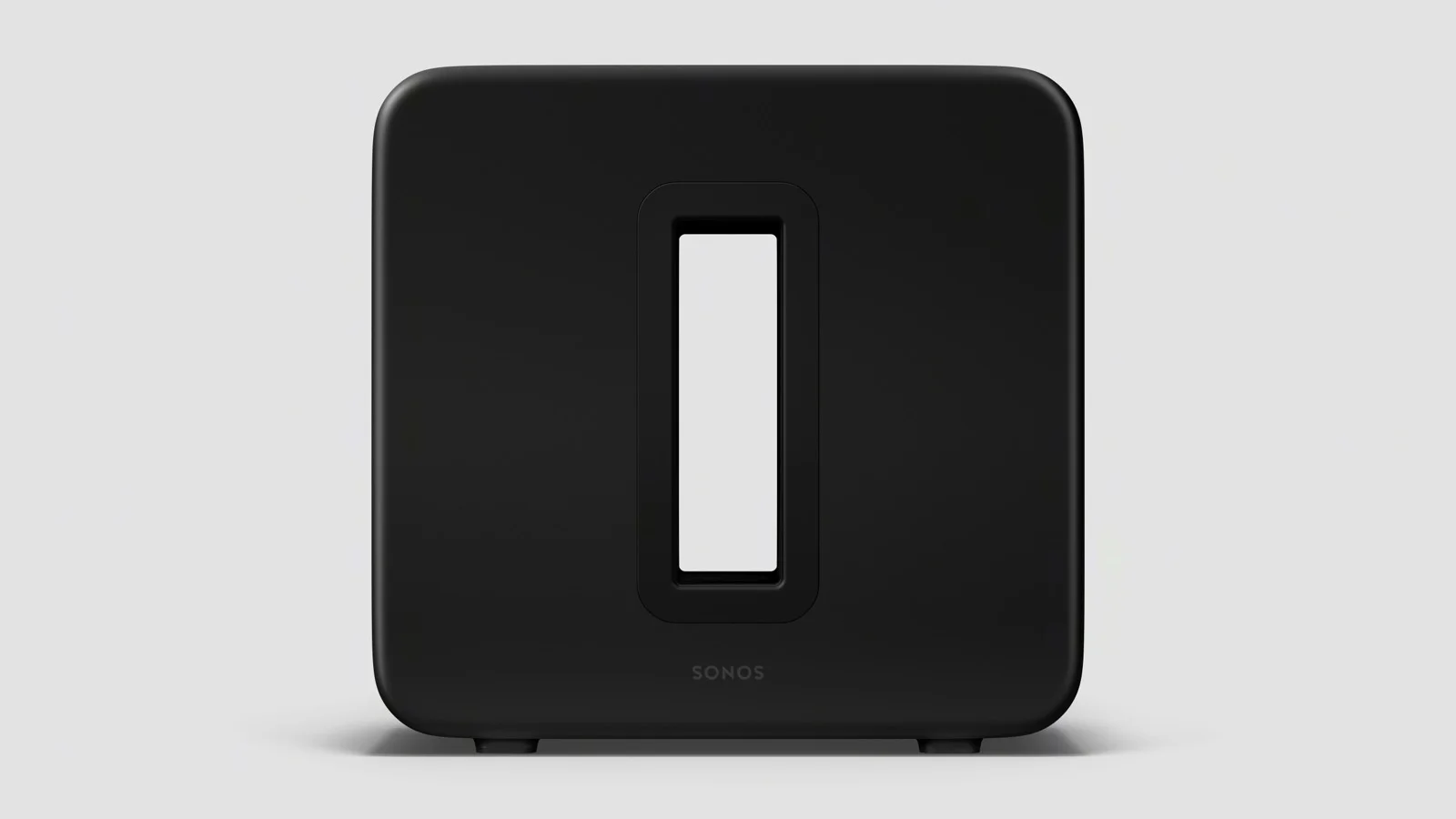
The Sonos Sub 4 brings dual force-cancelling woofers, WiFi 6, and Trueplay tuning to a sealed wireless sub that pairs with the Arc Ultra in one tap. The right bass anchor for a Sonos system — and only a Sonos system.
✅ Pros
- +Force-cancelling dual-driver design keeps the cabinet still at high output — no rattles, no walking on hardwood
- +Sealed bass extends cleanly to ~25 Hz with no port chuffing or overhang
- +WiFi 6 dramatically improves reliability vs. Sub (Gen 3) in dense WiFi environments
- +One-tap pairing with any Sonos soundbar or Amp
- +Trueplay room correction handles crossover, level, and EQ automatically
- +Music-friendly: articulate enough for jazz and acoustic, deep enough for movie LFE
❌ Cons
- −Sonos-only — no line-level or LFE input, no integration with any non-Sonos amplifier or AVR
- −$799 is expensive for the driver count and amplifier wattage by raw comparison
- −No manual DSP — no parametric EQ, no manual phase, no exposed crossover
- −Hardware-identical to Sub (Gen 3) — no acoustic upgrade if you already own one
- −Sealed design caps maximum SPL — not the choice for dedicated 4,000+ cu ft theater rooms
The Sonos Sub 4 is the right sub to buy if you already own a Sonos soundbar or Amp. Dual force-cancelling drivers in a sealed cabinet deliver clean, articulate bass that integrates with the Sonos Arc Ultra over WiFi in one tap, with Trueplay tuning handling room correction automatically. At $799, it is priced for the Sonos ecosystem buyer — the person who values "one app, one network, one tap" more than maximum SPL per dollar. If that's you, the Sub 4 is excellent. If you're outside the Sonos ecosystem and shopping on raw bass performance, the SVS SB-1000 Pro delivers more output and more DSP control for $200 less.
Key Specs at a Glance
The Sub 4 uses two custom-designed force-cancelling woofers driven by two Class-D digital amplifiers (one per driver) in a sealed cabinet. Sonos quotes frequency response down to 25 Hz. Wireless is WiFi 6 (802.11ax) on both 2.4 and 5 GHz, with a 10/100 Ethernet port for setup and as a wired fallback. There are no line-level audio inputs. Room correction is handled by Trueplay (iOS-guided) or Quick Tune (Android). One-tap pairing supports the Sonos Arc, Arc Ultra, Beam (Gen 2/3), Ray, and Amp. Dimensions are 15.3" H × 15.8" W × 6.2" D, ~36 lb, in Matte Black or Matte White. Price: $799.
What's New vs. Sonos Sub (Gen 3)
The Sub 4 looks identical to the Sub (Gen 3). It uses the same sealed cabinet with the signature vertical slot between two opposing drivers, the same physical dimensions, and the same dual-amp, dual-driver architecture. What changed is internal: WiFi 6 (802.11ax) replaces the older 802.11n radio, the onboard processor is faster with more memory, and a Bluetooth LE radio is added for setup. In dense WiFi environments, the radio upgrade is the change that actually matters — the Sub 4 stays locked to your soundbar with less audible dropout when the network gets crowded.
The drivers, amplifier topology, and acoustic design are the same as Gen 3. If you already own a Sub (Gen 3), the Sub 4 is not a meaningful sound-quality upgrade — it's a platform refresh. If you're buying new today, the Sub 4 is the version to get because it's the one Sonos will support longest.
Sound Quality
Sealed, dual-opposed bass is the right design choice for this product. The two drivers fire away from each other on the long axis of the cabinet, which mechanically cancels enclosure vibration — the sub stays still even at high output, so it doesn't rattle the floor, walk across hardwood, or muddy the midrange with cabinet resonance. Sealed (rather than ported) means the low end rolls off more gently and the bass starts and stops with the source. Music benefits the most: kick drums hit and release cleanly, basslines stay defined, and the sub blends with the Arc Ultra rather than calling attention to itself.
Pair it with the Sonos Arc Ultra, and it stops being a "subwoofer review" — it becomes a system review. The Arc Ultra hands the lowest one to two octaves to the Sub 4 automatically when they're paired, freeing the bar's Sound Motion woofer to play louder, cleaner, and higher in its passband. Dialogue stays present, action scenes get visceral, and movie scores extend cleanly down to ~25 Hz. The Sub 4 is the upgrade that takes the Arc Ultra from "great soundbar" to "real home theater."
Output is more than enough for typical living rooms — 2,000 to 3,500 cubic feet. The Sub 4 plays loud cleanly in this range. It won't shake a 4,000+ cu ft basement theater the way a larger SVS sub or a pair of subs will, and the sealed design means you don't get the chest-thumping low-end you'd get from a ported design at similar price.
Setup and the Sonos Tax
Setup is the easiest of any sub on the market. Plug the Sub 4 in next to your couch or anywhere it has a flat floor and one foot of clear space on each side. Open the Sonos app — it sees the Sub 4 over Bluetooth LE. Pair it to your existing soundbar or Amp in one tap. Run Trueplay (iOS) or Quick Tune (Android), and the app walks you through the room measurement while the system handles crossover, level matching, phase, and EQ automatically.
There are no line-level audio inputs. The Sub 4 connects only over WiFi, and it only pairs with Sonos soundbars and Amps. This is the Sonos tax. You don't bring this sub into a non-Sonos system, you don't run it from a Denon or Marantz AVR's LFE output, you don't connect it to a turntable. If you ever leave the Sonos ecosystem, the Sub 4 doesn't come with you.
For Sonos owners, this constraint is a feature. For everyone else, it's the reason this review exists — to make the boundary explicit.
Connectivity and Networking
The Sub 4 ships with WiFi 6 (802.11ax) on both 2.4 GHz and 5 GHz, and that radio upgrade is the headline functional change vs. Sub (Gen 3). In real-world use it means lower audio dropout rate in dense apartment-building WiFi environments where the older 802.11n radio could lose grip, cleaner handoff between the Sub and a modern home network (the Sub 4 still uses WiFi 6, but it negotiates cleanly with a WiFi 7 router like the Eero 7 without falling back to 2.4 GHz), and concurrent dual-band operation so the Sub 4 doesn't compete with other Sonos endpoints for the same band.
There's also a 10/100 Ethernet port. It's there for setup and as a fallback for difficult WiFi environments — wire one Sonos product, and the rest of the network bonds to it as a wired bridge.
Limitations Worth Knowing
Sonos-only, no exceptions. The Sub 4 only pairs with Sonos soundbars and the Sonos Amp. It does not have line-level inputs, an LFE input, or any way to be driven by a non-Sonos system. If your home theater is built around a Denon, Marantz, Yamaha, or other AVR, this is the wrong sub for you — the SVS SB-1000 Pro with stereo RCA + LFE inputs is the right answer.
No advanced DSP is exposed to the user. Trueplay does the EQ for you. Unlike the SVS app, there is no 3-band parametric EQ, no continuously variable phase, no manual crossover adjustment, no room-gain compensation control. For most Sonos owners this is the right tradeoff — Trueplay is genuinely good and the absence of controls means there's nothing to mis-tune. For users who want to dial in a measurement-mic-driven EQ in REW, this is a hard ceiling.
Hardware-identical to Sub (Gen 3): if you own a Sub Gen 3 already, the upgrade is WiFi 6 and a faster processor — not sound quality. Don't upgrade for sound. Sealed-only design: Sonos quotes 25 Hz response, which is solid but not exceptional. For dedicated theater rooms chasing infrasonic LFE, look at the SVS SB-1000 Pro or a larger SVS. And the price: $799 is high for a single-driver-class sub by raw spec comparison. You're paying for the Sonos integration — WiFi, Trueplay, one-tap pairing, multiroom audio support — not for SPL per dollar.
Who Should Buy the Sonos Sub 4
Buy the Sub 4 if you already own a Sonos Arc Ultra, Arc, Beam (Gen 2/3), Ray, or Sonos Amp, and you want to add real low end without rewiring anything. It's the right choice if you value setup simplicity and one-app control over manual DSP tuning, your room is 2,000–3,500 cubic feet (typical living rooms), and you watch movies and listen to music in roughly equal measure without retuning between use cases.
Consider the SVS SB-1000 Pro instead if you're outside the Sonos ecosystem — driving from an AVR like the Denon AVR-X2800H, Marantz Cinema 70s, or Yamaha RX-V6A. The SB-1000 Pro is $599 with a 12-inch driver and 325W amp, and the SVS app exposes parametric EQ, room gain, and configurable presets that the Sonos Sub 4 simply does not have.
The Sonos Sub Mini ($429) is the better pick if you own a Sonos Beam (Gen 2) or Ray rather than an Arc-class bar, your room is under 1,500 cubic feet, and budget is the constraint rather than absolute output.
Sonos Sub 4 vs. SVS SB-1000 Pro
The two subs solve different problems. The Sub 4 ($799) is wireless-only, pairs solely with Sonos soundbars and the Sonos Amp over WiFi, uses two force-cancelling drivers in a sealed cabinet, and runs through Trueplay for room correction. The SVS SB-1000 Pro ($599) has a single 12" front-firing driver and a 325W Sledge Class D amp in a sealed cabinet, with stereo RCA + dedicated LFE inputs and a phone app that exposes a 3-band parametric EQ, presets, and room gain.
The Sub 4 finishes a Sonos system. The SB-1000 Pro is the better sub on the spec sheet and the right answer for anyone with a real AVR. Most buyers will know which one applies to them within ten seconds.
Sonos Sub 4 vs. Sonos Sub (Gen 3)
The Sub 4 is a platform refresh, not a sound-quality upgrade. Drivers, amplification, cabinet, and acoustic tuning are identical. What changed: WiFi 6 (802.11ax) replaces WiFi 4 (802.11n), which is much more reliable in dense network environments. The onboard processor is faster with more memory, providing headroom for future Sonos software features. And Bluetooth LE is added for a faster setup pairing flow.
If you own a Sub (Gen 3), don't upgrade for sound. If you're buying new, the Sub 4 is what to buy — it's the version Sonos will support longest.
Bottom Line
The Sonos Sub 4 is the right wireless sub to pair with a Sonos soundbar. It's quiet engineering — dual-opposed force-cancelling drivers in a sealed cabinet, with a WiFi 6 platform refresh that fixes the one real complaint about Sub (Gen 3). One-tap pairing and Trueplay mean setup is effectively automatic.
The catch is the same catch every Sonos product has: it works inside Sonos and only inside Sonos. For owners of an Arc Ultra (or any other Sonos soundbar or the Sonos Amp), that constraint is a feature — the system stays simple. For everyone else, the SVS SB-1000 Pro is the smarter spend.
The Sonos Sub 4 is available on Amazon in Matte Black or Matte White at $799.
Our Verdict
The Sonos Sub 4 brings dual force-cancelling woofers, WiFi 6, and Trueplay tuning to a sealed wireless sub that pairs with the Arc Ultra in one tap. The right bass anchor for a Sonos system — and only a Sonos system.
Ready to buy the Sonos Sub 4?
Buy on Amazon →Affiliate link — we may earn a commission at no extra cost to you.