BenQ TK705i Review: The 4K Projector You Never Have to Re-Lamp
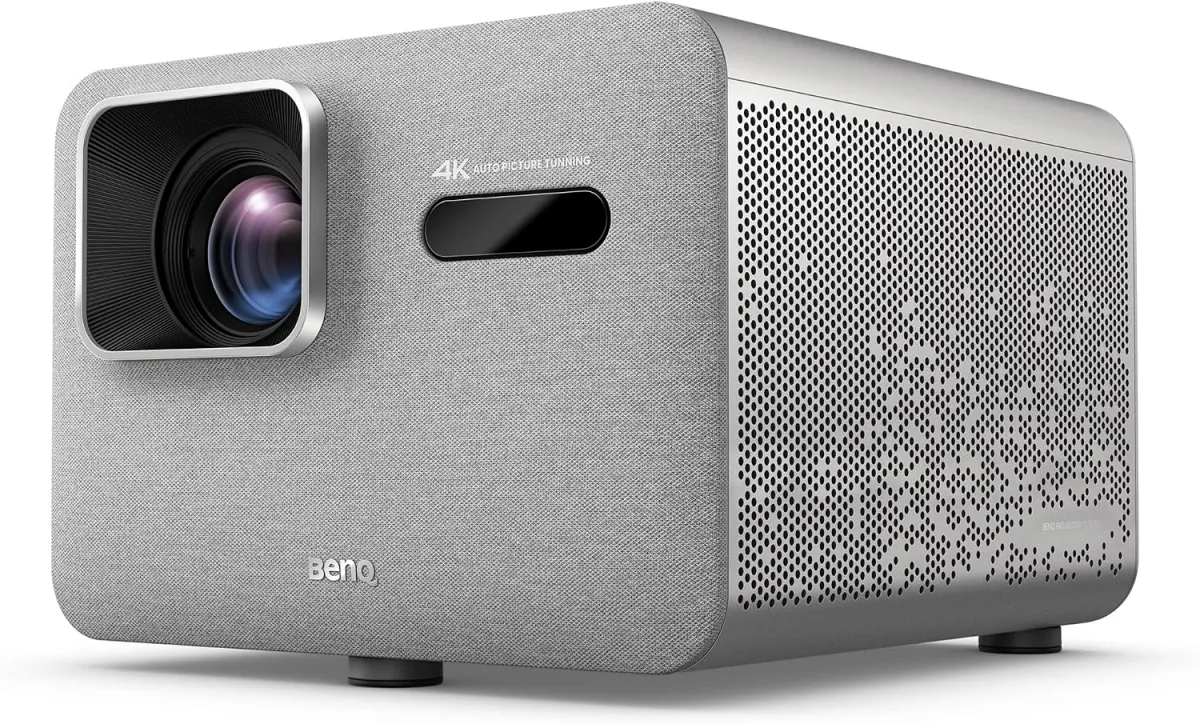
The BenQ TK705i is a $1,599 4K HDR projector built around a 20,000-hour 4LED light source — about 13 years at four hours a night, with no lamp to replace and no scheduled brightness cliff. Around it sits a bright, colorful picture that holds up with the lights on, Google TV built in, and genuinely low gaming latency. Three things need honest framing: the 5 ms input lag claim is not reproducible (9.3 ms is the real floor, and only in a mode that disables zoom and every geometry correction), the 600,000:1 contrast is a dynamic figure that leaves fully dark scenes grey and flat, and the two HDMI 2.1 ports do not carry 4K/120. Use it in a living room with some ambient light, run audio out over eARC instead of the built-in speakers, and it is an easy recommendation.
✅ Pros
- +20,000-hour 4LED light source — no lamp to replace, no scheduled brightness cliff
- +Bright, vibrant, natural-looking 4K HDR pictures that hold up with the lights on
- +Very low measured input lag (9.3 – 12.2 ms) for a projector
- +Google TV built in, with Wi-Fi 6 and a well-laid-out remote
- +eARC on HDMI-1 makes routing audio to real speakers a one-cable job
- +Quiet at 24 – 26 dBA, and reaches full brightness instantly
- +Excellent auto-setup: autofocus, auto keystone, screen fit, obstacle avoidance
- +Compact, genuinely attractive cube that suits a living room
❌ Cons
- −Black levels are flat and grey in a fully darkened room
- −The 5 ms input lag claim is not reproducible; 9.3 ms requires a mode that disables zoom and all geometry correction
- −HDMI 2.1 ports but no 4K/120 — 60 Hz is the ceiling
- −Built-in 2 × 8 W audio is harsh and bass-light
- −No optical lens shift, and only a 1.3× zoom, so placement is unforgiving
- −Not a native-4K chip, and slightly soft next to the sharpest DLP rivals
- −No Dolby Vision
- −BenQ publishes no DCI-P3 figure for this model — expect Rec. 709 color, not wide gamut
Verdict: The BenQ TK705i is the rare $1,599 projector whose headline feature is something you will never have to think about again — its light source. The 4LED engine is rated for 20,000 hours, which at four hours a night is roughly 13 years of viewing with no lamp to buy and no scheduled brightness cliff. Around that sits a genuinely bright, colorful 4K HDR picture, Google TV built in, and gaming latency that is excellent even though it never reaches the number on the box. Three things need honest framing. The "5 ms" input lag is a best-case claim that third-party testing could not reproduce — 9.3 ms is the real floor, and only in a mode that switches off every geometry correction you set up, including zoom. The "600,000:1" contrast is a dynamic figure produced by dimming the light source, not native panel contrast, and it shows: fully dark scenes look grey and flat. And the two HDMI 2.1 ports do not carry 4K/120. Use it in a living room with some ambient light, run the audio out over eARC instead of the built-in speakers, and it is an easy recommendation.
Check the price of the BenQ TK705i on Amazon →
Key Specs at a Glance
| Spec | Detail |
|---|---|
| Type | Single-chip DLP, 4LED light source |
| Resolution | 4K UHD (3840 × 2160) via 0.47" DMD with XPR pixel shift |
| Brightness | 3,000 ANSI lumens |
| Contrast | 600,000:1 (dynamic, with light-source dimming) |
| Light Source Life | 20,000 hrs normal / 30,000 hrs Eco |
| Color | 98% Rec. 709 (no DCI-P3 figure published for this model) |
| HDR | HDR10, HDR10+, HLG (no Dolby Vision) |
| Throw Ratio | 1.0 – 1.3 |
| Zoom | 1.3× optical, motorized |
| Lens Shift | None — fixed 100% vertical offset; digital image shift only |
| Max Screen Size | 120 inches |
| Input Lag (claimed) | 5 ms at 1080p / 2K / 4K 60 Hz |
| Input Lag (third-party measured) | 12.2 ms Gaming mode; 9.3 ms Gaming Boost |
| Refresh Support | 23 – 60 Hz (no 4K/120) |
| Smart Platform | Google TV (Android 11), Wi-Fi 6, Bluetooth 5.2 |
| HDMI | 2 × HDMI 2.1 (HDCP 2.2), one with eARC |
| Other Ports | 2 × USB-C, 12 V trigger, 3.5 mm audio out |
| Speakers | 2 × 8 W |
| Noise | 26 dBA typical / 24 dBA Eco |
| Dimensions | 9.0" × 6.6" × 9.8" (229 × 168 × 250 mm) |
| Weight | 8.4 lb (3.8 kg) |
| Street Price | $1,599 |
The Light Source Is the Actual Story
Most projector reviews bury the light engine near the bottom. Here it belongs at the top, because it is the one spec that changes what the projector costs you after you buy it.
The TK705i uses a 4LED engine rated at 20,000 hours in normal mode and 30,000 in Eco. Compare that to the lamp-based projector we already recommend at a slightly lower price, the Epson Home Cinema 2350, whose UHE lamp is rated 4,500 hours standard or 7,500 in Eco. Run either one four hours a night, every night — about 1,460 hours a year — and the math separates fast:
- Epson HC2350: roughly 3 years per lamp in standard mode. Third-party ELPLP97 replacements run about $35 to $80; genuine Epson units cost more.
- BenQ TK705i: roughly 13.7 years on the original light source. There is no lamp to replace.
The dollar figure is not the whole benefit. A UHE lamp dims measurably across its life, so a lamp projector is at its best the day you unbox it and slowly gets dimmer until you notice and spend money. LED output fades too, but far more slowly and far more gradually. Practically, the TK705i is a projector you install and forget, and for a living-room fixture that matters more than a one-time $60 part.
Two smaller LED dividends: it reaches full brightness almost immediately instead of warming up, and it runs quiet — 24 to 26 dBA, which is genuinely low for a compact 3,000-lumen projector and low enough to disappear under a movie soundtrack.
What "4K" Means on This Projector
The TK705i does not have a native 4K imaging chip. It uses a 0.47-inch DLP chip with roughly 2.1 million mirrors and Texas Instruments' XPR pixel-shifting, which flashes the mirror array through multiple positions fast enough to place all 8.3 million pixels on the screen within a frame.
This is worth being precise about rather than dismissive. DLP's XPR approach is fast enough that the Consumer Technology Association classifies it as true 4K, and it is not the same thing as a projector that simply accepts a 4K signal and downscales it. You are getting 8.3 million distinct pixels on the wall.
What you are not getting is the optical precision of a native-4K chip from a projector several times the price. What Hi-Fi?'s testing found the TK705i's images "still look 4K" from both native 4K and HD sources, but lacking "a little of that snap and crispness" that the best sub-$1,900 DLP projectors deliver. That is the honest position: real 4K detail, slightly soft for its class.
The same caution applies to the pixel-shift language on the Epson. Both of these projectors shift a sub-4K panel; neither is native 4K. If a native-4K panel is your requirement, you are shopping at a multiple of this price, not at $1,599.
Brightness and Black Levels: the Real Trade
The TK705i is bright, and reviewers found the 3,000-lumen rating if anything conservative. It holds a punchy, un-washed-out image with the lights on and looks genuinely luminous in a dark room. Combined with flexible HDR tone-mapping controls, that makes HDR content look good by affordable-projector standards.
The cost lands on black level. This is where the 600,000:1 contrast number needs unpacking: it is a dynamic specification, achieved by dimming the light source on dark content, not a measure of how much contrast the panel produces within a single frame. In practice What Hi-Fi? found dark areas inside mostly-bright scenes look fine, but fully dark sequences "look rather grey and flat." A Medium Adaptive Luma setting adds punch and hides some of it, at the cost of crushing shadow detail in the darkest corners.
That trade is the single most important thing to understand before buying:
- In a living room with ambient light, black-level limits are largely invisible, and the TK705i's brightness is exactly the right tool. This is the use case it is built for.
- In a blacked-out dedicated theater room, the flat blacks are conspicuous, and this is not the projector to buy. In that room the 3LCD Epson Home Cinema 2350 makes better use of your light control for less money.
Being realistic about which room you actually have is more valuable than any calibration setting. If you are still deciding whether a projector or a large TV suits your space, our TV size and viewing distance guide covers the geometry side of that choice, and our home theater projector setup how-to walks through throw distance and screen placement.
One DLP-specific note: single-chip DLP projectors can show a brief red/green/blue "rainbow" flash on high-contrast highlights that a minority of viewers find distracting. Testers who are specifically susceptible to it found the TK705i controls it well enough not to be a real problem. If you know you are sensitive to rainbow artifacts, a 3LCD projector like the Epson or the ultra-short-throw Epson EpiqVision LS800 removes the risk entirely, because three separate panels mean no spinning color wheel.
Gaming: Fast, but Not the Number on the Box
BenQ's spec sheet claims 5 ms of input lag at 1080p, 2K, and 4K/60. Independent testing did not reproduce it. What Hi-Fi? measured 12.2 ms in the standard Gaming picture mode, and got down to 9.3 ms only by enabling Gaming Boost.
Both of those are excellent numbers for a projector — 12.2 ms is under a single frame at 60 Hz and well below what most players can perceive. But the 9.3 ms figure carries a real cost. Gaming Boost disables every image-placement correction you configured during setup, including the zoom function. Unless the projector happens to throw a perfectly sized, perfectly placed image on your wall with no correction at all, you will want to live in standard Gaming mode and keep your geometry.
The bigger gaming caveat is the refresh rate. The TK705i has two HDMI 2.1 ports, and HDMI 2.1 on a spec sheet has trained people to expect 4K/120. It does not do 4K/120. The vertical scan range tops out at 60 Hz, and testers could not coax higher frame rates out of an Xbox Series X even by dropping the output resolution. If high-frame-rate console or PC gaming is the reason you are buying a projector, this is a hard disqualifier and you should stop here.
There are dedicated HDR FPS and HDR RPG picture modes, which are genuinely useful presets rather than marketing, and a 12 V trigger for driving a motorized screen.
Setup and Placement
Throw ratio is 1.0 to 1.3 with a 1.3× motorized optical zoom, so a 100-inch image needs roughly 8.5 to 11 feet of throw. That is a fairly tight window — noticeably less forgiving than the Epson HC2350's 1.6× zoom — so measure your room before ordering.
There is no optical lens shift. The projection offset is fixed at 100%, meaning the image sits entirely above the lens centerline, and any further repositioning is digital image shift, which works by cropping pixels rather than moving glass. Plan on placing this projector at or just below screen-bottom height rather than counting on shift to rescue an awkward position.
BenQ compensates with an aggressive automation suite it calls Smart Image Adaptation: auto 2D keystone, autofocus, automatic screen fit against a defined screen border, obstacle avoidance that shifts the image around objects in the beam path, and eye protection that dims the lamp if someone gets close to the lens. There is also an Auto Cinema Mode that adjusts tone and brightness based on your wall color and room light. These work well and make casual placement genuinely painless — just remember that everything except the optical zoom is digital, and digital correction always costs some resolution.
The cube-shaped body is 9 inches on a side and 8.4 pounds, with a fabric front and an optional mounting foot that adds tilt and rotation. It can be used inverted or tilted on a shelf.
The Sound Is the Weak Point — Plan Around It
The TK705i's cubic shape exists partly to house a real speaker system, which makes the result disappointing. The 2 × 8 W array is bright and harsh, with high-pitched effects and voices turning sibilant at the volumes people actually use for movie nights. Dense soundtrack passages sound thin, and deep bass lacks presence, can develop a whistling distortion, and sometimes drops out entirely.
There is some genuine promise in it — the sound projects beyond the cabinet better than most projector audio, and it does something with Dolby Atmos tracks — but the honest recommendation is to treat the built-in speakers as a setup convenience, not an audio system.
The good news is that BenQ put eARC on HDMI-1, so routing sound to real speakers is a single cable. Our HDMI ARC and eARC how-to covers the handshake settings that trip people up. Sensible pairings by budget:
- Simplest: a one-box soundbar like the Sonos Beam Gen 2 or, for more scale, the Sonos Arc Ultra.
- Best value in a real surround package: the Samsung HW-Q990D or the Klipsch Cinema 1200.
- Component route: an AV receiver such as the Denon AVR-S770H or, with more processing headroom, the Marantz Cinema 70s and the Denon AVR-X3800H. If you go this route, our 5.1 surround setup how-to and speaker crossover guide cover the configuration, and a subwoofer like the SVS SB-1000 Pro fixes the bass the projector cannot produce.
Sources and Streaming
Google TV (Android 11) is built in, running on Wi-Fi 6 with Bluetooth 5.2, and it covers essentially every major streaming app. It is a legitimate reason to pick this projector over one that needs a dongle hanging off the back.
That said, the built-in platform on any projector is the component most likely to feel slow in three years, while the light engine is rated for thirteen. With two HDMI inputs available, adding a faster source later is easy — the Apple TV 4K or NVIDIA Shield TV Pro both outclass built-in smart platforms for video processing. For physical media, the Panasonic DP-UB820 remains the reference 4K player, and it matters here: the TK705i supports HDR10+ and HLG but not Dolby Vision, so a player with good HDR10 tone mapping is doing real work.
TK705i vs Epson Home Cinema 2350
These are the two obvious long-throw picks around $1,300 to $1,600, and they genuinely solve different problems.
| BenQ TK705i | Epson Home Cinema 2350 | |
|---|---|---|
| Price | $1,599 | $1,299 |
| Engine | Single-chip DLP + XPR | 3-chip 3LCD + pixel shift |
| Light Source | 4LED, 20,000 hrs | UHE lamp, 4,500 hrs |
| Brightness | 3,000 ANSI lumens | 2,800 ISO lumens |
| Rainbow Artifact | Possible (well controlled) | None |
| Zoom | 1.3× | 1.6× |
| 4K/120 or 1080p/120 | Neither | 1080p/120 |
| Measured Input Lag | 9.3 – 12.2 ms | ~18 ms at 1080p/120 |
| Smart Platform | Google TV | Android TV |
| eARC | Yes | No (3.5 mm / Bluetooth out) |
| Best Room | Living room with some light | Dark, light-controlled room |
The short version: buy the Epson if you have a dark room and want the best image per dollar, and buy the BenQ if you have a normal living room, want lower latency, want eARC, and never want to think about a lamp again.
Buy It If
- Your projector lives in a real living room where you cannot kill all the light
- You want to install it once and never buy a lamp or track bulb hours
- You game on console at 60 Hz and care about latency
- You want streaming built in without hanging a dongle off the back
- You plan to send audio to a soundbar or AVR over eARC
Look Elsewhere If
- You have a dedicated, fully blacked-out theater room — black levels will bother you
- You need 4K/120 or 1440p for high-frame-rate gaming
- You were counting on the built-in speakers to be your only audio
- You need optical lens shift or a wide zoom range for an awkward room
- You want Dolby Vision or verified wide-gamut DCI-P3 coverage
- You are sensitive to DLP rainbow artifacts
The Bottom Line
At $1,599 the TK705i is not trying to be the best image in its price class, and it isn't. What it is trying to be is the projector that fits into a room people actually live in and then stops asking anything of them — no lamp schedule, no dongle, no warm-up, no fan noise, no complicated setup. It succeeds at that convincingly, and the 20,000-hour light source quietly makes it cheaper to own than a lamp projector that costs $300 less up front.
Go in knowing the three limits: dark-room black levels are its real weakness, 60 Hz is the refresh ceiling regardless of what HDMI 2.1 implies, and the speakers need replacing with anything. Accept those and it is one of the easiest living-room projectors to recommend right now.
Check the price of the BenQ TK705i on Amazon → · See all BenQ TK705i listings
Our Verdict
The BenQ TK705i is a $1,599 4K HDR projector built around a 20,000-hour 4LED light source — about 13 years at four hours a night, with no lamp to replace and no scheduled brightness cliff. Around it sits a bright, colorful picture that holds up with the lights on, Google TV built in, and genuinely low gaming latency. Three things need honest framing: the 5 ms input lag claim is not reproducible (9.3 ms is the real floor, and only in a mode that disables zoom and every geometry correction), the 600,000:1 contrast is a dynamic figure that leaves fully dark scenes grey and flat, and the two HDMI 2.1 ports do not carry 4K/120. Use it in a living room with some ambient light, run audio out over eARC instead of the built-in speakers, and it is an easy recommendation.
Ready to buy the BenQ TK705i?
Buy on Amazon →Affiliate link — we may earn a commission at no extra cost to you.