How Many Watts Do You Actually Need? AV Receiver Power Ratings Explained
Published 2026-10-20 · By NetAudioHub Editorial
Two receivers sit side by side at the same price. One says 100 watts per channel, the other says 145. The 145 is the worse amplifier. That's not a trick — it's what happens when one manufacturer measures honestly and the other measures at 1 kHz, into 6 ohms, with one channel driven and 10% distortion. Meanwhile the actual question — how much power your speakers need — has almost nothing to do with the receiver and almost everything to do with three numbers: your speakers' sensitivity, how far away you sit, and how loud you listen. This is the math that settles it, the decoder ring for power ratings, and the reason 100 honest watts is enough for most of the systems people are actually building.
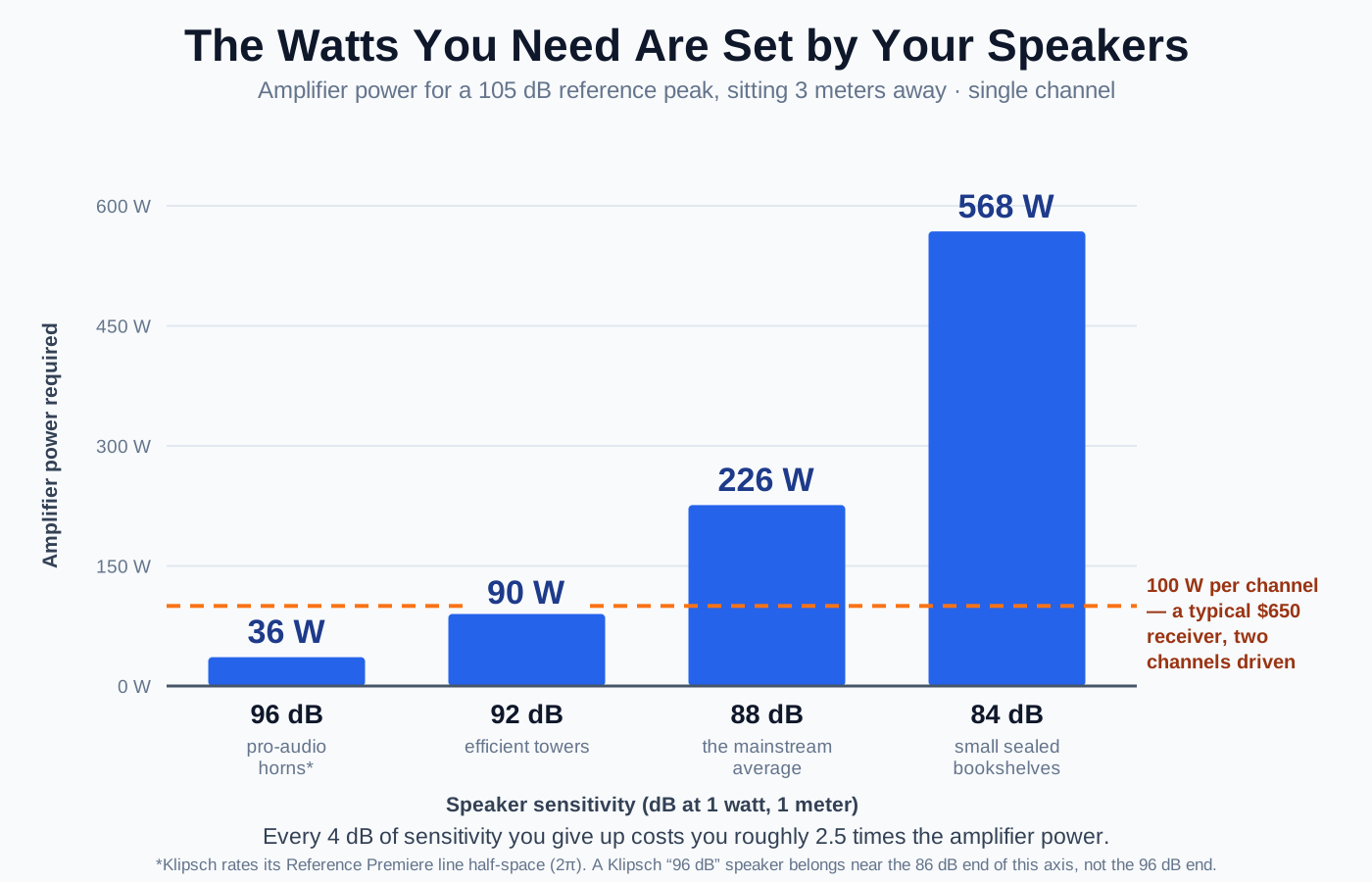
The short version: your speakers draw around two watts at normal movie volume, and the number on the receiver exists to survive the peaks. For an 88 dB-sensitive speaker three meters away, hitting a cinema-reference 85 dB average takes about 2 watts — but the 105 dB peak in the same scene takes about 226. That gap is the entire reason amplifier power ratings exist, and it's also why they're so easy to misread. An honest 100 watts per channel is enough for most systems people actually build, because "100 watts" measured properly (8 ohms, 20 Hz–20 kHz, two channels driven, under 0.1% distortion) is a much bigger amplifier than "145 watts" measured at 1 kHz into 6 ohms with one channel running at 10% distortion. And before you shop for watts at all: three extra dB of speaker sensitivity does exactly what doubling your amplifier does, and it's usually cheaper. Here's the math, the decoder ring for the spec sheet, and how to tell whether you're genuinely out of power or just have the volume knob in a confusing place.
The Only Three Numbers That Matter
Amplifier power is the wrong place to start. The question "how many watts do I need" can't be answered by looking at receivers at all, because the answer is set entirely by what's downstream and where you sit. Three inputs:
- Speaker sensitivity, in dB at 1 watt at 1 meter. This is how much sound your speaker makes per watt you feed it. It's printed on every spec sheet, it ranges from about 84 dB for small sealed bookshelves to about 98 dB for big horn-loaded towers, and that 14 dB spread represents a 25x difference in the amplifier you need. We go deeper on how the spec is measured and where it's fudged in speaker sensitivity explained.
- Listening distance, in meters from speaker to your ears. Sound falls off with distance, and in a room the practical rule is that doubling your distance costs you about 3 to 4 dB — which means it roughly doubles the power you need.
- How loud you actually listen. Not how loud you could. This is the input people get most wrong, and it's the one that makes the whole problem smaller than it looks.
That's it. Put those three numbers together and the wattage falls out.
The Math, Once
Here is the only equation in this article, and you only need it once:
Power needed (watts) = 10 ^ ( ( target SPL − sensitivity + distance loss − room gain ) / 10 )
The two constants worth memorizing instead of the formula:
- Doubling the power buys you 3 dB. Going from 100 watts to 200 watts is a 3 dB increase — audible, but modest. Going from 100 watts to 500 watts is 7 dB.
- Every 3 dB of speaker sensitivity halves the power you need. An amplifier upgrade and a sensitivity upgrade are the same lever, and the sensitivity side is usually the cheaper end of it.
Now the target. Cinema reference level — the calibration standard film mixes are made against — is an 85 dB average per channel with 105 dB peaks, and the LFE channel gets another 10 dB on top. Almost nobody listens at reference at home. Most people watch movies somewhere between 70 and 80 dB average, comfortably below it. On a Denon or Marantz the volume display is calibrated so that 0.0 dB is reference level and everything below it reads negative, which is why a perfectly normal listening level shows up as a number like −15.
So let's run a real case. An 88 dB-sensitive bookshelf speaker, sitting 3 meters away, in an ordinary room:
| What you're playing | SPL at your chair | Watts your amp is delivering |
|---|---|---|
| Normal TV / background music | 70 dB average | 0.07 W |
| Comfortable movie volume | 75 dB average | 0.23 W |
| Loud movie volume | 80 dB average | 0.72 W |
| Cinema reference average | 85 dB average | 2.3 W |
| A gunshot at reference volume | 95 dB peak | 23 W |
| A full reference-level peak | 105 dB peak | 226 W |
Read that column twice. At the volume you actually use, your 100-watt receiver is delivering a quarter of a watt. More than 99% of the rated power sits unused, waiting for a transient that lasts a tenth of a second.
That's not waste — it's the whole point. Amplifier power is not a loudness spec, it's a headroom spec. You buy 100 watts so that the 0.25 watts you actually use never gets anywhere near the amplifier's limits.
What Sensitivity Does to That Number
Same 3-meter distance, same room, same content. Only the speaker changes:
| Speaker sensitivity | Typical of | Watts for 95 dB peaks | Watts for 105 dB peaks |
|---|---|---|---|
| 84 dB | Small sealed bookshelves, some compact monitors | 57 W | 568 W |
| 86 dB | Many budget bookshelves | 36 W | 358 W |
| 88 dB | The mainstream average | 23 W | 226 W |
| 90 dB | Efficient bookshelves, most towers | 14 W | 143 W |
| 92 dB | Efficient towers | 9 W | 90 W |
| 96 dB | Pro-audio horns — and Klipsch ratings, with the caveat below | 4 W | 36 W |
One caution on that last row. Klipsch rates its Reference Premiere line half-space (2π), which reads 7–8.5 dB higher than the full-space figure nearly every other brand publishes. A Klipsch speaker rated 96 dB behaves like the 86 dB row of this table, not the 96 dB row: the RP-600M II is rated 94.5 dB half-space and measures 86.0 dB anechoic. Size an amplifier from the measured figure — see speaker sensitivity explained.
Two conclusions come straight out of that table.
First: with genuinely efficient speakers, a mid-priced receiver plays cinema reference level. A speaker that is 96 dB sensitive on conventional full-space terms needs 36 watts for a full reference peak, and a THX Select-certified receiver like the Onkyo TX-NR6100 at an honest 100 watts has nearly three times that in hand. Check the measurement condition before you bank that win, though. The Klipsch RP-600M II is rated 94.5 dB half-space but measures 86.0 dB anechoic, which puts it on the 86 dB row of the table above: 358 watts for a full reference peak, beyond any receiver. The Onkyo, or the Denon AVR-S770H at 75 watts, still takes that pairing to roughly 98 dB peaks at a 10-foot seat. That is louder than most people listen; it is simply not reference level, and no AV receiver would get there.
Second: with inefficient speakers, no AV receiver reaches reference. A 568-watt requirement is not an AVR conversation, it's a separate-power-amp conversation. If you own 84 dB speakers and a large room, you have already decided to either listen below reference or buy external amplification — and that was decided by the speaker purchase, not the receiver purchase.
This is the single most useful thing to take away: sensitivity is bought once and pays forever. Choosing a 91 dB speaker over an 88 dB one is functionally identical to doubling your amplifier, and it usually costs less than the amplifier would. It's worth weighing alongside the other trade-offs in bookshelf vs. floorstanding speakers, where towers tend to be the more efficient choice as well as the louder one.
Why the Number on the Box Isn't the Number You Get
Now the part that makes spec sheets nearly useless at a glance. A watt is a watt, but a power rating is a measurement, and measurements have conditions. Change the conditions and the same amplifier can honestly be labeled 100 watts or 160 watts.
Five variables get moved around:
- Impedance. Rating into 6 ohms instead of 8 ohms raises the number roughly 25 to 30%, because power is voltage squared over resistance. Same amp, bigger figure.
- Frequency range. The honest measurement sweeps the full 20 Hz to 20 kHz band. The flattering one tests a single 1 kHz tone, which is the easiest frequency for an amplifier and asks nothing of the power supply.
- Distortion threshold. Honest ratings quote 0.05% to 0.1% THD. Inflated ones quote 10% THD, which is audible, ugly clipping. You'd never listen there, but it lets the amp post a much bigger number.
- Channels driven. The standard is two channels driven simultaneously. One channel driven means the shared power supply has nothing else to feed.
- Continuous vs. dynamic. "Dynamic power" or "peak power" is measured with brief bursts. It's not a lie, but it describes a condition that lasts milliseconds, not a capability you can lean on.
Here's the decoder ring:
| Rating you see | What it means | How to treat it |
|---|---|---|
| 100 W — 8 ohms, 20 Hz–20 kHz, 2 ch driven, 0.08% THD | The FTC-style honest measurement | Trust it. This is the real amplifier. |
| 145 W — 6 ohms, 1 kHz, 1 ch driven, 10% THD | Every variable moved in the flattering direction | Assume it's the same amp as the 100 W above. |
| 165 W "dynamic power" | Burst measurement | Ignore for comparison purposes. |
| "1,400 W total system power" | Per-channel figure multiplied by channel count | Marketing. Divide and check the conditions. |
| THX Select / THX Ultra certified | Verified to drive a real system to reference in a room up to ~2,000 / ~3,000 cubic feet | The most trustworthy single signal on the box. |
Denon, Marantz, Onkyo, and Yamaha generally publish the honest numbers — which is precisely why their figures look lower than some competitors'. When you see 50 watts on a Marantz Cinema 70s and 145 on something cheaper, the Marantz is very often the stronger amplifier.
The all-channels-driven gap
There's one more discount to apply, and no manufacturer prints it. An AV receiver has one power supply feeding every channel. A rating measured with two channels driven tells you what the amp does when five or seven others are idle — which is not how you watch a movie.
In bench testing, receivers typically deliver somewhere around 50 to 65% of their two-channel rating when five to seven channels are driven at once. So an honest 100 W/ch receiver is realistically a 55 to 65 W/ch device during a busy Atmos scene. Bigger, heavier receivers with beefier transformers hold up better; slim budget chassis fall off more.
Practical rule: take the honest two-channel rating and multiply by 0.6. That's your working number. A 100 W receiver is a 60 W receiver in real surround use — which, per the sensitivity table above, is still comfortably enough for 90 dB-and-up speakers at sane volumes.
Where the Power Actually Goes
The per-channel rating is identical for every channel, but the demand absolutely is not:
- Front left and right do the most work, especially for music, where they carry the full range.
- Center channel is the busiest channel in film. Dialogue runs almost continuously, and it sits in the frequency range where intelligibility lives — one reason a weak center is behind so many "I can't hear the dialogue" complaints.
- Surrounds run at a much lower average level. Ambience and occasional effects.
- Height and Atmos channels are the lowest-demand channels in the system. Overhead content is sparse and effects-only. Fifty watts is genuinely plenty here, which is worth knowing when you're deciding how many height channels to build — adding four heights costs you far less amplifier headroom than the channel count suggests.
If you're expanding a system and worried about power, expand upward. Heights are cheap in watts.
And the subwoofer doesn't count at all
This is the most common misunderstanding in the whole topic. Your receiver's wattage rating has nothing to do with your bass. A home theater subwoofer is powered — it has its own amplifier inside, often 300 to 800 watts of it — and the receiver sends it a line-level signal over an RCA cable. Zero of the receiver's watts go to the sub.
Which means the single most power-hungry content in any movie — the LFE channel, calibrated 10 dB hotter than everything else — is entirely handled by a box with its own power supply. This also makes crossover setup a power decision, not just a tonal one: every hertz you hand off to the sub is work your receiver stops doing. Crossing your speakers over at 80 Hz instead of running them full-range measurably increases their headroom, because bass is where the watts go. Setting the crossover at 80 Hz is the highest-value free upgrade available to an underpowered system, and our crossover walkthrough covers the menu settings.
Browse powered home theater subwoofers if that's the gap in your system, or read our take on the SVS SB-1000 Pro — and if you're already running one, whether a second sub is worth it is a better use of money than a bigger receiver for most rooms.
Impedance: The Thing That Actually Strains Receivers
Watts get the attention; impedance causes the failures. A good separate power amplifier roughly doubles its output when impedance halves — 100 watts into 8 ohms becomes ~180 into 4. AV receivers do not. They have modest power supplies and limited current delivery, so a 4-ohm load makes them run hot, and many will trip into protection and shut down mid-movie rather than deliver the current.
This matters because "8 ohm nominal" speakers can dip to 3 ohms at particular frequencies, and some highly regarded speakers are genuinely 4-ohm designs. If that's what you own, the receiver's wattage number is not your constraint — its current capability is, and that's not printed anywhere. Speaker impedance and AVR pairing works through how to read the impedance curve and which receivers tolerate it.
Two related notes:
- Set the receiver's impedance menu correctly, but know what it does. On most receivers, selecting "4 ohm" doesn't add current capability — it limits the power supply rails to keep the amp cool. It's a protection setting, not a performance one.
- Wire gauge is a non-issue at normal lengths, and a real one at long ones. Sixteen-gauge is fine for short runs; longer runs to surrounds or heights want 14 or 12. The full breakdown is in speaker wire gauge.
How to Tell If You're Actually Out of Power
Most people who think they need more watts don't. Here's how to check.
The volume knob position tells you nothing. Denon and Marantz display a relative scale where 0.0 dB is calibrated reference level, so a reading of −15 or −25 is entirely normal and the fact that the display "only goes to 18" is irrelevant. Yamaha and Onkyo often use a 0–100 scale where the number is arbitrary. Sitting at 80 out of 100 doesn't mean you're near the amplifier's limit; it means the volume control is at 80.
Real symptoms of running out of amplifier, in order of reliability:
- The receiver shuts off during loud scenes and needs a power cycle. That's protection tripping — thermal or current. Unambiguous.
- The chassis gets genuinely hot on top during normal use, not just warm.
- Loud passages sound compressed and harsh rather than loud — the dynamics flatten out and cymbals and consonants get gritty. This is clipping, and it's the sound of the amplifier running out of voltage swing.
- Bass loses control and gets boomy and undefined exactly when the scene gets big.
Not symptoms of running out of amplifier:
- Dialogue you can't understand. That's almost always mix, center-channel placement, or room acoustics.
- Thin, weak sound at low volume. That's usually a crossover or calibration problem — run Audyssey or your receiver's room correction before you diagnose anything else.
- Uneven or missing bass. That's room modes and sub placement, not power.
And here's the counterintuitive part worth knowing: clipping a small amplifier is more dangerous to your speakers than driving them with a big one. A clipped waveform dumps sustained high-frequency harmonic energy into the tweeter and holds it there. Tweeters die from that far more often than from clean power. If you're regularly pushing a modest receiver into audible distortion, the safe fix is more power, not less volume-control travel.
When You Genuinely Need More Power
Add these up. One of them is a maybe; three of them is a yes.
- Speaker sensitivity below 86 dB.
- Nominal impedance of 4 ohms, or an impedance curve that dips below 4.
- Listening distance over 4 meters. At 4 m instead of 3 m, that 88 dB speaker's reference peak goes from 226 W to 402 W.
- Room volume over about 3,000 cubic feet, or an open-plan space that doesn't give you room gain.
- You actually listen loud. Reference level, regularly, with the lights off.
- Planar, ribbon, or electrostatic speakers. These are current-hungry by design and were never an AVR proposition.
If that's you, the fix isn't a more expensive receiver — receiver power scales badly with price, and you'd be paying for channels and processing you already have. The fix is pre-outs plus an external amplifier.
A receiver with pre-outs lets you use it as a processor and hand the demanding channels to a dedicated amp. Add a two-channel amp for the front left and right and you've solved 90% of the problem, because that's where the demand concentrates. A three- or five-channel amp covers the front stage and center. This is the key reason to care about pre-outs when you buy: the Denon AVR-X3800H carries full 11.4-channel pre-outs and can grow into external amplification later, while the AVR-S770H has subwoofer outputs only and is a closed box on that front. If there is any chance you'll add amplification, buy pre-outs now — retrofitting them is impossible.
Browse multi-channel home theater power amplifiers, and if you're weighing separates against an all-in-one more broadly, AV receiver vs. integrated amp vs. stereo receiver maps out the options. Note also that active speakers move the amplifier inside the cabinet and take this question off the table entirely — the trade-offs are in passive vs. powered vs. active speakers.
What to Spend the Money On Instead
If your budget has room and your speakers are 88 dB or better, watts are close to the worst place to put it. In rough order of audible return per dollar:
- Room correction quality. The step from Audyssey MultEQ to MultEQ XT32, or to Dirac Live, changes what your system sounds like far more than +3 dB of headroom will. Bass integration and dialogue clarity both live here.
- A subwoofer, or a second one. The most underpowered part of most systems is the bottom two octaves, and none of it comes from the receiver.
- Acoustic treatment. First reflections and bass traps are the cheapest real fidelity upgrade in audio, and no amount of amplifier fixes what the room is doing.
- Better speakers — chosen partly for sensitivity. You get the sound quality upgrade and the headroom upgrade in one purchase.
- Channel count and pre-outs. Four height channels and the ability to add amplification later both age better than a bigger power figure.
- Then watts. And when you get here, buy them as an external amp on the front channels, not as a more expensive receiver.
A Buying Checklist
- Look up your speakers' sensitivity first. Everything downstream depends on it. Under 86 dB changes the conversation; over 92 dB makes it almost moot.
- Measure your listening distance in meters, speaker to ears.
- Find the number in the sensitivity table that matches your speakers, and decide honestly whether you listen at 95 dB peaks or 105.
- Read the rating's conditions, not the rating. 8 ohms, 20 Hz–20 kHz, two channels driven, under 0.1% THD. Anything else is a different measurement.
- Multiply the honest two-channel rating by 0.6 for a realistic all-channels-driven figure.
- Treat THX Select or Ultra certification as the trustworthy shortcut if you don't want to do any of the above — it certifies real headroom for a stated room volume.
- Insist on pre-outs if your speakers are demanding or you might upgrade them.
- Set your crossover to 80 Hz and let the powered sub do the heavy lifting. Free headroom.
Browse AV receivers with Dolby Atmos and high-sensitivity home theater speakers, and if you're assembling the system from scratch, our 5.1 surround sound setup guide does it in the right order.
The Bottom Line
You use about two watts and you buy a hundred for the one tenth of a second that needs them. That's the honest shape of the problem, and once you see it, the spec-sheet arms race stops being interesting.
An honest 100 watts per channel — which is roughly 60 watts once every channel is working — drives 90 dB speakers to genuinely loud levels in a normal room with headroom in reserve. The receivers that publish 145 or 165 are frequently the same amplifier measured in a friendlier way, and the ones that publish 50 or 75 with the conditions spelled out are frequently better than they look.
The lever that actually moves is on the other end of the speaker cable. Three decibels of sensitivity is a free amplifier upgrade, an 80 Hz crossover is a free headroom upgrade, and a powered subwoofer means the loudest content in every movie never touches your receiver's power supply at all.
Check your speakers' sensitivity, measure your seating distance, and buy the receiver for its room correction, its channel count, and its pre-outs. The watts will take care of themselves.
Affiliate disclosure: NetAudioHub links to retailers including Amazon. We earn a small commission on qualifying purchases at no extra cost to you.