Epson Home Cinema 2350 Review: A 4K PRO-UHD Projector That Punches Above $1,300
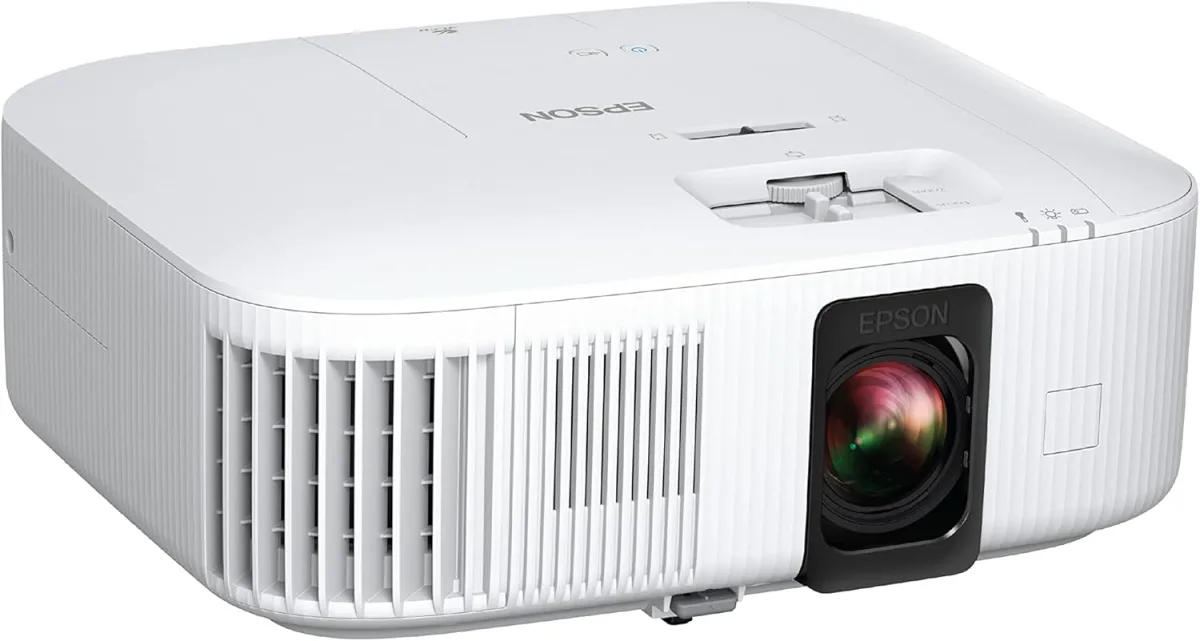
The Epson Home Cinema 2350 is a 3-chip 3LCD 4K PRO-UHD projector with 2,800 lumens, built-in Android TV, and sub-20ms input lag. Here's who it's for and where it beats a big TV.
✅ Pros
- +Bright, color-accurate 4K PRO-UHD image with equal color and white brightness
- +3-chip 3LCD engine — no rainbow artifacts
- +Built-in Android TV with a voice remote; no dongle needed
- +Low input lag (sub-20ms at 1080p/120) for big-screen gaming
- +1.6x optical zoom makes placement forgiving
- +Strong value for a 4K-capable long-throw projector
❌ Cons
- −Pixel-shifted 1080p, not a native-4K panel
- −Modest black levels; needs a dark, light-controlled room
- −Lamp light source (replacement cost; brightness fades over time)
- −No lens shift; no 4K/120 or 1440p
- −Built-in speaker and Bluetooth audio are weak points
The verdict: the Epson Home Cinema 2350 is the long-throw projector to buy near $1,300 for a dark or dim dedicated room. Its 3-chip 3LCD engine puts a bright, color-accurate 4K PRO-UHD image on a 100-inch-plus screen, built-in Android TV means you don't need a separate streaming box, and input lag stays under 20 ms at 1080p/120 for gaming. The honest trade-offs are that it's a pixel-shifted 1080p panel rather than a native-4K chip, and its lamp light source and modest black levels can't match a laser projector for ambient-light punch or contrast. In a room where you can control the light, it's one of the best projection values you can buy.
Key Specs at a Glance
The Home Cinema 2350 is a long-throw, 3-chip 3LCD home theater projector that renders 4K PRO-UHD by pixel-shifting a native 1080p (1920×1080) panel. It puts out 2,800 ISO lumens of both color and white brightness (1,900 in Eco) with up to 35,000:1 dynamic contrast, and supports HDR10 and HLG. Refresh runs up to 120 Hz with input lag of roughly 18 ms at 1080p/120, 19 ms at 4K/60, and 26 ms at 1080p/60. A 1.6x optical zoom gives a 1.34:1–2.17:1 throw ratio for a 40- to 500-inch image (about 100 inches from 8 feet). The 230 W UHE lamp (ELPLP97) is rated 4,500 hours standard or 7,500 in Eco. Android TV and a Google Assistant voice remote are built in, with 2× HDMI, 1× USB, a mini-jack audio out, and Bluetooth audio out. A 10 W mono speaker is onboard, fan noise is 36 dB (28 dB in Eco), and the projector measures 13.1" W × 10.9" D × 4.8" H at 9.0 lb. Street price is about $1,299 ($1,399 MSRP).
Where the 2350 Fits
The Home Cinema 2350 is Epson's entry into "true" 4K PRO-UHD home theater projection. It sits above the company's 1080p-only Home Cinema models and below the pricier laser projectors like the ultra-short-throw Epson EpiqVision LS800. Those two Epsons solve different problems: the LS800 is a living-room, lights-on, sit-it-on-the-cabinet replacement for a big TV; the 2350 is a traditional long-throw projector you place on a rear shelf or ceiling mount and use in a room where you can dim the lights. If you have light control, the 2350 gives you a far bigger image per dollar.
Against DLP rivals in the same price band, the 2350's headline advantage is its 3-chip 3LCD engine. Because it uses three separate panels — one each for red, green, and blue — rather than a single chip with a spinning color wheel, it produces equal color and white brightness and never shows the brief "rainbow" flash that light-sensitive viewers pick up on some DLP projectors.
Picture Quality
Color brightness is the standout. Epson quotes 2,800 lumens of both color and white brightness, and that parity matters more than the raw number. Many single-chip projectors hit their headline lumens on white but fall well short on color, which makes bright, saturated content look dull. The 2350 keeps colors vivid at full brightness, so animation, sports, and HDR highlights have real punch in a dim room.
4K PRO-UHD is pixel-shifting, not a native-4K panel. The 2350 drives a native 1080p chip and rapidly shifts pixels to place more detail on screen than 1080p alone, accepting and processing a 4K/HDR signal. It's genuinely sharper and more detailed than plain 1080p, and from a normal seating distance on a 100-inch screen most viewers won't feel shortchanged — but it is not the same as a native 4K DLP or LCoS chip, and pixel-peepers sitting close will see the difference. Judge it as an excellent enhanced-1080p image rather than a literal 4K one.
HDR is tone-mapped, and that's normal for the class. The 2350 accepts HDR10 and HLG and applies its own tone mapping with an adjustable HDR slider. No lamp projector at this price can hit the peak brightness HDR was mastered for, so think of HDR here as a wider, more graded color and contrast presentation rather than TV-style specular highlights. Set the slider to taste per source and it looks very good.
Black levels and contrast are the real ceiling. This is where the lamp light source and 3LCD panel show their limits. Blacks look dark-gray rather than inky, and the dynamic 35,000:1 contrast figure is a best-case number, not what you get in a mixed scene. In a fully darkened, light-controlled room the image is rich and satisfying; in a room with stray light or light-colored walls, contrast washes out faster than it would on a laser projector or a good TV. A dark screen wall and controlled lighting pay real dividends here.
Gaming
The 2350 is marketed as a gaming projector, and the input-lag numbers back it up: about 18 ms at 1080p/120 Hz, 19 ms at 4K/60, and 26 ms at 1080p/60. The 1080p/120 mode is the sweet spot — it's fast enough for everything short of competitive twitch shooters, on a screen far larger than any affordable TV. There's no 4K/120 and no 1440p support, so this is a 4K/60 or 1080p/120 machine, which lines up well with current consoles. Pair it with a receiver like the Yamaha RX-V6A or Denon AVR-S770H for surround sound and you have a big-screen gaming setup for a fraction of the cost of a comparably sized display.
Setup and Placement
The 1.6x optical zoom makes placement forgiving. With a 1.34:1–2.17:1 throw ratio you can put a 100-inch image up from roughly 8 to 13 feet away, so the 2350 drops into a wider range of rooms than short-zoom projectors that force one exact shelf position. There's keystone correction for squaring off an angled image, though as always you'll get the sharpest result by physically aligning the projector rather than leaning on digital keystone. Note there's no motorized lens shift at this price, so plan the mount or shelf height around the fixed vertical offset.
Built-in Android TV is a genuine convenience. Netflix, Prime Video, Disney+, YouTube, Max, Twitch and more run natively, with a Google Assistant voice remote — no dongle hanging off the back. Two caveats worth knowing: Netflix on Epson's Android TV build sometimes needs the bundled workaround app rather than a direct install, and the projector's own Bluetooth audio-out can be finicky about reconnecting. Most people will route audio through a receiver over HDMI anyway.
Fan noise and the built-in speaker are as expected. At 36 dB in full-power mode the fan is audible in quiet scenes; Eco mode drops it to a much quieter 28 dB at the cost of some brightness. The 10 W mono speaker is fine for a quick setup or casual use but is no substitute for even a modest soundbar or AV receiver in a real home theater.
Limitations Worth Knowing
It's pixel-shifted 1080p, not native 4K — sharper than 1080p, not identical to a native-4K chip. If maximum resolution is your priority and budget allows, native-4K projectors start higher up the ladder.
Black levels need a dark room. The lamp-and-3LCD combination can't match a laser projector or TV for contrast, and ambient light hurts it. A light-controlled room is close to mandatory to see it at its best.
Lamp, not laser. You'll replace the UHE lamp eventually (rated 4,500 h standard, 7,500 h Eco), an ongoing cost laser projectors avoid, and brightness also gradually declines over the lamp's life.
No lens shift, and 4K is capped at 60 Hz. Placement flexibility is good thanks to zoom, but the lack of lens shift limits mounting freedom, and there's no 4K/120 or 1440p for gaming.
Who Should Buy the Epson Home Cinema 2350
Buy it if you want the biggest possible image per dollar and can control the light in your room, you value accurate, bright color and want to avoid DLP rainbow artifacts, you game on a current console and want sub-20ms lag on a huge screen, or you'd rather not add a separate streaming box since Android TV is built in.
Look elsewhere if you need a lights-on living-room display — the ultra-short-throw Epson LS800 or a large TV will serve you far better — or if you want native-4K resolution and laser-grade black levels and contrast, or a plug-and-play machine with no lamp to ever replace.
Epson Home Cinema 2350 vs. the Epson LS800
The two Epsons don't really compete — they solve opposite problems. The Home Cinema 2350 is a long-throw projector for a ceiling or shelf mount, driven by a 230 W UHE lamp at 2,800 lumens, best in a dark or dim, light-controlled room, throwing a 40- to 500-inch image for about $1,299. The EpiqVision LS800 is an ultra-short-throw triple-laser unit that sits under the screen, hits 4,000 lumens, works in a living room with ambient light, throws a 100- to 150-inch image, and runs about $2,999. Put simply, the 2350 delivers the biggest image per dollar in a dedicated room, while the LS800 is a TV replacement that doesn't need a dark room — less than half the price, a much bigger maximum image, and a better dark-room picture per dollar, provided you can dim the lights.
Bottom Line
The Epson Home Cinema 2350 is one of the easiest projector recommendations near $1,300. You get a bright, color-accurate 4K PRO-UHD image, the artifact-free consistency of a 3-chip 3LCD engine, built-in Android TV, and gaming-grade input lag — a genuinely complete package that would have cost far more a few years ago. It asks for two things in return: a room where you can control the light, and acceptance that it's enhanced 1080p rather than native 4K with laser-grade black levels.
Meet those conditions and it's hard to get this much screen, color, and flexibility for the money. For a dedicated or dim home theater room where the goal is the biggest, most watchable image per dollar, the 2350 earns a strong recommendation. Check current pricing on Amazon.
Our Verdict
The Epson Home Cinema 2350 is a 3-chip 3LCD 4K PRO-UHD projector with 2,800 lumens, built-in Android TV, and sub-20ms input lag. Here's who it's for and where it beats a big TV.
Ready to buy the Epson Home Cinema 2350?
Buy on Amazon →Affiliate link — we may earn a commission at no extra cost to you.