10 vs 12 vs 15 Inch Subwoofer: What Driver Size Actually Changes
Published 2026-10-26 · By NetAudioHub Editorial
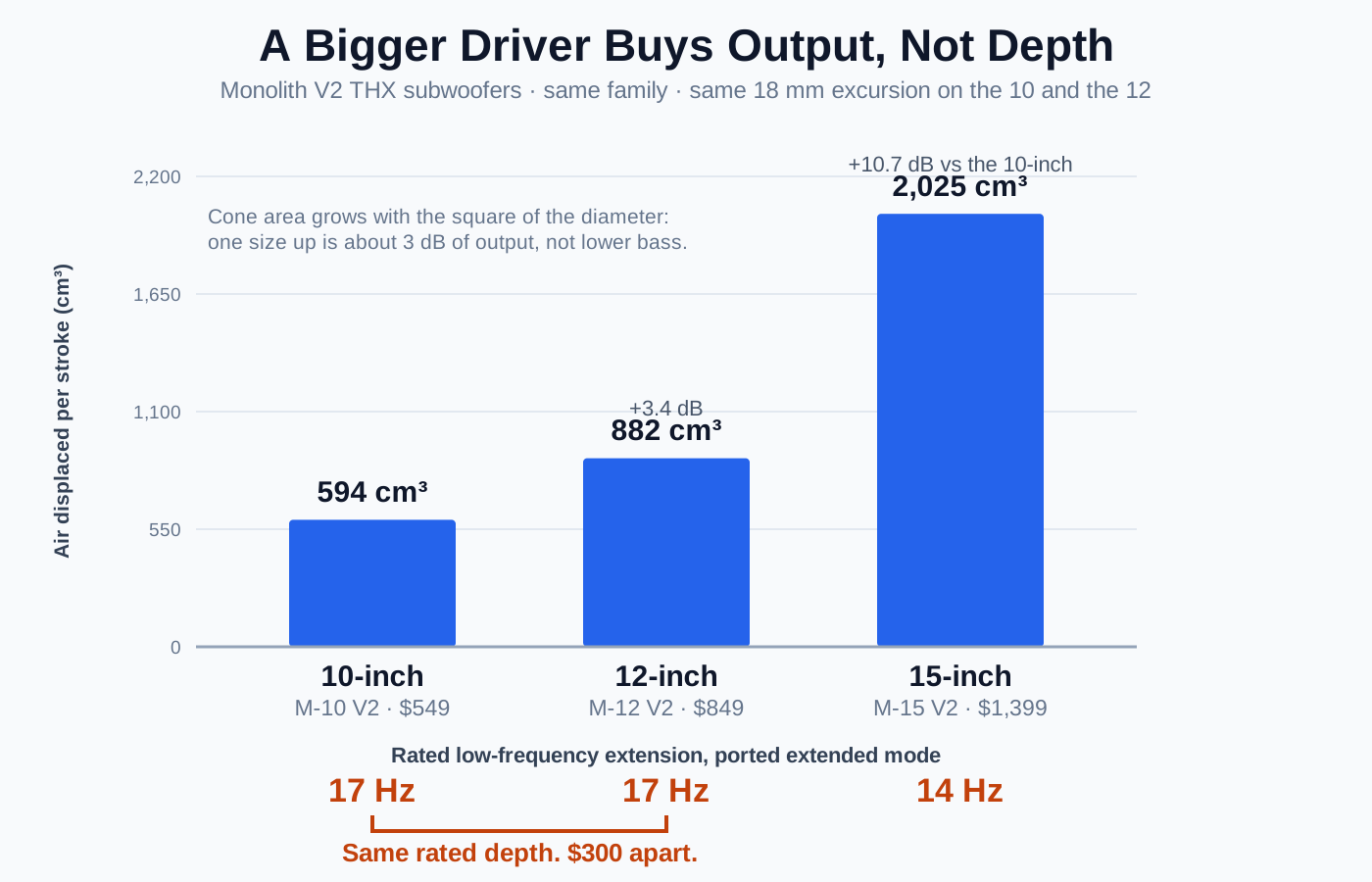
Monoprice sells a 10-inch and a 12-inch subwoofer in the same THX line, with the same 500-watt amplifier and the same 18 mm of excursion. They are rated to the identical frequency response: 17 Hz ported, 20 Hz sealed. The 12-inch costs $300 more. If driver size determined how deep a subwoofer plays, that would be impossible — and it is the clearest evidence you will find that the whole 10-vs-12-vs-15 question is being asked wrong. Diameter does not buy depth. It buys displacement, and displacement is output. Here is the arithmetic that converts inches into decibels, the reason a dual-9-inch cube beats plenty of 12s, and a sizing method based on your room's cubic feet instead of the number printed on the grille.
The short version: driver diameter does not determine how low a subwoofer plays. It determines how loud it can play before it runs out of cone travel. Monoprice sells a 10-inch and a 12-inch subwoofer in the same THX line with the same 500-watt amplifier and the same 18 mm of one-way excursion, and both are rated 17 Hz to 200 Hz in ported extended mode. Identical published depth, $300 apart. What the 12-inch actually buys is about 1.5 times the cone area, which is worth roughly 3.4 dB of clean output — the same gain you would get from doubling the amplifier power. Depth comes from somewhere else entirely: the enclosure alignment, the amplifier headroom, and the DSP. SVS makes the point in the opposite direction with the same 12-inch driver class and the same 325-watt amp in two boxes, where the ported version reaches 3 Hz lower and puts out about 8 dB more at 20 Hz. So stop shopping for inches and start shopping for the two things that actually matter: enough displacement for your room's cubic feet, and a box tuned to go as low as you want. Here is the arithmetic, the empirical check against published specs, and a sizing method that uses room volume instead of grille diameter.
The Two Experiments That Settle It
You can answer this whole question with two product comparisons that each hold one variable constant. Manufacturers have effectively run the experiment for us and published the results.
Experiment 1: change the diameter, hold everything else
Monoprice's Monolith V2 THX line is unusually useful here because the 10-inch and 12-inch models are near-identical apart from the cone:
| Spec | M-10 V2 | M-12 V2 |
|---|---|---|
| Driver | 10 inch | 12 inch |
| Amplifier | 500 W RMS / 900 W peak | 500 W RMS / 900 W peak |
| Xmax (one-way) | 18 mm | 18 mm |
| Sealed, THX EQ | 20 Hz to 200 Hz | 20 Hz to 200 Hz |
| Ported, Extended EQ | 17 Hz to 200 Hz | 17 Hz to 200 Hz |
| Weight | 72.5 lb | 98.3 lb |
| Price | $549 | $849 |
Monoprice quotes those response figures at -6 dB rather than the more common plus or minus 3 dB, so do not compare them directly against another brand's numbers — but both models are quoted the same way, which is all this comparison needs.
Same amp. Same excursion. Same rated response, in both port configurations. The only things that changed are the cone area, the cabinet, and $300.
If the popular intuition were right — bigger driver, deeper bass — this product pair could not exist. It does exist, because the intuition is wrong.
Experiment 2: hold the diameter, change the box
Now run it the other way. SVS builds the SB-1000 Pro and the PB-1000 Pro around 12-inch drivers of the same generation, both powered by the same Sledge 325D amplifier rated 325 watts RMS:
| Spec | SB-1000 Pro | PB-1000 Pro |
|---|---|---|
| Driver | 12 inch | 12 inch |
| Amplifier | 325 W RMS Sledge | 325 W RMS Sledge |
| Enclosure | Sealed | Ported, dual port |
| Rated response | 20 Hz to 270 Hz, plus or minus 3 dB | 17 Hz to 260 Hz, plus or minus 3 dB |
Identical driver size. Identical power. The ported box reaches 3 Hz lower on paper, and measured output at 20 Hz favors the ported model by roughly 8 dB — a difference you would otherwise need six times the amplifier power to produce.
Put the two experiments side by side and the conclusion is unavoidable. Changing the driver size while holding the box constant moved the extension by zero. Changing the box while holding the driver constant moved it by 3 Hz and 8 dB. The enclosure is the variable that controls depth. The cone is not.
Our full SVS SB-1000 Pro review covers why we still recommend the sealed version for most mixed music-and-movie systems, and sealed vs ported subwoofers goes through the tradeoff properly.
What Diameter Actually Buys: Displacement
A subwoofer makes bass by moving air. The amount of air it can move is its volume displacement:
Displacement = cone area x excursion
Cone area scales with the square of the diameter, so the jumps are bigger than the inch numbers suggest:
| Step up | Cone area ratio | Output gain at equal excursion |
|---|---|---|
| 10 inch to 12 inch | 1.44x | +3.2 dB |
| 12 inch to 15 inch | 1.56x | +3.9 dB |
| 10 inch to 15 inch | 2.25x | +7.0 dB |
Those figures use nominal diameters. Using typical effective piston areas instead — about 330 cm2 for a 10, 490 cm2 for a 12, 810 cm2 for a 15, since the rubber surround eats part of the nominal diameter — the numbers come out slightly higher: +3.4 dB, +4.4 dB, and +7.8 dB respectively. Either way the shape of the answer is the same.
One driver size up is worth about 3 to 4 dB. That is a real, audible improvement — but it is worth internalizing what else is worth 3 dB, because the alternatives are often cheaper:
- Doubling your amplifier power: +3 dB
- Adding a second identical subwoofer: +3 dB if the two are uncorrelated in the room, up to +6 dB if they sum coherently
- Moving from a 5 dB-down corner position to a strong position: frequently more than 3 dB, and free
That last one is why where to place a subwoofer is the highest-value thing you can do before spending anything. Position routinely swings the in-room response more than an entire driver size does.
Excursion is the other half, and it moves a lot
Displacement is area times travel, so a driver with more travel can substitute for area. Run the numbers:
- A 10-inch driver needs about 27 mm of one-way Xmax to displace as much air as a 12-inch at 18 mm.
- A 15-inch driver needs only about 11 mm to match that same 12-inch.
This is exactly why a compact sub can punch far above its grille size, and why a big cheap 15 with a short voice coil can disappoint. The Monolith M-15 V2 is a good illustration of both factors stacking: it does not just add cone area, it also goes from 18 mm to 25 mm of Xmax and from 500 W to 1,000 W. Combine the two and it displaces about 3.4 times what the M-10 V2 does, worth roughly 10.7 dB — far more than the 7 dB the diameter alone predicts. That is the real reason to buy a 15, and it is an output reason, not a depth reason.
The Empirical Check
A model is only worth trusting if it predicts something you did not use to build it. So take a completely different product line and see whether the arithmetic holds.
Klipsch's Reference subwoofers publish maximum acoustic output, which most brands do not:
| Model | Driver | Amplifier | Rated response | Max acoustic output |
|---|---|---|---|---|
| R-100SW | 10 inch | 150 W / 300 W peak | 32 Hz to 120 Hz, plus or minus 3 dB | 112 dB |
| R-120SW | 12 inch | 200 W / 400 W peak | 29 Hz to 120 Hz, plus or minus 3 dB | 116 dB |
Predicted from cone area alone: +3.2 dB. Predicted from the amplifier increase alone: +1.2 dB. Sum: +4.4 dB predicted. Klipsch publishes a 4 dB difference.
And the extension? It moved 3 Hz — from 32 Hz to 29 Hz — on a 44 percent larger cone with a 33 percent larger amplifier. Both of those are ported boxes in the same design family, which is precisely the condition under which the Monolith pair predicted extension would barely move.
The model predicts the output gain within half a decibel and correctly predicts that depth stays roughly put. That is about as good as consumer audio specs allow.
So Where Does Deep Bass Come From?
Four places, roughly in order of how much they matter:
- Enclosure alignment and tuning. A ported box tuned to 18 Hz reinforces output near that frequency and rolls off below it at about 24 dB per octave. A sealed box of the same driver rolls off earlier but far more gently, around 12 dB per octave, which means room gain can partially fill it back in. This is the single biggest lever, as Experiment 2 showed.
- Amplifier headroom plus DSP. Deep bass costs enormous power — output falls as frequency drops, so holding a flat response to 16 Hz takes vastly more wattage than holding it to 40 Hz. Modern subs use DSP to apply a boost at the bottom while limiting excursion so the driver survives it. That is engineering, not inches.
- Room gain. Below your room's pressure-vessel transition frequency, a sealed enclosure gets reinforcement from the room itself, often 6 to 12 dB. Small rooms give more of it than large ones. This is genuinely free extension and it is why sealed subs frequently measure lower in-room than their anechoic ratings suggest.
- Cone area. Last on the list, and it contributes to depth only indirectly — a bigger cone can sustain deep output without exceeding Xmax, so it raises the frequency-dependent ceiling rather than lowering the cutoff.
The cleanest proof of all four working together is the SVS 3000 Micro R|Evolution: dual-opposing 9-inch drivers in a sealed cube under a foot on every side, rated 20 Hz to 230 Hz plus or minus 3 dB on a 1,200-watt amplifier. It reaches the same rated 20 Hz as SVS's own sealed 12-inch and goes lower than plenty of 12s and a few 15s — because two 9s have more combined cone area than one 12, and because there is an enormous amount of amplifier and DSP behind them.
For the counterexample, our Klipsch Cinema 1200 review covers a 12-inch ported subwoofer rated to 29 Hz. Twelve inches, 600 watts, and it stops 9 Hz higher than an 11-inch cube with 9-inch drivers. The number on the grille told you nothing.
How to Actually Size a Subwoofer: Use Cubic Feet
Since diameter is a proxy for output and output is what has to fill a room, size by room volume. Measure length x width x height in feet, and include any space that is open to the room — a hallway or an open-plan kitchen is part of your acoustic volume whether you like it or not.
THX has already done this mapping, and it is the least arbitrary standard available. THX Certified Select is specified for rooms up to about 2,000 cubic feet; THX Certified Ultra for rooms up to about 3,000 cubic feet. Note where the Monolith line falls: the 10-inch carries Select certification, while the 12 and 15 carry Ultra. The certification tracks room volume, not driver diameter — which is the whole point.
| Room volume | Typical room | Sensible starting point |
|---|---|---|
| Under 1,500 cu ft | Bedroom, small den, apartment living room | One good 10-inch, or a high-excursion compact sub |
| 1,500 to 2,500 cu ft | Typical living room, 15 x 18 x 8 ft | One 12-inch, or two 10-inch |
| 2,500 to 4,000 cu ft | Large or open-plan living room | One 15-inch, or two 12-inch |
| Over 4,000 cu ft | Great room, dedicated theater, vaulted ceiling | Two 15-inch, or multiple ported subs |
A 15 x 18 ft room with 8 ft ceilings is 2,160 cubic feet, which is the single most common home theater volume in the US and lands squarely in one-12 or two-10 territory. If your room opens into a kitchen or stairwell, move up a row.
Two practical modifiers:
- Apartment or shared wall? Drop a row and go sealed. You will never use the headroom, and ported output below 25 Hz is exactly what travels through structure to your neighbors.
- Dedicated room with the door closed? Go up a row. Room gain in a small sealed room is real, and you can use every bit of the output.
Two Smaller Subs or One Bigger One?
This is the question that actually matters once you have a budget, and the arithmetic is close enough that the tiebreaker is not output at all.
Take the Monolith line again. Two M-12 V2s displace about 1,764 cm3 against the M-15 V2's 2,025 cm3 — so the pair is about 1.2 dB behind a single 15 on raw displacement, while costing $1,698 against $1,399. On output per dollar, the single 15 wins.
Buy the two 12s anyway, in most rooms.
The reason has nothing to do with how much air gets moved. A single subwoofer excites your room's standing-wave modes from one position, producing peaks and nulls that can easily span 20 dB across a few seats — and a null is not fixable with EQ, because you cannot boost a frequency that is cancelling. Two subs in different positions excite those modes differently and partially fill each other's nulls. The result is a flatter response across more seats, which is audible in a way that 1.2 dB of headroom is not.
The full argument, including where to put the second one, is in when a second subwoofer is worth it. The short form: if you have the money for one 15, strongly consider two 12s; if you have the money for one 12, strongly consider two 10s.
The exception is a dedicated single-seat room where you sit in one chair and nowhere else. There, buy the biggest single sub that fits and place it carefully.
What Bigger Drivers Do Cost You
Driver size is not free, and the costs are more practical than acoustic:
- Cabinet volume, not cone area, is what actually grows. The Monolith models measure about 3.4, 5.7, and 7.9 cubic feet externally. The 15 is more than twice the box of the 10 for 2.25 times the cone.
- Weight. 72.5 lb, 98.3 lb, 132.9 lb across that same line. The 15 is a two-person lift and a real consideration on an upper floor.
- Placement freedom shrinks as the box grows — and since placement is worth more than a driver size, a 12 you can put in the good spot beats a 15 you have to wedge behind the couch.
- Very large drivers can be harder to integrate up high. Above roughly 80 Hz a big cone starts to beam and the crossover region gets fussier, which is one more reason to keep your crossover at 80 Hz and let the mains do the work. See how to set your speaker crossover frequency and the 80 Hz crossover explained.
There is also a persistent belief that smaller drivers are "faster" or "tighter" and larger ones are "slow." As a driver-size claim this does not hold up — a subwoofer's job tops out around 80 to 120 Hz and every one of these drivers is far faster than that requirement. What people are actually hearing is the enclosure: ported boxes have higher group delay near tuning and a steeper rolloff, which reads as overhang. That is the sealed-versus-ported axis, not the 10-versus-15 axis.
The Buying Rules
- Never shop by driver diameter alone. Compare rated frequency response, amplifier RMS power, and enclosure type. Diameter without those three tells you nothing — and some subwoofers do not give you a diameter to shop on at all. The Sonos Sub 4 is a sealed dual force-cancelling design that reaches about 25 Hz, and the spec that decides whether you can buy it has nothing to do with driver size: it has no line-level or LFE input, so it only works with a Sonos soundbar or Amp and will not connect to an AV receiver at all.
- Size by room volume, not by inches. Under 1,500 cubic feet a good 10 is genuinely enough. Over 2,500, one 12 starts working hard.
- Buy depth from the enclosure and the amp. If you want sub-20 Hz output, look for a ported design or a sealed one with serious amplifier power and DSP — not simply a bigger cone.
- Two smaller subs beat one bigger sub in almost any room with more than one seat. You are buying response smoothness, which EQ cannot give you.
- Spend the placement effort before the upgrade money. Run subwoofer positioning and then room correction. A well-placed 10 beats a badly placed 15 at almost any frequency you care about.
- Check the Xmax if the manufacturer publishes it. A 10 with 25 mm of travel is a more serious device than a 15 with 9 mm, and the spec sheet will tell you which one you are looking at.
If you want to compare current pricing, the models discussed here are easy to find: the SVS SB-1000 Pro and SVS PB-1000 Pro are the sealed-versus-ported pair, the Klipsch R-100SW and Klipsch R-120SW are the budget 10-versus-12 comparison, and the SVS 3000 Micro is the compact option that outperforms its grille size. The Monolith V2 subwoofers are sold direct by Monoprice.
Bottom Line
The 10-versus-12-versus-15 question has a clean answer once you separate the two things people conflate. Diameter buys output, not depth. One size up is worth about 3 to 4 dB of clean headroom — genuinely useful, and exactly equivalent to doubling your amplifier power. It buys close to zero additional extension, which is why two subwoofers in the same THX line, three inches and $300 apart, carry the identical frequency rating.
Depth comes from the box, the amp, and the DSP. Smooth bass across your seats comes from having two subs and putting them in the right places. Neither is printed on the grille.
So size the driver to your room's cubic feet, buy the extension from the enclosure, and spend whatever is left on a second subwoofer rather than a bigger one. That ordering will get you better bass than any amount of agonizing over three inches of cone.
For the rest of the chain, see how many watts you actually need for the amplifier side and how to calibrate a subwoofer with miniDSP when you are ready to measure what you have.
Some links above are affiliate links, and we may earn a commission on purchases at no extra cost to you.