Projector vs TV for a Home Theater: The Crossover Point Moved to 110 Inches
Published 2026-10-14 · By NetAudioHub Editorial
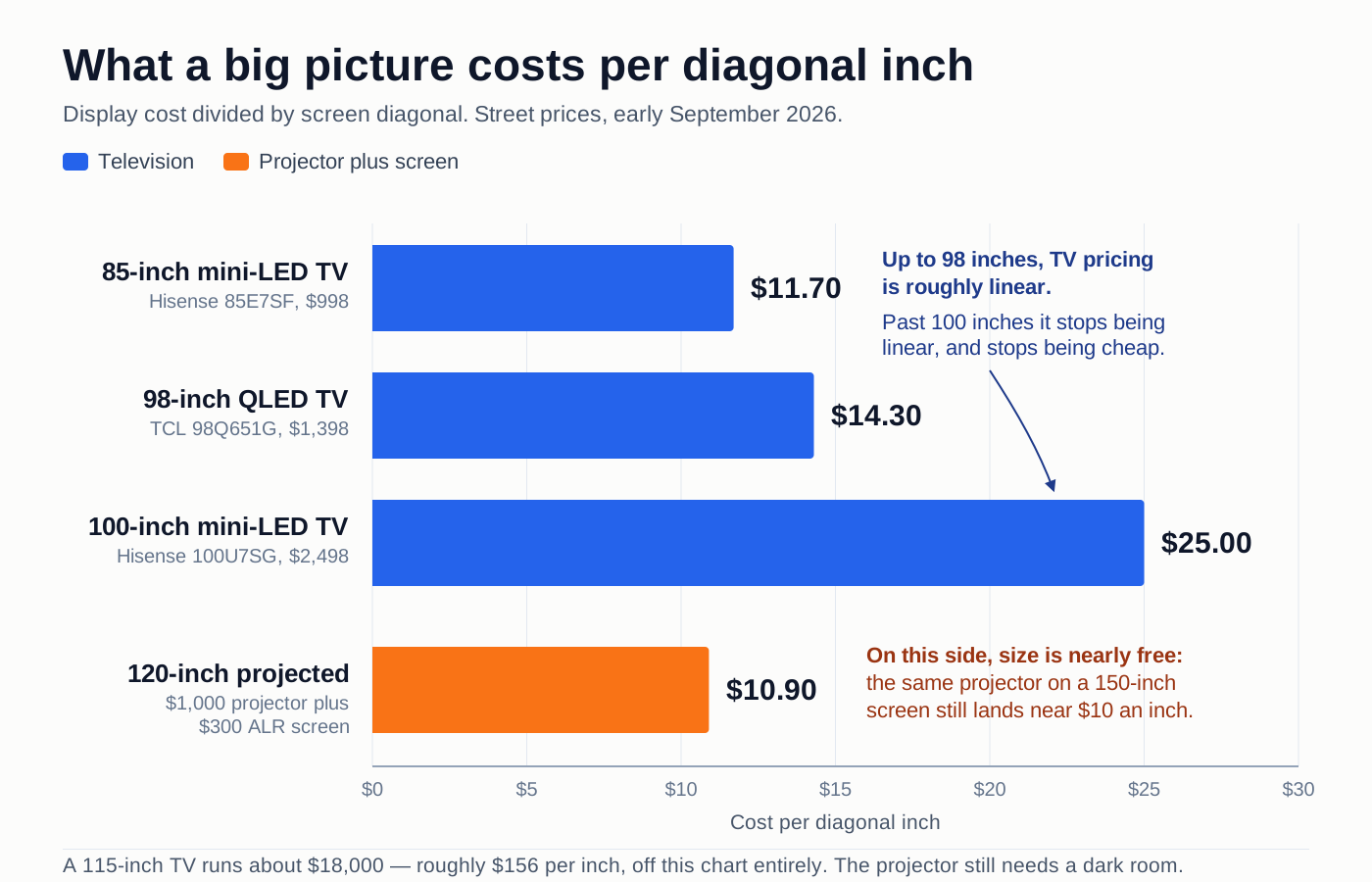
For fifteen years the answer was simple: TVs ran out of road somewhere around 85 inches, and if you wanted a bigger picture than that you bought a projector. That rule is now wrong. As of September 2026 an 85-inch mini-LED TV costs $998, a 98-inch QLED costs $1,398, and both of them deliver ten times the brightness of any projector you can buy for the same money. The projector's advantage did not disappear — it just moved up the size chart and got a lot more conditional. This is the complete cost of each setup, the one brightness calculation that settles most arguments, and where each choice genuinely wins.
The short version: buy a TV if your picture is going to be 100 inches or smaller, and buy a projector if you want to go past about 110 inches or you have a room you can genuinely darken. As of early September 2026 an 85-inch Hisense mini-LED sells for $998 and a 98-inch TCL QLED for $1,398, which means TVs now cost about $12 to $14 per diagonal inch right up to the 100-inch mark — the same rate as a projector plus a screen. And the TV is roughly ten times brighter: a well-set-up 120-inch projected image measures around 110 nits, while a mid-range mini-LED does 1,000 to 3,000. Projection still wins decisively on two things. Sizes above 110 inches barely exist as TVs and cost absurd money when they do, and a big reflected image in a dark room is genuinely easier to watch for three hours than a small bright rectangle. Everything else — daylight viewing, HDR punch, gaming latency, setup effort, running costs — now favors the TV. Here's the arithmetic.
The Old Rule and What Broke It
The conventional advice went like this: TVs get exponentially more expensive above 75 inches, so past about 90 inches of picture, a projector and a screen are the cheaper path to a big image. That was true for a long time. It stopped being true in the last two years, because 85-inch and 98-inch LCD panels went from halo products to volume products.
Here is what the market actually looks like right now, using street prices pulled in early September 2026:
| Picture size | Product | Price | Cost per diagonal inch |
|---|---|---|---|
| 85 inches | Hisense 85E7SF mini-LED | $998 | $11.70 |
| 98 inches | TCL 98Q651G QLED | $1,398 | $14.30 |
| 100 inches | Hisense 100U7SG mini-LED | $2,498 | $25.00 |
| 115 inches | TCL 115QM7K mini-LED | about $18,000 | $156 |
| 120 inches | Epson Home Cinema 2350 plus a $300 ALR screen | about $1,300 | $10.90 |
Read that table carefully, because it contains the whole argument. TV pricing is essentially linear up to 98 inches and then falls off a cliff. The jump from 98 to 115 inches costs roughly thirteen times more per inch. That cliff — not the 90-inch line from the old advice — is where projection becomes the value play.
Two caveats keep this table honest. The 85-inch and 98-inch entries are different product tiers, so the per-inch numbers are not a pure apples-to-apples panel comparison; the 100-inch Hisense is a better panel than the 98-inch TCL. And big-TV prices swing hard on promotions — the same 98-inch model has traded between $1,400 and $1,900 this year. Check today's number before you commit to either path.
What Each Setup Actually Costs to Finish
The mistake people make when pricing a projector is comparing the projector's price to a TV's price. A projector is not a finished product. It is one component of a system that does not produce a watchable image until you have added at least three more things.
| Line item | Projector path | TV path |
|---|---|---|
| Display | $1,000 for a bright 4K-class long-throw projector | $998 to $2,498 depending on size |
| Screen | $200 for a plain white matte screen, $300 to $500 for a 120-inch ambient-light-rejecting screen | $0 |
| Mounting | $40 to $150 for a ceiling mount, or a shelf you already own | $50 for a wall mount |
| Signal cable | $30 to $60 for a 25-foot certified 48 Gbps HDMI run | $15 for a 6-foot cable |
| Light control | $150 and up for blackout blinds if the room has windows | $0 |
| Sound | Required — projectors have no usable speakers | Strongly recommended, but a TV at least has speakers |
| Consumables | $150 to $300 per lamp on lamp-based models | $0 |
A realistic finished projector setup in a room you can darken lands at $1,300 to $1,600. In a bright living room with windows, add the ALR screen and the blackout blinds and you are at $1,800 to $2,200 — and that is the configuration where the projector is fighting hardest and winning least.
Both paths need real sound, so that line cancels out. If you have not solved that yet, our soundbar vs. AV receiver comparison covers the decision, and it matters more for a projector build because there is no fallback: a projector's built-in speaker is a beep, not a speaker.
The Brightness Math That Settles Most Arguments
This is the part that gets hand-waved, and it is the single most useful calculation in the whole comparison. Projector brightness is quoted in ANSI lumens, which is total light output. What you actually see is light per unit of screen area, measured in foot-lamberts. Spread the same lumens over a bigger screen and the image gets dimmer, in direct proportion to area.
The formula is simple: foot-lamberts equals lumens times screen gain, divided by screen area in square feet.
Two adjustments make the result realistic. First, the headline lumen number is measured in the projector's brightest and ugliest picture mode. In a color-accurate mode, count on roughly half of it. The Epson Home Cinema 2350 is rated at 2,800 lumens, so call it 1,400 in a mode you would actually watch. Second, assume a screen gain of 1.0 — and note that gray ALR screens often run gain of 0.8 or lower, trading brightness for black level, which costs you another 20 percent.
Here is what 1,400 usable lumens looks like across screen sizes, with the nit equivalent in the last column so you can compare directly against a TV spec sheet:
| Screen size | Screen area | Foot-lamberts | Nit equivalent |
|---|---|---|---|
| 92 inches | 25.1 sq ft | 56 fL | 191 nits |
| 100 inches | 29.7 sq ft | 47 fL | 162 nits |
| 110 inches | 35.9 sq ft | 39 fL | 134 nits |
| 120 inches | 42.7 sq ft | 33 fL | 112 nits |
| 135 inches | 54.1 sq ft | 26 fL | 89 nits |
| 150 inches | 66.8 sq ft | 21 fL | 72 nits |
For reference: the SMPTE standard for a commercial cinema screen is 16 fL, and the informal target for HDR-ish home viewing is 30 to 50 fL. So a 1,400-lumen picture on a 120-inch screen at 33 fL is genuinely good — brighter than your local multiplex, right in the home HDR window. Push the same projector to 150 inches and you are at 21 fL, which still beats a cinema but has visibly lost its punch.
Now put that next to a TV. A very good projected image is about a 110-nit image. A mid-range 2026 mini-LED TV does 1,000 nits on a full-field white and considerably more on small highlights. That is not a small gap; it is an order of magnitude, and it explains three things at once:
- Why projectors need dark rooms. At 110 nits, any meaningful ambient light lands on the screen as a proportionally huge amount of stray brightness, and contrast collapses.
- Why HDR on a projector is a compromise. HDR content is mastered assuming 1,000-nit or 4,000-nit highlights. A projector tone-maps all of that down into a 100-nit envelope. It can look beautiful, but a specular highlight cannot actually be bright. If you want to understand what that tone-mapping is doing, see our Dolby Vision vs. HDR10+ vs. HDR10 breakdown.
- Why the dark-room projector experience is still special. Once your eyes adapt to a dark room, 33 fL is plenty, and a huge low-intensity image is far more comfortable over a two-hour film than a bright small one. This is the real reason projector owners defend them, and it is a legitimate reason.
A useful rule falls out of the table: budget about 1,000 usable lumens per 30 square feet of screen, then double the number you shop for because of the picture-mode derate. For a 120-inch screen in a dark room, that means shopping at 2,500 lumens and up. In a room with any daylight, shop at 4,000 and up — that is the class the Epson EpiqVision LS800 sits in, and it costs $2,999, which puts it above the 100-inch TV it is trying to replace.
Where Projectors Still Win
Size above 110 inches. This is the whole case, and it is a strong one. A 120-inch or 135-inch picture costs a projector owner an extra $100 to $300 in screen material. It costs a TV buyer either $18,000 or nothing, because the product does not exist. If your ambition is a picture wider than your couch, projection is the only affordable route and probably always will be.
Comfort over long sessions. Reflected light off a matte screen is diffuse and low-intensity. Emissive light from a panel is direct. For three-hour movies in a dark room, most people find the projected image easier on the eyes, and that is not audiophile mysticism — it is a real difference in how much light is being pointed at your retinas.
It disappears. A 120-inch screen can retract or hide behind art, and the projector lives on the ceiling. A 98-inch TV is a permanent 8-foot-wide black rectangle that dominates the room whether it is on or off. In a multi-use living room, that is a genuine consideration.
Wide-aspect film. If you care about 2.35:1 scope material without letterbox bars, a wide screen with lens memory is a thing projectors do and TVs cannot.
Where TVs Now Win Outright
Any room with light in it. A TV at 1,000 nits does not care about your windows. This is the single biggest practical difference and it applies to most people's actual living rooms.
HDR impact. See the brightness math above. Specular highlights, sunlight on water, explosions — the things HDR was invented for — need brightness a projector does not have.
Gaming. Current mid-range and up TVs give you HDMI 2.1 with 4K at 120 Hz, VRR, ALLM, native 144 or 165 Hz panels, and input lag frequently under 16 ms. Most home projectors top out at 1080p/120 for low-lag modes and land in the 20 to 40 ms range at 4K. Our HDMI 2.1 feature explainer covers which of those specs actually matter for which console. If gaming is a primary use, this alone decides it.
Setup effort and geometry. A TV needs a wall and a stud finder. A projector needs a throw-distance calculation, a mounting position that clears your head, lens shift or a perfectly centered install, and a flat wall or screen. That is not hard, but it is work — our home theater projector setup guide walks the screen sizing and throw math if you want to see what you are signing up for.
Zero consumables and zero noise. Lamp-based projectors want a $150 to $300 replacement every 3,000 to 5,000 hours and run a fan the entire time. Laser models push the light source out to 20,000 hours or more but cost more up front. A TV has neither problem.
It is a finished product. Tuner, apps, speakers, remote. Nothing else to buy to get a picture on the wall tonight.
Which One Fits Your Room
| Your situation | Buy this | Why |
|---|---|---|
| Living room with windows, mixed daytime and evening use | TV, 85 to 98 inches | Brightness wins in ambient light, and per-inch pricing is excellent up to 98 inches |
| Dedicated theater room, no windows, movies are the point | Projector, 120 inches and up | The one scenario where the projector's weakness is neutralized and its strength is free |
| Gaming is the main use | TV | 4K/120, VRR, and sub-16 ms lag are not available on projectors at this price |
| You want the biggest possible picture and can control light in the evening | Projector plus an ALR screen | Above 110 inches there is no competing TV at any sane price |
| Basement or media room you can darken but also use in the day | Either — decide on the picture size | Under 100 inches take the TV; over 110 take the projector |
| Apartment, renting, no ceiling mounting allowed | TV, or a UST projector on a cabinet | Long-throw ceiling installs are usually off the table |
| Budget is hard-capped at $1,000 | TV, 85 inches | $998 for a finished 85-inch mini-LED beats a $1,000 projector with no screen |
The pattern: the size you want decides it, and the light in your room vetoes it. Pick your target picture size first, then check whether the room can support projection at that size. If it cannot, no amount of lumens shopping fixes it.
What I'd Actually Buy
Dark dedicated room, $1,500 all in. The Epson Home Cinema 2350 at roughly $1,000 street (list is $1,299) plus a 120-inch fixed-frame ALR screen at $300. Its 3-chip 3LCD engine means equal white and color brightness and no rainbow artifacts, and 2,800 rated lumens puts a 120-inch screen at a comfortable 33 fL. The honest limitations are a lamp light source and modest black levels, both of which matter less in a properly dark room.
Bright living room, want 100 inches, $2,500. The Hisense 100U7SG at $2,498. This is the setup where the old advice would have sent you to a projector, and it is now the wrong call. You get a picture you can watch at noon, real HDR highlights, a 165 Hz panel for gaming, and nothing else to buy.
Best value in a big picture, under $1,500. The TCL 98Q651G at $1,398. Ninety-eight inches for less than the cost of a finished projector build, with none of the room requirements. It is a step below the mini-LED sets on contrast and local dimming — our OLED vs. QLED vs. mini-LED explainer covers what that trade actually costs you — but at this size and price the trade is worth making.
Dark room, but you never want to change a lamp. The BenQ TK705i at $1,599 runs a 20,000-hour 4LED light source instead of a lamp — roughly 13 years at four hours a night, with no replacement cost and no scheduled brightness cliff. Two things our review had to correct against the marketing: the 600,000:1 figure is a dynamic contrast number that leaves genuinely dark scenes grey and flat, and its two HDMI 2.1 ports do not carry 4K/120.
No ceiling mount possible, want 100-plus inches. An ultra-short-throw projector like the Epson EpiqVision LS800 at $2,999, sitting on the cabinet where a TV would go. Its 4,000 lumens is the reason it works in daylight where cheaper projectors do not. Note the price relative to the 100-inch TV above: you are paying a $500 premium for the ability to scale to 150 inches later.
Whichever way you go, the room does more for the picture than the last $500 of hardware does. Dark walls and a dark ceiling matter enormously for projection, and the same surfaces you would treat for first reflections and bass are the ones scattering light back at your screen. Sitting at the right distance matters for both — our TV size and viewing distance guide gives you the numbers, and they apply to a 120-inch screen exactly as much as to a 65-inch panel.
The Bottom Line
The projector-versus-TV question used to be answered by a size number, and the number was around 90 inches. It is now around 110 inches, and it comes with a condition attached.
- Under 100 inches, buy the TV. Per-inch pricing is competitive, brightness is ten times better, gaming performance is not close, and there is nothing else to purchase. The 85-inch mini-LED at $998 and the 98-inch QLED at $1,398 are the two best big-picture values on the market.
- Over 110 inches, buy the projector — if the room cooperates. There is no TV alternative at a rational price, and a $300 screen upgrade buys picture size that would cost five figures in panel form.
- Between 100 and 110 inches, the room decides. Dark room, take the projector and go bigger than you planned. Any daylight at all, take the 100-inch TV.
- Do the lumen math before you buy anything. Roughly 1,000 usable lumens per 30 square feet of screen, and shop for double the rated number because of the picture-mode derate. A projector bought two sizes too dim for its screen is the most common way this decision goes wrong.
The projector case did not collapse. It just narrowed to what it was always genuinely good at: very large pictures, in rooms built to show them.