OLED vs QLED vs Mini-LED: Which TV Panel Is Actually Right for Your Room?
Published 2026-07-29 · By NetAudioHub Editorial
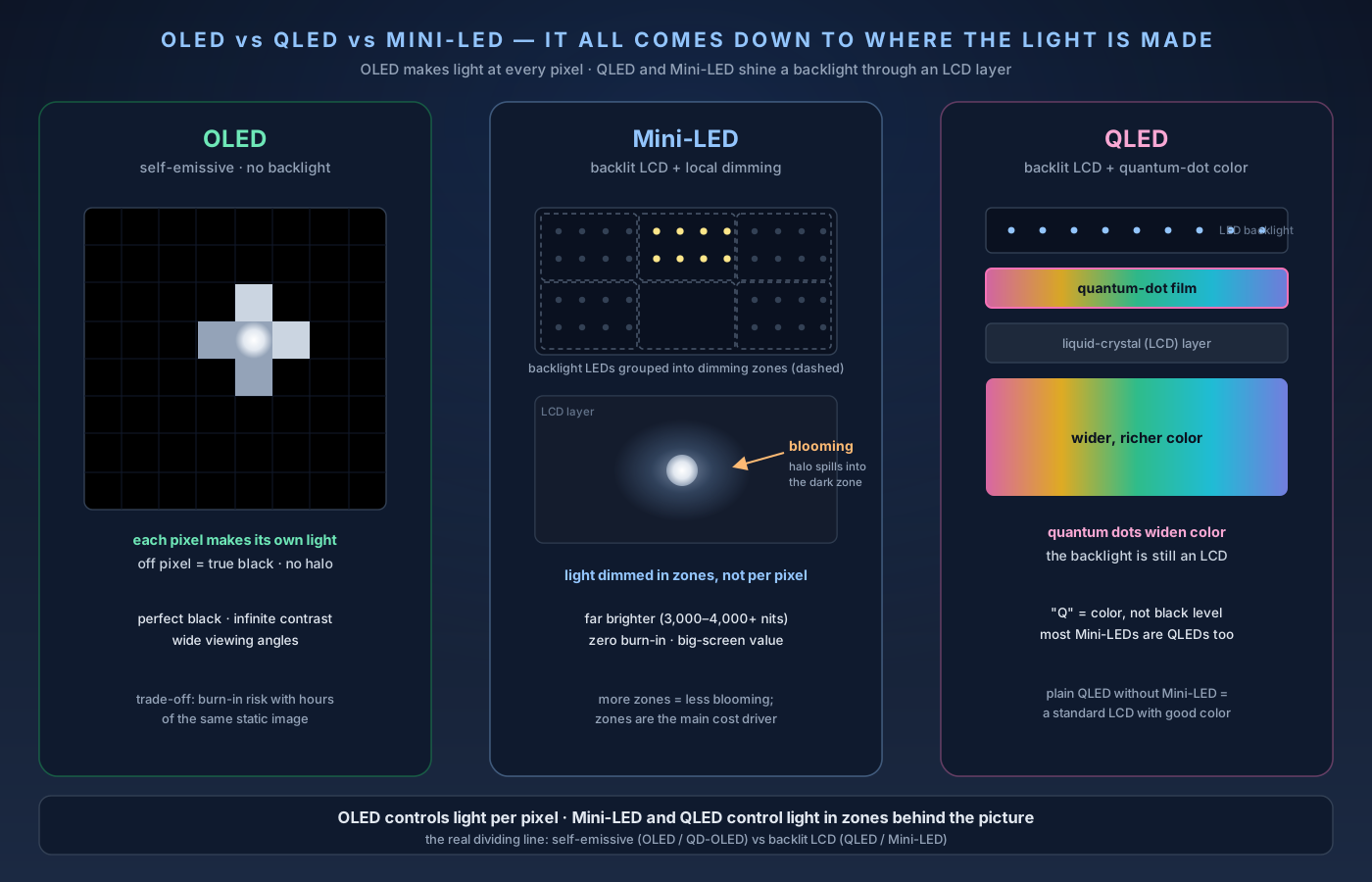
OLED, QLED, and Mini-LED aren't three equal rivals. OLED is self-emissive — every pixel makes its own light and switches fully off for perfect black. QLED and Mini-LED are LCD TVs where a backlight shines through a liquid-crystal layer. Here's what each term actually means, how the 2026 trade-offs (brightness, blooming, burn-in) really shake out, and which panel to buy for a dark theater versus a bright living room.
The verdict up front: there is no single best panel — the right one depends almost entirely on your room and what you watch. The one fact that clears up most of the confusion is that these three names aren't three equal rivals. OLED is a *self-emissive* technology: every pixel makes its own light and can switch completely off, which is why OLED delivers perfect, infinite black and the best contrast you can buy. QLED and Mini-LED are both *LCD* TVs — a backlight shines through a liquid-crystal layer, and "black" is really just the backlight dimmed as low as it can go. "QLED" mostly tells you the set has a quantum-dot film for richer color; "Mini-LED" tells you the backlight is split into thousands of tiny, independently dimmable zones for far better contrast than old LCDs. Many premium TVs are both at once. So the real choice is self-emissive OLED (including its brighter cousin QD-OLED) versus a high-zone Mini-LED LCD. Rule of thumb for 2026: for a dark home-theater room and movie-first viewing, OLED still wins on black levels and viewing angles. For a bright living room, a huge screen, lots of daytime sports and gaming, or hours of static content, a flagship Mini-LED wins on brightness, screen-size value, and zero burn-in worry. Below: what each term actually means, how the 2026 trade-offs really shake out, and how to pick.
First, Untangle the Names
Marketing has made this harder than it needs to be. Here is what each label really means:
- LED / LCD TV — the baseline. A liquid-crystal layer acts like millions of tiny shutters, and a backlight behind it provides the light. "LED TV" just means the backlight is made of LEDs (all of them have been for years). On its own, an LCD's black is only as dark as its backlight can dim.
- QLED — an LCD TV with a quantum-dot layer added. Quantum dots are microscopic particles that emit very pure red and green light when hit by the backlight, which widens the color range and boosts color brightness. Crucially, QLED is still a backlit LCD. The "Q" is about color, not about how black the blacks get. A cheap QLED with a basic backlight can still look mediocre.
- Mini-LED — an LCD TV whose backlight is built from thousands of tiny LEDs, grouped into local dimming zones that can each brighten or dim independently. This is the single biggest LCD upgrade in years: more zones means the TV can keep a bright object bright while the area right next to it goes nearly black. Most Mini-LED TVs are also QLEDs (they add quantum dots too).
- OLED — a fundamentally different technology. There is no backlight at all. Each of the millions of pixels is its own light source and can turn fully off. That's what "self-emissive" means, and it's why OLED black is true black, not dimmed black.
- QD-OLED — OLED with a quantum-dot color layer on top. It keeps OLED's perfect per-pixel black and gains higher brightness and richer color volume than traditional OLED. Think of it as the current high end of the self-emissive category.
- WOLED — the "classic" OLED approach (LG's panels), using a white OLED layer with color filters. 2026 flagships push it much brighter than early OLEDs (more on that below).
The takeaway: the real dividing line is self-emissive (OLED / QD-OLED) versus backlit LCD (QLED / Mini-LED). QLED and Mini-LED are on the same side of the fence — Mini-LED is just a much better backlight for an LCD.
How Each One Makes a Picture
Everything that follows — brightness, blooming, burn-in, viewing angle, price — comes straight from the physics of how the light is produced.
OLED (and QD-OLED): Every pixel emits its own light. To show black, a pixel simply switches off. There is no light leaking from a backlight because there is no backlight. This gives:
- Perfect black and effectively infinite contrast — a black pixel sits directly next to a bright one with no bleed between them.
- Pixel-level precision — a single white star on a black sky is a pinpoint, not a glowing blob.
- Wide viewing angles — color and contrast hold up when you sit off to the side.
Mini-LED / QLED LCD: A backlight shines through the liquid-crystal layer. Even the best liquid crystal can't block 100% of the light, so a "black" pixel still leaks a little. Mini-LED fights this by dimming the backlight zone behind that part of the image. The result depends heavily on how many zones there are:
- A budget LCD might have a few dozen zones (or none), so dark scenes look gray and washed out.
- A 2026 flagship Mini-LED can have thousands of zones — many now exceed 1,000, and top models push toward 5,000 or more — shrinking the halo effect dramatically.
- More zones = better contrast and less blooming, but zones are the main cost driver, which is why cheap "Mini-LED" sets don't look like the flagships.
Blooming vs. Burn-In: The Two Trade-offs Everyone Argues About
These are the two headline weaknesses, one for each side.
Blooming (the Mini-LED weakness). Because a Mini-LED dims light in zones rather than per pixel, a bright object on a dark background can cause a faint halo — light "blooming" out of the zone into the surrounding darkness. You'll notice it most on subtitles over black bars, star fields, or a bright cursor on a dark screen. The fix is more zones: at the high zone counts on 2026 flagships, blooming is greatly reduced and, in most real content, hard to spot at a normal viewing distance. It is not fully gone the way it is on OLED, but the gap has narrowed a lot.
Burn-in (the OLED weakness). Because OLED pixels are organic and self-emissive, showing the same bright static element for very long stretches — a channel logo, a news ticker, a game HUD, a taskbar — can, over time, cause uneven aging that shows up as faint permanent "ghosts." A few realities worth stating plainly:
- Modern OLEDs include strong mitigations: pixel shifting, logo dimming, and automatic compensation cycles.
- For varied viewing (movies, mixed TV, streaming), burn-in is very unlikely over a normal ownership span.
- The genuine risk cases are hours-a-day of the same static content — a TV left on one news channel all day, or a monitor showing the same desktop for work.
- Mini-LED and QLED (LCD) have essentially zero burn-in risk, which is why they're the safer pick for a TV that doubles as a PC monitor, a store display, or an all-day sports/news set.
So the trade is roughly: OLED gives you flawless black at a small long-term risk with static content; Mini-LED gives you zero burn-in worry at the cost of some residual blooming.
Brightness: Where Mini-LED Pulls Ahead
This is the other big real-world difference, and it's the reason bright rooms change the answer.
- OLED 2026 flagships land in roughly the 2,100–2,500 nits range at peak. LG's G6, using a new "Primary Tandem RGB" panel structure (stacking the color layers to push more light), measured around 2,475 nits in HDR and is about 20% brighter than the prior generation. Samsung's QD-OLED (S95-series) sits around 2,000+ nits in accurate picture modes with wide color volume.
- Mini-LED flagships go far higher — commonly 3,000–4,000+ nits, with 2026 top models like the Hisense U8-series exceeding 4,000 nits and Sony's Bravia 9 II near 3,990 nits. At CES 2026, brands demoed Mini-LED prototypes reaching even higher.
Two things to understand about those numbers:
- Peak brightness (a small bright highlight) is where Mini-LED's lead is biggest, and it makes HDR highlights pop harder and cuts through daylight glare.
- Full-screen sustained brightness — a fully white or very bright scene held for a while — is where the gap is even larger, because OLED deliberately limits sustained output to manage panel heat and longevity. Mini-LED has no such ceiling.
Practical upshot: in a dark room, OLED's perfect black makes its lower peak brightness look plenty punchy — contrast, not raw nits, drives the sense of "pop." In a bright room with windows and sunlight, Mini-LED's extra brightness (and often better anti-glare coatings) simply looks better.
Viewing Angle, Size, and Price
A few more differences that matter when you're actually choosing:
- Viewing angle: OLED and QD-OLED hold color and contrast at wide angles; traditional LCD/Mini-LED can wash out or shift color off-axis, though premium models add wide-angle layers to help. If your seating is spread out sideways, OLED has an edge.
- Screen size and value: Mini-LED scales to very large sizes (85", 98", and up) for far less money than OLED at the same size. If you want the biggest possible screen per dollar, Mini-LED usually wins.
- Price in general: Mini-LED spans budget to flagship, so it covers more price points. OLED has come down a lot but still commands a premium, especially the QD-OLED and tandem-RGB flagships. (Specific street prices move constantly — check current listings before you buy.)
- Motion and gaming: Both OLED and good Mini-LED offer 120Hz+ panels, low input lag, and VRR on flagship models. OLED's near-instant pixel response gives the cleanest motion; Mini-LED's brightness helps HDR games shine in a lit room. Both are excellent for modern consoles and PCs — Mini-LED just carries no burn-in worry for HUD-heavy games.
So Which Should You Buy?
Match the panel to your room and habits, not to a spec-sheet winner.
Choose OLED (or QD-OLED) if:
- You watch mostly movies and prestige TV, ideally in a dark or dim room.
- You care most about perfect black, contrast, and shadow detail.
- People sit at wide angles to the screen.
- You want the cleanest motion for film and gaming and your content is varied (low burn-in exposure).
- QD-OLED specifically if you also want higher brightness and the widest color while keeping perfect blacks.
Choose Mini-LED (QLED) if:
- Your TV lives in a bright room with windows or daytime viewing.
- You watch a lot of sports, news, or gaming with static HUDs, or use it as a monitor — where zero burn-in risk matters.
- You want the biggest screen for the money (85"+).
- You want maximum HDR peak brightness to make highlights and daylight scenes punch.
- Buy up the range: with Mini-LED, more dimming zones is the spec that most separates a great set from a mediocre one — cheap Mini-LEDs don't perform like the flagships.
A note on plain "QLED" (non-Mini-LED): a QLED without a Mini-LED backlight is really a standard LCD with good color. It can be a fine value TV, but don't expect flagship contrast from it. If contrast matters, look specifically for Mini-LED with a high zone count, not just the "QLED" badge.
Bottom Line
OLED, QLED, and Mini-LED aren't three teams in one league. OLED and QD-OLED are self-emissive — they own perfect black, contrast, and viewing angles, making them the pick for dark-room cinema. QLED and Mini-LED are LCD — Mini-LED, with its thousands of dimming zones and 3,000–4,000+ nits, owns brightness, big-screen value, and burn-in-free peace of mind for bright rooms and heavy daily use.
Decide the room first. A dark theater flatters OLED; a sunny living room flatters Mini-LED. Once you know which side of that line you're on, the rest of the choice gets easy — and in 2026, both sides are better than they've ever been.
Affiliate disclosure: NetAudioHub links to retailers including Amazon. We earn a small commission on qualifying purchases at no extra cost to you.