Will a Denon AVR-S770H Drive ELAC DF63 Towers? The Answer Turns on a Number ELAC Publishes Twice
Published 2026-09-28 · By NetAudioHub Editorial
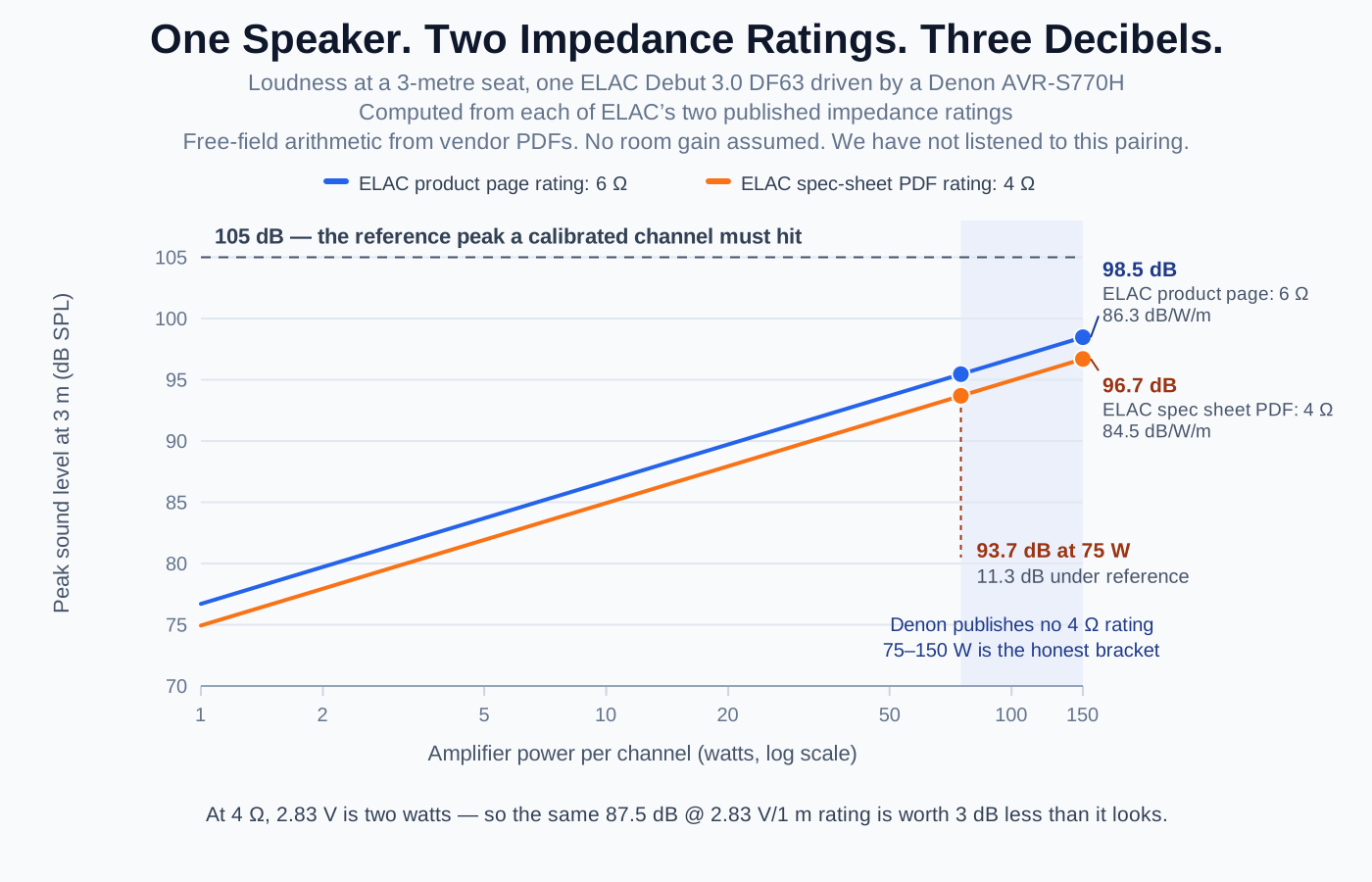
The Denon AVR-S770H is rated 75 watts per channel. The ELAC Debut 3.0 DF63 is rated 87.5 dB sensitive. Those two numbers look like a comfortable match and they are not, for a reason that has nothing to do with watts. ELAC's spec-sheet PDF rates the DF63 at 4 ohms nominal — where 2.83 volts is two watts, not one — so its real efficiency is about 84.5 dB per watt at one metre. Denon publishes no 4-ohm power rating at all. Run the arithmetic and a single DF63 peaks around 94 dB at a 3-metre seat in free field, roughly 11 dB below the 105 dB reference peak a calibrated home-theatre channel is supposed to hit. For stereo music at normal levels it is fine. For 5.1 film at reference it is not, and no receiver at this price fixes it.
Short answer: it depends on what you are asking it to do, and the deciding number is not the watts. For stereo music at ordinary living-room levels, a Denon AVR-S770H will drive a pair of ELAC Debut 3.0 DF63 towers perfectly adequately — roughly 97 dB of peak capability at a 3-metre seat, which covers an 80 dB average with a normal 15 dB crest factor and margin left over. For a calibrated 5.1 film system at reference level, it will not get close: a single DF63 tops out near 94 dB at that seat in free field, about 11 dB under the 105 dB peak a reference-calibrated channel is supposed to deliver. The reason is an impedance rating that ELAC publishes two different ways, and a 4-ohm power figure that Denon does not publish at all.
What This Analysis Is, and What It Is Not
We have reviewed both of these products individually. We have not listened to them together.
Everything below is arithmetic performed on published vendor specifications, plus one published third-party measurement that is labelled as such. There are no listening impressions in this article, because we have not done that listening. A pairing article that invents them is worse than useless — it is a claim that any reader who owns both boxes can catch.
So there is nothing here about how the DF63's midrange sits behind the Denon's preamp stage, nothing about whether Audyssey "tames" anything, and no verdict on tonal synergy. What a spec sheet can answer is the question people type into a search box before spending two thousand dollars — will this receiver play these speakers loudly enough, without running out — and that question has a numeric answer.
Where a number is disputed, we print both and show what each implies. Where a number is not published, we say so instead of estimating it.
The Two Products, As Published
Denon AVR-S770H
All figures from the Denon AVR-S770H owner's manual, North America / English edition, Specifications → Audio section (PDF). Front, centre, surround and surround-back channels all carry identical ratings.
| Spec | Figure | Stated measurement condition |
|---|---|---|
| Rated output | 75 W + 75 W | 8 ohms, 20 Hz – 20 kHz, 0.08 % THD, two channels driven |
| Rated output | 110 W + 110 W | 6 ohms, 1 kHz, 0.7 % THD, two channels driven |
| Rated output into 4 ohms | not published | — |
| All-channels-driven output | not published | — |
| Output connectors | 4 – 16 ohms | — |
| Analogue frequency response | 10 Hz – 100 kHz, +1 / −3 dB | Direct mode |
Two things on that list matter more than the headline number.
The 75 W figure is a two-channels-driven rating. That is the honest way to state it and Denon states it honestly — but it means the figure tells you nothing directly about what any one channel gets when five are working during a film. Denon publishes no all-channels-driven figure for this receiver, so that number is not derivable from published data. We are not going to invent a derating percentage to fill the gap. What can be said with confidence is narrower and still useful: 75 W per channel is an upper bound on what a DF63 receives in a 5.1 mix, not a floor.
The 110 W / 6-ohm figure is not comparable to the 75 W / 8-ohm figure and should not be read as "it makes more power into lower impedance." It is measured at a single 1 kHz tone rather than across 20 Hz – 20 kHz, and at 0.7 % THD rather than 0.08 % — roughly nine times the distortion allowance. Two different test conditions produce two numbers that cannot be placed on the same axis.
ELAC Debut 3.0 DF63
This is where it gets interesting, because ELAC publishes the DF63's specifications in three places and they do not agree.
| Spec | ELAC product page (elac.com/df63) | ELAC Debut 3.0 sales sheet, v1.0.0 (PDF) | ELAC Debut 3.0 owner's manual, v1.0.0 (PDF) |
|---|---|---|---|
| Nominal impedance | 6 ohms | 4 ohms | 4 ohms |
| Sensitivity | 87.5 dB @ 2.83 V / 1 m | 87.5 dB @ 2.83 V / 1 m | 87.5 dB @ 2.83 V / 1 m |
| Frequency response, −3 dB | not published | 46 Hz – 34 kHz | 46 Hz – 34 kHz |
| Frequency response, −6 dB | 31 Hz – 38 kHz | 31 Hz – 38 kHz | 31 Hz – 38 kHz |
| Power handling | 140 W peak | 100 W nominal / 150 W peak | 100 W nominal / 150 W peak |
| Recommended amplifier power | 30 – 180 W | 30 – 180 W | 30 – 180 W |
| Crossover frequencies | 550 Hz, 2,000 Hz | 550 Hz, 2,000 Hz | 550 Hz, 2,000 Hz |
The two PDFs agree with each other and disagree with the web page on impedance, on power handling, and on whether a −3 dB frequency limit exists at all. Our standing rule is that the vendor spec-sheet PDF is the source of record and the product page is secondary, because product pages routinely carry forward superseded numbers. On that rule the DF63 is a 4-ohm nominal speaker.
The independent measurement supports the PDFs. Erin's Audio Corner, measuring a DF63 on a Klippel Near Field Scanner, reports a minimum impedance near 3.4 ohms and an EPDR near 1.5 ohms. A speaker whose impedance bottoms out at 3.4 ohms is not a 6-ohm load in any practical sense.
Three further things ELAC does not publish, named rather than guessed:
- No measurement condition on the sensitivity figure. ELAC prints Sensitivity @2.83 v/1m: 87.5 dB and does not state whether it is anechoic, half-space, or in-room. We are taking it at face value because there is no basis to adjust it, but it is an unqualified number and you should know that.
- No tolerance on the frequency-response figures beyond the −3 dB and −6 dB limit points themselves. There is no ±3 dB window published for the passband. That is a sourced fact about the spec sheet, not an omission on our part.
- No minimum impedance. The 3.4-ohm figure above is third-party, not ELAC's.
Our full write-ups of both boxes are here: the Denon AVR-S770H review covers the receiver's feature set and its limits as a 5.2.2 platform, and the ELAC Debut 3.0 DF63 review covers the tower's three-way design and its measured behaviour. Both of those reviews reach the same conclusion this arithmetic reaches — the DF63 review warns off entry-level receivers, and the S770H review warns off low-sensitivity 4-ohm speakers in large rooms — but neither of them does the sum. This article does the sum.
One disclosure: our DF63 review carried the product page's 6 ohms and 140 W peak rather than the spec sheet's 4 ohms and 100 W nominal / 150 W peak. Building this arithmetic is what exposed it, and the review's spec table now carries the spec-sheet figures with both sources named. We are telling you here rather than quietly changing it.
The Three-Decibel Trap: 2.83 Volts Is Not Always One Watt
This is the whole article in one paragraph, so it is worth being slow about.
Speaker sensitivity is quoted one of two ways: dB at 1 watt / 1 metre, or dB at 2.83 volts / 1 metre. The industry drifted to the voltage version because amplifiers are voltage sources, and 2.83 volts was chosen because 2.83 volts into 8 ohms is exactly 1 watt. For an 8-ohm speaker the two ratings are the same number, and a whole generation of buyers learned to read them interchangeably.
They are only the same number at 8 ohms. Power is voltage squared over impedance, so the same 2.83 volts delivers:
| Nominal impedance | Power at 2.83 V | 87.5 dB @ 2.83 V / 1 m becomes |
|---|---|---|
| 8 ohms | 1.00 W | 87.5 dB @ 1 W / 1 m |
| 6 ohms | 1.34 W | 86.3 dB @ 1 W / 1 m |
| 4 ohms | 2.00 W | 84.5 dB @ 1 W / 1 m |
At 4 ohms, 2.83 volts is two watts. The speaker is being handed double the power to produce that 87.5 dB, so its actual efficiency is 3 dB lower than the number on the sheet appears to promise.
This matters twice over. First, the DF63 is a 84.5 dB/W/m speaker, not an 87.5 dB one — a meaningful deficit for a large tower. Second, which ELAC document you read changes the answer by 1.8 dB: the product page's 6-ohm rating implies 86.3 dB/W/m, the spec sheet's 4-ohm rating implies 84.5 dB/W/m. That is not a rounding difference. It is a 50 % difference in the amplifier power required for the same sound level.
If this convention is unfamiliar, our explainers on speaker sensitivity in dB and on 4-ohm versus 8-ohm speakers and what your AVR does about it cover the background this article assumes.
What the Denon Can Actually Deliver Into Four Ohms
Denon does not publish a 4-ohm power rating for the AVR-S770H. It publishes 8 ohms and 6 ohms. So the honest thing is to bracket it rather than pick a number.
The 8-ohm rating gives us the voltage the output stage is known to swing:
V = sqrt(75 W × 8 ohms) = 24.49 V RMS
From there, two bounds:
- Upper bound — a perfect voltage source. If the power supply holds that 24.49 V while the current doubles into half the impedance, the output is 24.49² / 4 = 150 W. No AV receiver at this price behaves like a perfect voltage source into 4 ohms on all channels, so treat this as a ceiling that will not be reached.
- Lower bound — supply-limited. If the power supply cannot deliver more total wattage than it does at 8 ohms, output stays at 75 W.
The real figure is somewhere in 75 – 150 W per channel, and on an entry receiver it sits nearer the bottom of that range. We are not going to pretend to know where, because Denon has not published it.
Two things reinforce the low end. The AVR-S770H owner's manual instructs the owner to change the receiver's internal Sp.Imp. setting to 4ohms when any connected speaker is 4 ohms — a protective measure, reached by a hidden button combination on the front panel, that constrains the amplifier. Denon publishes no power rating for the receiver in that state either. And the 75 W figure itself is a two-channels-driven number, so in a five-channel film mix each DF63 gets less than 75 W, by an amount Denon has not quantified.
The Arithmetic
Everything below uses the standard free-field relation, with no room gain assumed:
SPL = sensitivity(dB/W/m) + 10·log₁₀(watts) − 20·log₁₀(distance in metres)
and adds 3.01 dB for a stereo pair, which is the power sum of two uncorrelated sources.
Excluding room gain is deliberate. A real room reinforces the low end and adds reflected energy, so real-world levels at a given power will be higher than these figures. Every number here is therefore a floor, not a prediction. We have not measured a room, so we cannot tell you how much higher — and a pairing article that guessed at your room gain would be inventing the most important variable.
One DF63 at a 3-metre seat, on the spec-sheet reading (84.5 dB/W/m)
| Amplifier power | Single speaker | Stereo pair |
|---|---|---|
| 75 W/ch (lower bound) | 93.7 dB | 96.7 dB |
| 150 W/ch (upper bound) | 96.7 dB | 99.7 dB |
Against the reference-level target
A calibrated home-theatre channel is set so that a −20 dBFS pink-noise signal reads 85 dB SPL at the seat, which puts full-scale peaks at 105 dB per channel. That is the target the whole Dolby calibration convention is built around.
| Amplifier power | Single-channel peak at 3 m | Versus the 105 dB reference peak |
|---|---|---|
| 75 W/ch | 93.7 dB | −11.3 dB |
| 150 W/ch | 96.7 dB | −8.3 dB |
Eleven decibels is not a near miss. It is a factor of fourteen in power.
The inversion: what reference level would actually require
Turn the equation around and ask how many watts one channel needs for a 105 dB peak at 3 metres, free field:
| Sensitivity reading | Watts required |
|---|---|
| Spec sheet, 4 ohms (84.5 dB/W/m) | 1,013 W |
| Product page, 6 ohms (86.3 dB/W/m) | 676 W |
That number is large enough to be worth interrogating rather than just printing, so: it is a free-field figure, and free field is the pessimistic extreme. Room gain in a normal domestic room closes a substantial part of that gap, which is precisely why real systems calibrate successfully on far less power than this arithmetic demands.
But it also establishes something a bigger receiver cannot fix. The DF63's own rated peak power handling is 150 W (ELAC sales sheet v1.0.0). Against a free-field requirement of 1,013 W, the speaker's own rating is 8.3 dB short. Whatever the room contributes, it contributes to both sides of that comparison. At true reference level in a free-field-equivalent setting, this is a speaker limit at least as much as an amplifier limit — and buying a Denon AVR-X3800H instead does not move it.
Peaks Are the Whole Game
The counter-intuitive part of every amplifier-sizing exercise is how little average power is involved.
Average power required from each channel, stereo pair, 3-metre seat, spec-sheet sensitivity:
| Average level at the seat | Average power per channel |
|---|---|
| 75 dB (background listening) | 0.51 W |
| 80 dB (attentive listening) | 1.60 W |
| 85 dB (loud) | 5.07 W |
Half a watt. The AVR-S770H's 75 watts are not there to produce the average level — they exist entirely to survive the peaks, and the gap between average and peak is the crest factor. Well-recorded music runs roughly 15 dB; film soundtracks run to 20 dB and beyond.
Apply that to the 85 dB average figure and the demand explodes: a 15 dB crest factor wants 160 W per channel on peaks, and a 20 dB crest factor wants 507 W. This is why "how loud do you listen" is the wrong question and "how loud are your peaks" is the right one.
Where This Pairing Does Work
Everything above is the film case. The stereo-music case is much friendlier, and it is worth separating because most people who buy an AVR-S770H and a pair of towers are going to spend most of their hours doing exactly this.
Peak capability of the pair, spec-sheet sensitivity, free field, no room gain:
| Distance | At 75 W/ch | At 150 W/ch |
|---|---|---|
| 2.0 m | 100.2 dB | 103.2 dB |
| 2.5 m | 98.3 dB | 101.3 dB |
| 3.0 m | 96.7 dB | 99.7 dB |
| 4.0 m | 94.2 dB | 97.2 dB |
Take an 80 dB average — genuinely loud for a living room — with a 15 dB crest factor, so peaks reach 95 dB. Even at the pessimistic 75 W bound:
- at 2.5 m the pair has 3.3 dB of headroom over that 95 dB peak
- at 3.0 m it has 1.7 dB
- at 4.0 m it is 0.8 dB short, and that is before any room gain
So the working answer for stereo is: fine inside about three metres, marginal beyond it, and the marginal case is rescued by a room rather than by the receiver. If you are seated four metres back in a large open-plan space, this is the wrong amplifier for these speakers, and a Denon AVR-X2800H or Onkyo TX-NR6100 is the sensible step up — not because of the watts on the box, but because of what their power supplies do when the load drops below 4 ohms.
The Cheapest Fix Is Not an Amplifier
If you own this pairing and want more out of it, the highest-leverage change costs less than a receiver upgrade: cross the DF63s over to a subwoofer at 80 Hz and set them to "small."
Bass is where the power goes. Removing everything below 80 Hz from the towers removes the largest excursion demand, which reduces the current the Denon has to supply into the DF63's impedance minimum, which is where an entry receiver is most likely to misbehave.
The bass you give up is less than the spec sheet suggests. ELAC publishes a −3 dB point of 46 Hz; Erin's Klippel measurement puts the −3 dB point at 71 Hz. That is a spread of 0.63 octaves — about two-thirds of an octave — between the vendor's own −3 dB claim and the independent −3 dB measurement. If the measured figure is the one that describes your speaker, an 80 Hz crossover is barely taking anything the DF63 was contributing in the first place. Our subwoofer crossover explainer and the step-by-step crossover how-to cover the settings.
Note that this changes the arithmetic above in a way we have not modelled. Removing the bass band reduces the power demand on the fronts substantially, but by how much depends entirely on programme content, so we are not going to print a number for it.
So: Should You Buy This Pairing?
Buy it if your primary use is stereo or 2.1 music, your seat is within about three metres, and you are prepared to set the receiver's speaker-impedance option to 4ohms as the Denon manual directs. Within that envelope the arithmetic says the pairing has real headroom and the 75 W rating is not the constraint people assume.
Do not buy it if you are building a 5.1 or 5.1.2 system that you intend to calibrate and run at or near reference level. The single-channel peak lands about 11 dB short in free field, the 75 W rating is a two-channel figure that overstates what each channel sees in a five-channel mix, and Denon publishes neither a 4-ohm nor an all-channels-driven number that would let you check our working against theirs.
Do not buy it if your seat is four metres or more away in a large room, regardless of use. That is the case both of our individual reviews independently warn about, and the arithmetic agrees with them.
And a point that has nothing to do with the receiver: read ELAC's spec-sheet PDF, not ELAC's product page, before you set your receiver's impedance option. The two documents would have you set it differently. The PDFs and the independent measurement agree with each other, which is why we went with 4 ohms.
What We Cannot Tell You
The honest limits of a spec-sheet analysis, listed rather than glossed over:
- How the pairing sounds. Tonal balance, whether the combination hardens up before it clips, how it holds together over a two-hour film — none of that is derivable from a spec sheet, and we have not listened to it.
- How your room changes the numbers. Every figure here ignores room gain and reflections. Your room will make the low end louder than this model predicts. We have not measured a room, so we cannot say by how much.
- The AVR-S770H's 4-ohm power output, because Denon does not publish it. We bracketed it at 75 – 150 W and told you why.
- The AVR-S770H's all-channels-driven power output, because Denon does not publish that either. We did not estimate a derating factor.
- The AVR-S770H's output with its speaker-impedance option set to 4 ohms, because that is not published either.
- Whether ELAC's 87.5 dB sensitivity is anechoic, half-space or in-room, because ELAC does not state a measurement condition.
- Which of ELAC's two impedance ratings is the intended one. We showed both, computed both, and went with the PDFs because our house rule says the spec sheet outranks the product page and because the measured impedance minimum agrees with it. That is a judgment and we have labelled it as one.
The arithmetic is above and it is reproducible from the cited documents. If you want to know how they sound together, someone has to actually listen — and when that someone is us, we will say so plainly.