Will a WiiM Amp Drive Klipsch RP-600M IIs? We Did the Arithmetic, Not the Listening
Published 2026-09-24 · By NetAudioHub Editorial
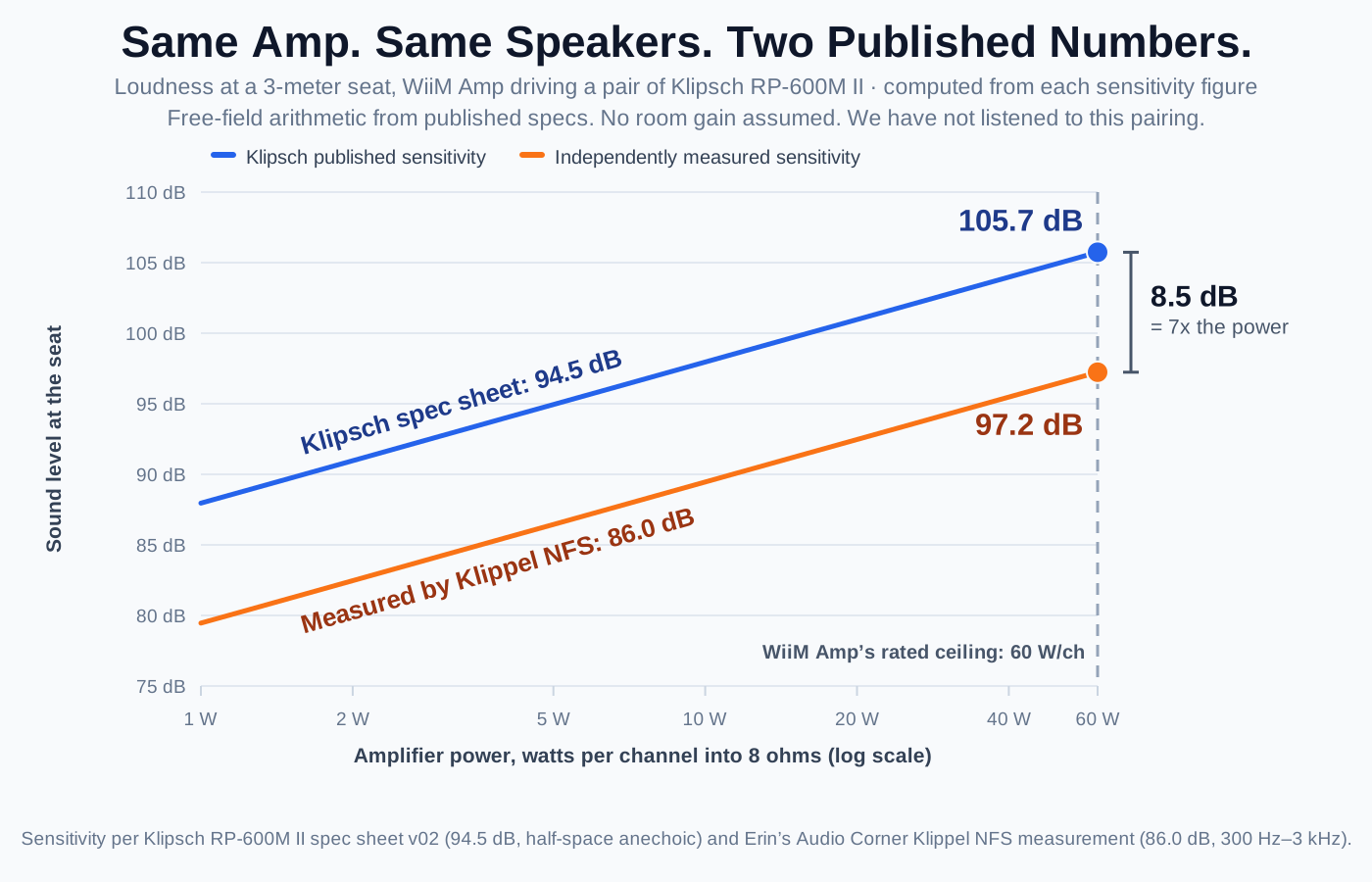
The WiiM Amp is rated 60 watts per channel into 8 ohms. The Klipsch RP-600M II is an 8-ohm bookshelf. Those two facts are supposed to settle the question, and they do not — because Klipsch's published 94.5 dB sensitivity and the 86.0 dB an independent lab measured on the same speaker are 8.5 dB apart, which is seven times the amplifier power. Using Klipsch's number, the pair hits 105.7 dB at a 3-meter seat and clears THX reference level on a $299 amp. Using the measured number, it hits 97.2 dB and reference level would need about 358 watts per channel. Here is the arithmetic, both ways, with every input cited — and an explicit statement of what spec sheets cannot tell you.
Short answer: yes, with a caveat that is more interesting than the answer. The WiiM Amp's rated 60 watts per channel will drive a pair of Klipsch RP-600M IIs to somewhere between 97 and 106 dB at a 3-meter seat, and the nine-decibel width of that range is not our uncertainty — it is the gap between the sensitivity Klipsch publishes and the sensitivity an independent lab measured on the same speaker. Plan on the low end. That still buys you a comfortable 77–82 dB average listening level with full peak headroom intact, which is louder than most people play music in a living room. What it does not buy you is THX reference level: on the measured number, 105 dB peaks at that seat would need roughly 358 watts per channel, and the WiiM has 60.
What This Analysis Is, and What It Is Not
We have reviewed both of these products individually. We have not listened to them together.
Everything below is arithmetic performed on published specifications and published third-party measurements. There are no listening impressions in this article, because we have not done that listening, and a pairing article that invents them is worse than useless — it is a claim any reader who owns the gear can catch.
So: no notes on how the horn sounds through the WiiM's DAC, no verdict on whether the class-D power section "suits" the Cerametallic woofer, no paragraph about the midrange. What spec sheets can answer is the question people actually type into a search box before they spend a thousand dollars — will this amplifier play these speakers loudly enough, in my room, without running out of power — and that question has a numeric answer. That is the article.
Where a number is disputed, we give you both numbers and show what each one implies. Where a number is simply not published, we say so rather than estimating.
The Two Products, As Published
| Spec | Value | Source |
|---|---|---|
| WiiM Amp — power output | 60 W/channel at 8 ohms; 120 W/channel at 4 ohms | WiiM published specifications |
| WiiM Amp — amplifier | TI TPA3255 class-D | WiiM published specifications |
| WiiM Amp — speaker load support | 8, 6, and 4 ohms; two pairs of 8 ohms in parallel; minimum impedance 2.67 ohms | WiiM published specifications |
| WiiM Amp — power supply | Internal, 100–240 V 50/60 Hz AC | WiiM published specifications |
| WiiM Amp — price | $299 | WiiM |
| Klipsch RP-600M II — sensitivity | 94.5 dB @ 2.83V / 1m, footnoted "SPL at 1M, half-space anechoic with 2.83V input" | Klipsch RP-600M II spec sheet v02 |
| Klipsch RP-600M II — sensitivity, independently measured | 86.0 dB @ 2.83V / 1m, averaged 300 Hz–3 kHz | Erin's Audio Corner, Klippel Near-Field Scanner |
| Klipsch RP-600M II — nominal impedance | "8 Ohms Compatible" (no minimum published) | Klipsch spec sheet v02 |
| Klipsch RP-600M II — power handling | 100 W continuous / 400 W peak | Klipsch spec sheet v02 |
| Klipsch RP-600M II — frequency response | 44 Hz – 25 kHz ±3 dB | Klipsch spec sheet v02 |
| Klipsch RP-600M II — low-frequency extension, measured | −3 dB at 74.7 Hz; −6 dB at 54.2 Hz | Erin's Audio Corner / spinorama.org |
| Klipsch RP-600M II — crossover | 1,500 Hz | Klipsch spec sheet v02 |
| Klipsch RP-600M II — price | $749/pair MSRP | Klipsch |
Two rows in that table do the real work, and they disagree with each other.
The 8.5 dB Problem
Klipsch rates the RP-600M II at 94.5 dB. An independent measurement of the same speaker, taken on a Klippel Near-Field Scanner and averaged across 300 Hz–3 kHz, returns 86.0 dB. Both are stated at the same nominal condition — 2.83 volts, one meter.
Neither party is lying. They are measuring different things, and Klipsch tells you so in the footnote: its figure is half-space anechoic, meaning the speaker is treated as radiating into a hemisphere rather than into free space. That framing, plus a choice of which frequencies to average and how, accounts for the difference.
The consequence is what matters:
- 8.5 dB is 7 times the amplifier power.
- A speaker that is really 86 dB sensitive needs seven watts to do what a 94.5 dB speaker does with one.
This is not a Klipsch-specific complaint — sensitivity specs across the industry are quoted under conditions that flatter them, which is exactly why "it's a 94.5 dB speaker, any receiver will do" is such a common and such a wrong conclusion. It is also why we run the arithmetic below twice. If you want the background on why this number behaves the way it does, our speaker sensitivity explainer covers the measurement conditions in more depth.
A correction we owed you, now made: when this article first went up, our own Klipsch RP-600M II review quoted this speaker at 96 dB — a figure carried over from the original RP-600M. It was wrong. Klipsch's current spec sheet for the II says 94.5 dB, and the independent measurement says 86.0 dB. We corrected the review the same day and logged the change in a Corrections note at the foot of it rather than editing quietly, because the whole point of this article is that the sensitivity number is the number everyone gets away with fudging.
One convenient fact makes the rest of the math legible: for an 8-ohm speaker, 2.83 volts is one watt. So a sensitivity quoted at 2.83V/1m can be read directly as decibels per watt per meter.
The Arithmetic
Here is the entire model. It is deliberately simple and deliberately conservative, and you can reproduce every number in the article from it:
SPL at the seat = sensitivity + 10 × log10(watts) − 20 × log10(distance in meters) + 3 dB for the pair
Three assumptions, stated plainly:
- Free-field, inverse-square propagation, no room gain. Real rooms add reinforcement, especially in the bass and especially near walls. Ignoring it makes these figures a floor, not a ceiling.
- +3 dB for two speakers, the power sum for uncorrelated content. Perfectly correlated, center-panned material can theoretically sum to +6 dB at an equidistant seat; that would add three decibels to every number below.
- A 3-meter (about 10-foot) listening distance, which is a normal sofa-to-speaker distance in a living room.
Sound level at the seat versus amplifier power, at 3 meters
| Watts per channel | Using Klipsch's 94.5 dB | Using the measured 86.0 dB |
|---|---|---|
| 1 W | 88.0 dB | 79.5 dB |
| 2 W | 91.0 dB | 82.5 dB |
| 5 W | 94.9 dB | 86.4 dB |
| 10 W | 98.0 dB | 89.5 dB |
| 20 W | 101.0 dB | 92.5 dB |
| 40 W | 104.0 dB | 95.5 dB |
| 60 W (the WiiM's rating) | 105.7 dB | 97.2 dB |
The same thing, at four listening distances, with the amp wide open
| Distance | Using 94.5 dB | Using 86.0 dB |
|---|---|---|
| 2.0 m / 6.5 ft | 109.3 dB | 100.8 dB |
| 2.5 m / 8 ft | 107.3 dB | 98.8 dB |
| 3.0 m / 10 ft | 105.7 dB | 97.2 dB |
| 4.0 m / 13 ft | 103.2 dB | 94.7 dB |
Those are peak figures — the loudest instantaneous moment the amplifier can produce before it clips. Nobody listens at that level continuously, which is where the next step comes in.
Peaks Are the Whole Game
Music and film do not sit at one level. The gap between the average level and the loudest transients — the crest factor — typically runs 15 to 20 dB on real program material. Film mixes are the strict case: the THX reference convention is an 85 dB average with 105 dB peaks, exactly 20 dB of headroom.
Amplifier power is bought almost entirely for those peaks. Here is what that means for this pairing at a 3-meter seat:
| Target average level | Avg. watts needed (86.0 dB) | With 15 dB peaks | With 20 dB peaks |
|---|---|---|---|
| 70 dB — quiet background | 0.11 W | 3.6 W | 11.3 W |
| 75 dB — normal listening | 0.36 W | 11.3 W | 35.8 W |
| 80 dB — loud | 1.13 W | 35.8 W | 113 W |
| 85 dB — THX reference | 3.58 W | 113 W | 358 W |
The bolded cells are the ones the WiiM Amp cannot deliver.
Read the first column again, because it is the genuinely counterintuitive part: the average power this system draws at a normal, satisfying listening level is about a third of a watt. The 60-watt rating is not there to sustain your listening level. It exists entirely to survive the 20-dB transients on top of it.
Running that logic backwards gives the cleanest statement of the result:
| Crest factor | Max clean average level, using 94.5 dB | Using 86.0 dB |
|---|---|---|
| 15 dB peaks | 90.7 dB average | 82.2 dB average |
| 20 dB peaks | 85.7 dB average | 77.2 dB average |
Plan on 77–82 dB average. For context, normal conversation sits around 60 dB and most people play music in a living room somewhere in the 70s. This pairing has room above where you will actually listen — but on the measured sensitivity figure it does not reach film reference level, and it is not close. Getting there would take about 358 watts per channel, roughly six times what the WiiM has.
Notice, though, what happens if Klipsch's 94.5 dB figure is the one you trust: reference level needs only about 51 watts, and the WiiM's 60 clears it. The entire answer to "does this pairing do reference level" flips on which sensitivity number you use. We would not bet on the flattering one. If you want a general treatment of how this calculation scales across other amplifiers and speakers, the same method applies to any pairing: it is only ever sensitivity, watts, and distance.
The Load Question
Separate from loudness: is this an electrically safe pairing? On published numbers, yes, with one gap.
- The RP-600M II is rated "8 Ohms Compatible" by Klipsch.
- The WiiM Amp explicitly supports 8, 6, and 4-ohm speakers, and publishes a minimum impedance of 2.67 ohms.
- An 8-ohm nominal load sits well inside that envelope.
The gap: Klipsch does not publish a minimum impedance or an impedance curve for the RP-600M II. Nominal impedance is a marketing-grade summary; what actually stresses an amplifier is how far the impedance dips and how severe the electrical phase angle is at that dip. Those numbers are not in the spec sheet, and we are not going to invent them or borrow the previous generation's. What we can say is that the WiiM's published floor of 2.67 ohms is low enough that an 8-ohm nominal bookshelf would have to behave very unusually to trouble it. If that distinction is new to you, our 4-ohm vs 8-ohm pairing guide explains why the nominal figure hides so much.
Two more load notes worth having:
The 120 W figure does not apply to you. The WiiM Amp's headline "120 watts per channel" is its 4-ohm rating. The RP-600M II is an 8-ohm speaker, so the number that governs this pairing is 60 watts. Every calculation above uses 60.
The amplifier will clip before the speaker is in danger. Klipsch rates the RP-600M II at 100 W continuous. The WiiM is rated at 60 W into that load. You will hear the amp run out long before the speaker's thermal limit is a concern — which is the right way round, though it is worth remembering that sustained clipping is itself hard on tweeters.
One published number we could not get: WiiM does not state the distortion level at which its 60 W and 120 W ratings are measured. A power figure without a THD condition is not directly comparable to one that has it, so treat 60 W as a ceiling of unspecified cleanliness rather than a guaranteed clean output. That is a gap in the vendor's spec sheet, not an estimate we are withholding.
Where This Pairing Actually Runs Short — and It Is Not the Amplifier
If you only take one practical recommendation from this article, take this one: buy a subwoofer before you worry about the amplifier.
Klipsch publishes a frequency response of 44 Hz – 25 kHz ±3 dB. The independent measurement puts the −3 dB point at 74.7 Hz and the −6 dB point at 54.2 Hz relative to the speaker's own midband reference. That is a much larger discrepancy than the sensitivity one in practical terms, because it lands squarely in the range where music has its foundation.
A 6.5-inch woofer in a cabinet this size rolling off in the 50–75 Hz region is entirely normal and not a defect. It just means the bottom octave-and-a-half is not there, and no amount of amplifier power will put it there — asking the WiiM to make up the difference with volume is the fastest route to running out of the headroom we just spent an article counting.
The convenient part is that the WiiM Amp is well set up for this. It has a subwoofer output with auto-detection and a user-adjustable 30–250 Hz crossover, so an 80 Hz crossover is a one-setting job in the app. Doing that hands everything below 80 Hz to the sub, which also returns headroom to the WiiM by relieving it of the most power-hungry content in the mix — the numbers above get better, not worse, once a sub is in the system.
Our crossover-setting how-to covers why 80 Hz is the default recommendation, and subwoofer placement matters more than most people expect.
So: Should You Buy This Pairing?
Yes, if your listening seat is roughly 3 meters or closer, you listen to music and TV in a normal living room at normal-to-loud levels, and you are adding a subwoofer. At that brief, the arithmetic says the WiiM Amp has headroom in hand even on the pessimistic sensitivity figure, and you are getting a streamer, a DAC, HDMI ARC, room correction and a power amplifier in one $299 box.
No, if you want film reference level, or you have a large room, or your seat is 4 meters-plus and you listen loud. On the measured sensitivity number you would need something in the region of 358 watts per channel to hit 105 dB peaks at 3 meters. That is a different class of amplifier, and the RP-600M II — rated to 100 W continuous — would be the next thing to outgrow.
Also no if you need surround. The WiiM Amp's HDMI is ARC rather than eARC and it is a two-channel device; that constraint is covered in our WiiM Amp review and has nothing to do with the power arithmetic here.
Check the current WiiM Amp price on Amazon →
Check the current Klipsch RP-600M II price on Amazon →
What We Cannot Tell You
The honest limits of a spec-sheet analysis, listed rather than glossed over:
- How the pairing sounds. Tonal balance, how the Tractrix horn interacts with this particular amplifier's output impedance, whether the combination is fatiguing over two hours — none of that is derivable from a spec sheet, and we have not listened to it.
- How your room changes the numbers. Every figure above ignores room gain and reflections. Your room will make the bass louder than this model predicts and may do unhelpful things elsewhere.
- Klipsch's impedance minimum, because it is not published.
- The distortion level behind WiiM's 60 W rating, because that is not published either.
- Which sensitivity figure is "right." We have shown both and recommended planning on the conservative one. That is a judgment, and we have labeled it as one.
If the arithmetic is what you came for, it is all above and it is reproducible from the cited specs. If you want to know how they sound together, someone has to actually listen — and when that is us, we will say so.