Q Acoustics 3030c Review: A Refined British Bookshelf for Music and Movies
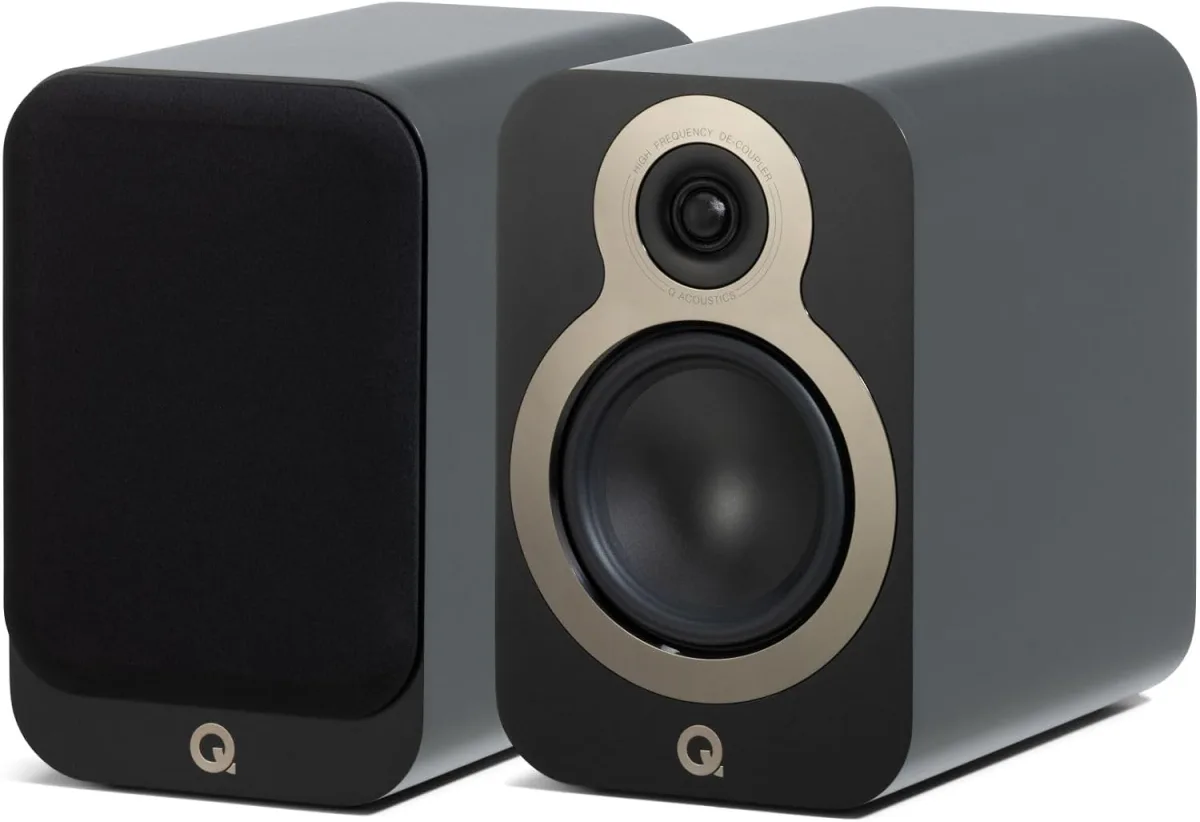
The Q Acoustics 3030c brings the new C3 mid/bass cone and an isolated sealed tweeter to a $699 standmount. Neutral, spacious, and one of the best-built bookshelf speakers in its class.
✅ Pros
- +Neutral, accurate tonal balance that suits any genre
- +Wide, layered soundstage with excellent imaging for the price
- +New C3 cone delivers tight, well-articulated bass
- +Sealed, isolated tweeter improves low-level detail and integration
- +Easy to drive — happy with modest amps and receivers
- +Outstanding build and finish; attractive in a living room
- +Voice-matches with the rest of the 3000c range for home theater
❌ Cons
- −Less deep bass than the larger-woofered 3030i it replaces
- −Sounds lean at low volumes without a sub or loudness contour
- −Needs stands and space from the wall; rear port limits shelf placement
- −Pricier than the outgoing generation
The Q Acoustics 3030c is the refined, music-first bookshelf speaker to buy near $700 a pair. It carries forward the 3000-series traits that made the outgoing 3030i a repeat award winner — neutral tonal balance, a wide soundstage, and finish quality that punches well above the price — while adding a new C3 (Continuous Curved Cone) mid/bass driver and a hermetically sealed tweeter that is mechanically isolated from the baffle. The result is tighter, better-articulated bass and cleaner detail. The one honest trade-off is that its 5.5-inch woofer digs slightly less deep than the 6.5-inch driver in the old 3030i, so if you crave the last bit of low-end weight without a subwoofer, factor that in. For most rooms, paired with a modest amp or receiver, this is one of the most complete standmounts in its class.
Key Specs at a Glance
The 3030c is a 2-way passive bass-reflex bookshelf/standmount sold as a pair. The mid/bass driver is a 5.5-inch (140 mm) C3 Continuous Curved Cone; the tweeter is a 0.9-inch (22 mm) hermetically sealed, mechanically isolated dome crossed over at roughly 2.4 kHz — lowered versus the 3030i. Frequency response is 48 Hz – 30 kHz (-6 dB), sensitivity is 86.5 dB (2.83 V / 1 m), and nominal impedance is 6 Ω (compatible with 4–8 Ω loads). Q Acoustics recommends 25–90 watts of amplification. The cabinet measures 324 × 205 × 329 mm (12.8" × 8.1" × 13.0") and each speaker weighs about 7.5 kg (16.5 lb). Finishes are Satin Black, Satin White, Claro Walnut, and Pin Oak, at roughly $699.99 per pair — some finishes list higher.
Where the 3030c Fits in the Lineup
The 3030c sits in the middle of Q Acoustics' current 3000c bookshelf range. Below it are the entry-level 3010c and the popular 3020c standmounts; above it, the range moves into floorstanders and the pricier 5000-series and Concept lines. Within the c-series bookshelves, the 3030c is the one to reach for when you want more scale and body than the smaller cabinets can give but still want a speaker that sits on a stand or a substantial shelf rather than the floor.
If you followed the previous generation, the 3030c is the direct successor to the 3030i — one of the most-recommended budget bookshelf speakers of the last several years. Q Acoustics didn't simply reskin it. The new model borrows driver and cabinet technology from the company's step-up 5000 series, which is the reason it sounds like a genuine upgrade rather than a refresh.
What's New: The C3 Cone and Sealed Tweeter
Two engineering changes define the 3030c.
The first is the C3 (Continuous Curved Cone) mid/bass driver. Instead of the older straight or flared cone profile, the 3030c uses a smoothly, continuously curved cone. Q Acoustics designed the shape to keep the cone behaving as one piece further up its range, which tightens bass and reduces the coloration that creeps in when a cone starts to flex unevenly. In practice it's the main reason the 3030c's low end sounds more controlled and articulate than the driver's modest 5.5-inch size would suggest.
The second is a hermetically sealed, mechanically isolated tweeter. The 0.9-inch tweeter is sealed in its own sub-enclosure and decoupled from the front baffle with a compliant surround. That isolation stops vibration from the mid/bass driver from modulating the tweeter, which cleans up fine detail and lets Q Acoustics run a lower crossover point for better integration between the two drivers. It's the same thinking found in the company's more expensive speakers, applied here.
These aren't marketing flourishes — they're the specific changes you hear as cleaner detail and more composed bass.
Sound Quality
Tonal balance is neutral and honest. The 3030c doesn't editorialize. Vocals come through without added warmth or brightness, and the treble is detailed without turning hard or splashy, even at higher volumes. This is a speaker tuned for accuracy rather than flattery, which makes it a genuinely versatile pick for a wide range of music.
Bass is tight, defined, and well-articulated. The C3 driver's strength is control. Bass lines are easy to follow, kick drums land with snap rather than bloom, and the low end never smears into the midrange. The trade-off is depth: with a 5.5-inch woofer, the 3030c rolls off earlier than the old 6.5-inch 3030i, so the very lowest octave isn't there without help. At low listening levels the foundation can sound a touch lean — a loudness or tone control, or better yet a subwoofer, fills it in nicely.
The soundstage is the standout. The 3030c throws a wide, spacious image with real separation between instruments and layers. Horizontal width and placement are excellent for the price; depth is good if not quite as cavernous. Give the speakers some room from the wall behind them and a bit of toe-in and they disappear as sources, which is exactly what you want.
Detail retrieval is a clear step up. The sealed, isolated tweeter pays off in low-level detail — the trailing edge of a cymbal, the texture in a vocal, the space around a plucked string. It's cleaner and more resolved than the outgoing model without ever sounding clinical.
Movies and Home Theater Use
The 3030c is a music-first speaker, but it makes an excellent front pair — or a capable rear/surround pair — in a home theater. Its neutral voicing means dialogue stays clear and intelligible, and the wide soundstage helps effects spread convincingly across the front. Because the low end rolls off around the mid-40s Hz, you'll want to run these as "small" in your AV receiver and cross them over to a subwoofer (80 Hz is the usual starting point). Done that way, the 3030c handles the detail and imaging while the sub carries the bottom octaves — a classic, well-balanced setup.
If you're building a matched system, Q Acoustics' 3000c center and the 3010c or 3020c as surrounds voice-match cleanly with the 3030c up front.
Setup, Placement, and Amplification
Easy to drive. With 86.5 dB sensitivity and a benign 6-ohm load, the 3030c doesn't demand a powerful amplifier. Q Acoustics recommends 25–90 watts, and reviewers have had good results with everything from modest integrated amps to tube designs. A quality budget-to-midrange amp or a mainstream AV receiver like the Yamaha RX-V6A has all the power these need.
Placement rewards a little care. Pull the speakers 20–40 cm off the wall behind them to control the port's bass reinforcement, use proper stands at ear height, and add a few degrees of toe-in toward the listening seat to sharpen the center image. The rear-firing port means these are not ideal jammed into a bookshelf cavity — give them breathing room.
Build and finish are a highlight. Fit and finish are excellent for the money, with clean edges, magnetic grilles, and finishes — satin black, satin white, and the wood-look Claro Walnut and Pin Oak — that look more expensive than they are. This is a speaker you can put in a living room without apologizing for it.
Limitations Worth Knowing
The smaller woofer means less deep bass than the 3030i. This is the headline trade-off. The move from a 6.5-inch to a 5.5-inch driver buys control at the cost of ultimate extension. If you listen without a subwoofer and want maximum low-end weight from a standmount, the older 3030i (while stock lasts) or a larger-woofered rival may suit you better.
There's a weaker foundation at low volumes. Like most compact standmounts, the 3030c sounds leaner at quiet levels. A subwoofer or a loudness contour solves it.
They need stands and space. Factor stands into your budget and give the rear port room to work. These are not a good fit for cramped shelf placement.
And the price has crept up versus the outgoing model. The 3030i launched around $399–$449 a pair; the 3030c sits closer to $699, with premium finishes higher. It's still strong value for the build and sound, but it's no longer a bargain-basement pick.
Who Should Buy the Q Acoustics 3030c
Buy it if you want a neutral, honest bookshelf speaker for music that also does movie duty as a front or surround pair; you value soundstage, imaging, and detail over sheer bass slam; you'll pair them with a subwoofer, or you mostly listen at moderate-to-loud volumes; and you want a speaker that looks and feels premium in a real living room.
Look elsewhere if you need maximum deep bass from a standalone bookshelf with no subwoofer — a larger-woofered speaker (or the outgoing 3030i) may satisfy more. Skip it too if you want a warmer, more forgiving voicing, since the 3030c is deliberately neutral, or if your budget tops out lower, where the 3010c or 3020c deliver much of the family sound for less.
Q Acoustics 3030c vs. the Competition
Against its closest rivals, the 3030c stakes out the middle ground. It pairs a 5.5-inch C3 cone with a 0.9-inch sealed, isolated tweeter, is voiced neutral and refined, measures 86.5 dB sensitive, and keeps bass tight down into the mid-40s Hz — its strengths are detail and imaging. The ELAC Debut 2.0 B6.2 is the value-bass champion — a larger 6.5-inch aramid woofer, a 1-inch cloth dome, similar 87 dB sensitivity, and a warmer, fuller tuning with deeper bass for less money, if outright refinement matters less to you. The Klipsch RP-600M II is the high-energy, movie-forward alternative: a 6.5-inch Cerametallic woofer, a 1-inch horn-loaded titanium tweeter, and a very high 96 dB sensitivity make it dynamic and effortless, but it's a more forward, less neutral listen. The 3030c splits the difference and wins on finish, imaging, and honest tonal balance — it's the choice for listeners who prize accuracy and soundstage.
Bottom Line
The Q Acoustics 3030c is a genuine step forward for one of the most-loved bookshelf lines in audio. The C3 cone and isolated sealed tweeter aren't marketing — they translate into tighter bass and cleaner detail, on top of the neutral balance, wide soundstage, and superb build the 3000 series is known for. The only real caveat is bass depth: the smaller woofer trades ultimate extension for control, so plan on a subwoofer if you want full-range weight.
For a music-first system that moonlights in home theater, the 3030c is one of the most complete and best-built standmounts you can buy near $700 a pair. Add a modest amp, give them stands and a little breathing room, and they'll reward you for years.
The Q Acoustics 3030c is available on Amazon in Satin Black, Satin White, Claro Walnut, and Pin Oak at around $699.99 per pair.
Our Verdict
The Q Acoustics 3030c brings the new C3 mid/bass cone and an isolated sealed tweeter to a $699 standmount. Neutral, spacious, and one of the best-built bookshelf speakers in its class.
Ready to buy the Q Acoustics 3030c?
Buy on Amazon →Affiliate link — we may earn a commission at no extra cost to you.