ELAC Debut 2.0 B6.2 Review: The Andrew Jones Bookshelf That Still Wins Under $400
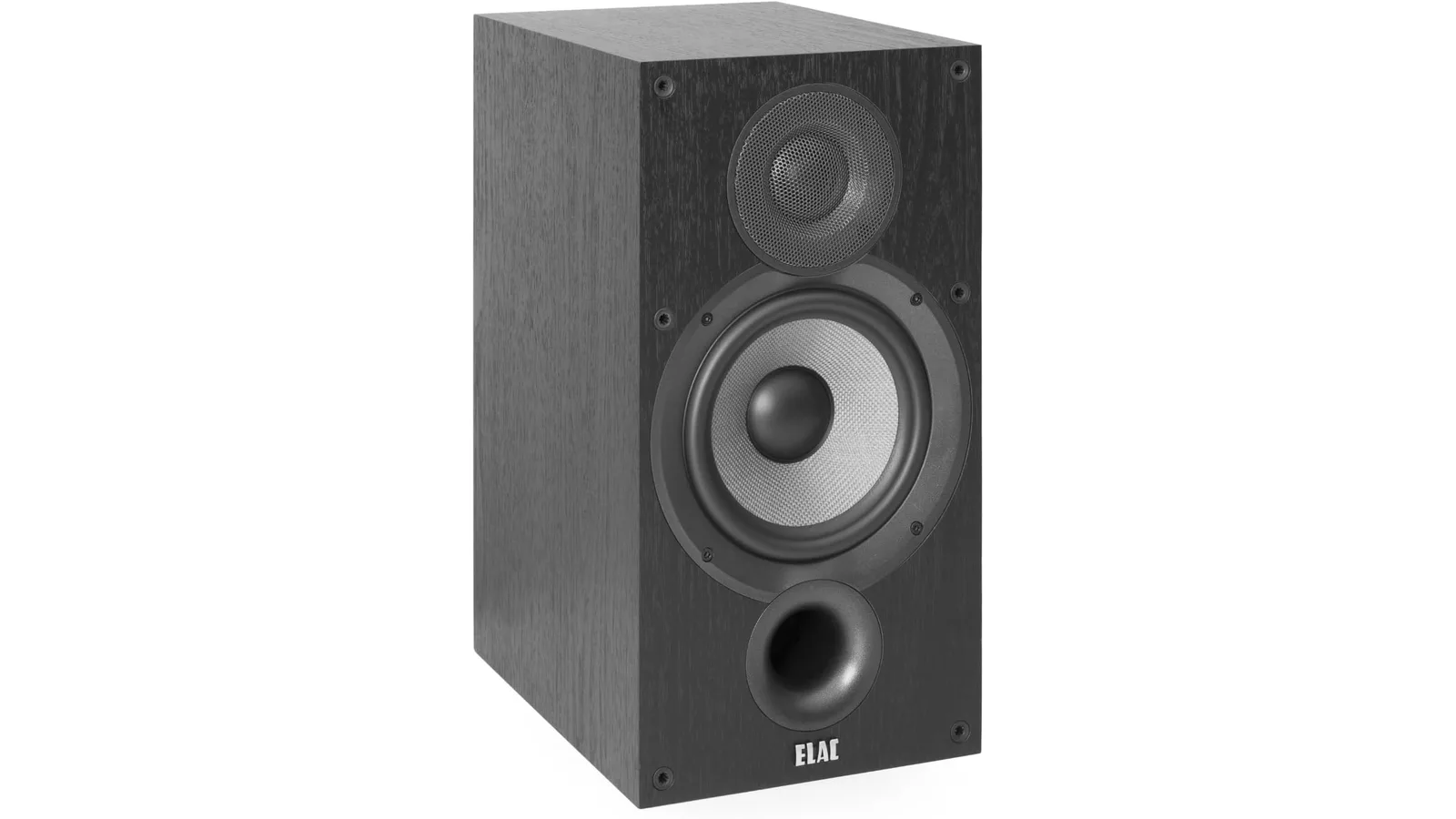
The ELAC Debut 2.0 B6.2 pairs a 1" cloth-dome tweeter and a 6.5" aramid-fiber woofer in a front-ported cabinet designed by Andrew Jones. The right pair under $400 for shelf-friendly home theater and music.
✅ Pros
- +Front-firing port — works on a real bookshelf or near a wall without bass bloat
- +Wide-dispersion waveguide gives every seat in the room a similar tonal balance
- +Smooth, fatigue-free cloth-dome tweeter — never bright on poorly mastered material
- +Aramid-fiber woofer extends cleanly to ~44 Hz and crosses over to a sub at 80 Hz
- +Andrew Jones design pedigree under $400/pair
- +Dual binding posts and bi-amp/bi-wire capability
- +Matching center (C6.2), surrounds (B5.2/B4.2), and sub for a full Debut 2.0 system
- +Lower budget impact than the Klipsch RP-600M II — leaves room for a real sub
❌ Cons
- −Vinyl-wrap finish, not real-wood veneer
- −Black Ash only — no other finishes
- −87 dB sensitivity needs more amplifier power than a horn-loaded equivalent
- −Limited dynamic headroom at high SPL in large rooms
- −Not the right pick if you want a "lit-up" or "exciting" sound — these are deliberately polite
- −Sub is recommended for serious home-theater use
The ELAC Debut 2.0 B6.2 is the bookshelf to buy under $400 if you want a polite, shelf-friendly speaker that sounds good at any volume. Andrew Jones designed the Debut line around a different question than Klipsch did: instead of maximizing efficiency, the B6.2 maximizes smoothness, dispersion, and placement flexibility. A 1-inch cloth-dome tweeter sits on a wide-dispersion waveguide; a 6.5-inch aramid-fiber woofer sits in a front-ported cabinet you can shove against a wall without bass bloat. At ~$379/pair, the B6.2 is the right answer for buyers who already own a midrange AVR like the Denon AVR-X2800H, Marantz Cinema 70s, or Yamaha RX-V6A and want a front stage that works at apartment volume, in a bookshelf, on a credenza, or anywhere a horn-loaded speaker would be too much. It is the deliberate, all-rounder counter-pick to the Klipsch RP-600M II — quieter, smoother, friendlier to placement, less dynamic at high SPL.
Key Specs at a Glance
The B6.2 is a 2-way passive bass-reflex bookshelf. The tweeter is a 1" (25mm) cloth soft-dome on a wide-dispersion waveguide; the woofer is a 6.5" (165mm) aramid-fiber cone in a front-firing bass-reflex enclosure. Crossover sits at 2,200 Hz. Frequency response is 44 Hz – 35 kHz, sensitivity is 87 dB @ 2.83V/1m, power handling is 30W minimum / 120W peak, and nominal impedance is 6 Ω. The cabinet is vinyl-wrapped MDF in Black Ash, with dual gold-plated binding posts for bi-amp or bi-wire. Dimensions are 14" H × 7.9" W × 9.1" D, ~14.3 lb each. Designed by Andrew Jones at ~$379 USD per pair.
What's New vs. the Original Debut 2.0 B6
The B6.2 is the second-generation refresh of the Debut B6 — still the Andrew Jones recipe, with three meaningful changes. The original B6 had a naked 1-inch dome; the B6.2 surrounds it with a deeper, shallower-flared waveguide that broadens horizontal dispersion and slightly tightens vertical dispersion. The practical result is that more than one seat in the room hears the same top end. The aramid woofer recipe is the same — woven aramid fiber, which trades the bright snap of metal cones for lower coloration — but with a refined cone geometry and a stiffer surround for slightly lower distortion at the top of the woofer's range, the 1.5 to 2 kHz band where it hands off to the tweeter. The cabinet adds internal bracing and the front port is tuned slightly higher, so the B6.2 is more tolerant of close-wall placement than the original B6 was.
If you already own the original B6 and you're happy, don't upgrade — the differences are real but evolutionary. If you're buying new, the B6.2 is the version to get and the one ELAC is supporting going forward.
Sound Quality
The B6.2 sounds the way Andrew Jones designs sound: smooth, deliberately uncolored, never bright. The cloth-dome tweeter on the wide-dispersion waveguide is the opposite of the Klipsch RP-600M II horn — instead of focusing high-frequency output forward at the listener, it spreads it more evenly across the room. Cymbals are present and clean but never edgy; sibilants on voices stay smooth; the upper midrange — the 2–4 kHz region where most bright speakers go wrong — is conspicuously polite. If you've ever ended a movie or a long album feeling like your ears were tired, that's the band that did it; the B6.2 doesn't.
The 6.5-inch aramid woofer does most of the speaker's character work. The woven aramid material has a different signature than metal cones: less snap on transients, more body in the lower midrange, slightly warmer through the male vocal range. The front port keeps the low-end output up to ~44 Hz cleanly, and unlike a rear-ported speaker, it doesn't depend on having a foot of breathing room behind it to sound right. Bass guitar lines are tuneful and never bloated; kick drums hit with weight rather than slam.
Imaging is the surprise. Soundstage width is broader than the cabinet size suggests, and the wide dispersion means the imaging holds together even when you're not in the perfect listening seat. This is where Andrew Jones's design philosophy shows — the B6.2 is designed to sound right in a real living room with real furniture and real seating positions, not just on a measurement axis.
Where they're honest about their limits: 87 dB sensitivity is real. The B6.2 needs more amplifier power per equivalent SPL than the 96 dB Klipsch RP-600M II — about 9 dB more, which translates to roughly 8x the amplifier power for the same loudness. A budget 65W AVR like the Yamaha RX-V6A drives them fine for music and TV in a small-to-medium room, but they don't have the dynamic headroom of a horn-loaded speaker at high movie volumes. If you want to feel a Marvel action scene in a large room, this is the wrong speaker; the Klipsch RP-6000F II is the right one.
In a 2.1 / 5.1 System
This is where most B6.2 buyers will end up using them, and where the value of the speaker is highest. As stereo fronts in a 2.1 setup with a sub like the SVS SB-1000 Pro crossed over at 80 Hz, you get a system that does music and dialogue-heavy TV exceptionally well. The B6.2 handles vocals, instrumentation, and effects above 80 Hz without strain; the sub handles the low end and the action-scene LFE. Crossing at 80 Hz also gets the woofer out of the band where it's working hardest, which lets the pair play louder cleanly.
As fronts in a 5.1 system, pair the B6.2 with the matching ELAC Debut 2.0 C6.2 center channel and a pair of the smaller B5.2 or B4.2 as surrounds. ELAC voices the Debut 2.0 line consistently across the family, so multichannel pans across the front stage and into the surrounds without timbre shifts. The full Debut 2.0 5.1 system — B6.2 fronts, C6.2 center, B4.2 surrounds, and a sub — lands well under the price of an equivalent Klipsch Reference Premiere II setup, which makes ELAC the right pick if you're spending more of your budget on the AVR.
As surrounds in a system anchored by the Klipsch RP-6000F II or other horn-loaded fronts, don't use them — the tonal mismatch is too large. Use matching surrounds from the same family as your fronts.
Setup, Placement, and Stands
Front-ported is the killer feature here, and it changes how you place these speakers. Unlike a rear-ported speaker, the B6.2 doesn't need 6+ inches of breathing room behind it. It still sounds best on stands at ear height, but if your only option is a built-in shelf or a credenza behind the TV, the front port lets you do it without bass bloat. This is the single biggest practical reason to choose the B6.2 over the Klipsch RP-600M II.
If you do use stands (and you should if you have the space), 24-to-26-inch stands get the tweeter to ear height when seated. The wide-dispersion waveguide is more forgiving of axis than a horn, but it still images best when the tweeter is roughly level with your ears. Toe-in is optional — the wide-dispersion design means the B6.2 sounds nearly the same on-axis and 15° off-axis. Aim them straight forward or slightly toed in; there's no wrong answer here the way there is with a horn-loaded speaker.
14-gauge speaker wire is plenty. The 6-ohm nominal impedance is well within any modern AVR's tolerance, and the dual binding posts accept banana plugs cleanly. For runs over 25 feet, step up to 12-gauge — see the speaker-wire how-to for the wiring detail.
Limitations Worth Knowing
The black ash finish is a vinyl wrap over MDF. It looks fine from across the room but you can tell up close. The Klipsch RP-600M II at $749/pair has a meaningfully nicer cabinet and finish. The B6.2 puts its budget into the drivers and crossover, not the wrap. There's also only one finish — Black Ash. No walnut, no white, no nothing. If finish matters to your room, this is a real limitation.
87 dB sensitivity is not high. A budget AVR drives them, but you won't have the dynamic headroom you'd get from a horn-loaded speaker. For movies played at reference level in a large room, look elsewhere. The B6.2 is at its best in rooms under 250 sq ft. Larger rooms expose the limited SPL ceiling and demand a floorstander.
Sub is recommended for home-theater use. The lower limit of ~44 Hz means LFE-heavy movie material wants a sub crossed over at 80 Hz. Music in a small-to-medium room works fine without one.
Who Should Buy the ELAC Debut 2.0 B6.2
Buy them if you want a bookshelf speaker you can actually put on a bookshelf — the front-firing port is wall-tolerant in a way that rear-ported designs are not. They're the right choice if you listen at apartment-to-medium volume more than reference-level action movies, you want a smooth, fatigue-free tonal balance you can listen to all day without ear strain, and you already own a midrange AVR like the Denon AVR-X2800H, Marantz Cinema 70s, or Yamaha RX-V6A. The B6.2 also lets you spend the saved budget vs. the Klipsch RP-600M II on a real subwoofer.
Consider the Klipsch RP-600M II instead if you watch movies at high SPL in a large room, you want a dynamic, lit-up sound with horn-loaded presence, you have the floor space for stands at least 6 inches off the back wall, or you prefer real-wood veneer (Ebony or Walnut) finish.
Consider the KEF LSX II LT instead if you don't own an AVR and don't want one, you're building a music-first system rather than a home theater, or you want streaming (AirPlay 2, Spotify Connect, Roon Ready) built into the speakers.
Step up to the Klipsch RP-6000F II floorstanders if your room is over 300 sq ft, you want the front stage to extend lower on its own without a sub, and you have the floor space for floorstanders.
ELAC Debut 2.0 B6.2 vs. Klipsch RP-600M II
These are the two bookshelves to compare at this price tier, and they're deliberately different. The ELAC B6.2 ($379/pair) uses a 1" cloth-dome tweeter on a wide-dispersion waveguide, a 6.5" aramid-fiber woofer, 87 dB sensitivity, a 6 Ω nominal impedance, a front-firing port, and a vinyl Black Ash finish. The Klipsch RP-600M II ($749/pair) uses a 1" Titanium LTS tweeter on a Hybrid Cross-Section Tractrix Horn, a 6.5" Cerametallic copper-spun woofer, 96 dB sensitivity, an 8 Ω impedance, a rear-firing port, and real-wood Ebony or Walnut veneer.
The B6.2 is the smoother, more forgiving, more shelf-friendly choice — best for apartment-to-medium volume, shelf or credenza placement, and music-heavy listening. The RP-600M II is the more dynamic, more exciting choice that needs space and volume — best for movie-heavy systems, larger rooms, and real volume. Pick by use case, not spec.
ELAC Debut 2.0 B6.2 vs. the Smaller B5.2 and B4.2
ELAC ships three sizes in the Debut 2.0 bookshelf line. The B4.2 has a 4-inch woofer and a ~120 Hz lower limit — surround duty only; don't use it as fronts. The B5.2 has a 5.25-inch woofer and a ~46 Hz lower limit — it works as fronts in very small rooms or as surrounds in a 5.1. The B6.2 has a 6.5-inch woofer and a ~44 Hz lower limit — the right front speaker for most rooms.
For a 5.1 system, the right configuration is B6.2 fronts, C6.2 center, B5.2 or B4.2 surrounds. The slight reduction in surround driver size doesn't hurt the system — surround content is mostly atmosphere and effects, not bass.
Bottom Line
The ELAC Debut 2.0 B6.2 is the right pair of bookshelves to buy under $400 if you want a smooth, shelf-friendly, fatigue-free speaker that works at the volume you actually listen at. Andrew Jones designed it to make a different tradeoff than Klipsch did: less dynamic headroom in exchange for broader dispersion, friendlier placement, and a polite tonal balance you can live with all day. The front-firing port lets it sit on a real bookshelf or close to a wall without booming; the wide-dispersion waveguide gives every seat in the room a similar top end; and the aramid woofer extends cleanly to where a sub takes over at 80 Hz.
If you watch movies at reference level in a large room, buy the Klipsch RP-600M II instead — its 96 dB sensitivity and horn-loaded dynamics are built for that job. If you don't own an AVR and don't want one, buy the KEF LSX II LT. For everyone else — apartment dwellers, small-to-medium living rooms, music-first listeners, and home-theater buyers who'd rather spend the saved money on a real subwoofer — the B6.2 is the obvious choice.
The ELAC Debut 2.0 B6.2 is available on Amazon at ~$379/pair in Black Ash.
Our Verdict
The ELAC Debut 2.0 B6.2 pairs a 1" cloth-dome tweeter and a 6.5" aramid-fiber woofer in a front-ported cabinet designed by Andrew Jones. The right pair under $400 for shelf-friendly home theater and music.
Ready to buy the ELAC Debut 2.0 B6.2?
Buy on Amazon →Affiliate link — we may earn a commission at no extra cost to you.