Speaker Placement 101: The Listening Triangle, Toe-In, and Distance From Walls
Published 2026-09-26 · By NetAudioHub Editorial
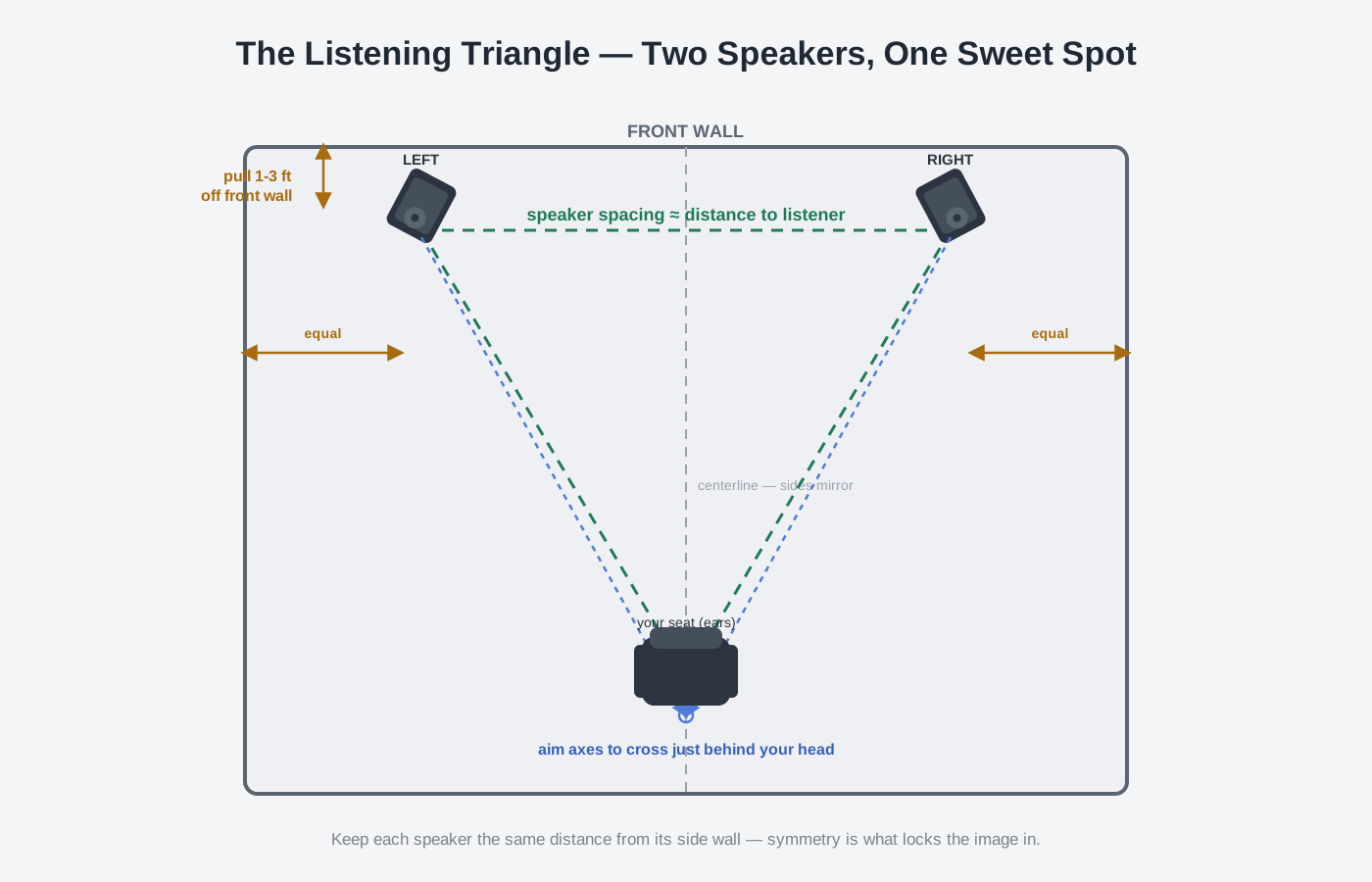
You can spend a fortune on speakers and give most of it back by putting them in the wrong place. Where a speaker sits in the room changes its tonal balance, its bass, and whether the sound snaps into a believable image between the two boxes or just smears across the wall — and none of that costs a dollar to fix. This is the plain-English version of speaker placement: build an equilateral triangle with your ears, aim the speakers with the right amount of toe-in, pull them off the walls to tame boom and sharpen depth, get the tweeters to ear height, and above all keep the left and right sides symmetric. Do those five things and cheap speakers will outperform expensive ones set up carelessly.
The verdict up front: speaker placement is the single highest-value tweak in audio, it is completely free, and almost everyone gets it wrong by shoving the boxes wherever the furniture allows. Five things decide whether your system images like a hologram or a mush. One, form an equilateral triangle: the two speakers should be about as far apart as they are from your listening seat. Two, dial in toe-in — angle them inward so their axes cross at or just behind your head, trading soundstage width for a sharper center image until it sounds right. Three, pull them off the walls — a foot or more from the wall behind them and away from corners — to tame boomy bass and open up depth. Four, get the tweeters to seated ear height. Five, and most important, keep the left and right sides symmetric — equal distances to the side walls and to you — because your ears read imaging from tiny timing differences, and asymmetry destroys it. Nail those and a modest pair of speakers will embarrass an expensive pair dumped carelessly in the corners. Here's how to do each one.
Why Placement Beats Gear
A speaker doesn't make sound in a vacuum — it makes sound in your room, and the room is part of the instrument. Move a speaker two feet and you change three things at once: how much the nearby walls reinforce its bass, how strong the early reflections are that arrive at your ears right after the direct sound, and how the left and right speakers combine into a stereo image. Those effects are large. The difference between a speaker in a corner and the same speaker pulled into the room can be a 6-10 dB bass swing and the difference between a vague wall of sound and voices that appear to float in a precise spot between the boxes.
That's why placement is the first thing to fix and the last thing people think about. It costs nothing, it's reversible, and it routinely outperforms a gear upgrade. Before you spend on anything, spend an afternoon moving what you already own.
Rule One: The Equilateral Triangle
Stereo works by presenting slightly different sound to your two ears and letting your brain reconstruct a soundstage. The layout that makes this snap into focus is an equilateral triangle: the distance between the left and right speakers should be roughly equal to the distance from each speaker to your ears.
- Speakers 6 feet apart → sit about 6 feet back.
- Speakers 8 feet apart → sit about 8 feet back.
You have some latitude — anywhere from a true equilateral to a slightly stretched isosceles triangle works — but two failure modes are common and worth naming:
- Speakers too far apart relative to your distance: the center image collapses into a "hole in the middle," where vocals seem to come from two places instead of one point.
- Speakers too close together: the soundstage shrinks to a narrow band and loses its sense of width.
Start at a true equilateral, then widen the speakers a little at a time until the soundstage is as broad as it can be without the center pulling apart. That balance point is your spot.
Rule Two: Toe-In (Aiming the Speakers)
Toe-in is how far you angle the speakers inward toward the listener rather than firing them straight down the room. It's the single most powerful tone and imaging control you have, and it costs nothing to experiment with.
Think of it as a slider between two extremes:
- More toe-in (axes crossing right at your head): tightest, most focused center image; more direct treble; less energy bouncing off the side walls. Great for pinpoint imaging and rooms with reflective side walls, but the "sweet spot" gets narrow — move off-center and the balance shifts.
- Less toe-in / firing straight ahead: wider, more enveloping soundstage and a bigger sweet spot, at the cost of a slightly softer, less precise center and more side-wall reflection.
A reliable starting point most speakers like: aim them so their axes cross just behind your head, maybe a foot past your ears. From there, toe in more if the center sounds vague or the treble sounds dull; toe out if the sound is too "in your face," fatiguing, or the stage feels cramped. Every speaker is voiced differently — some are designed to be listened to on-axis, others slightly off — so trust your ears over any single rule.
Rule Three: Distance From the Walls
Every boundary near a speaker reinforces its bass. Push a speaker against the wall behind it and into a corner, and it gets two or three surfaces all boosting the low end — which sounds impressive for about a minute and then reveals itself as one-note boom that drowns detail. Pulling speakers away from boundaries fixes this and, as a bonus, opens up the front-to-back depth of the soundstage.
Rules of thumb for the wall behind the speakers (the front wall):
- Get the front baffle at least 1 to 3 feet off the wall if the room allows.
- Ported (bass-reflex) speakers are especially sensitive because the port fires out low bass; keep the port a few inches clear of any wall. Sealed speakers are more forgiving and can live closer.
- Avoid corners for the mains — corner loading is the boom trap. (Corners are great for subwoofers, which is a different job — see where to place a subwoofer.)
And for the side walls: keep some space there too, and — critically — keep it equal on both sides. A strong early reflection off a nearby side wall smears imaging; a foot or two of clearance plus a soft furnishing (bookshelf, drapes, absorption panel) at the first-reflection point cleans it up. If your speakers must go close to the front wall out of necessity, toe them in a bit more and lean toward sealed designs to control the bass.
There's also a listener-position trick worth knowing: bass response is worst standing right against the back wall and in the exact center or corners of the room. Sitting somewhere around 38% of the way into the room's length tends to sidestep the worst bass peaks and nulls. If your couch is jammed against the back wall, pulling it forward even a foot often smooths the bass more than any gear change.
Rule Four: Ear Height and Tweeter Alignment
Treble is directional — it beams. If the tweeter isn't roughly level with your ears, you're listening off-axis and losing the top end and some of the imaging precision the speaker is capable of.
- Aim to get the tweeter at seated ear height, which for most people in a normal chair is about 36-40 inches off the floor.
- Bookshelf speakers almost always need stands to reach that height — sitting them on a low console or the floor points the tweeters at your shins. Proper stands are one of the best-value purchases in all of audio: speaker stands put the drivers where your ears are and kill the resonance you get from a hollow shelf or cabinet.
- Floorstanders are usually designed with the tweeter near ear height already, but if a speaker is voiced to be heard slightly off its main axis, a small backward tilt can help. When in doubt, sit down and put your ear at tweeter level, then adjust.
If you're deciding between bookshelf and floorstanding in the first place — and whether stands change that math — our bookshelf vs floorstanding breakdown covers the trade-offs.
Rule Five: Symmetry (The One People Skip)
This is the rule that separates decent setups from great ones, and it's the one real rooms fight hardest. Your brain locates sound using differences between your two ears measured in fractions of a millisecond. If the left speaker is 3 feet from its side wall and the right speaker is 6 inches from a bookcase, the two channels reach you differently and the stereo image pulls toward one side, blurs, and never quite locks in — no matter how good the speakers are.
So, as much as your room allows:
- Keep each speaker the same distance from its nearest side wall.
- Keep each speaker the same distance from your ears.
- Keep the objects around each speaker roughly matched — don't put one speaker in the open and the other in an alcove or next to a big cabinet.
- Sit on the centerline between the two speakers, not off to one side of the couch.
You will rarely get perfect symmetry. But every step toward it is audible, and it's free. If one side has a hard wall and the other a doorway, a rug, a curtain, or an absorption panel on the reflective side helps rebalance the two.
Where the Center and Surrounds Go
Everything above is about the front left and right speakers, which do the heavy lifting for both music and movies. For a full surround system, a few placement notes carry over:
- Center channel: keep it as close to ear height as possible, directly under or above the screen, and don't bury it in a cabinet that muffles dialogue. (Whether you even need one is its own question — see do you need a center channel speaker.)
- Surrounds: aim for symmetry again — same height and roughly the same distance on each side.
- Subwoofer: placement follows completely different rules than the mains, because bass is non-directional and dominated by room modes. Corners maximize output; the "subwoofer crawl" finds the smoothest spot. Details in where to place a subwoofer.
For the full channel-by-channel layout and angles, our 5.1 surround setup guide walks through the whole room.
A Quick Placement Cheat Sheet
| Parameter | Starting target | Why it matters |
|---|---|---|
| Speaker spacing | ≈ distance to your ears (equilateral) | Locks the center image without a "hole in the middle" |
| Toe-in | Axes cross just behind your head | Trades soundstage width for center focus; tames side reflections |
| Distance from front wall | 1-3 ft (more for ported) | Controls boomy bass; opens front-to-back depth |
| Distance from corners | As far as practical | Corners are the boom trap for mains |
| Side-wall distance | Some clearance, equal both sides | Cuts smeary early reflections; preserves imaging |
| Tweeter height | Seated ear height (~36-40 in) | Treble beams — off-axis = dull, vague top end |
| Listener position | ~38% into room length, on centerline | Sidesteps the worst bass peaks and nulls |
| Symmetry | Match left and right sides | Your ears read imaging from tiny timing differences |
After You've Moved Them: The Cheap Upgrades
Once positions are dialed, a few inexpensive things lock in the gains:
- Stands for bookshelf speakers, filled with sand or shot to deaden them, so the tweeters hit ear height and the cabinet isn't singing along with the music.
- Isolation between the speaker and whatever it sits on. A vibrating box couples its energy into a hollow stand or shelf and muddies the sound; a set of speaker isolation pads or spikes decouples it for a few dollars.
- A soft object at the first side-wall reflection — a bookcase, drapes, or a panel — on each side, symmetrically.
- Room correction as the final polish, after physical placement is right. Software like Audyssey, Dirac, or YPAO can flatten what the room does to bass and correct small channel imbalances, but it works best when it's cleaning up a good setup rather than rescuing a bad one — see Audyssey vs Dirac vs YPAO. Placement first, DSP second; never the other way around.
If boomy bass persists after you've pulled the speakers out and it's clearly a low-frequency problem, that's a room-mode and crossover issue — our subwoofer crossover 80 Hz explainer covers handing the low bass off to a sub so your mains can breathe.
The Compromises Real Rooms Force
Very few of us have a dedicated room where the speakers can go exactly where physics wants them. The TV is on one wall, the couch is where the couch fits, and one side of the room opens into the kitchen. That's fine — placement is about getting closer to ideal, not achieving perfection.
When you have to compromise, protect the rules in this order: symmetry first (it's the most audible and often the cheapest to fix), then toe-in (free, instant), then distance from the front wall (pull out what you can), then ear-height (stands or tilt), then spacing. A slightly-too-wide triangle in a symmetric room beats a perfect triangle where one speaker is crammed next to a fireplace. Move what you can move, treat what you can't, and let your ears — sitting in your actual seat — make the final call.
The Bottom Line
The best upgrade in audio is the one you already own, sitting in the wrong place. Build an equilateral triangle so the soundstage snaps into focus, aim the speakers with enough toe-in to sharpen the center without shrinking the stage, pull them off the walls and out of the corners to kill boom and reveal depth, raise the tweeters to your ears, and above all keep the two sides symmetric so imaging can lock in. None of it costs a dollar, all of it is reversible, and together it does more than most equipment upgrades. Spend the afternoon moving your speakers before you spend anything else — then, and only then, reach for stands, isolation, and room correction to finish the job.
Affiliate disclosure: NetAudioHub links to retailers including Amazon. We earn a small commission on qualifying purchases at no extra cost to you.