TP-Link Omada SG3210XHP-M2 Review: The 2.5G PoE+ Switch That Powers a Whole Home Lab
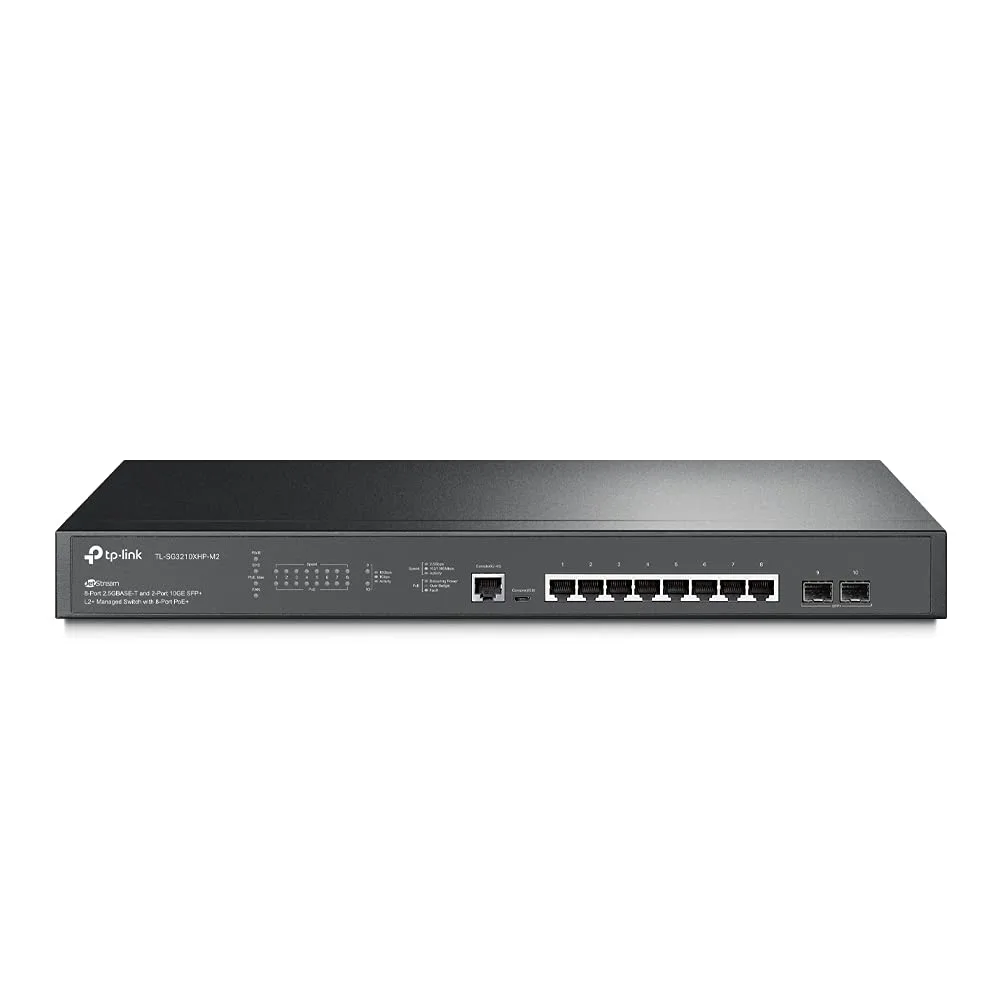
The TP-Link Omada SG3210XHP-M2 is an 8-port 2.5G PoE+ managed switch with 240W of PoE, two 10G SFP+ uplinks, and Omada SDN — for around $400. Here's the honest breakdown of who it's for.
✅ Pros
- +Eight full 2.5G ports, all PoE+, with a 240W budget that supports 30W on every port at once
- +Two 10G SFP+ uplinks keep the switch from becoming the bottleneck
- +Real L2+ management: VLANs, ACLs, QoS, static routing, ERPS, 802.1X
- +Omada SDN integration with a free self-hosted controller — no mandatory subscription
- +Excellent value versus enterprise-branded 2.5G PoE switches
- +5-year warranty and a genuinely non-blocking 80 Gbps / 59.52 Mpps fabric
❌ Cons
- −Fans — audible; needs a closet, rack, or out-of-the-way spot
- −PoE is 802.3at (30W max), not 802.3bt PoE++ — can't power the hungriest cameras/APs
- −10G transceivers/DAC not included — budget extra for the SFP+ uplinks
- −Omada's full value assumes you buy into the wider Omada ecosystem
- −Overkill (and over-featured) for a simple, no-PoE home setup
The TP-Link Omada SG3210XHP-M2 is the best-value 2.5G PoE+ switch for a serious home network or small office. For roughly $400 you get eight full 2.5-gigabit ports that can each deliver PoE+ power, two 10G SFP+ uplinks to a NAS or backbone, and genuine L2+ management through TP-Link's Omada platform. It's the switch you buy when you've got a handful of access points, a couple of PoE cameras, and a multi-gig NAS, and you're tired of your unmanaged gigabit box being the bottleneck. The two things to know before you click buy: it has fans (it belongs in a closet or rack, not on your desk), and its PoE tops out at 30W per port — plenty for most gear, short of the very hungriest.
The TP-Link Omada SG3210XHP-M2 is available on Amazon.
Key Specs at a Glance
The SG3210XHP-M2 is an L2+ managed switch with eight 2.5GBASE-T ports that all support PoE+, plus two 10G SFP+ uplink slots (transceivers or DAC cables not included). Its PoE runs the 802.3af/802.3at standards with a 240W total budget and up to 30W per port. The switching fabric is rated at 80 Gbps with a 59.52 Mpps forwarding rate, a 16K MAC address table, and a 12 Mbit packet buffer. Management features include up to 4K 802.1Q VLANs, static routing and DHCP relay, ACLs, 802.1X, QoS with eight priority queues, and ERPS ring protection — exposed through Omada SDN, a web GUI, CLI, or SNMP v1/v2c/v3. It's an actively cooled (two-fan) 1U rack-mountable chassis measuring 17.3 × 7.1 × 1.7 inches, drawing up to about 284W at full PoE load, backed by a 5-year TP-Link US warranty, at around $400 street.
What It Is: 2.5G and PoE, Finally in One Box
For years the frustrating gap in home networking was that you could get a cheap 2.5G switch or a cheap PoE switch, but combining both — multi-gig speed and power over the same cable — meant jumping to enterprise pricing. The SG3210XHP-M2 is the switch that closes that gap at a sane price.
Every one of its eight RJ45 ports runs at 2.5 Gbps and every one of them supplies PoE+ power. That matters because the two upgrades tend to arrive together: the same Wi-Fi 6, 6E, and Wi-Fi 7 access points that finally justify a 2.5G uplink are also the devices you want to power over Ethernet so you can mount them on a ceiling with a single cable. This switch does both jobs on all eight ports at once.
On top of that you get two 10G SFP+ slots. These are your uplinks — a fiber or DAC run to a 10G NAS, a core switch, or a router with a 10G port — so the switch itself never becomes the chokepoint when several 2.5G clients pull data at the same time. One honest note: SFP+ transceivers or DAC cables are not included, so budget another $20–$40 for those if you plan to use the 10G ports.
PoE: 240 Watts, and the 30W Ceiling That Matters
The PoE budget is where this switch earns its keep. It supplies 240W total, and with a 30W-per-port maximum across eight ports, the math works out perfectly: 8 × 30W = 240W. In practice that means you can run every port at full PoE+ power simultaneously without the switch throttling anything — there's no oversubscription trap where plugging in the seventh device suddenly starves the others.
That's enough to power a realistic home fleet: a stack of ceiling access points, several PoE cameras, a VoIP phone or two, maybe a PoE-powered mini PC or IoT hub. A Ubiquiti UniFi U6 Pro draws well under the limit, and most Wi-Fi 7 APs that accept PoE+ are comfortable here too.
Now the caveat, stated plainly: 30W per port is 802.3at (PoE+), not 802.3bt (PoE++). The newest generation of power-hungry hardware — some pan-tilt-zoom cameras, a handful of flagship Wi-Fi 7 access points, and outdoor gear with heaters — wants 60W or even 90W and expects PoE++. This switch cannot feed those; something like the UniFi U7 Pro Max or other 802.3bt-class devices will need an injector or a PoE++ switch. Check the wattage sticker on your hungriest device before you buy. For the overwhelming majority of home PoE gear, 30W is plenty; for a specific few devices, it's a hard stop.
Management: Omada Without the Subscription Tax
This is a genuinely managed switch, not a "smart" box with a stripped-down web page. You get VLANs (up to 4K), ACLs, QoS with eight priority queues, static routing and DHCP relay (the "L2+" part), 802.1X, link aggregation, and ERPS ring protection for redundant topologies. The 16K MAC table and 12 Mbit buffer are sized for a busy network, and the 80 Gbps switching capacity with a 59.52 Mpps forwarding rate means it's genuinely non-blocking for its port count.
The headline feature for most buyers is Omada SDN. If you already run TP-Link's Omada ecosystem — access points, a gateway, an Omada controller — this switch drops into the same single-pane dashboard and app, and you manage the whole network from one place. Crucially, local Omada controller software is free (self-hosted on a PC, Docker, or a hardware controller), so unlike some competitors, the core management doesn't sit behind an ongoing subscription. There is an optional paid cloud-hosted controller service if you want TP-Link to run it for you, but you don't need it.
If you don't run Omada, that's fine too — the switch works as a standalone managed unit via its own web GUI, CLI, or SNMP. You lose the single-dashboard convenience but keep every switching feature.
The Catch: This Thing Has Fans
The most important non-spec fact about the SG3210XHP-M2: it is not silent. Pushing 240W of PoE generates heat, and TP-Link cools it with two active fans. Reviewers and owners consistently describe it as audible — fine tucked into a closet, a rack, or a basement, but not something you want humming on the desk next to you in a quiet room.
This is the natural trade-off for a high-PoE switch in a compact 1U chassis, and it's shared by essentially every switch in this class. But it does mean the buying decision has a placement requirement attached: have somewhere to put it where fan noise won't bother you. If your networking gear lives in your office and silence is non-negotiable, a fanless 2.5G switch without PoE (and separate PoE injectors) may suit you better — you'll just give up the all-in-one convenience.
The chassis itself is a standard 1U rack-mount unit (17.3 × 7.1 × 1.7 inches) with mounting ears in the box, and it sits flat on a shelf just as happily as it racks.
Who Should Buy the SG3210XHP-M2
Buy it if you're building or upgrading a network with multiple PoE access points and/or cameras and want to power and connect them from one box; if you've moved to 2.5G clients (Wi-Fi 6/6E/7 APs, a multi-gig NAS, a modern desktop) and gigabit is now your bottleneck; if you want 10G uplinks to a NAS or core switch so the switch never becomes the chokepoint; if you run — or plan to run — TP-Link Omada and want one dashboard for the whole network; and if you have a closet, rack, or basement to put it in.
Skip it if you need PoE++ (802.3bt) for 60W/90W devices, since this tops out at 30W per port; if you need a silent, fanless switch for a living space or quiet office; if you only need a couple of multi-gig ports and no PoE, in which case the fanless, cheaper TP-Link TL-SG108-M2 is the smarter, quieter buy; or if you want a plug-and-play unmanaged switch and will never touch a VLAN, because then you're paying for management you won't use.
SG3210XHP-M2 vs. TL-SG108-M2 vs. UniFi Pro Switches
Compared with its stablemate the TP-Link TL-SG108-M2, the SG3210XHP-M2 adds exactly what that switch deliberately leaves out. All eight of its 2.5G ports carry PoE+, where the SG108-M2 has none; it adds two 10G SFP+ uplinks, where the SG108-M2 has none; and it brings a 240W PoE budget with full Omada L2+ management, where the SG108-M2 is unmanaged. The trade-offs are fans (the SG108-M2 is fanless and silent) and a higher price — roughly $400 versus about $130. A UniFi Pro-class 2.5G PoE switch sits above both: it usually offers many PoE ports, SFP+ uplinks, a higher PoE budget (802.3bt on some models), and UniFi Controller management, but typically at a meaningfully higher price and often with fans of its own.
The read: the TL-SG108-M2 is the quiet, cheap pick when you just need multi-gig ports and no PoE. The SG3210XHP-M2 is the step up when you need to power your gear and manage it — and it does so for meaningfully less than the enterprise brands charge for an equivalent 2.5G PoE+ managed switch. If you're already deep in the UniFi world, a matching UniFi switch keeps everything in one controller, usually at a higher price.
Bottom Line
The TP-Link Omada SG3210XHP-M2 is the switch that finally makes a proper multi-gig, PoE-powered home network affordable. Eight 2.5G PoE+ ports with a full 240W budget, two 10G uplinks, and real L2+ management for around $400 is a combination the enterprise brands still charge a premium for. For anyone running a fleet of access points, PoE cameras, and a multi-gig NAS, it's the obvious backbone.
Just go in with two facts in hand. It has fans, so give it a home in a closet or rack. And its PoE stops at 30W per port — more than enough for the vast majority of devices, but short of the 802.3bt PoE++ that a specific few flagship APs and cameras demand. Match those two constraints to your setup and this is an easy recommendation.
Our Verdict
The TP-Link Omada SG3210XHP-M2 is an 8-port 2.5G PoE+ managed switch with 240W of PoE, two 10G SFP+ uplinks, and Omada SDN — for around $400. Here's the honest breakdown of who it's for.
Ready to buy the TP-Link Omada SG3210XHP-M2?
Buy on Amazon →Affiliate link — we may earn a commission at no extra cost to you.