GL.iNet Flint 3 (GL-BE9300) Review: The Value Wi-Fi 7 Router for Tinkerers
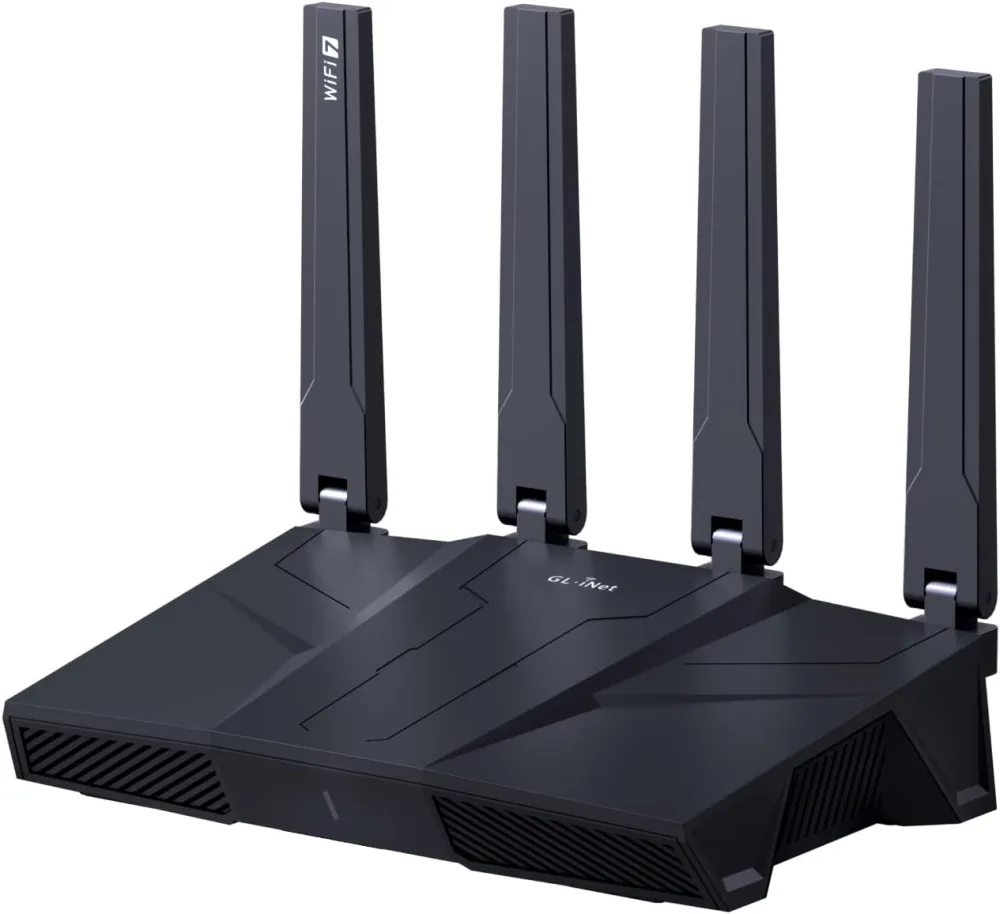
The GL.iNet Flint 3 (GL-BE9300) is a tri-band Wi-Fi 7 router with five 2.5GbE ports, OpenWRT firmware, and built-in WireGuard — a ~$210 value pick for VPN and privacy-focused homes.
✅ Pros
- +True tri-band Wi-Fi 7 (2.4 + 5 + 6 GHz) with MLO at a value price
- +Five 2.5GbE ports — every wired port is multi-gig
- +OpenWRT-based firmware with full LuCI access for serious control
- +Built-in WireGuard/OpenVPN, 30+ provider profiles, network-wide policy routing
- +AdGuard Home ad/tracker blocking built in, no subscriptions
- +1 GB RAM / 8 GB storage and a quad-core SoC keep it responsive under load
- +USB 3.0 port for storage or a cellular modem
❌ Cons
- −No 10G port — wired backbone caps at 2.5 Gbps per link
- −WireGuard throughput (~680 Mbps) is lower than the older Flint 2
- −Classic (non-DCO) OpenVPN is slow (~140 Mbps)
- −Firmware updates are largely manual, not automatic
- −Feature depth is overkill for anyone who wants simple set-and-forget
- −Internal fan can be audible under sustained heavy load
Verdict: The Flint 3 is the value Wi-Fi 7 router for people who want control. For around $210 it gives you tri-band 802.11be with MLO, five 2.5GbE ports, and OpenWRT-based firmware with built-in WireGuard and OpenVPN — a combination that costs a lot more from the big-name brands, if you can get it at all. It's not the fastest VPN router GL.iNet makes, and it has no 10G port, but for privacy-focused, tinker-friendly homes it's the most capable router you can buy at the price.
Check the current price on Amazon →
Key Specs at a Glance
| Spec | Detail |
|---|---|
| Wi-Fi Standard | Wi-Fi 7 (802.11be) |
| Class | BE9300 (tri-band) |
| Bands | 2.4 GHz (688 Mbps) + 5 GHz (2882 Mbps) + 6 GHz (5765 Mbps) |
| Wi-Fi 7 Features | MLO (Multi-Link Operation), 4K-QAM, 6 GHz band |
| Ethernet | 5× 2.5GbE (1× WAN, 4× LAN) — every port is 2.5G |
| 10G Ports | None |
| USB | 1× USB 3.0 Type-A |
| SoC | Qualcomm quad-core @ 1.5 GHz |
| RAM / Storage | 1 GB DDR4 / 8 GB eMMC |
| Firmware | OpenWRT-based (GL.iNet UI + LuCI) |
| VPN | WireGuard & OpenVPN (client + server), 30+ VPN providers |
| Cooling | Internal fan |
| Power | <25 W (12V/4A) |
| Dimensions / Weight | 240 × 157 × 74 mm / 848 g |
| Price | ~$190–$219 street (MSRP $209.99) |
What the Flint 3 Is For
Most routers in this price range make you pick one thing: fast Wi-Fi, or an open platform, or good VPN, or lots of ports. The Flint 3's pitch is that you don't have to choose. It's a genuine tri-band Wi-Fi 7 router and an OpenWRT box and a VPN appliance and a five-port 2.5G switch, in one $210 chassis.
That combination is what makes GL.iNet routers a cult favorite. The Flint 3 runs OpenWRT under the hood, so you get an approachable GL.iNet admin UI for everyday use and the full LuCI interface underneath when you want to go deep — VLANs, custom firewall rules, ad-blocking, scripting, the works. Compare that to the locked-down apps on most consumer routers (or the paywalled features on an Eero) and it's a different philosophy entirely.
If you want a router you configure once and forget, this is more surface than you need — buy something simpler. If you like knowing exactly what your network is doing and being able to change any of it, this is the router.
The Ports: Five 2.5G, No 10G
Every wired port on the Flint 3 is 2.5GbE — one WAN and four LAN. That's the headline for wired setups and it's genuinely generous: most routers near this price give you one or two 2.5G ports and pad the rest out with old gigabit. Here, a 2.5G ISP handoff, a 2.5G NAS, a 2.5G desktop, and a 2.5G switch uplink all get full-speed ports with room to spare.
The trade-off is the ceiling: there is no 10G port. If you have 5-gig or 10-gig fiber, or you move large files between 10G-connected machines, the Flint 3 caps your wired backbone at 2.5 Gbps per link. For that you'd want a router with a 10G port — the ASUS RT-BE88U is the obvious step up, with dual 10G plus quad 2.5G.
For the far more common case — gigabit or 2.5-gig internet and a mostly-2.5G LAN — five 2.5G ports is exactly right, and you're not paying the 10G tax.
There's also a single USB 3.0 Type-A port for a shared drive or a cellular modem, which OpenWRT handles well.
Wi-Fi 7 Performance
The Flint 3 is a true tri-band BE9300 router: 688 Mbps on 2.4 GHz, 2882 Mbps on 5 GHz, and 5765 Mbps on 6 GHz, for roughly 9.3 Gbps of aggregate radio capacity. Unlike dual-band Wi-Fi 7 routers that drop the 6 GHz band, the Flint 3 keeps it — so 6 GHz-capable clients get the clean, low-congestion spectrum and wide channels that are the best part of Wi-Fi 7.
MLO (Multi-Link Operation) is supported, letting compatible Wi-Fi 7 clients bond bands for lower latency and steadier throughput. In practice, a nearby 6 GHz client easily saturates a gigabit or 2-gig internet plan, and the 5 GHz band delivers strong whole-home coverage GL.iNet rates at roughly 2,000 sq ft and well over 100 connected devices.
The Qualcomm quad-core SoC is tuned for Wi-Fi throughput and port density rather than raw single-thread grunt, and it shows: wireless performance is competitive with pricier tri-band routers, and the router stays composed under a full house of devices. An internal fan keeps it cool under sustained load — worth knowing if you're sensitive to fan noise in a bedroom or office, though it's generally quiet.
VPN: Strong, But Read the Fine Print
VPN is the reason a lot of people buy GL.iNet, so this deserves a clear-eyed look.
- WireGuard: GL.iNet rates the Flint 3 at up to ~680 Mbps on WireGuard, and independent testing lands close to that. That's fast enough to run your entire network through a VPN and still outrun most home internet plans.
- OpenVPN: With OpenVPN-DCO acceleration, throughput is in the same neighborhood. But if your provider or setup relies on classic OpenVPN, plan for closer to ~140 Mbps — a big gap worth knowing before you buy.
- Convenience: The firmware supports client and server modes for both protocols and has built-in profiles for 30+ commercial VPN providers, so pointing your whole network at NordVPN, Mullvad, Proton, etc. is a few clicks.
The honest caveat: if peak WireGuard speed is your only reason to buy, the Flint 3 is not the fastest option in GL.iNet's own lineup. The older Flint 2 (GL-MT6000) actually posts higher WireGuard numbers (~850 Mbps), and the Brume 3 gateway is faster still. The Flint 3's SoC prioritizes Wi-Fi 7 and five 2.5G ports over VPN silicon. For nearly everyone, ~680 Mbps of whole-network WireGuard is far more than enough — just don't buy it expecting it to beat the Flint 2 at VPN.
Setup and Software
Setup is quick through the GL.iNet mobile app or the web admin panel. The everyday UI is clean and beginner-friendly — SSIDs, guest network, VPN toggles, parental controls, and ad-blocking are all front and center.
The depth is what sets it apart:
- OpenWRT + LuCI: the full open-source stack is one click away for VLANs, custom firewall/NAT rules, static routes, and packages from the OpenWRT repo.
- AdGuard Home is built in for network-wide ad and tracker blocking without a separate Pi-hole box (though you can still run Pi-hole if you prefer).
- Network-wide VPN policy routing lets you send specific devices or domains through the VPN and everything else direct.
- No subscriptions: every feature is included. There's no paywalled security tier.
The one rough edge is updates: GL.iNet firmware updates tend to be manual rather than silent-automatic, so you'll want to check for new builds periodically. For a router this configurable, that's a fair trade — but it's the opposite of the set-and-forget experience of a mesh app.
Who Should Buy the Flint 3
Buy it if:
- You want real tri-band Wi-Fi 7 (with 6 GHz and MLO) without paying flagship prices.
- You value control — OpenWRT, LuCI, VLANs, custom firewall rules — over a locked-down app.
- You want whole-network WireGuard/OpenVPN and built-in ad-blocking with no subscription.
- Your LAN is 2.5G-based and gigabit-to-2.5-gig internet fits your plan.
Skip it if:
- You have 5-gig or 10-gig internet or a 10G LAN — you need a 10G port; look at the ASUS RT-BE88U.
- Peak WireGuard speed is your single priority — the Flint 2 (GL-MT6000) is faster at VPN for less money.
- You have a large multi-story home where coverage matters more than features — a Wi-Fi 7 mesh will serve you better than any single router.
- You want a router you never think about — the depth here is wasted on set-and-forget users.
Pros and Cons
Pros
- True tri-band Wi-Fi 7 (2.4 + 5 + 6 GHz) with MLO at a value price
- Five 2.5GbE ports — every wired port is multi-gig
- OpenWRT-based firmware with full LuCI access for serious control
- Built-in WireGuard/OpenVPN, 30+ provider profiles, network-wide policy routing
- AdGuard Home ad/tracker blocking built in, no subscriptions
- 1 GB RAM / 8 GB storage and a quad-core SoC keep it responsive under load
- USB 3.0 port for storage or a cellular modem
Cons
- No 10G port — wired backbone caps at 2.5 Gbps per link
- WireGuard throughput (~680 Mbps) is lower than the older Flint 2
- Classic (non-DCO) OpenVPN is slow (~140 Mbps)
- Firmware updates are largely manual, not automatic
- Feature depth is overkill for anyone who wants simple set-and-forget
- Internal fan can be audible under sustained heavy load
Flint 3 vs. Flint 2 vs. Mainstream Wi-Fi 7
| GL.iNet Flint 3 (BE9300) | GL.iNet Flint 2 (MT6000) | Typical Big-Brand Wi-Fi 7 | |
|---|---|---|---|
| Wi-Fi | Tri-band Wi-Fi 7 (6 GHz) | Dual-band Wi-Fi 6 | Tri-band Wi-Fi 7 |
| 2.5G Ports | 5 | 2 | 2–4 |
| 10G Port | No | No | Sometimes 1 |
| Firmware | OpenWRT + LuCI | OpenWRT + LuCI | Vendor app (locked) |
| WireGuard | ~680 Mbps | ~850 Mbps | Varies, often slower |
| Price | ~$210 | ~$130–160 | $250–$400+ |
The read: get the Flint 3 for Wi-Fi 7, 6 GHz, and more 2.5G ports; get the Flint 2 if you're on Wi-Fi 6 and want the fastest cheap WireGuard; skip the big brands unless you specifically need 10G or their ecosystem.
Bottom Line
The GL.iNet Flint 3 is what happens when a router is designed for people who actually run their network instead of just using it. Tri-band Wi-Fi 7 with 6 GHz and MLO, five 2.5GbE ports, OpenWRT with full LuCI, and whole-network VPN — all for around $210 — is a stack of capabilities the mainstream brands charge far more for and lock down anyway.
Go in knowing the two real limits: there's no 10G port, and its WireGuard speed trails the cheaper Flint 2. Neither matters for the target buyer — a privacy-minded, control-hungry home on gigabit-to-2.5-gig internet. For that person, this is the best value Wi-Fi 7 router on the market.
Rating: 4.4 / 5
Our Verdict
The GL.iNet Flint 3 (GL-BE9300) is a tri-band Wi-Fi 7 router with five 2.5GbE ports, OpenWRT firmware, and built-in WireGuard — a ~$210 value pick for VPN and privacy-focused homes.
Ready to buy the GL.iNet Flint 3 (GL-BE9300)?
Buy on Amazon →Affiliate link — we may earn a commission at no extra cost to you.