The FCC Router Ban Is in Effect: What to Buy in May 2026 (and What to Avoid)
Published 2026-05-01 · By NetAudioHub Editorial
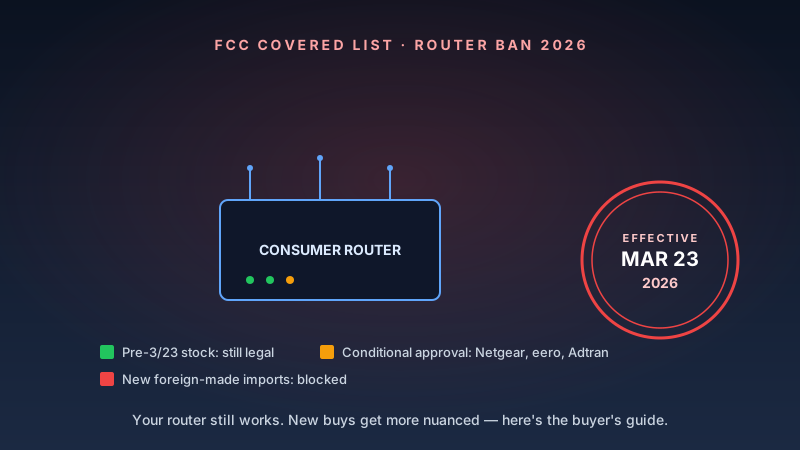
The FCC's foreign router ban took effect March 23, 2026. Your existing router is fine. New imports are blocked except for a short list of conditional approvals. Here's the buyer's guide.
The verdict up front: Your existing router still works and is not affected. New foreign-made consumer routers were added to the FCC's Covered List on March 23, 2026, blocking fresh imports — but pre-ban stock can still be legally sold and used. Netgear, eero, and Adtran have conditional approvals that run through October 1, 2027. If you've been planning to upgrade, the next ten months are the cleanest window: selection is wide, prices are still competitive, and you can lock in a router that will get firmware updates through at least early 2027. Here's the buyer's guide.
What Actually Happened on March 23, 2026
On March 23, 2026, the FCC released DA-26-278, updating the agency's Covered List under Section 2 of the Secure Networks Act to include all consumer-grade routers where any major stage of manufacturing, assembly, design, or development takes place outside the United States.
The official rationale is national security. The Covered List already includes equipment from Huawei, ZTE, Hytera, Hikvision, and Dahua, plus Kaspersky software. Routers were the next addition. The FCC's FAQ document frames the move as preventing supply-chain risk in equipment that sits between every American household and the open internet.
The practical effect is narrower than the headlines suggest. The order does three specific things:
- Blocks new equipment authorizations for foreign-made consumer routers after March 23, 2026.
- Preserves existing authorizations. Routers approved before that date can still be imported, sold, and used.
- Allows continued firmware and security updates for previously authorized devices through March 1, 2027.
It does not retroactively un-authorize any router already on the market, and it does not restrict the use of routers consumers already own. The "your router is now illegal" framing on social media is wrong.
Who's Affected
Almost every consumer brand sold in the United States manufactures in Asia. The order covers all of them by default unless they secure conditional approval.
The list of affected brands includes ASUS (Taiwan-headquartered, manufactured offshore), TP-Link (now US-headquartered after a 2022 separation from its Shenzhen-based parent, but still manufacturing offshore), D-Link, Linksys, Synology, and the previously offshore-manufactured product lines from US-headquartered companies like Netgear, eero, and Google.
In other words: every router you've heard of.
The catch — and the reason the market hasn't collapsed — is that pre-March-23 stock remains legal. Retailers and distributors are allowed to sell down their inventory. Manufacturers are allowed to import previously authorized SKUs that were already in the supply chain. So the shelves at Amazon, Best Buy, Costco, and B&H still look mostly normal six weeks in. They will thin out over time, particularly on newer SKUs, as the FCC stops authorizing replacements.
The Conditional Approval Carve-Outs
Three companies have negotiated conditional approvals that allow them to keep importing new product into the United States. These approvals were announced through April 2026 and are time-limited.
Netgear
Netgear's conditional approval, announced in mid-April 2026, is the most consequential for consumers. It covers the company's full Nighthawk and Orbi lineups, plus their cable gateway and modem product families. Specifically, the approval extends to:
- Nighthawk: R, RAX, RAXE, RS, MK, MR, M, and MH series
- Orbi: RBK, RBE, RBR, RBRE, LBR, LBK, and CBK series
- Cable gateways and modems: CAX and CM series
Netgear's stated justification is that the company moved consumer router manufacturing out of China and into Indonesia, Vietnam, and Thailand, and removed China-sourced internet-connected components from its bill of materials. Whether that's the binding rationale or whether other factors weighed in has not been disclosed by the FCC.
Either way, the practical outcome: Netgear is the only mainstream consumer brand that can introduce genuinely new models in the United States right now. The approval expires October 1, 2027.
eero
eero secured a conditional approval shortly after Netgear's. eero's lineup — eero 6+, eero Pro 6E, eero Max 7, and the various Plus tiers — remains importable. As with Netgear, the approval runs to October 1, 2027.
Adtran
Adtran's approval is more enterprise-focused. It covers the SDG-9000 Service Delivery Gateway product line, including the WiFi 7 variants. Most home buyers will never see Adtran on a shelf, but if you're a network integrator or buying for a managed-service deployment, it's relevant.
TP-Link's Pending Application
TP-Link is actively negotiating with the FCC for conditional approval. The company's argument is that it separated from its Shenzhen-based parent in 2022 and now operates as a US-headquartered independent entity. As of the start of May 2026, that application has not been granted. Existing TP-Link inventory remains legal to sell; new model authorizations are paused.
If TP-Link secures approval in the coming months, the buyer's calculus shifts again. Until then, treat any new TP-Link launch as uncertain in the US market.
What Happens to Firmware Updates
This is the most important detail for anyone buying today.
The FCC's order includes a waiver allowing previously authorized routers — even from manufacturers without conditional approval — to continue receiving firmware and security updates through March 1, 2027. That window matters because router security depends on firmware updates. Without them, a CVE published a year from now could leave your network exposed.
After March 1, 2027, unless the FCC extends the waiver or a manufacturer secures conditional approval, devices from non-approved foreign brands may legally lose update support in the US. This is the cliff to plan around.
Concretely:
- Buying a Netgear, eero, or Adtran router in 2026: You will get updates well past 2027 because the manufacturer is approved.
- Buying a TP-Link, ASUS, or Synology router in 2026: You will get updates through March 1, 2027 with certainty. Beyond that, depends on whether the manufacturer secures conditional approval.
- Keeping the router you already own: Same as above — your existing router gets updates through March 2027 at minimum.
This is not a reason to panic-buy a new router today. It is a reason to be deliberate if you were already planning to upgrade.
What to Buy Right Now
Recommendations break into three buckets: best Netgear/eero options for buyers who want the longest update runway, best legacy stock for value-focused buyers willing to accept the March 2027 cliff, and what to skip.
Best Long-Runway Pick: Netgear Orbi RBE973 (WiFi 7 Mesh)
Why this matters under the ban: Orbi sits inside Netgear's conditional approval. New SKUs will keep arriving and firmware will keep flowing past 2027.
Netgear Orbi 970 Series RBE973S WiFi 7 is a tri-band quad-band WiFi 7 mesh — 2.4 GHz, two 5 GHz, and 6 GHz with dedicated 6 GHz backhaul. It is overkill for most homes, but it's the cleanest "buy once, ride out the regulatory uncertainty" option in the consumer space.
Pros:
- Inside Netgear's FCC conditional approval — ongoing updates and new accessories
- Quad-band design with dedicated 6 GHz backhaul
- 10 GbE WAN port plus multi-gig LAN
- Solid coverage per node; works well in two- and three-node configs
Cons:
- Premium pricing — well over $1,500 for a 3-pack
- Netgear's app pushes Armor security subscription aggressively
- Larger footprint than competing mesh systems
Best Value Long-Runway Pick: eero Max 7
Why this matters under the ban: eero is approved through October 2027. The Max 7 brings WiFi 7 in eero's signature minimal-setup form.
The Amazon eero Max 7 is tri-band WiFi 7 with dedicated 6 GHz backhaul and 10 GbE ports. Setup remains the easiest in the mesh category — five minutes from box to working network.
Pros:
- eero is on the FCC's conditional approval list
- Dedicated 6 GHz backhaul, two 10 GbE + two 2.5 GbE ports per node
- Simplest setup of any WiFi 7 mesh
- Native Alexa integration
Cons:
- Advanced features (parental controls, ad blocking) sit behind eero Plus subscription
- Cloud-managed only — no local admin interface
- Per-node price is high
Best Mid-Range Long-Runway Pick: Netgear Nighthawk RS700S
Why this matters under the ban: Nighthawk is in the conditional-approval list. WiFi 7 standalone routers are rarer than WiFi 7 mesh, and the Netgear Nighthawk RS700S is one of the strongest in this category.
Pros:
- Tri-band WiFi 7 with 320 MHz channel support on 6 GHz
- 10 GbE WAN/LAN port
- Inside Netgear's approval window
- Strong single-router coverage for medium-sized homes
Cons:
- Web admin UI feels dated compared to ASUS or Ubiquiti
- Armor security subscription required for full firewall feature set
- Not a mesh — needs additional Orbi nodes if you outgrow it
Best Legacy-Stock Value: TP-Link Deco XE75 (Pre-Ban Inventory)
Why this matters under the ban: Pre-March-23 stock is legal to sell and use. The TP-Link Deco XE75 is the strongest value mesh on the market — WiFi 6E, dedicated 6 GHz backhaul, mature app.
Pros:
- Best per-dollar value in mesh networking
- Dedicated 6 GHz backhaul on a tri-band design
- Clean app and onboarding
- Wired backhaul fully supported
Cons:
- TP-Link has not yet secured conditional approval — firmware updates only guaranteed through March 1, 2027
- Only Gigabit Ethernet (no 2.5 GbE)
- HomeCare advanced features require subscription after year one
If TP-Link secures conditional approval in the next few months, this risk evaporates. If not, you should plan to revisit your router by early 2027.
Best Standalone WiFi 6E Pick: TP-Link Archer AXE75
For buyers on a tighter budget who don't need mesh, the TP-Link Archer AXE75 is still the cheapest viable path into the 6 GHz band. Same firmware-window caveat as the Deco XE75.
What to Skip
Brand-new TP-Link/ASUS/D-Link models without confirmed approval status. If a model launches after March 23, 2026 from a brand without conditional approval, the import path is unclear. You may end up with a device that loses authorized firmware support sooner than expected.
Anything labeled "FCC pending." Pre-ban this was routine; post-ban it can mean the manufacturer is awaiting a decision the FCC may not grant.
Cheap unbranded mesh kits from marketplace sellers. These were already a security risk before the ban. The new authorization rules make them worse.
Side-by-Side Buyer Reference
| Pick | Brand status | WiFi standard | Update runway | Price tier |
|---|---|---|---|---|
| Netgear Orbi RBE973 | Conditional approval (to Oct 2027) | WiFi 7 | Long | Premium |
| eero Max 7 | Conditional approval (to Oct 2027) | WiFi 7 | Long | Premium |
| Netgear Nighthawk RS700S | Conditional approval (to Oct 2027) | WiFi 7 | Long | Mid–high |
| TP-Link Deco XE75 (pre-ban stock) | Pending — updates through Mar 1, 2027 | WiFi 6E | Medium | Mid |
| TP-Link Archer AXE75 (pre-ban stock) | Pending — updates through Mar 1, 2027 | WiFi 6E | Medium | Budget |
What This Means for Your Existing Network
Three concrete steps you can take this week, regardless of what router you own:
- Check your firmware version. Make sure you're on the latest stable build. Most routers update over the network automatically; some — like ASUS — require you to pull updates manually through the web admin or app.
- Note your router's authorization date. If you bought it before March 23, 2026 (which covers nearly every router currently in service), you're in the legacy-stock bucket and your update window runs at least through March 1, 2027.
- Set a calendar reminder for January 2027. That's the time to reassess: has your manufacturer secured conditional approval? Has the FCC extended the firmware update waiver? Should you buy a Netgear or eero replacement?
You do not need to do anything dramatic today. The ban is forward-looking. The shelves are not empty. Your network is fine.
Frequently Asked Questions
Is my current router now illegal?
No. The Covered List update applies to new equipment authorizations after March 23, 2026. Your existing router is unaffected. You can keep using it indefinitely — the only question is how long it will keep getting firmware updates.
Will Amazon, Best Buy, and other retailers stop selling foreign-made routers?
Not immediately. Pre-ban inventory remains legal to sell. Expect availability to thin out over months, particularly on newer SKUs that can no longer be replenished. Older popular models will stay on shelves the longest.
Will TP-Link be banned outright?
TP-Link is not on the Covered List as a named entity. The ban is general — all foreign-made consumer routers — and TP-Link is affected because of where its products are manufactured. The company is seeking conditional approval. Whether it gets one is the most consequential open question in the consumer router market right now.
What about WiFi 7 phones, laptops, and IoT devices?
The Covered List update is specific to consumer routers. Client devices — phones, laptops, smart speakers — are not affected by this order. They're regulated through different mechanisms.
Should I rush to buy a router now?
If you were already planning to upgrade, the next several months are the best window: wide selection, competitive pricing, and a clear update runway through March 2027 even on non-approved brands. If your current router works, there is no urgency.
What happens after March 1, 2027?
The FCC could extend the firmware update waiver. Conditional approvals could expand. TP-Link could be approved (or not). The most likely outcome is messy partial extensions and ongoing negotiation. Plan to reassess in early 2027.
The Bottom Line
The FCC router ban is a real regulatory shift, but it is not the consumer crisis that the headlines suggested. Your existing router works. Pre-ban stock is legal. New imports from approved manufacturers — Netgear, eero, Adtran — keep flowing.
For most buyers, the cleanest move in May 2026 is one of two paths:
- If you want the longest update runway: buy a Netgear or eero WiFi 7 product. The eero Max 7 is the easiest setup; the Orbi RBE973 is the most capable mesh; the Nighthawk RS700S is the standalone pick.
- If you want the best per-dollar value and accept the March 2027 reassessment: the TP-Link Deco XE75 for mesh or Archer AXE75 for a standalone router remain the strongest legacy-stock buys.
Either path leaves you with a working network and a clear plan. Set the January 2027 reminder, and revisit then with whatever the regulatory picture looks like.
Affiliate disclosure: Links in this article use the tag `webstore0fd1-20`. NetAudioHub earns a commission on qualifying purchases at no extra cost to you.